
Chemical buyers in regulated industries like pharmaceuticals, food, and electronics face risks beyond pricing. Supply disruptions, quality issues, regulatory non-compliance, and price fluctuations can halt production and escalate costs. This is why sustainable sourcing in regulated industries is becoming a critical priority for long-term stability. For example, in 2025, U.S. chemical imports fell 8%, with a 30% drop from China, while tariffs of up to 145% impacted operations. To address these challenges, here are seven actionable chemical sourcing strategy steps:
- Diversify Suppliers: Avoid over-reliance on one region or supplier. Cap critical material sourcing from a single area at 50% and pre-qualify backup suppliers.
- Strengthen Supplier Audits: Evaluate suppliers thoroughly, monitor ongoing performance, and conduct regular audits using a chemical supplier verification checklist to ensure compliance and reliability.
- Leverage Digital Tools: Use real-time monitoring for financial health, regulatory changes, and performance metrics like on-time delivery and quality rates.
- Ensure Compliance: Require essential documents like Safety Data Sheets (SDS) and Certificates of Analysis (CoA) to meet regulatory standards (e.g., FDA, TSCA).
- Balance Inventory: Combine safety stock for critical materials with just-in-time inventory for lower-risk items to manage costs and availability.
- Draft Strong Contracts: Use long-term agreements with clear terms for pricing, supply commitments, and risk-sharing clauses.
- Build Supplier Relationships: Share forecasts, conduct regular reviews, and maintain consistent orders to strengthen partnerships and secure priority during disruptions.
These strategies work together to reduce risks, stabilize operations, and safeguard production. For example, balancing inventory can prevent losses of $50,000–$500,000 per day from production delays. By combining supplier diversification, robust audits, and solid contracts, chemical buyers can navigate challenges more effectively.
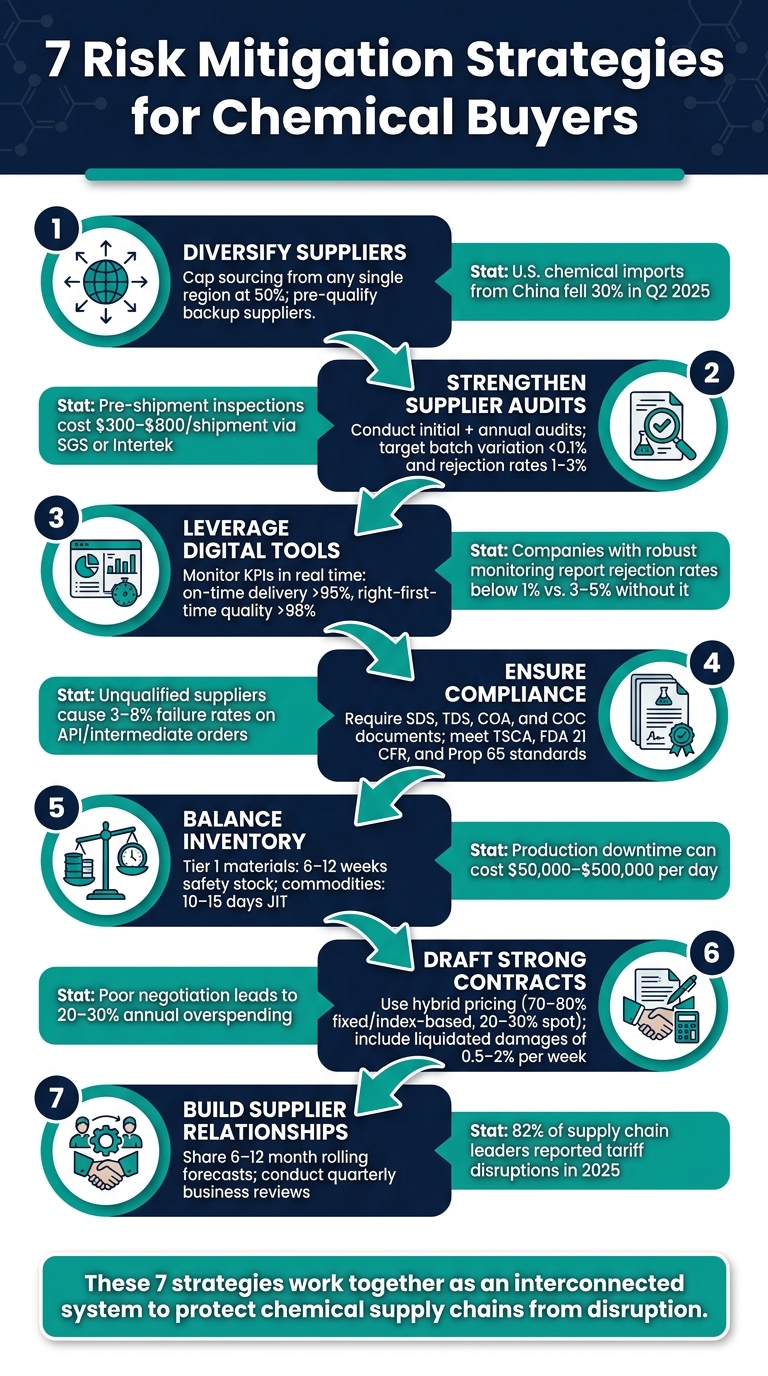
7 Risk Mitigation Strategies for Chemical Buyers
AMS Talks: Critical Chemical Supply Chain Risk and Mitigation
sbb-itb-aa4586a
1. Diversify and Regionalize Your Supplier Base
Relying too heavily on a single supplier or region can spell trouble for your operations. A sudden disruption – whether from a plant shutdown, port strike, or policy shift – can bring production to a standstill if you don’t have backups in place. This approach lays the groundwork for additional risk-management strategies discussed in later sections.
The numbers tell a cautionary tale: U.S. chemical imports from China fell by nearly 30% in Q2 2025, and new tariffs of up to 145% on Chinese imports were introduced in April 2025 [4]. Companies dependent on one region were left scrambling, either absorbing steep costs or rushing to secure alternative suppliers under tight deadlines.
As Elchemy highlighted:
"Most chemical buyers unknowingly concentrate their sourcing within narrow geographic regions… This concentration creates dangerous single points of failure that can devastate operations." [5]
To avoid this pitfall, start by mapping your supplier network and identifying areas of overconcentration. A good guideline is to cap any critical material’s sourcing from a single region at 50% [4]. For high-risk materials – particularly those requiring certifications like USP, FCC, or FDA compliance – pre-qualify at least one backup supplier by asking the right questions in a different region. Relying on untested suppliers during a crisis can create a false sense of preparedness [4].
Geographic diversification is just one piece of the puzzle. Technical diversification adds another layer of resilience. This is especially critical when you source custom chemical blends that require precise formulation and specialized manufacturing capabilities. For example, you can qualify suppliers that use different synthetic methods or adopt a blended sourcing model: procure Tier 1 materials domestically (with shorter lead times of 2–4 weeks) while sourcing lower-risk chemicals internationally (with lead times of 8–16 weeks) [6]. This balanced strategy ties into the audit and contract management practices covered later.
Allan Chemical Corporation is a prime example of this approach in action. With over 40 years of experience and a well-established supplier network, they help mitigate overreliance while maintaining strict quality and regulatory compliance standards.
2. Strengthen Supplier Qualification and Ongoing Audits
Improving your supplier qualification process is key to ensuring dependable partnerships and reducing potential risks. This process requires thorough evaluation. Start by confirming a supplier’s ability to deliver consistent quality, adhere to compliance standards, and meet deadlines. Focus on critical metrics like maintaining batch-to-batch consistency below 0.1% variation and keeping rejection rates between 1% and 3% – rates exceeding 5% often indicate underlying problems. Always check that the Certificate of Analysis is signed by a qualified quality control professional and verify whether the supplier is directly involved in manufacturing. These steps form the foundation for long-term reliability through ongoing audits.
For first-time orders, a pre-shipment inspection (PSI) can be a valuable precaution. Using a trusted third-party agency like SGS or Intertek, a PSI ensures that product specifications and packaging comply with requirements before shipping. The typical cost for this service ranges from $300 to $800 per shipment [2]. Once this safeguard is in place, it naturally transitions into the need for continuous monitoring.
Supplier audits shouldn’t be treated as a one-off task. Begin with an initial on-site or remote audit, followed by regular re-audits and annual evaluations that address pricing, delivery performance, and compliance [2][6]. During these audits, assess critical areas like backup production capabilities, documented force majeure incidents, and contractual remedies for off-spec products [2]. This consistent oversight is especially vital given the steep penalties for non-compliance with standards such as OSHA or REACH, which can lead to EPA fines of up to $70,000 per day [7].
At Allan Chemical Corporation, we prioritize rigorous supplier qualification and ongoing audits as part of our dedication to delivering quality and reliability in the specialty chemicals we provide.
3. Use Data and Digital Tools to Monitor Supplier Risk
Digital tools have transformed supplier risk management, providing continuous oversight that complements traditional audits. While annual questionnaires give a periodic snapshot, real-time digital monitoring offers ongoing updates on factors like financial health and regulatory compliance.
For instance, data tools can quickly identify financial warning signs, such as increasing Days Sales Outstanding (DSO) or declining inventory turnover. These trends often hint at potential issues like delayed payments or shipment disruptions, long before official downgrades occur [8]. By adding this digital layer, businesses can receive instant alerts, such as when a supplier’s Dun & Bradstreet credit score drops below the critical threshold of 80, a key benchmark for financial stability in chemical procurement [7].
Automation also plays a crucial role in monitoring regulatory risks. Platforms track updates to sanctions from the Office of Foreign Assets Control (OFAC), FDA Warning Letters, and anti-dumping orders issued by the U.S. International Trade Commission (USITC). Alerts are triggered immediately when changes happen. A notable example occurred in March 2025, when an adhesives manufacturer faced an unexpected $43,000 anti-dumping duty on specialty amine imports from China. The company had overlooked updates in the USITC database, where the final duty rate, determined during an annual review, far exceeded the initial deposit. This oversight erased the purchase margin [9].
Performance scorecards provide another layer of day-to-day monitoring. High-performing suppliers in the chemical industry generally achieve on-time delivery rates above 95% and right-first-time quality rates above 98% [3]. The table below outlines key performance indicators (KPIs) to help identify early signs of trouble before they escalate:
| KPI | Target | Yellow Flag | Red Flag |
|---|---|---|---|
| On-time delivery rate | >95% | 85–95% | <85% |
| Right-first-time quality | >98% | 95–98% | <95% |
| CoA accuracy | >99% | 97–99% | <97% |
| CAPA responsiveness | <10 days | 10–30 days | >30 days |
| Complaint rate | <1 per 100 lots | 1–3 per 100 lots | >3 per 100 lots |
Source: ChemContract Chemical Supplier Qualification Framework [3]
Staying vigilant also means reviewing supplier public disclosures, such as sustainability reports and sub-supplier certifications, to catch potential documentation gaps between formal audits [8]. Companies with robust data-driven oversight programs often report material rejection rates below 1%, compared to 3–5% for those with limited monitoring [3]. This difference not only reduces production disruptions but also lowers overall sourcing costs. Leveraging digital tools in this way strengthens risk management and prepares organizations for further mitigation efforts.
4. Put Quality and Regulatory Compliance Controls in Place
Digital monitoring can alert you to risks as they happen, but solid documentation is the backbone of effective compliance and risk management. Having the right paperwork from the beginning is one of the easiest ways to sidestep costly issues down the road. Documentation serves as the foundation for all future risk controls.
At a bare minimum, suppliers should provide four essential documents: a Safety Data Sheet (SDS) aligned with GHS Revision 7 or higher, a Technical Data Sheet (TDS), a Certificate of Analysis (COA), and a Certificate of Compliance (COC) [10]. The COA includes batch-specific details like lot numbers, test results, and methods (e.g., HPLC or Karl Fischer), while the COC confirms overall compliance. It’s crucial to request the COA directly from the manufacturer to ensure traceability of lot numbers and authenticity of test results.
Chemicals must also meet regulatory standards such as TSCA, FDA 21 CFR Parts 210/211, and Proposition 65 for California sales. Additionally, grade certifications should align with FCC, USP, or ACS standards, depending on the application.
The consequences of skipping these checks can be substantial. Unqualified suppliers contribute to failure rates of 3%–8% for API or intermediate orders. Rejected batches not only delay production by 4–10 weeks but also consume 20–60 hours of QA time [11]. The financial and operational risks of bypassing proper qualification far outweigh the upfront investment in thorough verification [2].
"The cost of skipping qualification – recalls, Form 483 observations, supply interruptions, financial exposure to a single underqualified vendor – now routinely exceeds the cost of running a thorough program." – Dr. Ram Sharma, Founder & CEO, ChemContract [11]
To further strengthen compliance, establish a Quality Agreement with every critical supplier. This legally binding document should outline responsibilities for key areas like change control, deviation notifications, and recall procedures. It should also mandate supplier notification and approval before any changes to formulas, manufacturing sites, or processes take place. Allan Chemical Corporation’s direct relationships ensure these documentation standards are met from the outset. By implementing these controls, your documentation not only guarantees product integrity but also supports broader risk management efforts, such as improving inventory strategies.
5. Balance Safety Stock and Just-In-Time Inventory for Critical Chemicals
Having reliable compliance documentation ensures you know what you’re buying, but your inventory strategy determines whether it’s available when you need it. Mismanaging this balance can be costly, with potential losses ranging from $50,000 to $500,000 per day [4]. On the other hand, overstocking chemicals – especially those with limited shelf lives – leads to waste, higher disposal costs, and even regulatory complications if hazardous material storage limits are surpassed. Striking the right balance is essential to avoid these risks.
Start by categorizing your materials based on their criticality. Not every chemical requires the same inventory approach. For example:
- Tier 1 materials like APIs or specialty reagents, which are crucial for production, may need 6 to 12 weeks of safety stock.
- Commodity inputs with multiple local sources can often rely on a just-in-time approach, with 10 to 15 days of coverage.
- Imported specialty chemicals with longer lead times (6–8 weeks) typically require a buffer of 30 to 45 days [12].
| Material Category | Recommended Coverage | Review Frequency |
|---|---|---|
| Critical / Specialty (Tier 1) | 6–12 weeks | Weekly |
| Important (Tier 2) | 4–8 weeks | Weekly |
| Unstable / Imported | 30–45 days | Weekly |
| Local Commodity (Tier 3) | 10–15 days | Every 2–4 weeks |
This segmentation is the cornerstone of efficient inventory planning. To further reduce risk, consider collaborative inventory models like vendor-managed inventory (VMI) or consignment arrangements. These strategies shift carrying costs off your balance sheet while ensuring materials remain accessible. This is particularly useful for high-value specialty chemicals, where tying up working capital can be a significant burden [4].
"The just-in-time model that dominated pre-2020 chemical procurement optimized for cost at the expense of resilience." – Dr. Ram Sharma, Founder & CEO, ChemContract [4]
Additionally, keep an eye on lead time changes as a potential warning sign of supply chain issues. For instance, if a supplier’s typical 14-day lead time suddenly stretches to 28 days, it’s more than just an administrative hiccup – it’s a signal of market changes. Automate reorder points based on actual delivery times, not just supplier promises, and review high-volatility materials at least weekly [1]. Allan Chemical Corporation’s direct supplier relationships and just-in-time delivery model offer a practical solution for maintaining steady access to critical chemicals without resorting to overstocking.
6. Use Long-Term Contracts and Risk-Sharing Clauses
Once your inventory strategy is set, the next crucial step is securing strong contracts. These contracts, much like supplier audits or digital risk monitoring, serve as a key layer in managing supply chain risks. A well-structured long-term agreement does more than just lock in pricing – it establishes clear protocols for handling disruptions. Without this clarity, companies risk overspending by 20–30% annually due to ineffective negotiations and a lack of market insight [1].
When drafting contracts, align pricing structures with market realities. For instance, fixed-price terms offer stability, index-based pricing works well for commodities, and cost-plus agreements fit custom products. Many seasoned buyers combine these approaches, securing 70–80% of their annual volume under fixed or index-based terms while keeping 20–30% flexible for spot purchases. This hybrid strategy ensures both stability and adaptability [13].
Accountability clauses are another essential component. Include provisions like minimum supply commitments and performance penalties, such as liquidated damages (typically 0.5–2% of the order value per week). These measures protect against market volatility, especially during crises when spot market prices can surge by 200–400% [4][13].
"Long-term supply agreements with defined volume commitments and pricing mechanisms provide mutual security. Suppliers are more likely to prioritize customers with committed volume." – Dr. Ram Sharma, Founder & CEO, ChemContract [4]
Force majeure clauses also require careful attention. Clearly define exclusions to prevent misuse, such as excluding routine material shortages or capacity constraints. Additionally, mandate a 60–90 day notice period for any anticipated disruptions [13]. These provisions strengthen supply security and reinforce your risk management framework.
Key Contractual Clauses and Their Benefits
| Clause Type | What It Protects Against | Typical Terms |
|---|---|---|
| Liquidated Damages (LAD) | Late delivery | 0.5%–2% of order value per week [13] |
| Price Re-Opener | Supplier repricing during market spikes | Triggered by >10% feedstock cost change [13] |
| Minimum Supply Commitment | Allocation shortfalls during shortages | Up to full annual requirement [13] |
| Force Majeure Limitation | Misuse of "acts of God" clauses | Excludes raw material/capacity shortages [13] |
| Quality Rejection Rights | Off-spec material disputes | 48–72 hour notification window [13] |
Allan Chemical Corporation demonstrates how structured contractual commitments can provide buyers with the security they need. Their approach ensures supply stability, backed by well-defined commercial terms, making them a reliable partner for risk-conscious buyers.
7. Build Strong Supplier Relationships and Internal Expertise
Strengthening supplier relationships, alongside measures like diversified sourcing and thorough audits, plays a key role in building a resilient supply chain. While contracts and inventory buffers are important, the most successful chemical buyers go beyond these basics by fostering strong partnerships and cultivating in-house expertise.
During times of crisis, suppliers tend to prioritize buyers who offer reliable forecasts and maintain consistent order volumes [4]. This approach can significantly lower rejection rates – sometimes below 1% – and help avoid costly production delays [3].
"Transactional procurement, driven solely by price and competitive bidding, is most vulnerable during supply disruptions." – ChemContract [4]
To ensure suppliers prioritize your needs, share rolling demand forecasts for the next 6–12 months, conduct regular business reviews (quarterly or semi-annually), and process invoices promptly. These actions not only strengthen relationships but also create a foundation for more effective risk management practices.
Equally important is the development of robust internal expertise. Just as digital tools and audits help monitor supplier performance, knowledgeable procurement teams make better decisions, faster. Teams with a deep understanding of reaction chemistry, raw material dependencies, GHS hazard data, and regulatory requirements – such as TSCA and FDA guidelines – are better equipped to navigate risks. Dr. Ram Sharma, Founder & CEO of ChemContract, emphasizes this point: "Chemical procurement is not just purchasing – it is a strategic function that determines 40–60% of total manufacturing cost and directly impacts product quality, regulatory compliance, and speed to market." [6]
One critical blind spot to address is the assumption that diverse suppliers automatically mean diverse sources. Many suppliers that appear independent may actually rely on the same upstream intermediate manufacturer. Knowing the full extent of your supplier’s supply chain, not just your own, can help mitigate this hidden risk [4].
Allan Chemical Corporation illustrates the benefits of prioritizing relationships. With over 40 years of experience and direct partnerships with carefully vetted manufacturers, Allan Chemical Corporation provides technical support, documentation assistance, and reliable supply continuity – all rooted in long-standing partnerships.
"The investment in resilience pays dividends not just during crises, but through the day-to-day operational stability that allows procurement teams to focus on strategic value creation rather than firefighting." – ChemContract [4]
Comparison Table
Before choosing a cost-optimized procurement strategy, it’s essential to weigh the trade-offs. Each sourcing decision comes with its own set of advantages and challenges.
| Approach | Primary Benefit | Primary Risk / Cost |
|---|---|---|
| Single-Sourcing | Offers volume discounts; simplifies relationship management | High risk of production halts if the supplier fails [1][2] |
| Multi-Sourcing | Provides resilience against regional disruptions and trade volatility [1] | Increases administrative complexity; may reduce volume leverage [1] |
| Desk Audits | Low cost; quick check of registrations and documentation [2] | Can overlook operational realities or data integrity issues [2] |
| On-Site Audits | Thorough verification of manufacturing systems and quality practices [2] | Expensive and time-intensive; requires 1–3 days of travel and resources [3] |
| Safety Stock | Shields production from late deliveries and lead time variability [1] | Ties up working capital; adds warehousing and insurance costs [1] |
| Just-In-Time (JIT) | Promotes lean operations with minimal inventory costs [1] | High risk of production delays if a shipment is late [1] |
This table serves as a guide to align risk management strategies with the specific challenges of each material.
No single method works universally. Tailor your approach based on the criticality of materials, lead times, and supplier risk. For audits, match the method to the supplier’s profile while meeting supplier audit requirements for chemical distribution. The best strategies adapt sourcing, auditing, and inventory practices to the unique risks associated with each material.
Disclaimer: This content is for informational purposes only. Always consult official regulations and qualified professionals when making sourcing or formulation decisions.
Conclusion
No single strategy can fully protect your supply chain on its own. Instead, the seven approaches discussed earlier function as an interconnected system: diversification creates multiple sourcing options, rigorous supplier qualification ensures dependable alternatives, and digital monitoring provides early detection of potential issues. At the same time, robust contracts and balanced inventory help stabilize financial and material resources. Strong supplier relationships and internal expertise further ensure continuity during disruptions. Together, these strategies create a framework designed to safeguard operations from unexpected challenges.
Production downtime in pharmaceutical manufacturing caused by raw material shortages can cost anywhere between $50,000 and $500,000 per day [4]. Additionally, 82% of supply chain leaders reported that tariff impacts disrupted their operations in 2025 [1]. These figures highlight why reactive procurement is no longer sustainable. The focus must shift toward building supply chains capable of weathering disruptions without severe consequences.
"Supply chain resilience isn’t about eliminating all risk – it’s about building the capacity to absorb disruptions without catastrophic consequences." – Dr. Ram Sharma, Founder & CEO, ChemContract
Allan Chemical Corporation supports this holistic approach. With over 40 years of experience in regulated industries like pharmaceuticals, food, cosmetics, and electronics, Allan Chemical provides pre-qualified supplier networks, technical-grade and compendial-grade materials (USP, FCC, ACS, NF), and flexible inventory solutions to ease procurement challenges. Their domestic sourcing capabilities help U.S. buyers mitigate risks associated with international shipping and tariffs, while their technical support ensures key documents such as Certificates of Analysis and Safety Data Sheets are always ready for audits.
Identify your most critical materials and apply the appropriate strategies to protect them. The chemicals essential to your production deserve the highest level of safeguarding.
Disclaimer: This content is for informational purposes only. Consult official regulations and qualified professionals before making sourcing or formulation decisions.
FAQs
How do I decide which chemicals need safety stock?
To determine which chemicals need safety stock, concentrate on their role in operations instead of assuming every material holds the same weight. Pay special attention to critical or high-priority items – such as those with no substitutes or those vital for production continuity. Base stock levels on real usage data and confirmed supplier lead times, particularly for chemicals with extended shipping durations or those sourced from regions prone to disruptions. Maintaining detailed records and fostering strong relationships with suppliers is essential for a resilient supply chain.
What should I look for in a supplier audit?
To thoroughly evaluate quality systems and related processes, start with a standardized checklist. This should cover key areas like safety protocols, manufacturing procedures, and regulatory documentation. Pay close attention to internal processes such as batch consistency controls and material traceability, as these are critical for maintaining product integrity.
Inspect the availability and reliability of testing facilities – ideally, these should be in-house to ensure quicker and more controlled assessments. Always verify the authenticity and completeness of Certificates of Analysis (COAs). Lastly, review the company’s compliance history with regulatory bodies like the FDA or EPA, and confirm that systems for corrective and preventive actions are effectively implemented.
Which contract clauses best protect against shortages?
To prevent supply shortages, it’s wise to include a minimum supply commitment clause in your contracts. This clause obligates suppliers to prioritize your orders up to a specified annual volume, even during periods of market instability.
Make sure to outline consequences for non-compliance, such as credits for future orders, price adjustments, or even the option to terminate the contract. Building long-term partnerships – like those offered by Allan Chemical Corporation – can also help ensure your needs are prioritized during supply allocation challenges.




Comments are closed