
Sourcing beverage chemicals responsibly is critical to meeting regulations and protecting your brand. Non-compliance can cost up to $70,000 per day in fines, and poor supplier choices risk product recalls and reputation damage. A structured approach ensures compliance, safety, and reliability while meeting consumer demand for responsible practices.
Here’s what to focus on:
- Supplier Certifications: Verify compliance with purity standards (e.g., USP, FCC) and request Certificates of Analysis (COAs) and Safety Data Sheets (SDSs). You can also use a Safety Data Sheet finder to quickly verify hazard data.
- Traceability: Ensure suppliers provide full supply chain documentation and origin details to avoid unethical practices.
- Environmental Practices: Evaluate suppliers’ carbon emissions, waste management, and packaging safety.
- Documentation: Maintain accurate COAs and SDSs that meet regulatory requirements, and conduct periodic third-party tests for quality assurance.
- Delivery and Risk Management: Check on-time delivery rates, packaging durability, and contingency plans for supply disruptions.
- Regular Audits: Schedule supplier audits and track performance metrics like delivery accuracy and corrective action rates.
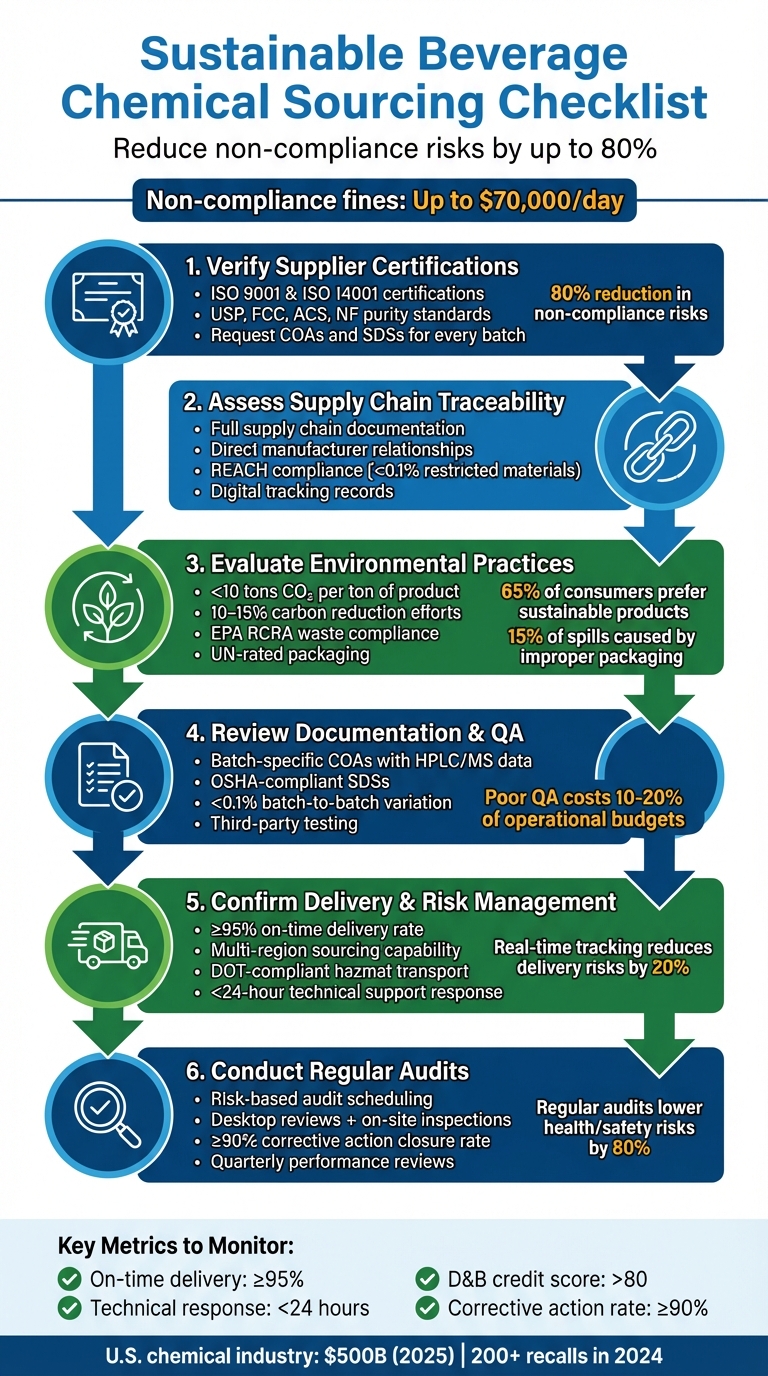
6-Step Checklist for Sustainable Beverage Chemical Sourcing
Step 1: Verify Supplier Certifications and Compliance Standards
Ensuring your supplier meets the required certifications is critical for maintaining product quality and adhering to regulations. Certifications related to quality and environmental practices serve as a safeguard against issues like recalls and regulatory penalties. In fact, a thorough certification verification process can lower non-compliance risks by up to 80% [1].
Check for ISO and Regulatory Certifications
Certifications like ISO 9001 indicate that a supplier has consistent quality control processes, which is essential since even minimal purity deviations can affect formulations. ISO 14001, on the other hand, demonstrates a commitment to reducing environmental impact through better waste and emissions management [1].
Ask for up-to-date certificates and audit reports to confirm the validity of certifications across all facilities. For context, the U.S. chemical industry was valued at $500 billion in 2025, yet over 200 chemical-related product recalls were reported in 2024 alone [1]. It’s also important to verify that these certifications match the specific purity standards required for your industry.
Verify Industry-Specific Purity and Safety Standards
Beyond ISO certifications, certain industries demand adherence to stricter purity benchmarks. For example, chemicals used in beverages must comply with standards set by organizations like the USP (United States Pharmacopeia), FCC (Food Chemicals Codex), ACS (American Chemical Society), and NF (National Formulary). Suppliers should provide a Certificate of Analysis (COA) for every batch, detailing test results from techniques such as HPLC/MS or FTIR to confirm compliance with the required grade [1].
For imported chemicals, ensure REACH registration to confirm that substances contain less than 0.1% restricted materials, helping you avoid EPA violations. Additionally, request Safety Data Sheets (SDS) that meet OSHA‘s Hazard Communication Standard (29 CFR 1910.1200) requirements [1].
At Allan Chemical Corporation, we strictly adhere to these certification and compliance protocols to guarantee the quality and responsibility of our chemical sourcing practices. With certifications verified, the next step is to ensure the integrity of the entire supply chain. This requires robust risk mitigation strategies to address potential disruptions and safety challenges.
This content is for informational purposes only. Consult official regulations and qualified professionals before making sourcing or formulation decisions.
sbb-itb-aa4586a
Step 2: Assess Supply Chain Traceability and Transparency
Once certifications are verified, the next step is to confirm the origins of your chemicals and their production methods. Having full traceability allows you to track a chemical’s journey from its source to your facility. This minimizes the risk of unintentionally sourcing materials linked to harmful environmental practices or unethical labor conditions.
Evaluate Supplier Transparency
Ask suppliers for detailed origin statements and comprehensive supply chain maps that outline all tiers of their supply chain [2][3]. Establishing direct relationships with manufacturers, rather than depending solely on intermediaries, can help reduce the chances of supply chain fraud. Without direct oversight, intermediaries may misrepresent or fabricate origin details [2].
Trace Chemical Origins and Environmental Impact
To understand how your chemicals impact the environment, it’s essential to track both their source and production methods. Request digital tracking records that connect shipment lot numbers to corresponding testing data. This ensures you can quickly recall products if necessary [1][3]. Additionally, obtain traceability files that document the material’s entire journey – from its origin to your facility – including details about extraction or cultivation methods [2][3]. For imported chemicals, confirm REACH compliance to ensure restricted substances stay below the 0.1% threshold [1]. If needed, use forensic verification to independently validate the origins of your chemicals [3].
At Allan Chemical Corporation, we prioritize transparency by maintaining direct relationships with manufacturers and implementing strict documentation procedures. This approach ensures your supply chain remains secure, while aligning with your environmental and ethical sourcing goals.
The next step involves analyzing your suppliers’ environmental and sustainability practices to finalize your sustainable sourcing checklist.
This content is for informational purposes only. Consult official regulations and qualified professionals before making sourcing or formulation decisions.
Step 3: Evaluate Environmental and Sustainability Practices
When selecting suppliers, it’s essential to examine how they manage their environmental impact. A good benchmark to consider is maintaining less than 10 tons of carbon emissions per ton of product produced[1]. This metric helps identify suppliers who are actively working to minimize their environmental footprint instead of just making surface-level claims about being "green." Strong environmental practices are just as important as certifications when building a sustainable supply chain.
Review Carbon Footprint Reduction Efforts
Ask suppliers for their latest carbon emissions data. Effective practices can lead to reductions of 10–15%[1]. Look for documentation that confirms their use of renewable energy and their commitment to resource efficiency. With about 65% of consumers favoring sustainable products[1], aligning with suppliers who have verified carbon reduction measures not only supports compliance with regulations but also meets growing market expectations.
To complete your evaluation, dive into their waste management and recycling policies.
Assess Waste Management and Recycling Policies
Ensure that suppliers comply with EPA RCRA standards, as non-compliance can result in significant penalties[1]. Request records of EPA-compliant waste disposal and documentation of spill response and containment measures. Additionally, check whether they prioritize bio-based ingredients, which can further reduce environmental impact. Packaging is another critical area – improper packaging accounts for 15% of chemical spills during transport[1]. Inspect packaging samples for UN ratings and DOT compliance to ensure safe and secure distribution.
At Allan Chemical Corporation, we integrate stringent environmental management systems into our operations. This ensures that our waste management practices and carbon reduction initiatives align with your sustainability objectives, all while delivering the reliability and quality your beverage production requires.
Once you’ve confirmed these environmental practices, move on to reviewing the supporting documentation to validate these claims.
This content is for informational purposes only. Consult official regulations and qualified professionals before making sourcing or formulation decisions.
Step 4: Review Documentation and Quality Assurance Processes
After evaluating suppliers and environmental factors, the next step is to ensure proper documentation. This step confirms the quality, compliance, and traceability of the chemicals you source. Every batch should have accompanying records to substantiate the supplier’s claims about purity, safety, and environmental responsibility.
Request Certificates of Analysis and Safety Data Sheets
A Certificate of Analysis (COA) should include detailed numerical test results rather than vague statements like "pass." These results should confirm that the product meets required purity standards. Look for HPLC/MS or FTIR analytical data and microbial counts (e.g., less than 100 CFU/g for food-grade chemicals) [1]. Also, check that the lot number on the COA matches the one on the container label [4].
A Safety Data Sheet (SDS) must adhere to OSHA’s Hazard Communication Standard (29 CFR 1910.1200). It should provide specific instructions for handling, storage, spill management, and the required personal protective equipment (PPE). Always request batch-specific SDSs instead of relying on generic versions. To stay prepared for audits or recalls, maintain a centralized digital archive of all COAs and SDSs.
Evaluate Supplier Quality Assurance Protocols
Beyond batch-specific documents, assess the supplier’s overall quality assurance systems. Reliable suppliers should provide Technical Data Sheets (TDS) with details on physical properties, application recommendations, and stability data, such as pH ranges [1]. Consistency is key – aim to work with suppliers who demonstrate minimal batch-to-batch variation (less than 0.1%) [1].
To verify the accuracy of COAs, periodically conduct third-party lab tests on critical ingredients like glycerin [1]. Additionally, confirm that suppliers have robust Standard Operating Procedures (SOPs) for quality assurance, batch testing, and contamination prevention during storage and transportation. Poor quality controls can lead to production interruptions, potentially costing manufacturers 10% to 20% of their operational budgets [1].
At Allan Chemical Corporation, we provide detailed documentation for every batch, including COAs, compliant SDSs, and technical support. These resources ensure quality verification at every stage of procurement, setting the foundation for evaluating supplier delivery and risk management in the next step.
This content is for informational purposes only. Consult official regulations and qualified professionals before making sourcing or formulation decisions.
Step 5: Confirm Delivery, Packaging, and Risk Management Capabilities
After reviewing documentation in Step 4, it’s time to evaluate the supplier’s delivery reliability, packaging standards, and risk management practices. These factors directly influence your production timelines and sustainability goals.
Assess Delivery Timelines and Reliability
Timely delivery is essential to avoid production delays and reduce waste from expired or urgently ordered materials. Aim for suppliers with a minimum 95% on-time delivery rate [1]. Check at least 12 months of performance records to ensure consistency. Also, verify that their production capacity aligns with your needs. For example, if you require 100 tons of citric acid monthly, conduct site visits or capacity audits to confirm they can maintain this output [1].
Using real-time tracking tools like GPS or blockchain can lower delivery risks by as much as 20% [1]. For hazardous chemicals, confirm that transporters hold the necessary Hazmat certifications. Additionally, assess the supplier’s financial health by requesting a Dun & Bradstreet credit score above 80 and reviewing 2–3 years of financial statements to minimize risks of operational disruptions [1].
Once delivery reliability is assured, the next step is to examine packaging safety and sustainability.
Check for Sustainable Packaging Solutions
Safe packaging is critical for transporting chemicals without incident. Packaging failures contribute to 15% of chemical spills during transit [1]. For hazardous or corrosive chemicals, require UN-rated and DOT-compliant packaging, such as sealed drums, secondary containment systems, and clear hazard labeling. Request packaging samples to evaluate their durability and compliance with regulations before finalizing any agreements.
Sustainability in packaging is another key consideration. Suppliers focused on reducing environmental impact may provide data on carbon emissions associated with their packaging and logistics. A common benchmark is less than 10 tons of CO₂ per ton of product [1]. With 65% of consumers favoring eco-friendly products [1], sustainable packaging helps meet both regulatory standards and customer expectations.
Evaluate Risk Management Strategies
Supply chain disruptions, whether caused by regional shortages or policy changes, require suppliers to have robust contingency plans. Confirm that they maintain multi-region sourcing capabilities – for instance, sourcing from the U.S., India, and China – to mitigate risks like tariffs or geopolitical issues [1]. Request written emergency restocking plans that outline backup suppliers and buffer stock policies.
Timely issue resolution is also critical. Ensure the supplier offers technical support with a response time under 24 hours [1]. Review their spill response plans and PPE training records to confirm compliance with OSHA’s Hazard Communication Standard. Non-compliance with OSHA or EPA regulations can lead to fines of up to $70,000 per day and cause production downtime ranging from 10% to 20% [1].
At Allan Chemical Corporation, we prioritize multi-region sourcing and use real-time delivery tracking to uphold these standards. This proactive approach strengthens our risk management framework and supports sustainable sourcing practices, ensuring reliable supplier performance over time.
This content is for informational purposes only. Consult official regulations and qualified professionals before making sourcing or formulation decisions.
Step 6: Conduct Regular Supplier Audits and Performance Reviews
To maintain consistent quality and uphold sustainability goals, it’s crucial to set up a system for ongoing supplier evaluations. Instead of treating supplier validation as a one-time process, regular audits and performance reviews help ensure that suppliers continue meeting your standards over time. This approach safeguards supply chain integrity and adapts to evolving requirements.
Schedule Routine Supplier Audits
Regular audits are an effective way to minimize risks, with studies showing they can lower health and safety risks by as much as 80% [1]. A risk-based approach is key – prioritize audits for high-spend suppliers or those delivering materials critical to production and subject to strict regulatory oversight.
Different audit methods can serve specific purposes:
- Desktop reviews: Ideal for verifying updated certifications or Safety Data Sheets.
- On-site inspections: Useful for uncovering operational issues like improper spill containment or missing PPE training records that aren’t evident from documentation.
- Self-assessment questionnaires: Provide a snapshot of practices for initial screenings or lower-risk suppliers.
When conducting audits, align your criteria with established quality and regulatory standards. For instance, check compliance with REACH restrictions (ensuring substances stay below 0.1%) and OSHA’s Hazard Communication Standard [1]. Sustainability efforts should also be assessed, such as verifying carbon footprint reductions of 10–15% and adherence to EPA’s Resource Conservation and Recovery Act (RCRA) for waste management [1].
Another important metric to track is the Corrective Action Closure Rate – this measures how effectively suppliers address audit findings within agreed deadlines. A target rate of 90% or higher reflects a commitment to improvement [5]. Once your audit schedule is in place, shift attention to ongoing performance monitoring.
Monitor Supplier Performance Metrics
Between audits, tracking key performance indicators (KPIs) ensures you maintain visibility into supplier reliability and catch potential issues early.
"Good ingredient sourcing is not a single accomplishment. It’s an ongoing routine that ensures the quality, transparency, and endurance of a brand" [2].
Key metrics to monitor include:
- On-time delivery: Aim for 95% or higher to avoid production delays.
- Technical response time: Suppliers should respond to technical inquiries within 24 hours.
- Product quality consistency: Ensure materials meet agreed specifications every time.
Financial stability is another critical factor. A Dun & Bradstreet credit score above 80 helps minimize risks of sudden operational disruptions [1]. Keep in mind that unreliable suppliers can result in production delays, which cost manufacturers between 10% and 20% in downtime [1].
Using a centralized digital database to store supplier certifications, audit reports, and performance data can streamline this process. Such a system not only simplifies compliance verification but also helps identify trends. For example, if a supplier’s delivery accuracy drops from 98% to 92% over three months, you can address the issue promptly rather than waiting for a major problem to occur.
Consider setting up quarterly performance reviews with your key suppliers. These meetings provide an opportunity to discuss metrics, resolve concerns, and align on shared goals, including sustainability targets. At Allan Chemical Corporation, we prioritize transparent communication and detailed performance tracking. This approach supports our partners’ continuous improvement while ensuring adherence to quality and sustainability standards.
This content is for informational purposes only. Consult official regulations and qualified professionals before making sourcing or formulation decisions.
Conclusion
Focusing on sustainable sourcing strengthens your brand, reduces risks, and enhances supply chain resilience. Using a thorough checklist – covering certifications, traceability, environmental practices, quality documentation, delivery capabilities, and regular audits – can lower non-compliance risks by as much as 80% [1].
The next step is to elevate procurement from a transactional task to a strategic function. By emphasizing data-driven decisions and reliable supplier performance, you can reduce production delays and maintain long-term cost stability. Partnering with suppliers who value transparency, sustainability, and regulatory compliance—and knowing the right questions to ask chemical suppliers— transforms procurement into a competitive advantage.
Through rigorous audits and a commitment to improvement, supplier relationships evolve into strategic assets in today’s highly regulated industries. With over 40 years of experience, Allan Chemical Corporation supports regulated industries with specialty chemicals, offering just-in-time delivery, technical expertise, custom chemical blends, and long-standing partnerships with trusted manufacturers. These practices align with the principles outlined in the checklist.
By adopting this checklist and collaborating with suppliers who meet high standards for sustainability and compliance, you can prepare your supply chain for shifting consumer demands and regulatory pressures. Regular audits, performance tracking, and open communication ensure that your supply chain remains strong, compliant, and prepared for long-term success.
This content is for informational purposes only. Consult official regulations and qualified professionals before making sourcing or formulation decisions.
FAQs
Which supplier certifications matter most for beverage chemicals?
Key supplier certifications for beverage chemicals often include compliance with OSHA and EPA regulations. Meeting these regulatory requirements is critical to maintaining safety and ensuring the quality of products used in the beverage industry.
What documents should I require for every batch (COA, SDS, TDS)?
To ensure safety, quality, and compliance with regulations, always request the following documents for each batch of beverage chemicals:
- Certificate of Analysis (COA): Confirms the batch meets specified quality standards.
- Safety Data Sheet (SDS): Provides critical safety and handling information.
- Technical Data Sheet (TDS): Details technical specifications and usage guidelines.
These documents are essential for verifying the suitability and safety of the chemicals being used.
How often should I audit chemical suppliers for sustainability and compliance?
Auditing chemical suppliers every year is a smart way to ensure they consistently meet quality, safety, and regulatory standards. These audits can confirm compliance with key regulations such as OSHA and EPA guidelines, reducing potential risks in sourcing. Sticking to industry best practices helps maintain high safety standards and regulatory alignment over time.


Comments are closed