
Chemical Oxygen Demand (COD) measures the oxygen needed to break down organic matter in wastewater. High COD levels in pulp mill effluents – often exceeding 15,000 mg/L – pose serious risks to aquatic life by depleting oxygen and blocking sunlight. To meet discharge limits (100–125 mg O₂/L), chemical treatments are essential.
The most effective solutions include:
- Sodium Hypochlorite (CAS No. 7681-52-9): A strong oxidizer for organic breakdown, but may produce harmful byproducts.
- Hydrogen Peroxide (H₂O₂): Highly efficient, especially in advanced oxidation processes like Fenton reactions.
- Ozone (O₃): Extremely powerful for removing color and refractory organics, with up to 95.92% COD reduction post-biological treatment.
- Ferric Chloride (FeCl₃): A coagulant that removes suspended solids but generates significant sludge.
- Polyaluminum Chloride (PAC): Effective for high-COD effluents, achieving up to 70% reduction.
Combining coagulation (e.g., PAC or FeCl₃) with oxidation (e.g., Ozone or H₂O₂) improves efficiency, reduces chemical use, and enhances biodegradability. Proper pH management is critical for optimizing these processes and achieving regulatory compliance.
BOD / COD / TSS
sbb-itb-aa4586a
Top Chemicals for COD Reduction
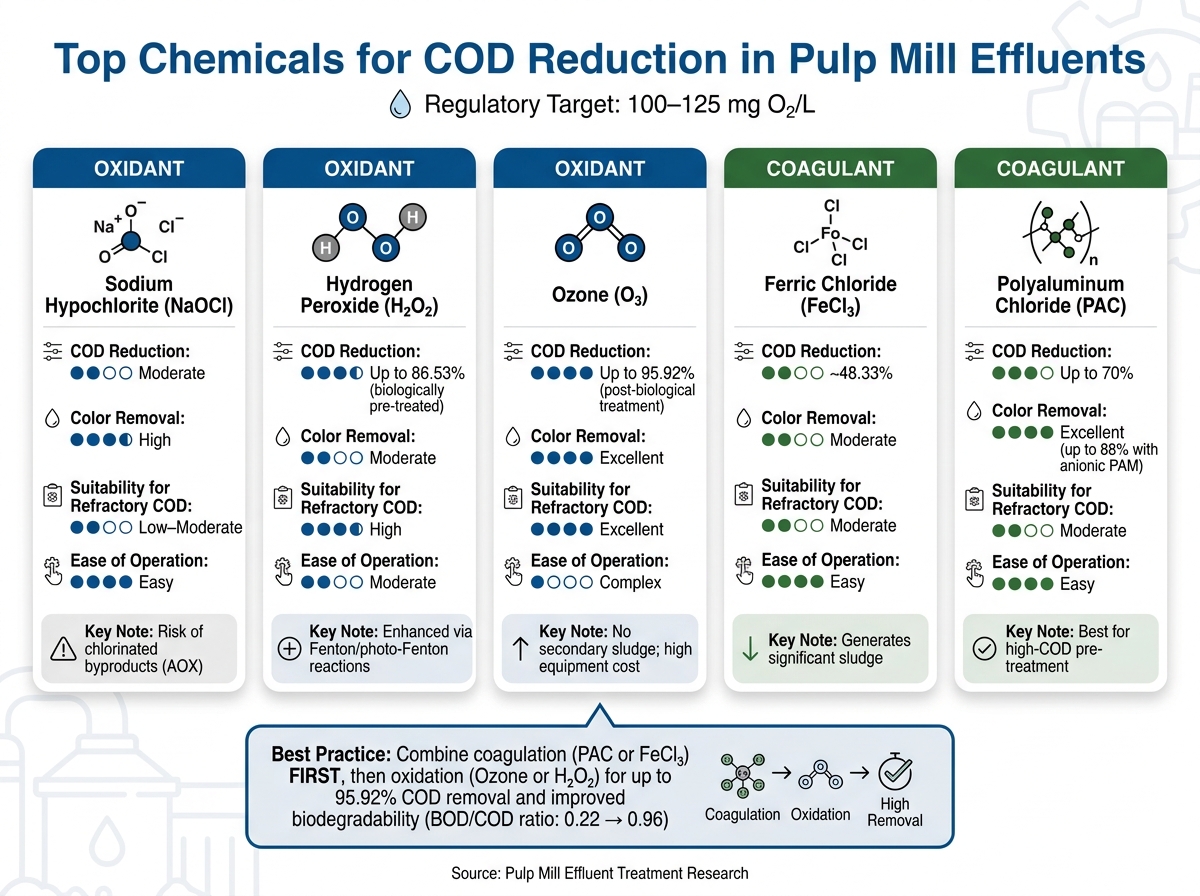
COD Reduction Chemicals for Pulp Effluents: Performance Comparison
Reducing Chemical Oxygen Demand (COD) in pulp mill effluents often involves the use of specific chemicals that act as oxidants or coagulants. Each chemical brings unique properties and performance levels to the treatment process. Here’s a closer look at some of the most commonly used options.
Sodium Hypochlorite
Sodium hypochlorite (NaOCl, CAS No. 7681-52-9) is a strong oxidizing agent widely applied in wastewater treatment to degrade organic compounds and reduce oxygen demand. However, one downside is its potential to form chlorinated byproducts, such as adsorbable organic halogens (AOX). These byproducts are persistent due to the stability of carbon–chlorine bonds[1][2].
Hydrogen Peroxide
Hydrogen peroxide (H₂O₂) is a versatile oxidant used in both bleaching processes and as a polishing step following biological treatment. It has demonstrated COD removal rates of 85.13% in raw pulp wastewater and 86.53% in biologically pre-treated wastewater[1]. Its efficiency increases significantly when incorporated into Advanced Oxidation Processes (AOPs) like Fenton or photo-Fenton reactions. These methods generate hydroxyl radicals, which effectively break down refractory organic compounds. Careful dosing is essential, as excess hydrogen peroxide can quench these radicals and reduce the overall efficiency of the process[1].
Ozone
Ozone (O₃) ranks as one of the most powerful oxidants for treating pulp mill effluents. It is particularly effective at removing color and targeting refractory organics, such as lignin derivatives. Under optimal conditions – pH 5 and a 9-minute contact time – ozone can achieve up to 88.53% COD removal in raw wastewater. This rate improves to 95.92% following biological pre-treatment[1].
"When cleaning industrial wastewater, in particular, ozonation is good at eliminating color and oxidizing refractory organics." – Tariq Javeed, Department of Environmental Sciences, The University of Lahore[1]
Catalytic ozonation, which uses catalysts like TiO₂, further enhances COD reduction. For instance, a TiO₂-loaded catalyst can achieve a 52% COD reduction within just 8 minutes at an ozone dose of 16 mg/L[4]. While ozone’s lack of secondary sludge production is a clear advantage, its higher equipment costs often limit its use to polishing stages or for tackling particularly stubborn organic loads.
Ferric Chloride
Ferric chloride (FeCl₃) serves as a coagulant by destabilizing suspended and colloidal particles, encouraging their aggregation and settling. When used in combination with lime and polymers, ferric chloride can achieve a COD removal efficiency of approximately 48.33%[1]. While it is effective in reducing color and turbidity, the process generates significant amounts of sludge, which must be managed and disposed of appropriately.
Polyaluminum Chloride (PAC)
Polyaluminum chloride (PAC) is another effective coagulant, particularly for effluents with high initial COD levels. Under neutral pH conditions, PAC can reduce COD by up to 70% in paper industry wastewater[3].
"The initial pH of the wastewater had a significant impact on the COD removal." – Joanna Boguniewicz-Zablocka, Department of Thermal Engineering and Industrial Facilities, Opole University of Technology[3]
PAC is often employed as a cost-effective pre-treatment step. It helps lower the organic load, making subsequent biological or oxidation treatments more efficient. In combined coagulation-oxidation systems, PAC addresses suspended and colloidal organics, while oxidants focus on the dissolved fraction.
Combining Coagulation and Oxidation for Better COD Removal
Treating pulp mill effluent requires more than a single solution. While individual chemicals can target specific contaminants, combining coagulation and oxidation creates a more effective treatment process. Coagulation works well for removing suspended solids and bulk organic matter, but it falls short when dealing with dissolved, hard-to-degrade compounds like lignin derivatives. Oxidation, on the other hand, is excellent for breaking down these stubborn molecules. However, using oxidation alone on raw, high-strength effluent often leads to wasted oxidants since they are quickly consumed by other organic materials. By integrating these two methods, the strengths of each process are maximized, reducing waste and improving overall treatment efficiency.
The best sequence for this approach is coagulation first, followed by oxidation. Coagulation removes the bulk of the organic load upfront, leaving fewer suspended solids to compete with refractory compounds for oxidants. This not only minimizes oxidant waste but also ensures the oxidants are used more effectively. Studies back this up – one example showed that combining coagulation with noncatalytic wet oxidation achieved 77.5% COD removal and 87% color reduction, compared to just 51% COD removal with catalytic wet oxidation alone [5].
Another advantage of combining these methods is the improved biodegradability of the treated effluent. The integrated process increases the BOD/COD ratio from 0.22 to 0.96, making the effluent much easier to handle in biological treatment systems [5]. For particularly high-strength effluents, multi-stage systems can take this even further.
In fact, multi-stage systems have achieved remarkable results. For instance, a three-stage process involving Permanganate, Electro-Fenton, and Sulfate Radical treatments reduced COD levels in pulp and paper wastewater from 1,450 mg/L to just 62 mg/L, meeting discharge standards [6].
pH management plays a crucial role in these integrated systems. Proper pH control enhances the effectiveness of both coagulation and oxidation. Acidic conditions are ideal for breaking down color-causing chromophore groups with molecular ozone, while alkaline conditions support the formation of hydroxyl radicals [1][4]. Additionally, using Permanganate at acidic pH creates optimal conditions for the next Electro-Fenton stage, reducing the need for extra pH adjustments [6]. This careful balancing act improves treatment results while cutting down on chemical use.
How to Choose the Right Chemical
When selecting a chemical for effluent treatment, it’s important to match the agent to your specific needs, considering the characteristics of your effluent, treatment goals, and operational limitations.
Start by analyzing the composition of your effluent. For wastewater with high levels of suspended solids, coagulants like Ferric Chloride or PAC (Polyaluminum Chloride) are effective. These chemicals function best in acidic conditions (pH 2–5) and can reduce COD (Chemical Oxygen Demand) by as much as 70% under optimal conditions [3]. On the other hand, if your effluent contains dissolved organics with high molecular weights, such as lignin derivatives, an oxidant might be a better choice. These considerations should align with the performance data highlighted earlier.
Your treatment objectives should also guide your choice. For instance, PAC combined with an anionic PAM (Polyacrylamide) can remove up to 88% of color [7]. For oxidizing stubborn COD, Ozone and Hydrogen Peroxide are highly effective. Ozone, for example, can remove 95.92% of COD in biologically pre-treated effluent [1], while Hydrogen Peroxide achieves 75–80% mineralization without producing toxic halogenated by-products [9].
Finally, operational factors like facility capacity, safety protocols, and cost must be considered. Coagulants are straightforward to dose and manage, making them a practical choice for many facilities. However, advanced oxidants like Ozone require on-site generation and involve higher energy consumption and safety measures. While Sodium Hypochlorite is affordable and widely accessible, its potential to form harmful organochlorinated by-products makes it less suitable for facilities with strict toxicity regulations [8][10].
Comparison Table
The table below provides a quick overview of the performance, coagulation efficiency, and operational ease of different chemicals:
| Chemical | Color Removal | Coagulation Performance | Oxidation Strength | Suitability for Refractory COD | Ease of Operation |
|---|---|---|---|---|---|
| Ferric Chloride | Moderate | Excellent | Low | Moderate | Easy |
| PAC | Excellent | Excellent | Low | Moderate | Easy |
| Ozone | Excellent | N/A | Very High | Excellent | Complex |
| Hydrogen Peroxide | Moderate | N/A | High | High | Moderate |
| Sodium Hypochlorite | High | N/A | Moderate | Low–Moderate | Easy |
Key Takeaways
Reducing COD in pulp effluents requires a tailored approach, as no single chemical solution can address all challenges. The best treatment strategy depends on the specific composition of the wastewater – whether the issue arises from suspended solids, dissolved organics, color compounds, or a combination of these.
For effluents with suspended solids, coagulants like Ferric Chloride and PAC (Polyaluminum Chloride), especially when paired with cationic PAM (Polyacrylamide), can reduce COD by 81% and total suspended solids by 95% [7]. On the other hand, effluents dominated by dissolved organics call for effective oxidation methods.
When dealing with recalcitrant organics – particularly after biological treatment – oxidation processes become indispensable. For instance, Ozone can remove up to 95.92% of COD when used as a post-biological treatment step [1]. Hydrogen Peroxide is another option, often utilized to boost COD reduction during pre-treatment.
pH adjustment is another critical yet often overlooked factor in ensuring effective COD reduction. Proper pH levels can significantly enhance the efficiency of treatment processes.
The most effective programs combine multiple stages. Starting with coagulation as a pre-treatment, moving to biological processing, and finishing with advanced oxidation provides the best results. This sequence is particularly effective for addressing color removal and refractory COD that biological treatments alone cannot fully eliminate [1].
Disclaimer: This content is for informational purposes only. Always consult official regulations and qualified professionals before making sourcing or formulation decisions.
FAQs
Which chemical is best for my pulp effluent COD?
When it comes to reducing Chemical Oxygen Demand (COD) in wastewater, there’s no one-size-fits-all solution. The choice of chemical depends heavily on factors like the effluent’s pH and the concentration of organic matter. Frequently used options include Polyaluminum Chloride (PAC), which is often combined with flocculants such as cationic and anionic polyacrylamides. For more intensive treatment, advanced oxidation methods like ozone, Fenton reagents, or hydrogen peroxide may be employed. To find the most effective approach for your facility, it’s essential to analyze and benchmark your wastewater profile.
Why coagulate before oxidation?
Coagulation is the initial step in addressing high-molecular-weight compounds such as lignin, which are difficult to break down through oxidation. This process lowers turbidity and organic content, streamlining downstream oxidation both in terms of efficiency and cost. By enhancing the performance of secondary treatments, coagulation plays a vital role in meeting stringent discharge requirements. Allan Chemical Corporation provides technical-grade solutions specifically designed to support these essential wastewater treatment processes.
What pH is best for COD reduction?
The optimal pH for reducing COD (Chemical Oxygen Demand) varies based on the treatment method. For instance, Coagulation tends to be most effective at a neutral pH of 7.5, while certain flocculants perform better in acidic conditions, specifically below pH 3. Advanced oxidation processes, such as ozone treatment, typically achieve peak efficiency around pH 5. On the other hand, some Electrocoagulation techniques are more effective in alkaline settings.
Allan Chemical Corporation provides technical-grade solutions tailored to support these diverse industrial wastewater treatment needs.


Comments are closed