
Supplier onboarding in the chemical industry is a detailed process of verifying and integrating suppliers into a company’s system. This involves handling strict compliance requirements, documentation like Safety Data Sheets (SDS), and ensuring suppliers meet quality and logistics standards. Poor onboarding can lead to compliance violations, payment fraud, and supply chain disruptions.
Key Risks in Supplier Onboarding:
- Regulatory & Compliance Risks: Missing or outdated certifications (e.g., REACH, SDS) can result in legal issues.
- Quality Risks: Suppliers may fail to meet material grade or purity standards, disrupting production.
- Supply Continuity Risks: Relying on a single supplier or manual processes increases vulnerability to delays.
Solutions to Manage Risks:
- Use standardized checklists for compliance and automate document tracking.
- Test initial shipments to confirm quality standards.
- Diversify suppliers to reduce reliance on single sources and maintain safety stock.
A structured onboarding process, with centralized data management and cross-team collaboration, ensures supplier compliance, reduces risks, and strengthens supply chain reliability.
Vendor Onboarding Made Simple: Supplier Compliance and Management Tools
sbb-itb-aa4586a
Key Risks in Chemical Supplier Onboarding
Bringing new chemical suppliers on board comes with unique challenges, especially given the regulated and potentially hazardous nature of these materials. Identifying and managing these risks is essential to ensure safety and maintain the integrity of your supply chain. This section focuses on three primary areas of concern: regulatory and compliance risks, quality and specification issues, and supply continuity challenges. Mitigation strategies for each will be addressed in later sections.
Regulatory and Compliance Risks
One major risk is dealing with missing or outdated documentation. Chemical supplier onboarding requires specific records such as REACH declarations, Safety Data Sheets (SDS), Good Manufacturing Practice (GMP) certificates, and trade compliance verifications. Missing or expired documents can lead to significant consequences.
"In pharma and food and beverage environments governed by GMP and GFSI standards, a single missing certification at the point of supplier registration is sufficient to trigger a full audit non-conformance." – LeanLinking [5]
Relying on manual processes, like spreadsheets and email chains, makes it easier for teams to overlook document expiration dates. This can result in certifications lapsing unnoticed. Additionally, there’s the risk of onboarding suppliers that appear on global sanctions lists (e.g., OFAC or UN lists) or those with undisclosed ownership ties to restricted regions – issues that could create legal and reputational problems.
Beyond compliance, ensuring that materials meet the required grade and purity standards presents another layer of complexity.
Quality and Specification Risks
Even if a supplier adheres to general industry standards, they might not meet the specific grade or purity requirements for your application. This is especially critical in industries like pharmaceuticals and food manufacturing, where materials must meet compendial grades such as USP, FCC, or NF. Failing to verify these grades before shipment can disrupt production and compliance.
Traceability is another critical factor. If a supplier cannot prove their qualification process occurred before commercial shipments began, it poses a compliance risk in regulated industries [7]. Manual data entry during onboarding can further complicate matters, with transcription errors affecting up to 15% of records. These errors lead to issues like duplicate entries, mismatched specifications, and unreliable supplier performance data [5]. Without a clear and accurate audit trail, addressing these problems becomes more time-consuming and expensive.
Supply Continuity and Logistics Risks
Dependence on a single supplier for critical raw materials is a risk that often goes unnoticed until a disruption occurs. Whether it’s a production issue, geopolitical event, or logistics failure, relying on one supplier leaves little room to maneuver. This is particularly problematic in Just-In-Time (JIT) systems, which depend on precise inventory levels and accurate data exchanges to function smoothly.
"Supply chain risk management must be an integral part of any business strategy, as disruptions can have cascading effects on global trade and economies." – Amy David, PhD, Clinical Professor of Management, Purdue University [8]
Delays during onboarding can also worsen supply continuity risks. Manual, email-based processes can stretch activation timelines from days to weeks, forcing procurement teams to make off-system purchases that bypass standard risk controls. Additionally, errors in capturing banking or tax information during onboarding can lead to payment disputes. In a JIT environment, even a short payment delay can cause suppliers to halt shipments, creating production bottlenecks.
Risk Management Strategies for Supplier Onboarding
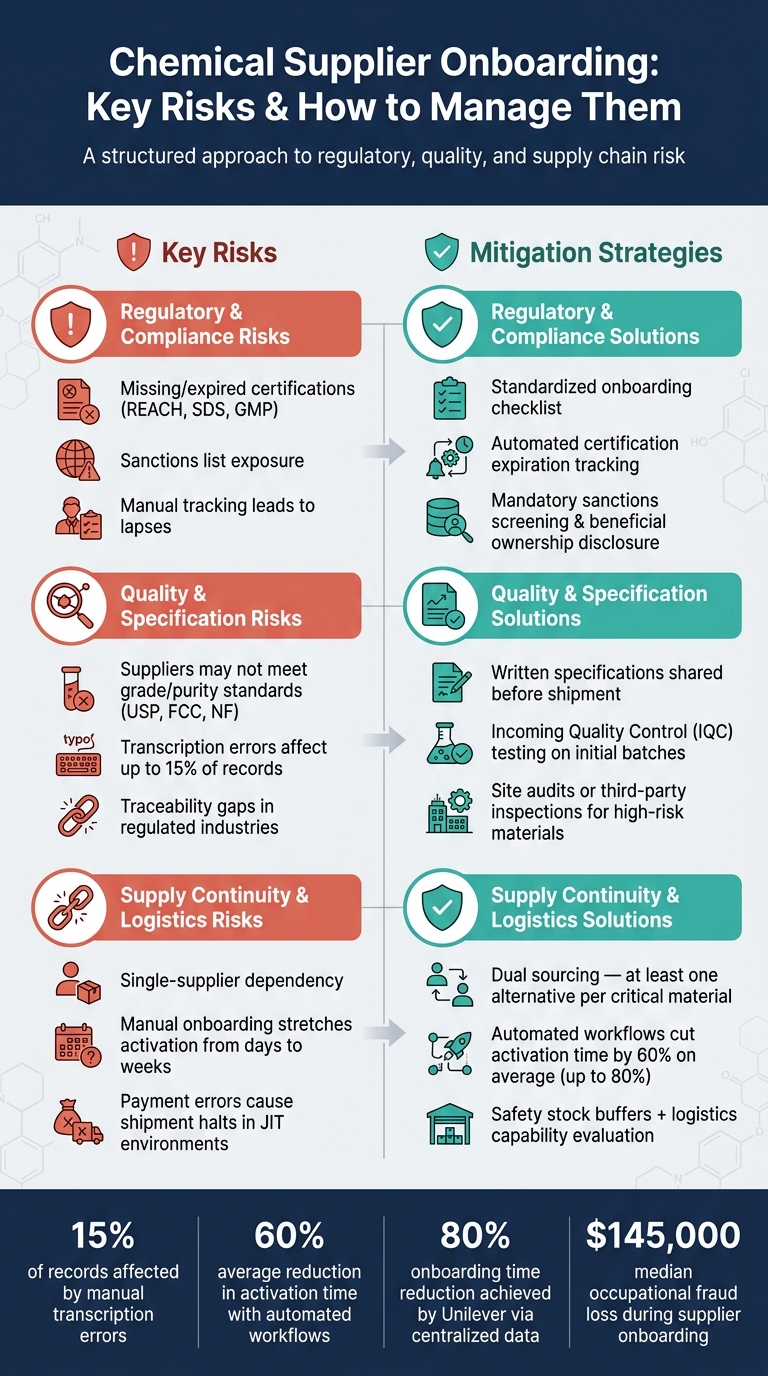
Chemical Supplier Onboarding: Key Risks & Risk Management Strategies
Identifying risks is only the first step; the real challenge lies in addressing them effectively. Below are actionable strategies tailored to each risk category, designed to help procurement and quality teams enhance their supplier onboarding processes.
Reducing Regulatory and Documentation Risks
A standardized onboarding checklist can replace inconsistent document collection practices. By evaluating all suppliers against the same criteria, you can ensure regulatory compliance from the start. Confirming mandatory certifications early in the process helps prevent potential compliance issues.
"A thorough, organized, and supplier onboarding process is a key step not just for compliance but also for risk management." – Patrick McConville, Certa [9]
Leverage automation tools to track certification expirations and enforce timely renewals. Additionally, mandatory screening for sanctions lists and beneficial ownership disclosures can address common regulatory blind spots. Aligning supplier quality standards with your specifications is another critical step in minimizing risks.
Controlling Quality and Specification Standards
Quality expectations must be clearly communicated before any shipments begin. Providing suppliers with written specifications eliminates confusion about what constitutes acceptable quality.
"What looks like ‘acceptable quality’ to a supplier may fall short of your brand’s standards. Such a misalignment often results in product defects, delays, or costly rework." – AMREP [6]
For regulated industries, incoming quality control (IQC) testing on initial batches is an effective safeguard. Testing initial samples against agreed-upon specifications can help identify issues early. For higher-risk materials, consider site audits or third-party inspections. Partnering with suppliers who maintain documented internal quality control procedures offers additional assurance. For instance, Allan Chemical Corporation works closely with vetted manufacturers and provides CoAs (Certificates of Analysis) and SDS (Safety Data Sheets) documentation, simplifying verification for procurement teams handling specialty chemicals.
Once quality benchmarks are secured, focus on mitigating supply chain vulnerabilities.
Building Supply Chain Resilience
Relying on a single supplier for critical materials can be risky, especially during disruptions. Dual sourcing – establishing at least one alternative supplier for each essential raw material – helps reduce this exposure [10]. Diversifying suppliers across different regions further minimizes the risk of simultaneous disruptions affecting both primary and backup sources.
Safety stock planning is another key strategy. Maintaining a buffer of business-critical inventory helps cushion delays, which is crucial in Just-in-Time supply chains. When onboarding new suppliers, evaluate their logistics capabilities to ensure they can handle hazardous materials, comply with Department of Transportation (DOT) regulations, and effectively serve your required locations [4].
Onboarding Process Structure and Governance
Even the best risk strategies can fall apart without a structured and consistent process. Effective governance ensures that every step in supplier onboarding is followed meticulously, leaving no room for skipped approvals or incomplete documentation.
Standardized Onboarding Workflows
Standardizing workflows removes guesswork from the onboarding process. This approach categorizes suppliers into risk tiers based on factors like geographic location, spending levels, and the types of chemicals they supply. Suppliers in higher-risk categories – such as those handling hazardous materials or operating under strict regulations – undergo more rigorous checks. Meanwhile, lower-risk suppliers follow a simpler path.
The process typically includes verifying key details like legal name, tax ID, and beneficial ownership, collecting compliance documents, evaluating quality credentials, and conducting structured sample tests. A defined approval sequence ensures no step is overlooked. Research highlights that automated onboarding workflows can cut supplier activation time by 60% on average, with top-performing systems achieving reductions of up to 80% [3].
"Onboarding is one of the most consequential checkpoints in the entire supplier lifecycle." – apexanalytix [3]
This structured workflow lays the foundation for effective data management.
Centralized Supplier Data Management
When supplier records are scattered across multiple systems, it increases risk and inefficiencies. A centralized supplier database – often referred to as a "golden supplier record" – brings all validated information into one place. This ensures synchronization across procurement, finance, and quality systems [3]. For example, if a supplier updates their banking details or a compliance certificate expires, every relevant team is notified immediately.
For chemical companies, this kind of centralized visibility is especially valuable. Documents like Safety Data Sheets (SDS) and Certificates of Analysis (CoA) have expiration dates and version histories that must be tracked accurately. A centralized system with time-stamped records simplifies regulatory audits by providing an organized, defensible trail of every document and approval [1][2]. Unilever serves as a prime example: after centralizing supplier data management, it reduced onboarding time by 80%, demonstrating the power of structured data governance at scale [11].
With centralized data in place, enabling cross-team collaboration becomes significantly easier.
Cross-Team Collaboration in Onboarding
Supplier onboarding in the chemical industry involves input from several departments. Quality teams review specifications, regulatory affairs ensure compliance, and operations assess logistics. When these teams operate in silos, critical information can fall through the cracks.
The solution is to use a shared workflow where tasks are routed sequentially, and each team has clear responsibilities. For instance, a large U.S. healthcare system with over 30,000 employees replaced its email-based onboarding process with a cross-functional platform. As a result, it achieved a 50% reduction in onboarding cycle time and a 40% drop in supplier inquiries [1]. Assigning data stewardship to procurement while IT handles system access and security prevents confusion over ownership [12].
"If you don’t get onboarding right, everything else is compromised." – apexanalytix [12]
The table below outlines how different teams contribute to a well-structured onboarding process:
| Team | Role |
|---|---|
| Procurement | Identifies suppliers, assigns risk tiers, and manages data stewardship. |
| Quality Assurance | Reviews CoAs, approves specifications, and evaluates batches. |
| Regulatory Affairs | Verifies compliance and reviews necessary documentation. |
| Finance/Legal | Validates banking details, reviews contracts, and screens for fraud. |
| Operations | Assesses logistics, capacity, and safety protocols. |
Each team plays a critical role in mitigating risks, ensuring that the onboarding process is thorough and well-governed. Together, these structured workflows and collaborative systems strengthen supplier risk management from the very beginning.
Conclusion and Key Takeaways
Summary of Risks and Solutions
The process of onboarding chemical suppliers comes with notable risks, including a median occupational fraud loss of $145,000 [1]. Addressing these challenges requires a combination of strategic measures to tackle regulatory, quality, and supply continuity concerns. Effective approaches – such as risk-based tiering, structured intake portals, centralized data systems, and ongoing monitoring – help focus attention on critical suppliers while simplifying the overall workflow.
"A modern supplier onboarding process is not about collecting more data. It’s about capturing the right information, at the right depth, for the right suppliers." – Sourcing Acumen [4]
These strategies underline the importance of refining processes and maintaining active supplier relationships to ensure long-term success.
Final Thoughts on Best Practices
Onboarding should be treated as a continuous process rather than a one-time task. Supplier risks – such as changing certifications, ownership shifts, or financial instability – can emerge unexpectedly. Real-time tracking of sanctions, financial standing, and document validity is essential to keep the supplier pool reliable and compliant over time.
For instance, Allan Chemical Corporation draws on decades of experience to ensure precise documentation, adherence to strict specifications, and timely deliveries, minimizing disruptions during onboarding.
Disclaimer: This content is informational. Consult official regulations and qualified professionals before making sourcing or formulation decisions.
FAQs
What documents should I require before approving a new chemical supplier?
Before deciding on a new chemical supplier, it’s important to gather key documents and conduct thorough evaluations. Start by requesting verified identity credentials and, if relevant, food safety plans. Confirm compliance with standards such as Good Manufacturing Practices (GMPs).
Additionally, perform financial, operational, and cybersecurity assessments to gauge the supplier’s stability and risk management. Don’t overlook sanctions checks and adverse media reviews, as they can reveal potential red flags. Finally, review and agree on clear contract terms to establish expectations upfront. These steps ensure the supplier meets safety, compliance, and reliability requirements.
How do I decide which suppliers need deeper onboarding checks?
To figure out which suppliers need more thorough onboarding checks, start by categorizing them based on their criticality and risk profile. Pay close attention to those that present higher risks in areas like operations, finances, compliance, or cybersecurity.
Key actions include confirming the supplier’s identity, performing sanctions and adverse media screenings, and evaluating their financial and operational stability. Focus your detailed due diligence efforts on suppliers that are crucial to your operations or carry significant risk exposure. This approach helps address potential issues before they escalate.
What’s the fastest way to reduce onboarding delays without increasing risk?
The fastest way to reduce onboarding delays while keeping risks low is by implementing risk-based controls, automating essential workflows, and consolidating supplier data into a single system. These measures deliver better risk visibility and simplify the process, ensuring both efficiency and adherence to safety and compliance standards.


Comments are closed