
The cleaning industry is shifting toward bio-based ingredients, driven by consumer demand, corporate goals, and stricter regulations. Bio-based detergents are replacing petroleum-based products, offering reduced emissions and better biodegradability. The global market for these ingredients, valued at $6.7 billion in 2023, is expected to double by 2030 with a 9.2% CAGR.
Key highlights include:
- Bio-Based Surfactants: Derived from renewable feedstocks like agricultural waste, these alternatives reduce greenhouse gas emissions and are less harmful to the environment.
- Enzymes in Detergents: Microbial enzymes, such as proteases, improve cleaning efficiency at lower temperatures, saving energy and water.
- Cold Water Cleaning: Innovations like plant-based surfactants and new biosurfactant formulations enable effective cleaning in cold water, cutting energy use by up to 65%.
- Market Growth: Laundry detergents lead the bio-based market, while rhamnolipids and methyl ester sulfonates (MES) gain traction due to improved performance and skin compatibility.
- Regulatory Push: Programs like the EPA’s Safer Choice and EU Green Deal are accelerating the adoption of bio-based formulations.
The transition to bio-based detergents aligns with global goals for reduced emissions and improved product safety. Manufacturers are investing in technology and supply chain transparency to meet growing demand for high-performance, renewable cleaning solutions.
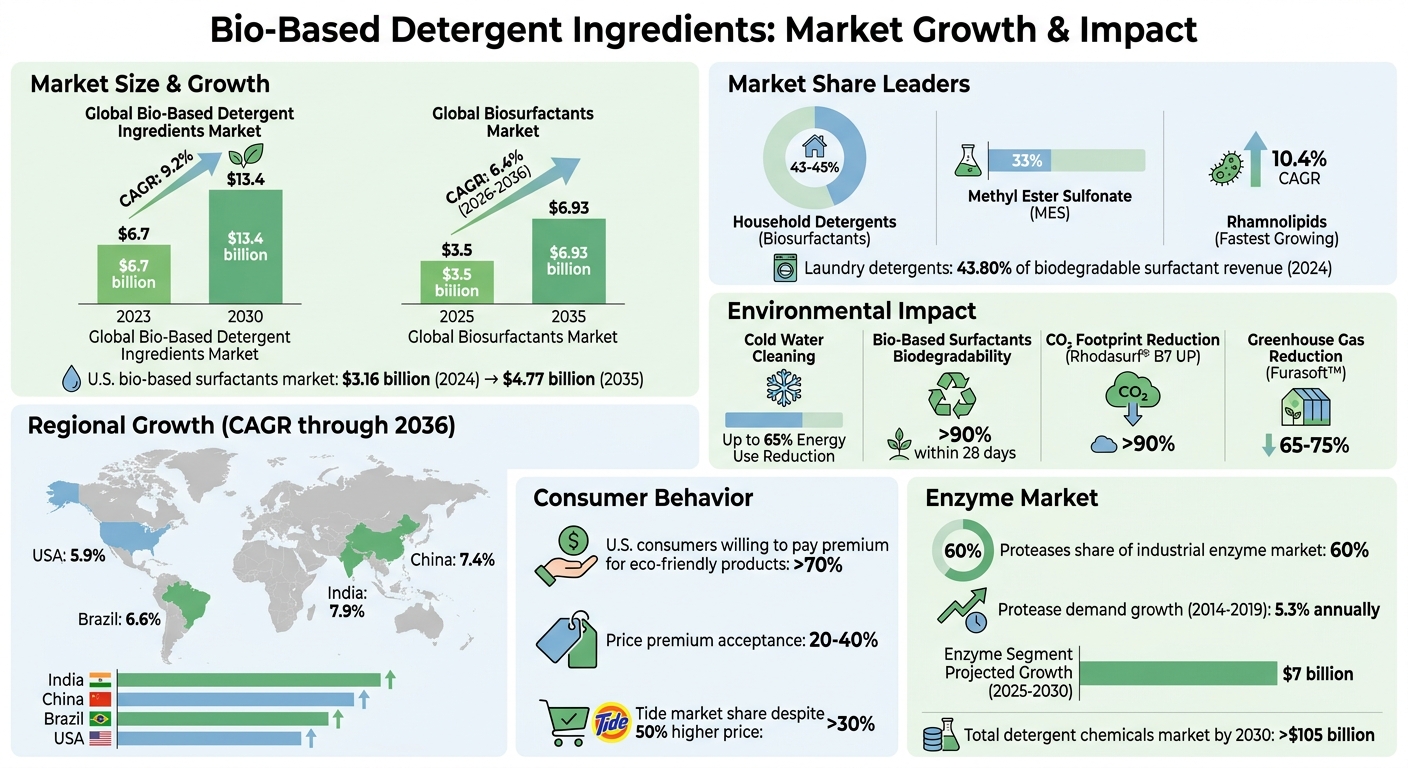
Bio-Based Detergent Market Growth and Key Statistics 2023-2035
Bio-Based Surfactants: Recent Developments
Surfactants are transitioning from petroleum-based origins to renewable alternatives. By 2034, the global bio-based surfactants market is projected to exceed $32 billion, with household detergents and cleaning products accounting for around 43% of this revenue [6]. This growth is fueled by advancements in second-generation feedstocks that avoid competition with food resources.
Renewable Feedstocks in Surfactant Production
Second-generation feedstocks are reshaping sustainable surfactant production. Manufacturers are now utilizing agricultural waste (e.g., corn steep liquor, rice bran oil, waste frying oil), forestry byproducts (e.g., cellulose residues, pulp byproducts), and plant residues (e.g., Furcraea sp. liquids, soapnut saponins) [4][5][6][7]. These waste materials, once considered pollutants, are now valuable resources for upcycling.
Globally, over 29 million metric tons of lipid-rich waste are generated annually, offering immense potential for microbial conversion into surfactants [5]. For instance, Candida bombicola cultivated on waste frying oil can produce 221.9 g/L of sophorolipids, while Enterobacter sp. UJS-RC grown on corn steep liquor yields 4.4 g/L of rhamnolipids with a 75% emulsification index and surface tension reduced to 28 mN/m [5]. In May 2024, researchers successfully stabilized residues from the fique plant, achieving saponin concentrations of 1,034–1,148 mg/L, which match the cleaning efficiency of synthetic detergents [7].
Another innovative method involves using liquid-assisted grinding (LAG) for mechanochemical synthesis. This process converts cellulose waste into amide surfactants without requiring solvents, catalysts, or external heating. The result is a cleaner production method that yields 85–90% efficiency and reduces water surface tension to below 27 mN/m for 12-carbon alkyl chains [4].
"Amide‐based surfactants, in comparison to esters and ethers/glycosides, display better stability due to the nature of the amide bond, which is stronger and consequently more resistant to hydrolysis" [8].
Cold Water Cleaning Performance
In addition to renewable feedstocks, efforts are focusing on improving energy efficiency in cleaning processes. Washing clothes in cold water has become a key area for innovation. Alkyl polyglycosides (APGs), non-ionic surfactants derived from plants, perform well at lower temperatures and are less affected by water hardness compared to traditional linear alkylbenzene sulfates [6]. Their plant-based composition also offers benefits for both the environment and skin sensitivity.
Recent developments further enhance cold water performance. In March 2026, Sironix Renewables introduced the Furasoft™ line, which incorporates upcycled furan structures. This innovation reduces greenhouse gas emissions by 65–75% compared to petrochemical alternatives, while maintaining high solubility and resistance to hard water [9]. Similarly, in April 2026, Syensqo launched Rhodasurf® B7 UP, a bio-based alternative to laureth-7, at its Moerdijk facility. This product reduces the net CO₂ footprint by over 90% while delivering the same cleaning and wetting performance [11].
"We created the Furasoft™ personal care line to help companies meet growing demand for better-performing products that are milder, safer and more sustainable." – Christoph Krumm, CEO and co-founder, Sironix Renewables [9].
Researchers are also engineering production strains to modify the hydrophobic side chains of mannosylerythritol lipids (MEL). These modifications create more hydrophilic structures tailored for laundry detergents [10]. When used at lower washing temperatures, such as 30°C (86°F), these biosurfactants can reduce the climate change impact of laundry cycles by up to 65% compared to conventional methods [10]. These advancements not only meet stringent performance standards but also accelerate the shift toward environmentally friendly detergents.
For bio-based ingredients backed by decades of expertise and rigorous testing, trust Allan Chemical Corporation‘s 40+ years of experience.
This content is for informational purposes only. Consult official regulations and qualified professionals before making sourcing or formulation decisions.
sbb-itb-aa4586a
Enzymes from Biological Sources
Microbial enzymes have revolutionized detergent formulations by enabling effective cleaning at lower temperatures. These enzymes are known for their impressive stability, high catalytic activity, and cost-effective recovery processes[12]. Proteases, in particular, dominate the industrial enzyme market, accounting for about 60% of its total share. Between 2014 and 2019, global demand for proteases grew at an annual rate of 5.3%[12]. These advancements have paved the way for multi-enzyme systems and refined microbial engineering.
Alkaline proteases, derived from bacteria like Bacillus and Halobacillus, are especially effective at breaking down protein-based stains such as blood, milk, and grass. They achieve this by hydrolyzing proteins into smaller peptides and amino acids[12][13]. These enzymes remain functional even under challenging conditions, including high pH levels (up to 12), the presence of surfactants like SDS and Tween 80, and exposure to oxidizing agents[12][13]. This resilience makes them ideal for integration into detergent formulations, where they work seamlessly with other cleaning agents.
Optimized enzymes operate efficiently at temperatures between 45°C and 50°C, reducing the need for hot water and saving energy. For instance, research on Bacillus paramycoides WSA showed that a protease concentration of just 10 U/mL, combined with 0.7% detergent, could completely clean bloodstained fabric in 10 minutes at 113°F (45°C)[13]. Additionally, this protease retained 75% of its activity after 10 minutes at 176°F (80°C), highlighting its remarkable thermostability[13]. To meet the demands of industrial laundry conditions, researchers are increasingly turning to enzymes sourced from extremophilic bacteria that thrive in environments with high salinity or temperature[12].
Multi-Enzyme Systems
The introduction of multi-enzyme systems in detergents has expanded their ability to handle a variety of stains simultaneously. This approach leverages enzymatic synergy, where the combined action of multiple enzymes boosts cleaning performance. While proteases target protein-based stains, pairing them with other enzymes and surfactants enhances the removal of more complex soils. This synergy is particularly valuable for modern high-efficiency (HE) washing machines, which use less water and operate at lower temperatures[17].
Market trends reflect the growing interest in enzyme-enhanced detergents. The detergent chemicals market’s enzyme segment is projected to grow by $7 billion between 2025 and 2030, fueled by increasing consumer demand for high-performing, eco-friendly products[17]. Additionally, the push for biodegradable and sustainable ingredients is expected to contribute annual growth of 2.5% to the detergent chemicals market, which is anticipated to exceed $105 billion by 2030[17]. Multi-enzyme systems offer a way to replace harsher chemical components with enzyme-based alternatives while maintaining strong cleaning capabilities.
Microbial Strain Engineering
Advances in microbial strain engineering are further improving enzyme production and performance. By employing metabolic engineering, scientists can redirect cellular resources to boost enzyme output, altering genes and optimizing metabolic pathways to achieve this goal[14]. Synthetic biology has introduced tools for creating genetic circuits that fine-tune enzyme production while eliminating competing pathways[14]. Techniques like Directed Evolution and Rational Engineering are also being used to enhance enzyme activity, stability, and effectiveness under industrial conditions[14].
Recent research highlights the success of engineered strains in improving cleaning efficiency. For example, Virgibacillus salarius VS-23 demonstrated the ability to remove blood stains in just 7 minutes, while Aspergillus terreus AUMC 15762 effectively eliminated oil spots within 60 minutes. These studies also show how waste-derived substrates can enhance enzyme yield and performance, offering sustainable solutions for enzyme production[15][16].
This content is for informational purposes only. Consult official regulations and qualified professionals before making sourcing or formulation decisions.
Market Drivers and Consumer Preferences
Advances in enzyme and surfactant technology are reshaping the detergent market, with a growing focus on bio-based ingredients. Factors like environmental impact, health considerations, and regulatory requirements are now central to consumer and industry priorities. Over 70% of U.S. consumers report they’re willing to pay more for cleaning products they perceive as safer and more environmentally friendly, pushing manufacturers to incorporate renewable ingredients into their formulations[3]. This shift has driven notable growth, with the U.S. bio-based surfactants market expected to grow from $3.16 billion in 2024 to $4.77 billion by 2035[3].
One key consumer demand is faster biodegradability. Unlike petroleum-based surfactants that can linger for months, bio-based alternatives break down by over 90% within 28 days[3]. Concerns about allergens, skin irritation, and the desire for "clean label" products have also spurred interest in plant-based formulations. Additionally, there’s increasing demand for detergents optimized for cold-water washing and reduced rinse cycles, helping households save energy and water[2][18]. These preferences highlight how consumers are prioritizing sustainability without compromising cleaning performance. Notably, laundry detergents have emerged as a leader in the bio-based market, reflecting these evolving expectations.
Laundry Detergent Market Position
Laundry detergents dominate the bio-based market, accounting for 43.80% of biodegradable surfactant revenue in 2024[3]. This segment is a natural fit for bio-based ingredients as consumers increasingly turn away from harsh chemicals and synthetic compounds[1]. To succeed, formulations must balance affordability with effective cleaning, environmental responsibility, and fabric care[18]. Even with price premiums of 20–40%, consumers continue to favor products that combine performance with reduced environmental impact[3].
Take Tide, for example. Despite being priced about 50% higher than the average liquid detergent, Tide holds more than 30% of the liquid-detergent market in the U.S.[2]. This demonstrates that consumers are willing to pay more when they perceive added value in terms of both cleaning power and sustainability.
Regulations and Corporate Commitments
Government regulations and corporate initiatives are playing a major role in driving the adoption of bio-based ingredients. Programs such as the EPA’s Safer Choice and California’s stringent chemical safety laws are pushing manufacturers toward biodegradable and low-VOC (volatile organic compound) alternatives[3]. In Europe, policies like the Green Deal and the Circular Economy Action Plan are encouraging the use of bio-based formulations[10]. The European Commission’s proposed Product Environmental Footprint (PEF) provides a standardized way to assess and communicate the environmental impact of detergent products[10].
Beyond regulations, companies like Unilever and Procter & Gamble are advancing sustainability through innovative product designs[3][18]. For instance, in February 2026, Procter & Gamble launched Tide evo, a waterless detergent in the form of dissolvable fiber-based tiles packaged in fully recyclable paperboard[2]. Similarly, Unilever introduced its first paper-based laundry detergent container in February 2022, crafted from responsibly sourced materials and designed to be 100% biodegradable[1]. These examples underscore how sustainability has evolved from a niche concern to a primary consideration, with plant-derived surfactants and biodegradable enzymes becoming standard features rather than premium options[18].
This content is for informational purposes only. Consult official regulations and qualified professionals before making sourcing or formulation decisions.
Market Outlook Through 2035
The bio-based detergent market is poised for notable growth, driven by regulatory changes, advancements in technology, and shifting consumer preferences. The global biosurfactants market is expected to expand from USD 3.5 billion in 2025 to USD 6.5 billion by 2035, with a 6.4% CAGR projected from 2026 to 2036, eventually reaching USD 6.93 billion[19]. This upward trend underscores the transition from bio-based ingredients being niche options to becoming essential for standing out in sustainability-focused markets[19]. These projections provide a foundation for exploring bio-enzymes, surfactants, and strategies for supply chain management.
Growth in Bio-Enzymes and Surfactants
Household detergents are anticipated to dominate the biosurfactants application market, accounting for 45.0% of its share in 2026. Methyl Ester Sulfonate (MES) is set to lead with a 33.0% share, thanks to its established production efficiency and cost advantage over petrochemical-based Linear Alkylbenzene Sulfonate (LAS)[19]. Rhamnolipids, on the other hand, are emerging as the fastest-growing category, with a projected CAGR of 10.4% from 2025 to 2035. Their antimicrobial properties and compatibility with sensitive skin make them particularly appealing for premium and personal care products[19].
One major hurdle remains: the 3–5× price gap between fermentation-derived biosurfactants and their petrochemical counterparts. Shambhu Nath Jha, Principal Consultant for Chemicals & Materials at Fact.MR, emphasizes:
"In my analysis, I have observed that the cost-parity threshold between fermentation-derived biosurfactants and petrochemical LAS is the single most consequential inflection point for this market."[19]
To address this, manufacturers are turning to metabolic engineering, continuous fermentation systems, and optimized downstream processing to boost yields and improve consistency – all aimed at achieving cost parity[19].
Regional growth patterns highlight unique drivers. India is projected to lead with a 7.9% CAGR through 2036, fueled by a growing personal care sector and domestic production incentives. China follows closely with a 7.4% CAGR, supported by industrial cleaning needs and stricter environmental regulations. Brazil, leveraging its bio-ethanol and sugarcane industries, is expected to grow at 6.6% CAGR. Meanwhile, the USA is forecasted to see a 5.9% CAGR, bolstered by innovation in natural products and rising demand for biodegradable cleaning solutions[19].
Supply Chain Transparency Technologies
As the market evolves, ensuring supply chain integrity becomes increasingly important. Established markets like the UK and USA now expect full traceability to meet eco-responsibility standards[19]. This has prompted companies to adopt verification systems that confirm the origin and production methods of "responsibly harvested" and "renewable plant-based" materials[1].
To secure bio-based ingredient supplies during scale-up, the industry is moving toward long-term supply agreements. Formulators are also focusing on multi-functional biosurfactant systems that meet strict eco-label criteria without sacrificing cleaning performance. These transparency efforts not only help with regulatory compliance but also strengthen consumer trust. Updates to the EU Detergent Regulation and the expansion of eco-label programs are pushing manufacturers to phase out petrochemical surfactants, making traceability and transparency both a regulatory necessity and a consumer demand[19].
This content is for informational purposes only. Consult official regulations and qualified professionals before making sourcing or formulation decisions.
Conclusion
The transition from petrochemical to bio-based detergent ingredients marks a major step forward in reshaping the cleaning products industry toward greater sustainability. Bio-based surfactants, such as Mannosylerythritol Lipids (MEL), offer high biodegradability and reduced toxicity compared to traditional synthetic options – all while maintaining or even surpassing performance standards[10][20]. These ingredients leverage renewable resources like rapeseed oil, glucose, and byproducts from agro-industrial processes, contributing to a circular economy[10][20]. This shift not only lowers operational emissions but also creates a more sustainable cleaning process overall.
The environmental benefits extend even further when paired with cold-water cleaning methods. By optimizing formulations for cold-water use, manufacturers can cut environmental impact by up to 65% compared to conventional detergents used at standard temperatures[10]. This approach reduces lifecycle emissions by combining cold-water efficiency with a closed-loop carbon system[10].
These advances are driving notable market growth in the bio-based detergent sector. The adoption of renewable ingredients aligns closely with global goals like the UN Sustainable Development Goals, particularly SDG 12 (Responsible Consumption and Production) and SDG 13 (Climate Action)[10].
For formulators, the challenge lies in balancing high performance with sustainability. Moving forward, integrated supply and cost optimization strategies and advancements in technology will play a key role. Transparent, long-term agreements for renewable materials will help bridge cost differences and meet evolving regulatory and consumer expectations.
This content is for informational purposes only. Consult official regulations and qualified professionals before making sourcing or formulation decisions.
FAQs
How can I tell if a detergent is truly bio-based?
To spot a bio-based detergent, focus on ingredients sourced from renewable biological materials, such as biosurfactants like saponins. These come from plants or microorganisms, making them biodegradable and environmentally friendly. Check product labels or descriptions for terms like "bio-based" or "plant-derived", and review the ingredient list for natural components. This can help confirm the detergent’s origin and eco-conscious qualities.
Do bio-based detergents clean as well in cold water?
Bio-based detergents, crafted from materials like wood fibers and corn protein, have proven to work well across a range of water temperatures – even in cold water. These products offer cleaning performance on par with traditional detergents, presenting an environmentally friendly option for those looking to make greener choices.
Why are biosurfactants still more expensive than petrochemical surfactants?
Biosurfactants tend to carry a higher price tag, primarily because of the costly production process. Challenges include the complexities of microbial synthesis and the need for specialized fermentation and purification methods. These hurdles make large-scale manufacturing less economical, even as interest in sustainable alternatives continues to rise.




Comments are closed