
Water-based acrylic resins are advanced coatings designed to protect metal surfaces from corrosion. These resins, often formulated using emulsion polymerization, rely on water as a carrier instead of organic solvents, significantly reducing harmful VOC emissions. By incorporating specialized additives and advanced polymer structures, they provide durable protection, even in harsh industrial environments like marine structures and chemical storage tanks.
Key Highlights:
- Corrosion Resistance: High-performance water-based resins can endure 2,000–3,000+ hours in salt spray testing, outperforming many solvent-based alternatives.
- Environmental Compliance: Emit VOC levels as low as 50 g/L, meeting strict EPA and OSHA standards.
- Durability: Offer strong adhesion, UV resistance, and longer maintenance cycles for metal surfaces.
- Chemical Composition: Include hydroxy monomers and crosslinking agents to form robust, water-resistant films.
- Additives: Fluorinated monomers and zinc phosphate enhance hydrophobicity and corrosion inhibition.
Water-based systems are increasingly preferred due to their low toxicity, safety for workers, and compliance with modern regulations. While initial costs may be slightly higher, reduced cleanup expenses and longer lifecycle benefits make them a cost-effective choice for industrial applications.
Water Based Coating: Prevent Rust & Corrosion On Metal Parts
sbb-itb-aa4586a
Chemical Composition and Synthesis: Water-Based vs. Solvent-Based Acrylic Resins
Water-based acrylics, formulated as emulsions, differ from solvent-based acrylics, which rely on hydrocarbon solvents. Despite these differences, both types originate from similar monomers, such as acrylic acid, methacrylic acid, and various acrylate monomers [5]. While the choice of carrier influences safety and regulatory considerations, the fundamental chemistry of these resins remains consistent.
To improve corrosion resistance, manufacturers often create polyol-based acrylic resins by incorporating hydroxy monomers like Hydroxy Ethyl Methacrylate and crosslinking them with polyisocyanates. This process forms a three-dimensional thermosetting network, which resists cracking and blistering. The result? Better water resistance and adhesion, preventing moisture from penetrating metal surfaces and causing damage [5].
Monomer Selection and Polymerization Methods
Water-based acrylic resins are typically produced through emulsion polymerization. In this process, acrylic monomers are polymerized in water with the help of surfactants, creating a stable dispersion of fine particles [7]. Formulators use "hard" monomers, like Methyl Methacrylate (MMA), to increase hardness and block resistance, while "soft" monomers, such as Butyl Acrylate (BA), enhance flexibility and adhesion [7]. The shift toward water-based formulations has been significant – over 55% of U.S. manufacturers now use them, contributing to a 50% reduction in VOC emissions since 2005 [7].
Advanced techniques, like miniemulsion polymerization, allow for the inclusion of hydrophobic monomers, such as fluorinated acrylates, which are difficult to dissolve in water [6]. These methods also enable the creation of complex particle structures, like core–shell morphologies. Research shows that core–shell particles with pure fluorinated acrylate cores offer exceptional corrosion protection, with some formulations enduring 1,200 hours of salt-spray testing. In comparison, conventional acrylic latexes with phosphate surfmers typically last up to 400 hours under similar conditions [6].
Recent industry developments highlight a growing focus on sustainability and performance. For example, Arkema partnered with Catalyxx in September 2025 to produce bio-based acrylic resins using proprietary fermentation technology, aiming to lower the carbon footprint of industrial coatings [7]. Similarly, Dow increased its North American production capacity for acrylic emulsions in March 2024 to meet the rising demand for low-VOC coatings in the automotive and construction industries. These advancements reflect an ongoing commitment to improving resin performance while addressing environmental concerns.
Additives That Improve Corrosion Resistance
Specialized additives play a crucial role in enhancing the corrosion resistance of acrylic resins. Fluorinated monomers, such as Perfluoro Octyl Acrylate (POA) and Fluorinated Acrylate–Siloxane (FASAR), increase hydrophobicity and reduce surface free energy, limiting water and oxygen permeability. Meanwhile, phosphate-based additives like Sipomer PAM200 improve wet adhesion and prevent flash rust on metal surfaces during the drying process [8] [6] [4]. This added wet adhesion is often the key to avoiding coating failures when defects occur [4].
Corrosion-inhibitive pigments, such as submicron-sheet Zinc Phosphate (Zn₃(PO₄)₂), act as active inhibitors. When combined with fluorinated siloxanes, they offer a dual-layer defense by merging hydrophobic barriers with chemical inhibition [8]. For instance, a waterborne alkyd resin modified with 30% fluorinated acrylate–siloxane and 5% zinc phosphate demonstrated a corrosion inhibition efficiency of 99.92%, with a corrosion rate as low as 8.37 × 10⁻³ mm per year [8]. Additionally, phase transfer catalysts like cyclodextrins help transport highly hydrophobic monomers through the aqueous phase during emulsion polymerization, addressing a critical challenge in resin synthesis [6].
This information is intended for educational purposes only. Always consult official regulations and qualified professionals before making formulation or sourcing decisions.
Performance Comparison: Corrosion Resistance and Durability
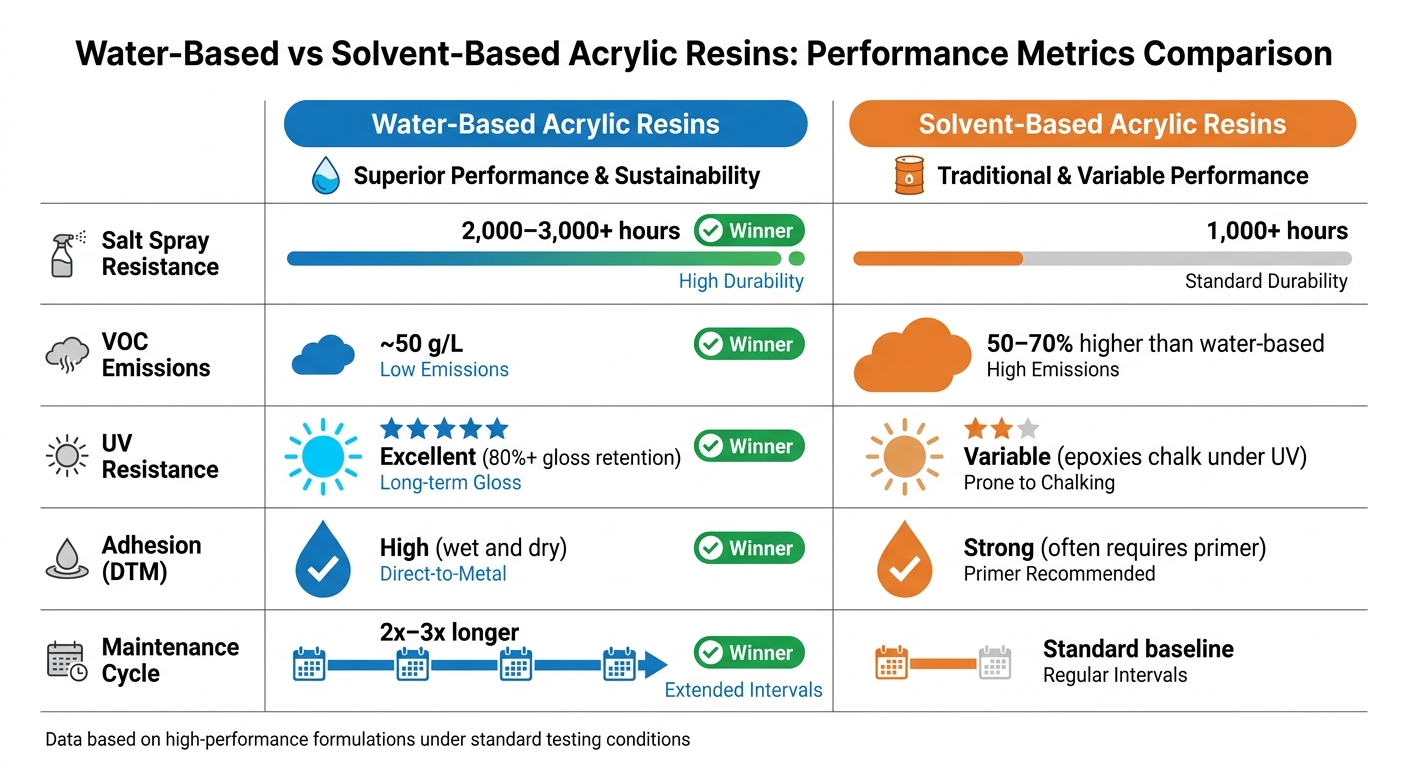
Water-Based vs Solvent-Based Acrylic Resins Performance Comparison
Corrosion Resistance Test Results
Water-based resins designed for high performance can endure 2,000–3,000+ hours in salt spray tests, far surpassing the typical 1,000-hour benchmark [9]. For instance, Nippon Paint’s "AQUA MARINE" system offers over 3,000 hours of protection under these conditions [9]. On the other hand, solvent-based acrylics generally meet the 1,000-hour standard but struggle to exceed it without additional modifications.
This exceptional performance is largely due to improved resin purity. Tony Neely, a Technical Specialist at BASF, highlights the importance of minimizing ionic species:
"Rusting is an electrochemical process, so that needs to be taken into account. I could have the best resin in the world, but if I include a lot of ionic species, I’m adding things with a bigger potential to rust and take away the protective properties with that resin" [11].
In March 2020, BASF introduced ACRONAL PRO 770, a waterborne acrylic binder specifically designed to minimize ionic species in the water phase. Coatings formulated with this resin achieve VOC levels as low as 50 g/L while maintaining high gloss retention after 1,000 hours of QUV exposure [11]. These advancements highlight the growing potential of water-based resins for direct application on metal surfaces.
Durability on Metal Surfaces
Beyond corrosion resistance, durability on metal surfaces is another critical performance factor. Modern water-based acrylics combine primer and topcoat functionalities into a single Direct-to-Metal (DTM) application, streamlining the coating process [11]. Research demonstrates that incorporating around 8 wt% organosilane monomer into water-reducible acrylic coatings improves adhesion strength and corrosion resistance on metal substrates. However, exceeding 16 wt% can negatively impact performance [1].
Surface smoothness also significantly influences durability. As Tony Neely explains:
"The reason the coating is glossy is because it’s physically smoother. Because of this, you can achieve increased resistance to abrasion and staining" [11].
Glossy water-based acrylics, with their smoother surfaces, offer enhanced resistance to abrasion and staining, effectively doubling or tripling maintenance intervals [9]. Additionally, both water-based and solvent-based acrylics exhibit strong UV resistance, outperforming epoxies, which tend to chalk and degrade when exposed to sunlight [10][11].
Performance Metrics Table
| Performance Metric | Water-Based Acrylic (High-Performance) | Solvent-Based Acrylic (Traditional) |
|---|---|---|
| Salt Spray Resistance | 2,000–3,000+ hours [9] | 1,000+ hours [9] |
| VOC Emissions | Approximately 50 g/L [11] | 50–70% higher than water-based [9] |
| UV Resistance | Excellent (80%+ gloss retention) [9] | Variable (epoxies chalk under UV) [10] |
| Adhesion (DTM) | High (wet and dry) [11] | Strong (often requires primer) [11] |
| Maintenance Cycle | 2x–3x longer [9] | Standard baseline [9] |
This content is for informational purposes only. Consult official regulations and qualified professionals before making sourcing or formulation decisions.
Environmental and Economic Considerations
When comparing water-based and solvent-based acrylic resins, their environmental impact and cost implications play a significant role in distinguishing the two.
VOC Emissions and Environmental Compliance
Water-based acrylic resins use water as their primary carrier, unlike solvent-based systems that rely on organic solvents. These solvents evaporate and release high levels of volatile organic compounds (VOCs). Solvent-based formulations typically emit between 250 and 400 g/L of VOCs, while water-based alternatives achieve much lower levels – often below 50 g/L and, in some cases, under 10 g/L [12]. VOCs contribute to ground-level ozone (smog) when combined with sunlight and nitrous oxides, leading to stricter regulations on solvent-based coatings [3].
In addition to VOCs, solvent-based systems can release hazardous pollutants like benzene and methylene chloride, which pose serious health risks [3]. Water-based resins, by contrast, are safer for workers due to their lower toxicity, reduced inhalation risks, and non-flammable nature [7]. These characteristics make it easier to comply with stringent regulations, including U.S. EPA Method 24, California’s SCAQMD, and the EU Paints Directive (2004/42/EC) [7][12].
Recent innovations reflect this shift toward sustainability. In September 2025, Dow introduced a next-generation acrylic polymer emulsion for coatings and adhesives, designed to reduce VOC emissions while meeting the durability demands of automotive OEMs [7]. Similarly, Engineered Polymer Solutions (EPS) launched a fluorosurfactant-free all-acrylic emulsion in May 2025, addressing the growing need for PFAS-free and APE-free formulations in the U.S. market [7]. Ben Smith, Vice President of Flowcrete Americas, underscores this trend:
"The more sustainable solution will always trump a similar but less environmentally friendly system, thanks to the fact that businesses are increasingly seeing the benefits of promoting themselves as sustainable companies" [13].
These environmental advantages align with the superior corrosion resistance and durability of water-based formulations, making them a compelling choice for many applications.
Cost Analysis for Industrial Use
While water-based technologies offer clear environmental and safety benefits, they also impact production costs. Initial material costs for low-VOC formulations are typically 10–15% higher than those of solvent-based systems. However, their total lifecycle costs can be competitive due to reduced cleanup expenses (since water replaces chemical solvents) and lower regulatory compliance costs [12][7]. Although water evaporation requires more energy than solvent evaporation – potentially increasing drying costs – this is often offset by savings in other areas, such as lower insurance premiums (thanks to reduced flammability and toxicity) and the elimination of expensive VOC abatement systems like scrubbers or thermal oxidizers [13].
There are some logistical considerations as well. Water-based resins generally have a shorter shelf life – 6 to 12 months compared to up to 24 months for solvent-based products – which may affect bulk purchasing strategies. Additionally, transitioning to water-based systems may require stainless steel equipment to prevent corrosion caused by the water carrier [13].
Krystal Nanan, a Civil Engineer and Project Manager, highlights another financial advantage:
"Waterborne coatings also allow industrial coating manufacturers to spend considerably less money on regulation compliance consulting while helping them avoid excessive fines for regulatory non-compliance" [3].
This content is for informational purposes only. Consult official regulations and qualified professionals before making sourcing or formulation decisions.
How to Select Acrylic Resins for Corrosion Resistance
Choosing the right acrylic resin plays a critical role in ensuring long-term protection against corrosion. This decision directly affects the quality of the initial application, its durability, and ongoing maintenance costs.
Regulatory Standards and Certifications
Adhering to environmental and safety regulations is a key factor when selecting resins. Agencies like the EPA and OSHA have targeted volatile organic compounds (VOCs) and hazardous air pollutants (HAPs) for reduction, making compliance with these standards essential for modern coatings [3]. For example, Section 112 of the Clean Air Act mandates that industrial facilities limit emissions from surface coatings and manufacturing processes [3].
When assessing resins, look for compliance with standards such as ISO 2114 or DIN 53402, which address acid value and its impact on water solubility and adhesion [14]. Additionally, consider the Minimum Film-Forming Temperature (MFFT) to ensure compatibility with your curing environment – whether ambient conditions or oven curing – to avoid cracking during film formation [14]. Industrial applications demand resins tailored for "maintenance" purposes, as architectural binders often lack the ability to form the continuous films required for effective corrosion protection [2].
Advances in acrylic polymer technology have significantly improved corrosion resistance. For instance, second-generation waterborne acrylic resins, introduced in the early 1980s, have demonstrated durability in harsh environments like chemical storage tanks, highway bridges, and marine-exposed structures, with field exposure histories exceeding 15 years [2].
Supplier Reliability and Custom Formulations
The reliability of your supplier is just as important as the resin itself. A dependable supplier offers technical support, custom formulations, and verified performance data. Since accelerated lab tests often fail to replicate real-world conditions, top manufacturers provide both R&D insights and field exposure data to validate the longevity of their coatings [2][15].
Custom formulations are particularly valuable, as they allow for tailored solutions that balance acrylic components for UV stability with corrosion inhibitors designed for specific environments [15]. Suppliers also help address application challenges, such as managing environmental factors like temperature and humidity, which are critical for proper film formation in hybrid systems [15].
Allan Chemical Corporation, for instance, leverages over 40 years of experience to support regulated industries with just-in-time delivery and technical expertise. Their access to second-generation waterborne technologies and the ability to incorporate specialized rheology modifiers and corrosion inhibitors make them a strong partner for industrial applications. Reliable suppliers should also provide detailed application guidelines, as improper handling during application is a leading cause of coating failures [15].
The rising demand for high-performance corrosion protection is evident in market trends – the global market for these coatings was valued at approximately $7.5 billion in 2022 and is expected to grow to $9.8 billion by 2027 [15]. These factors underscore the growing confidence in water-based acrylic systems for industrial use.
This content is for informational purposes only. Consult official regulations and qualified professionals before making sourcing or formulation decisions.
Conclusion: Choosing the Right Solution for Corrosion Resistance
Selecting the right acrylic resin for corrosion protection involves balancing performance, regulatory compliance, and lifecycle costs. Water-based acrylic resins have become the go-to choice for industrial coatings, largely due to increasingly stringent environmental requirements.
Main Benefits of Water-Based Acrylic Resins
Water-based acrylic resins stand out by using water as a carrier instead of organic solvents, helping manufacturers comply with strict EPA standards [7]. This shift has significantly reduced VOC emissions, improved worker safety by eliminating flammable solvents, and minimized exposure to harmful vapors [7][2]. Additionally, all-acrylic emulsions offer outstanding UV stability and resistance to chalking, ensuring long-lasting durability for metal surfaces in challenging environments [7]. As highlighted by Elchemy:
"For U.S. producers across sectors, water based acrylic polymer emulsion is no longer just a greener alternative. It is often the only compliant path forward." – Elchemy [7]
These advantages emphasize the importance of a dependable supply chain and technical support to guarantee consistent coating performance. The market reflects this growing confidence, with acrylic polymer emulsions expected to represent over 45% of the U.S. emulsion polymer market by 2025. Globally, the market is forecasted to grow from $7.5 billion in 2024 to $12.2 billion by 2033 [7].
Working with Reliable Suppliers
While the formulation benefits of water-based acrylic resins are clear, working with a reliable supplier is key to fully realizing these advantages. A trusted supplier ensures access to high-quality materials, technical expertise, and stable supply chains. Allan Chemical Corporation, with over 40 years of experience, supports regulated industries by offering just-in-time delivery and competitive pricing. Their portfolio includes advanced waterborne technologies, PFAS-free options, and high-solids grades tailored for direct-to-metal applications. Additionally, reliable suppliers can help manage raw material price fluctuations – since acrylic acid prices are closely tied to crude oil and natural gas markets – and provide thorough documentation to meet specification requirements [7].
This content is for informational purposes only. Always consult official regulations and qualified professionals before making sourcing or formulation decisions.
FAQs
When should I choose water-based acrylics over solvent-based for metal?
Water-based acrylics are an excellent choice for metal surfaces when safety and environmental considerations take priority. These coatings can cut VOC emissions by as much as 95%, resulting in lower odors, easier cleanup, and adherence to stringent regulations. Advances in their formulation have significantly improved adhesion, durability, and corrosion resistance, making them a reliable option for industrial uses that demand safer handling and a focus on sustainability.
What surface prep is needed for direct-to-metal acrylic coatings?
Before applying direct-to-metal acrylic coatings, it’s crucial to properly prepare the surface. Start by thoroughly cleaning the metal to eliminate rust, oil, and any contaminants that might interfere with adhesion. In some cases, abrasive blasting or comparable techniques may be necessary to create a surface texture that promotes better bonding. Ensuring the metal is clean and correctly prepped is key to achieving the best performance from the coating.
Why do water-based coatings fail in humid or cold conditions?
Water-based coatings often struggle in humid or cold conditions because their barrier properties and wet adhesion can weaken. These qualities are critical for ensuring long-term corrosion protection, particularly when the coating is exposed to defects or moisture.


Comments are closed