
The European Union‘s Regulation (EU) 2026/405, introduced in early 2026, brings stricter rules for detergent formulations and sourcing. Key changes include mandatory biodegradability for surfactants, lower phosphate limits, and the introduction of Digital Product Passports (DPPs) for ingredient traceability. Compliance deadlines start on September 23, 2029, with additional requirements for polymeric films and organic substances by 2032 and 2034. These updates affect global supply chains, requiring manufacturers to source compliant materials, secure detailed documentation, and appoint EU-based representatives if exporting to the region.
Key Updates:
- Biodegradability Standards: Surfactants must achieve a 60% biodegradation rate within 28 days.
- Phosphate Restrictions: Household laundry detergents capped at 0.5g phosphorus per load; dishwasher detergents at 0.3g.
- Digital Product Passports: Mandatory for tracking ingredients and ensuring transparency.
- Expanded Scope: Includes probiotic cleaners and water-soluble polymeric films.
Manufacturers face challenges in replacing non-compliant materials, diversifying suppliers, and meeting documentation requirements. Partnering with experienced sourcing specialists can help navigate these regulatory changes and avoid disruptions.
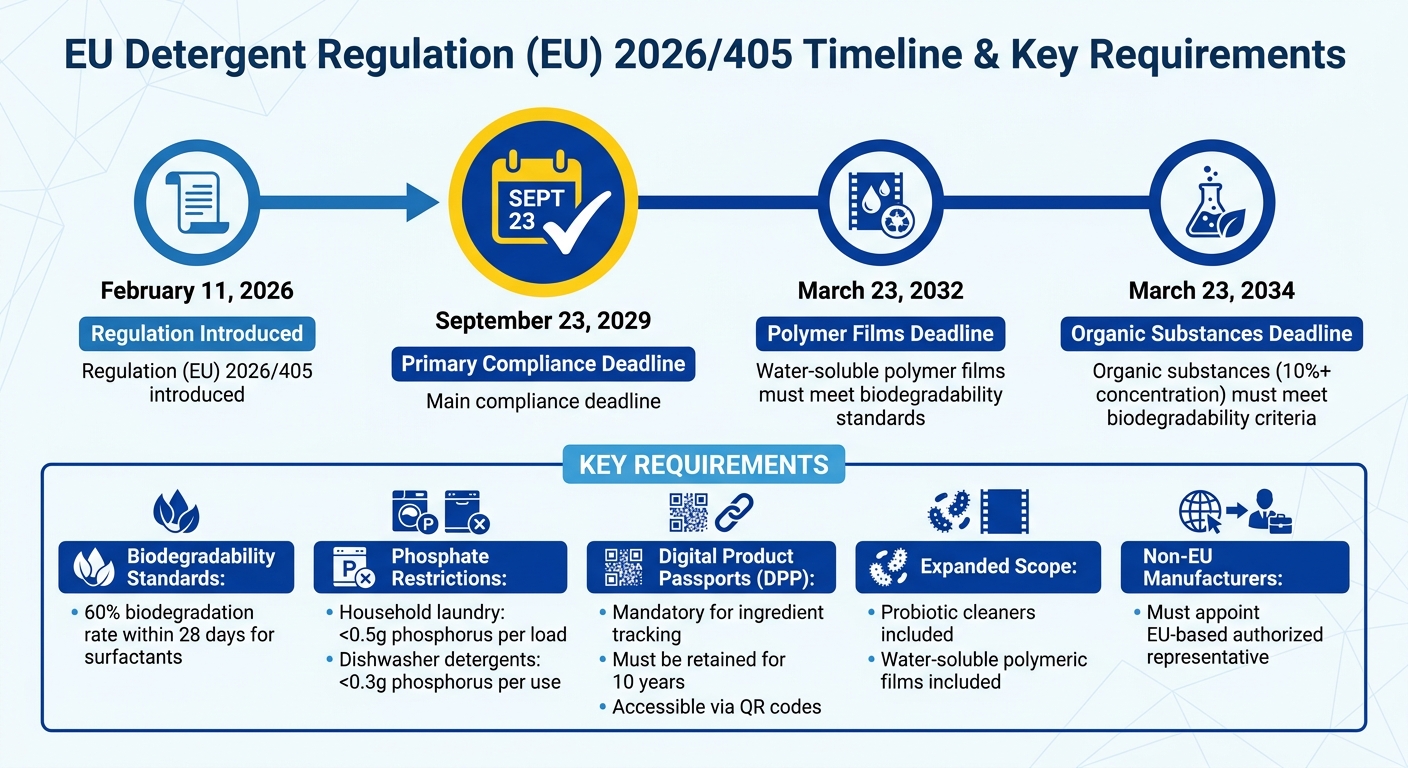
EU Detergent Regulation 2026/405 Compliance Timeline and Key Requirements
1. Shift to Biodegradable Surfactants
Compliance with Recent Detergent Regulations
The introduction of Regulation (EU) 2026/405 has set a clear requirement: all surfactants must meet strict biodegradability standards before being allowed into the EU market [4]. Specifically, surfactants now need to demonstrate a biodegradation rate of at least 60% within 28 days [1]. This shift means manufacturers must immediately reevaluate their current surfactant options to ensure compliance.
"All surfactants used in detergents must comply with ultimate biodegradability criteria before the product can be placed on the EU market." – Belab Services [4]
Impact on cost optimization in chemical sourcing and supply chain adjustments
This regulation has a ripple effect on sourcing strategies and supply chains. Sourcing teams must carefully audit their existing surfactant portfolios to pinpoint ingredients that fall short of the new standards. Any non-compliant materials will need to be replaced well before the September 23, 2029 deadline [4]. Meanwhile, raw material suppliers face growing demands to provide documented proof of biodegradability, as manufacturers aim to maintain compliance throughout their formulations [7].
Supplier Certifications and Documentation Capabilities
To meet these regulatory demands, manufacturers now depend on suppliers with robust certification and documentation processes. Suppliers must provide accredited laboratory testing reports that confirm the required 60% biodegradation rate within 28 days. Additionally, sourcing agreements should include provisions for delivering comprehensive technical documentation, including data for the Digital Product Passport (DPP) [1][9].
The DPP, a standardized digital format, will include key details such as ingredient lists, traceability information, and environmental impact metrics. This information will be accessible via QR codes, ensuring transparency across the supply chain [3]. For manufacturers outside the EU, appointing an EU-based authorized representative is essential. This representative will maintain the DPP and act as a regulatory liaison to ensure compliance [1][3].
This content is for informational purposes only. Consult official regulations and qualified professionals before making sourcing or formulation decisions.
sbb-itb-aa4586a
2. Replacement of Phosphate Builders
New regulations are reshaping detergent formulations, particularly by targeting phosphate builders alongside surfactant biodegradability.
Compliance with Recent Detergent Regulations
Regulation (EU) 2026/405, introduced on February 11, 2026, imposes stringent limits on phosphorus content in household detergents [1][7]. Under this rule, household laundry detergents must contain less than 0.5 grams of total phosphorus per standard washing machine load. For automatic dishwasher detergents, the allowance is even stricter – less than 0.3 grams per use [1]. These limits represent a significant tightening of previous standards.
In the United States, similar regulations aim to curb phosphate use to address nutrient pollution concerns [10].
Impact on Sourcing Strategies and Supply Chain Adjustments
Phasing out phosphates has created challenges in sourcing because no single ingredient can fully replicate their multifunctional role. Sodium tripolyphosphate (STPP), for example, historically provided pH stabilization, grease removal, and dirt suspension [12]. As Susan O. Baba, External Relations Manager at Procter & Gamble, aptly noted:
"There’s no good proxy for flour… It takes a bunch of other ingredients to replicate what that one ingredient [phosphate] does" [12].
Manufacturers now rely on a blend of specialty chemicals to replace phosphates. These include acrylic dispersants, sodium silicates, bleach activators, chelating agents, and specialized enzymes [12]. This shift demands more sophisticated sourcing strategies and meticulous documentation to ensure that these ingredients meet performance standards.
Supplier Certifications and Documentation Capabilities
Suppliers must provide detailed phosphorus measurements to comply with the Detergent Phosphorus Protocol (DPP) [7][11]. For detergent manufacturers, this means working with suppliers equipped to handle the complex documentation required for the new ingredient combinations. Each alternative – whether dispersants, chelating agents, or enzymes – requires its own certification and traceability data.
For companies exporting to the EU, appointing an authorized representative to manage the DPP and maintain technical documentation has become a critical step. These measures are essential for meeting compliance deadlines, such as the September 23, 2029 application date [7].
This shift highlights the growing complexity of regulatory compliance in chemical sourcing, underscoring the need for clear verification processes and robust supplier partnerships.
This content is for informational purposes only. Consult official regulations and qualified professionals before making sourcing or formulation decisions.
3. Increased Documentation and Certification Requirements
Recent detergent regulations have introduced stricter documentation and digital reporting requirements, significantly increasing compliance responsibilities. These changes go far beyond simply listing ingredients. Now, manufacturers must implement systems that consolidate and present detailed product information, such as packaging images, full ingredient breakdowns (including microorganisms), and traceability data. This information must be easily accessible, often through QR codes [1].
Compliance with Recent Detergent Regulations
The introduction of Regulation (EU) 2026/405 has made the Digital Product Passport (DPP) a mandatory requirement. Manufacturers must retain technical documentation and digital labels for a minimum of 10 years after a product enters the market [2]. For detergents containing microorganisms, suppliers are required to provide detailed taxonomic identification and proof that the microorganisms are non-pathogenic [1]. The regulation will fully come into effect on September 23, 2029, following a 3.5-year transition period [2]. These changes have significant implications for how supply chains and sourcing teams handle data.
Impact on Sourcing Strategies and Supply Chain Adjustments
The new documentation standards are reshaping supplier selection processes. Sourcing teams now prioritize suppliers capable of providing standardized, machine-readable data. For instance, surfactant suppliers must certify – through accredited laboratory testing – that their products achieve a biodegradation rate of at least 60% within 28 days [1]. Additionally, non-EU manufacturers must appoint an EU-based authorized representative to oversee technical documentation and act as a regulatory contact [2].
Supplier Certifications and Documentation Capabilities
Suppliers are now expected to upgrade their digital data management systems to meet these heightened standards. This includes providing detailed documentation on biodegradability and microbial safety. Manufacturers should audit their suppliers’ digital readiness and revise procurement contracts to include clauses requiring compliance documentation for conformity assessments. This includes meeting the CE marking requirements now applicable to detergents [13].
For manufacturers adapting to these evolving regulations, working with a sourcing partner like Allan Chemical Corporation (https://allanchems.com) can simplify the process. With over 40 years of experience in regulated industries, Allan Chemical Corporation offers the technical expertise and digital support needed to navigate these new compliance and certification demands.
This content is for informational purposes only. Consult official regulations and qualified professionals before making sourcing or formulation decisions.
4. Supply Chain Diversification for Restricted Ingredients
Compliance with Recent Detergent Regulations
The Regulation (EU) 2026/405 has introduced stricter rules that go beyond traditional surfactants. By March 23, 2032, water-soluble polymer films must comply with biodegradability standards, while organic substances used at concentrations of 10% or more must meet similar criteria by March 23, 2034 [6][7]. Additional limits on phosphorus and new requirements for detergents containing microorganisms add further challenges to sourcing. These changes push manufacturers to rethink their supplier relationships and adapt to a more regulated landscape, making diverse and flexible supply chains a necessity.
Impact on Sourcing Strategies and Supply Chain Adjustments
To meet these growing compliance demands, manufacturers can no longer rely on a single supplier for critical materials. Instead, they need to identify multiple suppliers capable of providing compliant alternatives, such as biodegradable surfactants, phosphate-free builders, or certified microbial ingredients with the necessary documentation. Expanding the supplier base helps mitigate risks, like supply interruptions, if a primary supplier fails to meet the updated regulatory standards.
For manufacturers outside the EU, appointing an EU-based Authorized Representative is now mandatory to handle technical documentation and ensure compliance [3][6]. This shift requires sourcing teams to reassess their entire supply chain to confirm it can support Digital Product Passport (DPP) requirements. Allan Chemical Corporation (https://allanchems.com), with over 40 years of experience in regulated industries, offers expertise in navigating these challenges. Their strong supplier partnerships and comprehensive documentation support help manufacturers build resilient, compliant supply networks.
This content is for informational purposes only. Consult official regulations and qualified professionals before making sourcing or formulation decisions.
5. Focus on Flexible Sourcing Partners
Manufacturers are increasingly prioritizing adaptable sourcing partners to handle the challenges posed by shifting regulatory landscapes. This approach builds on the need for supply chain diversification.
Impact on Sourcing Strategies and Supply Chain Adjustments
The transition period for Regulation (EU) 2026/405, spanning 42 months and culminating in full compliance by September 23, 2029, calls for sourcing partners who can keep pace with changing regulatory requirements [2][4]. These partners are crucial for navigating the move toward ultimate biodegradability for surfactants and staying ahead of deadlines for water-soluble films (2032) and other organic substances (2034) [4][7]. To ensure smooth operations, suppliers must be able to modify formulations, source compliant alternatives, and maintain production stability during these transitions.
For manufacturers outside the EU, sourcing partners can also act as EU-based authorized representatives. They play a vital role in aligning refill station labeling and safety standards with the latest regulations [2][7]. This adaptability highlights the importance of choosing partners who can respond quickly to regulatory milestones.
Supplier Certifications and Documentation Capabilities
To meet regulatory demands, sourcing partners must provide the digital data required for the Digital Product Passport (DPP). This includes ingredient lists, microorganism information, and traceability records [2][7]. Manufacturers are obligated to retain the DPP and related technical documentation for a decade [2]. Additionally, suppliers should deliver technical documentation and safety data sheets (SDS) to comply with tighter market surveillance and import controls [4][5].
With over 40 years of experience in regulated industries, Allan Chemical Corporation (https://allanchems.com) supports manufacturers by offering robust technical assistance and documentation capabilities. Their extensive supplier network and just-in-time delivery systems help businesses meet compliance requirements while managing the complexities of both digital and physical documentation across multiple markets.
This content is for informational purposes only. Consult official regulations and qualified professionals before making sourcing or formulation decisions.
Conclusion
The new Regulation (EU) 2026/405 introduces significant changes to detergent chemical sourcing. Published on March 2, 2026, the regulation sets compliance deadlines starting September 23, 2029, with additional biodegradability requirements for water-soluble polymer films by 2032 and organic substances at concentrations of 10% w/w or higher by 2034 [8][7][9].
"The new legislation will ease product sales across the EU, protect health and the environment, simplify consumer information, and clarify labeling requirements for businesses." – UL Solutions [8]
This updated framework offers advantages for manufacturers but also brings challenges, including the need for comprehensive documentation systems and Digital Product Passports. Non-EU companies face the added requirement of appointing an EU-based authorized representative [8][3]. Navigating these complexities calls for experienced sourcing partners to ensure compliance without disrupting production.
Allan Chemical Corporation (https://allanchems.com), with over 40 years of experience, specializes in supporting regulated industries through transitions like these. Their just-in-time delivery systems help manufacturers avoid stockpiling materials that could become non-compliant, while their robust documentation capabilities streamline the creation and management of Digital Product Passports. Through established supplier networks and support for Safety Data Sheets and ingredient disclosure, AllanChem provides the reliability and flexibility needed to meet evolving regulatory demands.
The move toward biodegradability and digital labeling marks a transformative shift in the detergent supply chain. Partnering with knowledgeable chemical suppliers will help businesses meet the September 2029 compliance deadline, adapt to future requirements, and maintain seamless market access across jurisdictions.
This content is for informational purposes only. Consult official regulations and qualified professionals before making sourcing or formulation decisions.
FAQs
How do I test and document surfactant biodegradability for EU compliance?
To meet the requirements of Regulation (EU) 2026/405, you need to test surfactant biodegradability using standardized methods. These tests evaluate how quickly and completely surfactants break down under natural conditions. It’s crucial to keep thorough records of your testing methods, results, and compliance documentation to ensure readiness for market surveillance.
Additionally, submit an Ingredient Data Sheet (IDS) electronically to the European Chemicals Agency (ECHA). This submission must include detailed information about the biodegradability of the surfactants. For reliable testing and documentation, it’s advisable to use recognized standards, such as OECD test methods.
What should I change in my supplier qualification process to support Digital Product Passports?
To align with Digital Product Passports (DPP), it’s important to revamp your supplier qualification process. Focus on gathering and validating detailed supply chain information, including material composition, country of origin, compliance records, and environmental data.
Start by involving suppliers early in the process to set clear expectations. Regularly verify the accuracy of the data they provide and emphasize transparency throughout your supply chain. Maintain consistent communication to ensure your suppliers stay aligned with DPP standards and any updates to EU regulations.
Do I need an EU Authorized Representative to sell detergents into the EU, and what do they do?
Yes, if your business operates outside the EU, you are required to appoint an EU Authorized Representative to sell detergents within the region. This representative ensures that your products comply with EU regulations and acts as a contact point for European authorities. Taking this step is essential for adhering to legal requirements and keeping access to the EU market.




Comments are closed