
UV light is transforming food preservation. UV-C (100–280 nm) is ideal for killing pathogens and extending shelf life, while UV-A (315–400 nm) boosts nutrients like carotenoids and antioxidants in produce.
Key differences:
- UV-C: Targets microbial DNA to prevent pathogen growth, slows aging in green vegetables, and increases certain vitamins.
- UV-A: Stimulates bioactive compounds, enhancing nutritional content in red/orange produce like tomatoes.
Quick Comparison
| Aspect | UV-A | UV-C |
|---|---|---|
| Wavelength Range | 315–400 nm | 100–280 nm |
| Primary Function | Boosts nutrients (e.g., carotenoids) | Kills pathogens, slows spoilage |
| Best For | Red/orange produce (e.g., tomatoes) | Green vegetables, microbial control |
| Effects on Color | Enhances red/orange pigments | Preserves green hues at moderate doses |
| Microbial Impact | Minimal | Strong pathogen reduction |
UV-A is best for enhancing nutrients, while UV-C excels in food safety and shelf-life extension. Proper dosing is crucial to avoid nutrient loss or sensory changes.
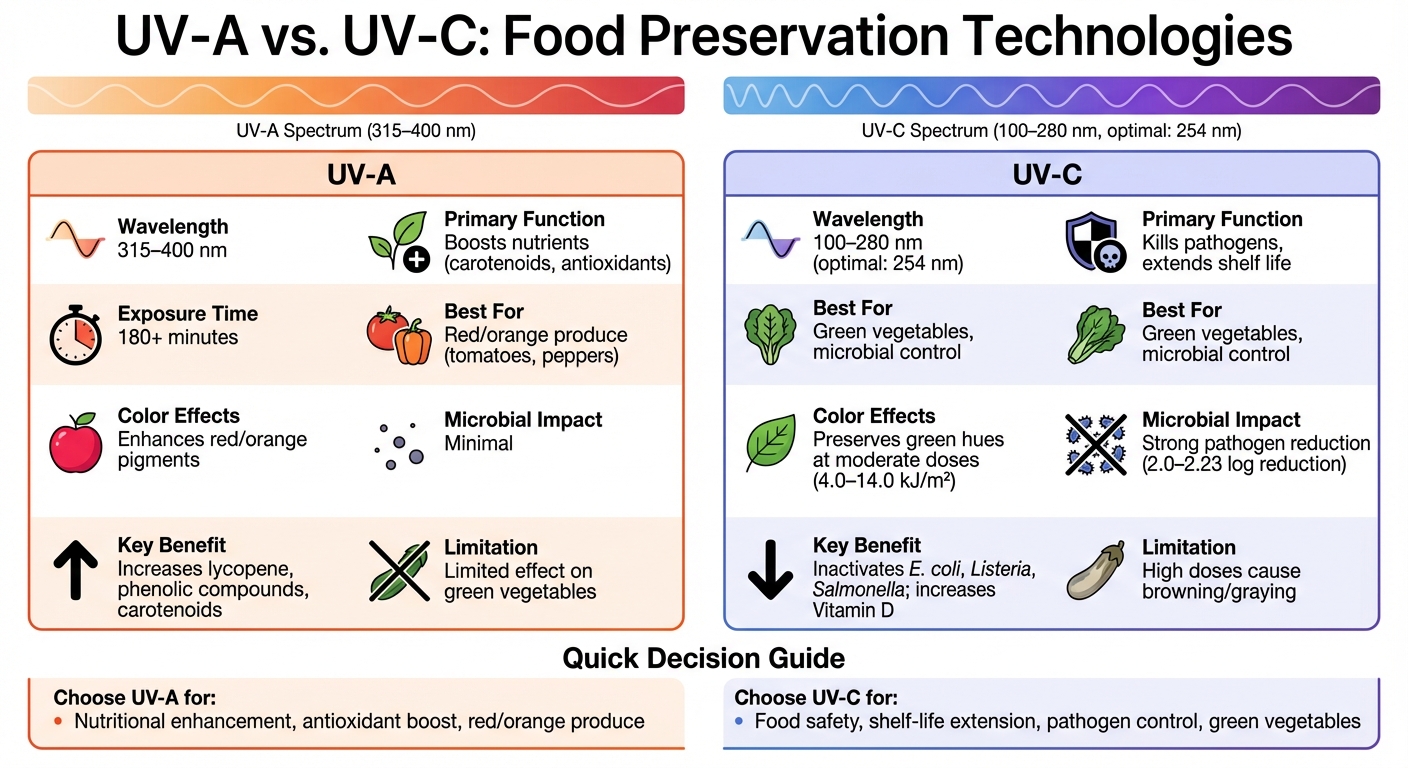
UV-A vs UV-C Light Comparison for Food Processing
Ultraviolet light could extend shelf life of food and reduce waste
sbb-itb-aa4586a
UV-A vs. UV-C: How They Differ
UV-A and UV-C light serve different purposes in food preservation, each offering unique benefits. UV-C (200–280 nm) is primarily used for its germicidal properties, disrupting microbial DNA to stop pathogens from reproducing. On the other hand, UV-A (315–400 nm) triggers physiological responses in plant tissues, encouraging the production of bioactive compounds like antioxidants and pigments. These differences allow food processors to choose the most appropriate technology for their specific needs.
How UV-A Light Works
UV-A light doesn’t sterilize food but instead stimulates the production of secondary metabolites. When plants are exposed to UV-A wavelengths near 365 nm, they increase the production of compounds such as lycopene and phenolic compounds, enhance photosynthetic pigments like carotenoids, and activate antioxidant pathways. For example, tomatoes irradiated at 365 nm for at least 180 minutes show higher levels of carotenoids and flavonoids. However, UV-A’s impact on delaying yellowing in green vegetables like broccoli is relatively limited [1]. This ability to boost bioactive compounds contributes to both nutritional improvements and extended shelf life.
How UV-C Light Works
UV-C light is a powerful tool for microbial decontamination in food processing. Operating most effectively at 254 nm, it damages microbial DNA by causing strand breaks and oxidative damage, effectively inactivating pathogens like E. coli, Listeria, and Salmonella [2]. For instance, UV-C treatment has been shown to reduce Listeria on pork tenderloin by an average of 2.23 log colony-forming units per 100 mL [2]. Beyond its antimicrobial effects, UV-C helps delay vegetable aging by slowing chlorophyll breakdown and inhibiting enzymes that degrade cell walls, preserving the firmness of produce like tomatoes and peppers [1]. Since 2000, the FDA and USDA have approved UV irradiation as a safe alternative to thermal pasteurization [2].
Common Uses in Food Processing
In food processing, UV-C is widely used to decontaminate fresh-cut produce, juices, and food-contact surfaces. For example, water-assisted UV-C (WUV) at a dose of 0.3 kJ m⁻² can reduce Listeria monocytogenes populations on baby spinach by about 2.0 ± 0.1 log₁₀ [1]. Meanwhile, UV-A is employed to enhance nutritional value by boosting antioxidant activity and pigments in produce like tomatoes and leafy greens. Both UV-A and UV-C can also increase vitamin D levels in certain foods [2]. It’s important to note that UV-C works only on surfaces directly exposed to the light, limiting its range of action [2]. These distinct capabilities make UV-A and UV-C valuable tools for improving both food safety and quality.
This content is for informational purposes only. Consult official regulations and qualified professionals before making sourcing or formulation decisions.
Effects on Nutritional Content
This section shifts focus to how UV-A and UV-C treatments influence the nutritional makeup of foods. Each type of UV light interacts with food differently, sparking unique biochemical reactions. By understanding these effects, food processors can choose the right method to improve nutritional value while ensuring safety.
UV-A Impact on Nutrients
UV-A light triggers a mild stress response in food, promoting the production of beneficial bioactive compounds without significantly depleting nutrients. For instance, when tomatoes are exposed to UV-A at 365 nm for at least 180 minutes, they show an increase in photosynthetic pigments like carotenoids, along with higher levels of lycopene and phenolic compounds[1]. Research on pigeon pea leaves also indicates that UV-A has a weaker effect on flavonoid and stilbene production compared to UV-B or UV-C wavelengths[1].
UV-C Impact on Nutrients
The effect of UV-C light on nutrients is more nuanced and depends on factors like dosage and food type. A study conducted by the University of Murcia in 2013 revealed that treating vine-ripe tomatoes with UV-C doses (1.0–12.2 kJ/m²) boosted lycopene by 14% and increased chlorogenic and ferulic acids. However, it also reduced β‑carotene, naringenin, and rutin levels[4]. This phenomenon, known as hormesis, shows that low doses can enhance beneficial compounds, while excessive exposure may degrade some nutrients. UV-C is also known for its ability to inactivate pathogens while enhancing certain vitamins. For example, it can increase Vitamin D₂ levels in bread, yeast, and mushrooms, as well as Vitamin D₃ in milk, all while preserving heat-sensitive vitamins like Vitamin A, Vitamin C, and thiamin[2][3].
"UV-C irradiation of tomatoes could improve the beneficial effect of red tomatoes for human health by increasing the levels of certain bioactive compounds; it could also be used to obtain higher content of bioavailability components, such as cis‐isomers from lycopene."
- Sergio Bravo, Department of Food Science and Nutrition, University of Murcia[4]
These findings highlight the diverse nutritional effects of UV-A and UV-C, paving the way for a detailed comparison.
Nutritional Effects Compared
UV-A and UV-C treatments lead to notably different outcomes in terms of nutrition. UV-A tends to enhance carotenoids and photosynthetic pigments in produce like tomatoes, offering a gentler method with minimal nutrient loss. On the other hand, UV-C provides robust antimicrobial benefits but comes with more variable nutritional effects. For example, UV-C can increase anthocyanin levels in berry nectars and help preserve chlorophyll in broccoli at doses between 4.0 and 14.0 kJ/m². However, prolonged exposure may reduce total phenolic compounds and antioxidant activity in liquid foods[1][5]. Additionally, the effects on specific compounds vary – lycopene levels often rise, while β‑carotene levels may drop after UV-C treatment[4].
For food processors, UV-A offers a milder approach to nutrient enhancement, while UV-C delivers stronger microbial control with a more complex impact on nutrients.
This content is for informational purposes only. Consult official regulations and qualified professionals before making sourcing or formulation decisions.
Effects on Sensory Properties
UV treatments don’t just alter nutritional content – they also impact how food looks, feels, and tastes. Both UV-A and UV-C light influence sensory qualities like color, texture, and flavor, but each type of treatment has its own unique effects.
UV-A Effects on Color, Texture, and Flavor
UV-A light is particularly effective at enhancing the natural colors of fruits. For instance, exposing tomatoes to UV-A light (365 nm for 180 minutes) increases lycopene and carotenoid levels, intensifying their red hues[1]. However, UV-A struggles to maintain the green color of vegetables like broccoli. Even at doses of 4.5 and 9.0 kJ/m², it fails to prevent yellowing in broccoli florets, limiting its usefulness for preserving the fresh appearance of leafy greens[1]. When it comes to texture, UV-A has little impact, and it generally preserves the natural flavor of foods. Its strength lies in enhancing pigments rather than providing comprehensive sensory benefits.
UV-C Effects on Color, Texture, and Flavor
UV-C light offers stronger preservation of sensory qualities but must be carefully dosed to avoid harmful effects. Moderate doses (4.0–14.0 kJ/m²) help retain the green color of vegetables like broccoli by slowing chlorophyll breakdown[1]. For white vegetables such as water bamboo, a dose of 4.24 kJ/m² helps maintain their bright appearance[1]. However, excessive exposure can have the opposite effect. For example, iceberg lettuce treated with 40.8 kJ/m² yellows within seven days, and high doses on broccoli increase phaeophytin levels, turning it gray[1]. UV-C also helps preserve texture by delaying softening in tomatoes and peppers (at 3.7 kJ/m²) and reducing lignin formation, which prevents hardening in asparagus and water bamboo[1]. As for flavor, UV-C has minimal impact, making it a good choice for preserving juices and nectars without altering their taste profiles[6].
| Sensory Quality | UV-A Impact | UV-C Impact |
|---|---|---|
| Color Retention | Boosts red/orange pigments like carotenoids; less effective for greens | Delays yellowing in greens at moderate doses; high doses can cause graying or browning |
| Texture | Minimal effect | Slows softening in tomatoes/peppers; prevents hardening in asparagus/bamboo |
| Flavor | Preserves natural taste | Maintains natural taste; ideal for juices and nectars |
The decision to use UV-A or UV-C depends on the food and the desired results. UV-A is ideal for enriching the colors of red and orange produce, while UV-C provides broader benefits, especially for green vegetables and fruits, as long as dosage levels are carefully managed to avoid negative effects.
This content is for informational purposes only. Consult official regulations and qualified professionals before making sourcing or formulation decisions.
Conclusion
UV-C is highly effective for disinfecting produce and preserving the green color of vegetables when applied in moderate doses. On the other hand, UV-A enhances nutritional compounds like lycopene and phenolics but requires longer exposure and provides limited microbial protection. UV-C (100–280 nm) stands out for its ability to disrupt pathogen DNA and slow the yellowing process in green vegetables. Meanwhile, UV-A (315–400 nm) focuses on boosting bioactive compounds, particularly in red and orange produce.
Choosing Between UV-A and UV-C
Deciding between UV-A and UV-C depends on your specific processing objectives. If the goal is pathogen reduction and extending shelf life, UV-C is the preferred choice. It works well for maintaining the green color of vegetables like broccoli and cucumbers and for delaying the softening of tomatoes and peppers. However, for enhancing nutritional content and increasing antioxidants in red and orange produce, UV-A at 365 nm is a strong option. Careful dosing is essential, as excessive UV-C exposure can lead to browning and speed up aging in leafy greens. Understanding these distinctions helps optimize current processing methods and opens doors for new UV applications in food.
What’s Next for UV Technology in Food
Emerging UV technologies are focusing on improving both nutritional and sensory outcomes. UV-LED technology is gaining traction as it eliminates the need for mercury lamps and allows precise wavelength targeting for specific goals, whether nutritional or microbial. Researchers are also investigating Far-UVC at 222 nm, which has shown promise in achieving a 2.8 to 3.0 log reduction of E. coli and Salmonella on alfalfa seeds without harming the seeds themselves [7]. Combining UV with other treatments, such as cold plasma, ozone, or infrared radiation, is another exciting development. For instance, pairing UV-C with cold plasma at 10 kV achieved a 3.4 log bacterial reduction on black peppercorns, showcasing the potential for synergistic effects [7]. As advancements continue, manufacturers can look forward to wavelength-specific protocols tailored to different plant species and maturity levels, ensuring optimal nutritional quality, sensory appeal, and food safety.
This content is for informational purposes only. Consult official regulations and qualified professionals before making sourcing or formulation decisions.
FAQs
How do I choose UV-A vs. UV-C for my specific food product?
When deciding between UV-A and UV-C, your choice should align with your goals for food preservation and quality. UV-C is highly effective at reducing microbes, ensuring food safety, and keeping nutritional losses minimal, making it an excellent option for products like liquids and sauces. On the other hand, UV-A has weaker germicidal properties but may improve certain nutrients and enhance sensory attributes. The best option depends on the type of food, the desired shelf life, and how you want the sensory qualities to be affected.
What UV dose is “too much” and can it reduce nutrients or cause discoloration?
When using UV treatment on food, a dose becomes "too much" if it starts to break down nutrients or alters the food’s appearance, such as causing discoloration. These effects usually occur at higher UV doses, but the exact limits vary depending on the specific food and the conditions of the treatment. To prevent nutrient loss and visible changes, it’s crucial to carefully adjust and control the UV exposure.
How can UV-C treat foods evenly if it only works on exposed surfaces?
UV-C achieves thorough treatment by utilizing systems that expose all food surfaces. Approaches such as dynamic or multi-directional irradiation are employed to provide consistent coverage, overcoming the surface-level limitations of UV-C. These techniques ensure every part of the food is treated, enhancing its effectiveness despite inherent constraints.




Comments are closed