
Titanium-based PVD coatings, like Titanium Nitride (TiN) and Titanium Aluminum Nitride (TiAlN), are widely used to improve the wear resistance of industrial tools and components. These coatings are applied through Physical Vapor Deposition (PVD), a process that creates durable, nanocrystalline layers. TiN reduces surface friction, while TiAlN offers higher hardness (44.8 GPa) and greater resistance to plastic deformation due to solid solution strengthening. Both coatings extend the lifespan of tools in industries such as manufacturing, aerospace, and electronics.
Key Takeaways:
- TiN: Reduces friction, ideal for moderate wear conditions.
- TiAlN: Higher hardness and better for high-stress environments.
- Applications: Cutting tools, aerospace components, and electronics.
Quick Comparison:
| Feature | TiN Coating | TiAlN Coating |
|---|---|---|
| Type | Binary Nitride | Ternary Nitride |
| Hardness | Lower than TiAlN | 44.8 GPa |
| Elastic Modulus | Lower than TiAlN | 438.6 GPa |
| Wear Resistance | Moderate | High |
| Primary Use | Friction reduction | High-load applications |
Both coatings enhance durability, but choosing the right one depends on the specific application and performance requirements.
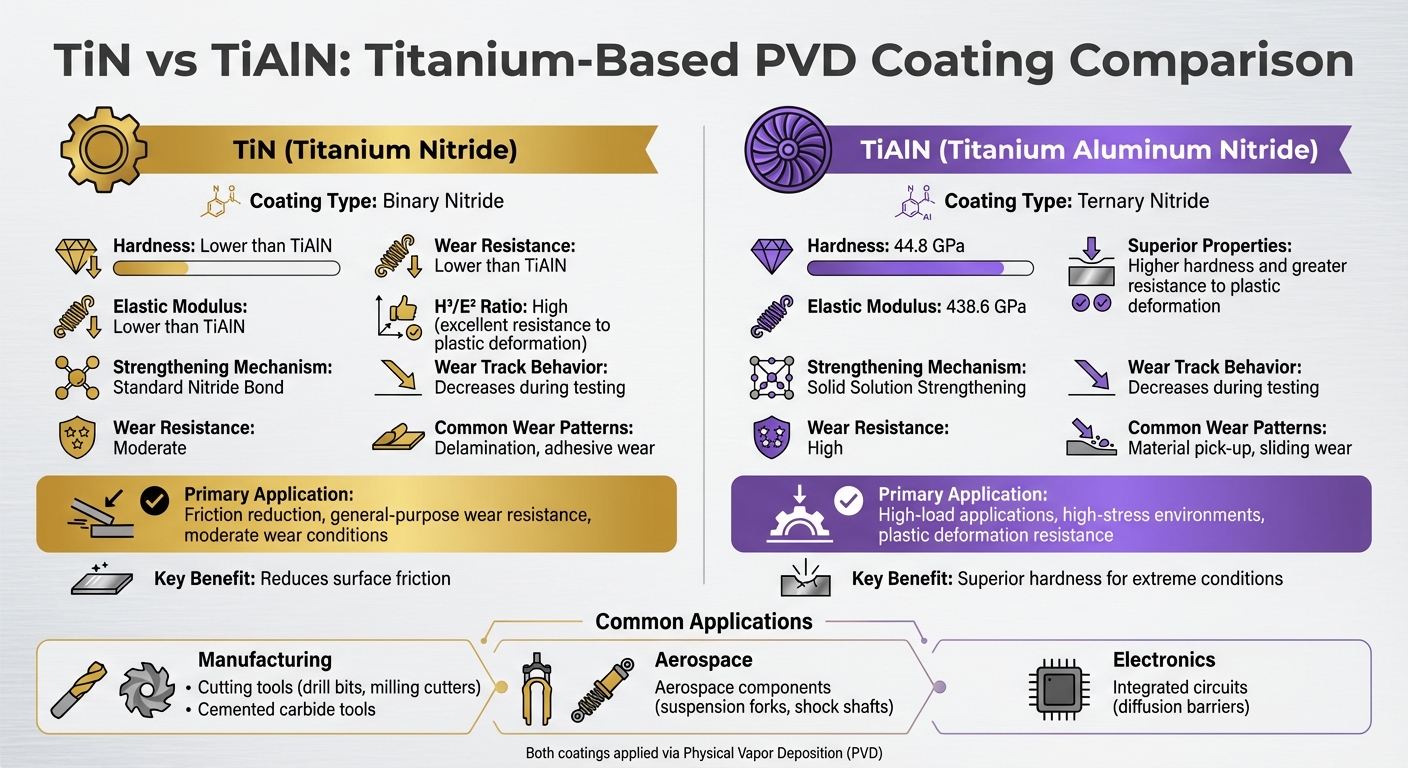
TiN vs TiAlN Coating Properties Comparison Chart
Wear Resistance of TiN Coatings
Research Findings on TiN Coating Performance
Titanium Nitride (TiN) coatings significantly reduce friction and create smoother wear tracks compared to uncoated high-speed steel. This performance stems from TiN’s high H³/E² ratio, which reflects its excellent resistance to plastic deformation. Research highlights a clear link between higher H³/E² values and reduced wear. Additionally, TiN coatings produced using hollow cathodic-assisted multiarc ion plating exhibit a nanocrystalline structure, further enhancing their mechanical strength. While binary TiN provides a reliable foundation, ternary alternatives like Titanium Aluminum Nitride (TiAlN) and Titanium Silicon Nitride (TiSiN) offer even better wear resistance due to advanced strengthening mechanisms [1]. These findings emphasize the critical role of deposition conditions, which are explored in the next section.
How Deposition Parameters Affect TiN Coatings
Deposition parameters play a pivotal role in refining the properties of TiN coatings. For instance, deposition temperature directly impacts the coating’s microstructure and mechanical characteristics. Higher temperatures typically result in denser crystal structures, which improve both hardness and adhesion to the substrate. Similarly, the atmosphere and pressure settings during processes like reactive magnetron sputtering and multiarc ion plating significantly affect the coatings’ wear resistance and structural integrity. Achieving optimal performance involves focusing on maximizing the H³/E² ratio rather than solely increasing hardness. Fine-tuning these parameters is essential for meeting the demanding wear resistance requirements in industrial applications [1].
sbb-itb-aa4586a
Wear Resistance of TiAlN Coatings
TiAlN Coating Performance in Friction Testing
TiAlN coatings show superior performance in friction tests compared to uncoated and bare nitrided tools, especially when working with high-strength steel. A study conducted in March 2022 by the National Institute of Technology Silchar evaluated monolayer TiAlN and composite AlCrN/TiAlN coatings applied via PVD (Physical Vapor Deposition) on plasma-nitrided DAC-10 tool steel. Testing with SAPH370 steel balls demonstrated that AlCrN/TiAlN composite coatings outperformed monolayer TiAlN in both nanoindentation and tribological tests. This advantage is attributed to the composite’s higher hardness and strain hardening exponent, which result in better nanomechanical properties and a lower wear rate under dry sliding conditions [3].
The composite coating’s high hardness (44.8 GPa) and elastic modulus (438.6 GPa) provide strong resistance to plastic deformation [1]. Interestingly, TiAlN coatings reduce surface roughness at wear tracks during friction testing, while uncoated high-speed steel substrates exhibit increased roughness over time [1]. This smoothing effect contributes to lower friction coefficients and enhanced wear resistance, making TiAlN coatings a reliable choice for demanding applications.
How TiAlN Coatings Wear Down
The wear mechanisms of TiAlN coatings evolve in distinct stages during use. Initially, the coating develops specific sticking and sliding zones at the interface between the tool and the workpiece [2]. Over time, common failure patterns emerge, including coating peeling, crater wear on the rake face, and edge wear at the tool tip [2].
Severe adhesion of SAPH370 steel, combined with heavy oxidation, is identified as the primary cause of wear. Galling, where the workpiece bonds more strongly to the coating than the coating does to its substrate, plays a significant role [3]. A July 2020 study led by Anhai Li at Shandong University examined TiAlN PVD-coated cemented carbide tools during high-speed turning. The findings revealed that the final failure patterns – coating peeling, crater wear, and edge breakage – stem from a mix of adhesion and diffusion [2]. These wear characteristics directly impact the coating’s performance in industries like manufacturing, aerospace, and electronics, where durability under extreme conditions is a top priority.
This content is for informational purposes only. Consult official regulations and qualified professionals before making sourcing or formulation decisions.
TiAlN: The titanium-aluminium-nitride coating
TiN vs. TiAlN Coating Comparison
Recent studies [1] show that the structural makeup of these coatings – TiN as a binary nitride and TiAlN as a ternary nitride – plays a key role in their performance. TiN consists of titanium and nitrogen, while TiAlN adds aluminum to the mix. This addition introduces solid solution strengthening, making TiAlN more resistant to plastic deformation. These differences form the foundation for a detailed look at their performance.
Mechanical testing indicates that TiAlN, with a hardness of 44.8 GPa and an elastic modulus of 438.6 GPa, is better suited for high-load applications. Both coatings reduce friction compared to uncoated steel, but TiAlN’s aluminum content gives it an edge in handling high-stress conditions [1].
Friction tests provide further insight. Both coatings smooth wear tracks during use, but TiN tends to show delamination and adhesive wear, while TiAlN primarily exhibits sliding wear and material transfer [1]. These findings align with earlier observations of wear resistance.
Performance Comparison Table
Here’s a side-by-side look at the key performance metrics for TiN and TiAlN coatings:
| Property | TiN Coating | TiAlN Coating |
|---|---|---|
| Coating Type | Binary Nitride | Ternary Nitride |
| Hardness | Lower than TiAlN | 44.8 GPa [1] |
| Elastic Modulus | Lower than TiAlN | 438.6 GPa [1] |
| Strengthening Mechanism | Standard Nitride Bond | Solid Solution Strengthening [1] |
| Wear Track Behavior | Decreases during testing | Decreases during testing |
| Common Wear Patterns | Delamination, adhesive wear | Material pick-up, sliding wear |
| Primary Application | General-purpose wear resistance | High-load plastic deformation resistance |
TiN is a practical choice for moderate wear conditions, while TiAlN excels in high-stress environments. Both coatings are applied using hollow cathodic-assisted multiarc ion plating on high-speed steel [1]. These distinctions make them suitable for industries like manufacturing, electronics, and aerospace.
This information is intended for general guidance. Always consult experts and official standards for sourcing or formulation decisions.
Where Titanium-Based PVD Coatings Are Used
Titanium-based coatings are prized for their exceptional wear resistance, making them indispensable in industries like manufacturing, electronics, and aerospace. These coatings enhance the durability of tools and components, especially under conditions involving extreme stress, heat, and friction.
Manufacturing Applications
TiAlN coatings are widely applied to cemented carbide cutting tools used in high-speed turning, milling, and face milling. These coatings create a robust barrier between the tool and the workpiece, which is particularly beneficial when working with challenging materials such as Ti-17, Ti6Al4V, and AerMet100 steel – key materials in aerospace manufacturing [2].
"The wear mechanisms of a TiAlN PVD-coated carbide cutting tool in turning Ti-17 titanium alloy were dominated by the interaction wear effect among the adhesion, oxidation and diffusion between cemented carbide substrate and workpiece material." – Baolin Wang, Anhai Li, and Gaihua Liu, Journal of Mechanical Science and Technology [2]
These coatings reduce cutting forces, control temperatures, and improve surface finishes, significantly extending the lifespan of tools. For instance, TiN coatings on drill bits and milling cutters can boost tool longevity by three times or more [4]. They also resist wear typically associated with high-speed machining [2]. Beyond titanium alloys, these coatings are used for machining materials like AISI 4140 steel and compacted graphite cast iron, enhancing tool durability [2].
Electronics and Aerospace Applications
In high-tech environments, titanium-based coatings serve critical functions. In aerospace, TiN coatings (with a Vickers hardness of 1,800–2,100) are applied to components like suspension forks and shock shafts [4]. These coatings remain stable at elevated temperatures, oxidizing only at 1,472°F (800°C) in normal atmospheric conditions – an essential feature for parts exposed to intense heat [4]. Advanced variants like TiAlSiN provide oxidation resistance between 400°C and 600°C, making them suitable for roughing operations that generate substantial heat [5].
In aerospace electronics, thin TiN films act as diffusion barriers, preventing metal migration into silicon and ensuring the reliability of integrated circuits. With an electrical resistivity of approximately 39 μΩ·cm, TiN serves as an effective barrier metal in microelectronics [4]. This capability is particularly valuable in 45 nm transistor technology, where TiN enables gate length scaling while minimizing leakage and enhancing drive current [4].
This content is for informational purposes only. Consult official regulations and qualified professionals before making sourcing or formulation decisions.
Conclusion
Studies show that TiAlN coatings excel over binary TiN coatings in applications requiring exceptional hardness and resistance to plastic deformation. With a hardness of 44.8 GPa and an elastic modulus of 438.6 GPa, TiAlN achieves these impressive mechanical properties through solid solution strengthening [1]. This makes it particularly suited for high-stress environments such as high-speed machining and heavy-duty forming operations.
On the other hand, TiN coatings are ideal when friction reduction is the priority rather than maximizing hardness. Both coatings significantly reduce surface friction compared to uncoated high-speed steel and improve surface finish during wear. In contrast, uncoated steel tends to become rougher over time [1].
A key factor in mechanical performance is the H³/E*² ratio, which is a critical measure of resistance to plastic deformation. Research highlights a strong correlation between wear volume and this ratio [1]. Engineers must carefully consider this parameter alongside operational factors like temperature, load, and material interactions to ensure the coating choice aligns with the application’s demands.
Ultimately, the choice between TiN and TiAlN coatings depends on the specific requirements of your application. TiAlN offers superior hardness and deformation resistance for extreme conditions, while TiN provides dependable friction reduction for less rigorous environments. Understanding these differences helps maximize tool life and improve component performance across industries like manufacturing, aerospace, and electronics.
This content is for informational purposes only. Always consult official regulations and qualified professionals before making sourcing or formulation decisions.
FAQs
How do I choose between TiN and TiAlN for my tool?
When deciding between TiN (Titanium Nitride) and TiAlN (Titanium Aluminum Nitride) coatings, it’s all about matching the coating to your tool’s specific job and performance requirements.
TiN is a solid choice for general-purpose cutting and machining. It reduces friction, which helps extend the lifespan of tools, making it a practical option for less demanding tasks or when budget considerations are a priority.
On the other hand, TiAlN steps up the game with added aluminum, which enhances hardness, wear resistance, and thermal stability. This makes it the go-to option for high-speed or high-temperature applications. If your tools face aggressive conditions, TiAlN is better suited to handle the challenge.
What does the H³/E*² ratio mean for wear resistance?
The H³/E*² ratio is a measure that connects hardness (H³) with the elastic modulus (E_²). This ratio serves as an important marker for wear resistance. In titanium-based PVD coatings, such as TiN and TiAlN, a higher **H³/E_² ratio** typically indicates improved wear performance.
Which PVD settings most affect TiN coating performance?
Key factors in Physical Vapor Deposition (PVD) that affect Titanium Nitride (TiN) coating performance include temperature, DC bias voltage, nitrogen flow rate, and DC power. These parameters play a crucial role in determining the coating’s hardness, adhesion, and wear resistance – traits essential for its durability and tribological performance.



Comments are closed