
Atomic Layer Deposition (ALD) is a process used to create ultra-thin, precise films for electronics, particularly in the semiconductor industry. It relies on chemical precursors to deposit layers atom by atom. These precursors must meet three key criteria: volatility (to ensure efficient transport), thermal stability (to prevent decomposition), and reactivity (to ensure uniform film growth). ALD is especially valued for its ability to create uniform coatings on 3D structures, outperforming methods like Chemical Vapor Deposition (CVD) and Physical Vapor Deposition (PVD) in conformality and precision.
Key ALD precursors for semiconductor applications include metal halides (e.g., TiCl₄ for titanium nitride films) and metal organics (e.g., Cu(I) amidinates for copper interconnects). Each type has specific benefits and trade-offs, such as thermal stability or potential contamination risks. The choice of precursor impacts film quality, purity, and electrical performance, making selection and handling critical for manufacturing success.
Proper handling, storage, and delivery systems are essential to maintain precursor integrity, ensure safety, and comply with regulations. This includes using inert atmospheres, temperature-controlled systems, and advanced delivery methods like direct liquid injection for low-volatility materials. Reliable sourcing and detailed quality control are also vital to avoid disruptions in semiconductor production.
Core Properties of ALD Precursors
Key Precursor Requirements
For atomic layer deposition (ALD) to work effectively, precursors must exhibit a combination of specific properties: volatility, thermal stability, and self-limiting reactivity. If any of these is lacking, the deposition process becomes unreliable and inconsistent.
"The atomic layer deposition (ALD) process requires precursors with high volatility and high thermal stability to allow their transport in the gas phase, but also high reactivity with the substrate." – Stéphane Daniele, University Professor, Université Lyon 1 [2]
Volatility is crucial because it ensures the precursor can travel efficiently from its source to the heated substrate. Chemists often tweak molecular structures – such as incorporating fluorine atoms or using asymmetric ligands – to enhance volatility. Thermal stability is equally vital. If a precursor decomposes prematurely, it leads to uncontrolled chemical vapor deposition (CVD)-like growth, which compromises layer uniformity [1][2].
The self-limiting nature of precursor reactivity is what sets ALD apart. Once the surface sites are saturated, the reaction naturally stops, ensuring precise control over layer thickness. Ligand steric hindrance plays a role here, as it limits how many precursor molecules can attach during each cycle, directly influencing the growth per cycle (GPC) [2].
These core properties are not just theoretical – they directly impact the quality and performance of the resulting thin films.
How Precursor Properties Affect Film Performance
The performance of a deposited film is tightly linked to the properties of the precursor. The table below highlights the relationship between precursor characteristics and film quality:
| Precursor Property | Impact on Film |
|---|---|
| Volatility | Ensures uniform thickness and controlled growth rate |
| Thermal Stability | Prevents carbon contamination and maintains film purity |
| Self-Limiting Reactivity | Enables conformal coverage in high-aspect-ratio 3D structures |
| Ligand Steric Hindrance | Controls growth per cycle (GPC) and influences film density |
For example, in metallic copper films, copper(I) amidinates are prized for their excellent volatility and thermal stability. These properties allow for clean ligand removal and result in high-purity copper deposition [1].
Conformality, which refers to the ability to coat even the walls of deep, narrow structures uniformly, is heavily dependent on precursor reactivity. A reactive precursor ensures surface sites are saturated quickly, allowing unreacted molecules to diffuse further into complex geometries before the purge step. This makes the choice of precursor critical – not just for chemical compatibility, but for ensuring the film meets the stringent performance demands of semiconductor devices [1].
sbb-itb-aa4586a
ALD Precursor Design for Hard to Deposit Metals with Chuck Winter – ALD Stories Ep. 6
Common Precursor Types for Metallic Thin Films
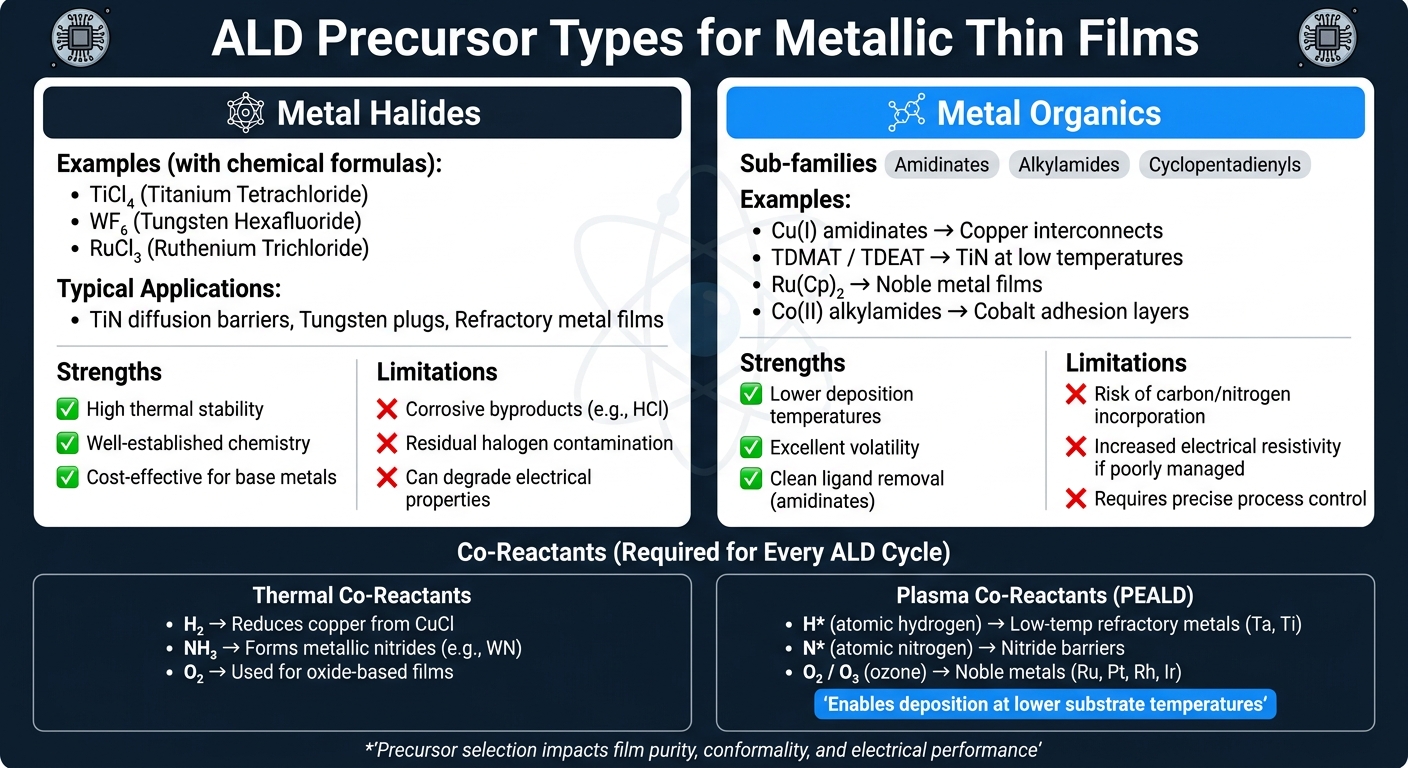
ALD Precursor Types: Metal Halides vs. Metal Organics Compared
ALD (Atomic Layer Deposition) precursors are available for nearly all non-radioactive elements [1], but only specific families are commonly used for metallic thin film production. Each group has unique chemical properties and trade-offs.
Metal Halide Precursors
Metal halides consist of a metal atom bonded to halogen atoms, typically chlorine or fluorine. Examples include titanium tetrachloride (TiCl₄), tungsten hexafluoride (WF₆), and ruthenium trichloride (RuCl₃). These precursors are known for their thermal stability, making them ideal for depositing refractory metals and nitride barrier films. For instance, TiCl₄ is widely employed to create titanium nitride (TiN) diffusion barriers in semiconductor applications.
However, these compounds produce corrosive byproducts like hydrogen chloride, which can damage equipment and substrates. Additionally, residual halogen contamination can negatively affect the electrical properties of the film. To counter this, aggressive co-reactants such as H₂ or disilane (Si₂H₆) are used to ensure complete removal of halogen ligands [1].
Metal Organic Precursors
Metal organic precursors were developed to address the limitations of halides. This family includes subcategories like amidinates, alkylamides, and cyclopentadienyls.
"Combining all these physical and chemical properties in one derivative requires precise molecular engineering in terms of 3D structure and strength of both intra-molecular chemical bonds and inter-molecular interactions." – Stéphane Daniele, University Professor, IRCELYON [2]
Cu(I) amidinates are highly volatile and decompose cleanly, making them ideal for depositing pure copper interconnects. Similarly, Co(II) alkylamides are used for cobalt adhesion layers. Alkylamides such as TDMAT (tetrakis(dimethylamido)titanium) and TDEAT (tetrakis(diethylamido)titanium) are paired with NH₃ or plasma radicals to deposit TiN films at lower temperatures compared to halide-based methods [1]. However, these organic precursors carry the risk of incorporating carbon or nitrogen into the film, which can increase electrical resistivity if process conditions aren’t carefully managed [2].
| Family | Examples | Typical Applications |
|---|---|---|
| Metal Halides | TiCl₄, WF₆, RuCl₃ | TiN barriers, tungsten plugs |
| Amidinates | Cu(I) amidinates, Co(II) amidinates | Copper interconnects, cobalt adhesion layers |
| Alkylamides | TDMAT, TDEAT | TiN diffusion barriers |
| Cyclopentadienyls | Ru(Cp)₂, Pt(MeCp)Me₃ | Ruthenium and platinum noble metal films |
The success of ALD also depends on selecting the right co-reactant to complete the thin film deposition process.
Plasma and Thermal Co-Reactants
Each ALD cycle requires a co-reactant – a secondary reagent that reacts with the adsorbed precursor to remove ligands and form the final metallic film. The choice of co-reactant is as critical as the precursor itself [1].
Thermal co-reactants like H₂, NH₃, and O₂ rely on heat to drive the reaction. For example, H₂ is commonly used to reduce copper from CuCl, while NH₃ is essential for forming metallic nitrides like tungsten nitride (WN).
On the other hand, plasma-enhanced ALD (PEALD) uses high-energy radicals – such as atomic hydrogen (H*), nitrogen (N*), or oxygen (O*) – generated by a plasma source. These radicals provide enough energy to remove ligands at much lower substrate temperatures, which is vital for temperature-sensitive layers. PEALD is particularly effective for depositing refractory metals like tantalum (Ta) and titanium (Ti) used in interconnect diffusion barriers. For noble metals such as ruthenium, platinum, rhodium, and iridium, oxidants like O₂ or ozone (O₃) are employed to cleanly combust organic ligands from the surface [1].
How to Select the Right Precursor for Manufacturing
Key Selection Criteria
Choosing the right ALD (Atomic Layer Deposition) precursors involves evaluating their reaction window, volatility, and ligand chemistry. Start by considering the ALD window, which is the temperature range where the precursor reacts completely in a self-limiting manner. Staying within this range prevents issues like condensation or thermal decomposition.
Volatility is another critical factor, as it ensures the precursor remains in the gas phase during deposition. For solid precursors, heated delivery lines are necessary to avoid condensation. The ligands attached to the precursor also play a major role – select ligands with predictable elimination pathways to minimize unwanted residues like carbon, oxygen, or fluorine. These residues can increase electrical resistivity and compromise the purity of the thin film.
"The selection of optimal metal precursors represents one of the most crucial aspects of ALD conductor development." – PatSnap Eureka [3]
These factors provide a foundation for matching precursors to specific manufacturing needs.
Application-Specific Considerations
The choice of precursor varies widely depending on the intended application. Below is a breakdown of common uses and their corresponding precursor requirements:
| Application | Precursor Examples | Key Requirement |
|---|---|---|
| Copper seed layers | Copper(II) 2,4-pentanedionate, vinyltrimethylsilane complexes | High purity, low carbon contamination [3] |
| Barrier metals (TiN, TaN) | TiCl₄, tantalum ethoxide, tantalum pentafluoride | Thermal stability, halide-free film [3][4] |
| Cobalt adhesion layers | Cobalt carbonyl, cyclopentadienylcobalt dicarbonyl | Compatibility with advanced logic processes [3][4] |
| Gate stack electrodes | Ruthenocene, platinum/palladium compounds | Oxidation resistance, low resistivity [3][4] |
For applications like 3D NAND and through-silicon vias (TSVs), where aspect ratios can exceed 20:1, conformality becomes the top priority. Precursors with smaller molecular sizes and high surface reactivity are ideal for these scenarios. Meanwhile, flexible electronics and IoT devices require low-temperature processing, often achieved with organometallic precursors combined with plasma-enhanced ALD.
Cost is another factor to weigh. Noble metal precursors, such as those for platinum, ruthenium, and palladium, tend to be more expensive than base metals like copper or nickel. However, their superior conductivity and oxidation resistance can simplify downstream processing, potentially reducing the total cost of ownership over time. Balancing cost with performance is key to achieving optimal results.
Why Reliable Sourcing Matters
Beyond chemical performance, the reliability of precursor supply is essential for consistent manufacturing. Contaminants or particle impurities can ruin entire wafer batches, making purity and quality control non-negotiable. Efficient delivery systems are also important – aim to use at least 90% of the precursor in each ampoule to minimize waste and control costs [5].
Regulatory compliance is another critical consideration. In the United States, precursors must adhere to TSCA (Toxic Substances Control Act) standards. Additionally, manufacturers are increasingly reviewing formulations for PFAS (per- and polyfluoroalkyl substances) due to growing regulatory scrutiny [3]. Partnering with suppliers who provide detailed safety data sheets (SDS) and Certificates of Analysis (CoA) ensures compliance and quality.
For example, Allan Chemical Corporation offers electronics-grade chemicals with just-in-time delivery, flexible batch options, and comprehensive technical documentation like CoAs and SDS. Working with a reliable supplier helps manufacturers maintain consistent production while reducing risks associated with single-source dependency.
Disclaimer: This content is for informational purposes only. Consult official regulations and qualified professionals before making sourcing or formulation decisions.
Safe Handling and Delivery of ALD Precursors
Storage and Handling Best Practices
Many ALD (Atomic Layer Deposition) precursors come with significant risks – they can be pyrophoric, toxic, or highly sensitive to moisture. Improper storage doesn’t just pose safety hazards; it can also compromise the quality of the precursors. This can lead to uncontrolled chemical vapor deposition (CVD), potentially ruining production runs. Maintaining precise storage and delivery conditions is critical for meeting the stringent quality standards required in ALD processes.
The golden rule? Always keep precursors in an inert atmosphere, such as nitrogen or argon, to prevent unwanted reactions. Temperature and humidity must be carefully regulated, and storage containers should be tailored to the specific hazards of each precursor. For instance, chloride impurities are particularly harmful in semiconductor manufacturing because they form corrosive films that degrade electrical performance [6]. Ensuring the purity of precursors and maintaining proper storage conditions go hand in hand.
"Purity is non-negotiable, as contaminants directly compromise the quality and performance of the final thin film." – Kintek Solution [6]
Proper storage is just the first step; the delivery system must also be designed to protect the integrity of the precursor.
Delivery System Design
The journey of a precursor from its storage container to the deposition chamber is just as important as the precursor’s composition. The delivery method should match the physical state of the precursor – whether it’s a gas, liquid, or solid at room temperature.
- Volatile liquids: Use bubblers with an inert gas like nitrogen or argon to transport vapor efficiently into the chamber.
- Low-volatility or thermally sensitive liquids: Direct liquid injection (DLI) offers precise control over dosing and is ideal for these precursors.
- Solid precursors: Solid source sublimation is necessary, requiring the precursor to be heated into a vapor. Heated downstream lines prevent condensation during transport.
To avoid corrosion and contamination, internal surfaces of ampoules, valves, and gas lines should be treated with protective coatings like metal oxides, nitrides, or fluorides [5]. These coatings act as diffusion barriers, extending the lifespan of components exposed to reactive chemicals.
"The combination of reactive chemicals and elevated temperatures creates a corrosive environment that will degrade any metal components exposed to the precursor." – Entegris [5]
For large-scale operations, dual-ampoule cabinet systems are a game-changer. These systems allow automatic switching between ampoules when one is depleted, ensuring uninterrupted deposition. To minimize waste, the system should utilize at least 90% of the precursor in each ampoule before switching, which helps lower costs and reduce material waste [5].
Worker Safety and Waste Management
Safety and waste management protocols are just as critical as storage and delivery systems in maintaining a safe and efficient operation.
In the U.S., facilities handling ALD precursors must comply with OSHA 29 CFR 1910.1200, EPA TSCA, and DOT 49 CFR regulations for transport and labeling [7]. These regulations are mandatory, with violations carrying not only financial penalties but also serious safety risks.
Engineering controls are the first line of defense. Fume hoods, local exhaust ventilation, and closed handling systems help minimize worker exposure. Advanced facilities also rely on real-time leak detection, automated pressure monitoring, and emergency shutdown interlocks to enhance safety. Workers should use chemical-resistant gloves, appropriate respiratory gear, and eye protection suited to the specific hazards of each precursor [7].
Disposal of reactive and toxic precursors requires careful attention. Before disposal, reactive materials must be neutralized, and toxic substances need specialized containment. Scrubbers and thermal oxidizers are commonly used to treat process exhaust, with advanced systems capable of reducing harmful emissions by up to 99% [7]. For continuous production, closed-loop recovery systems can reclaim 15–25% of unreacted precursors, reducing both waste and raw material costs [7].
Disclaimer: This content is for informational purposes only. Consult official regulations and qualified professionals before making sourcing or formulation decisions.
Conclusion
Choosing the right ALD precursor is a balancing act between performance, safety, and dependable sourcing. Even a precursor with excellent specifications can disrupt the process if it introduces impurities, degrades during transport, or comes from a supplier with inconsistent quality controls. This delicate balance impacts every step of ALD processing, from reaction kinetics to the properties of the final film.
When it comes to performance, the challenge lies in finding the sweet spot between reactivity and stability. As Gelest explains:
"Precursor selection is key in ALD processes, namely finding molecules which will have enough reactivity to produce the desired films, but are stable enough to be handled and safely delivered to the reaction chamber." [4]
The volatility and stability of the precursor directly influence the quality and attributes of the film, making these factors essential considerations.
Safety and regulatory challenges also play a significant role in handling ALD precursors. In the U.S., manufacturers must comply with TSCA inventory requirements while managing the operational complexities of working with pyrophoric and moisture-sensitive materials. Meeting these demands requires robust delivery systems, specialized training for personnel, and effective waste management protocols.
Finally, sourcing reliability is non-negotiable. Interruptions in the supply chain can bring semiconductor production to a standstill, making supplier diversity and consistent material quality critical [3]. Trusted suppliers are indispensable for regulated industries where variability is not an option. Allan Chemical Corporation (allanchems.com) brings over 40 years of expertise in delivering specialty chemicals to electronics and other high-stakes sectors. Their just-in-time delivery model and strong manufacturer relationships ensure reliable, compliance-focused solutions for demanding applications.
Disclaimer: This content is for informational purposes only. Consult official regulations and qualified professionals before making sourcing or formulation decisions.
FAQs
How do I pick the best ALD precursor for my metal film?
To choose the right ALD precursor for your metal film, focus on volatility – aim for a vapor pressure of at least 0.1 Torr – and thermal stability to ensure it doesn’t break down during the process. The precursor must react effectively with the substrate, generate volatile and non-corrosive byproducts, and minimize contamination risks. For consistent results, it should either vaporize easily, exist as a liquid at room temperature, or dissolve in an inert solvent with comparable vapor pressure.
What causes contamination in ALD metal films, and how do I prevent it?
Contamination in ALD (Atomic Layer Deposition) metal films can arise from impurities in chemical precursors, leftover reactants, byproducts, or incomplete reactions. These issues can negatively impact the purity and performance of the final film.
To address this, it’s crucial to use high-purity precursors that offer the right balance of volatility and thermal stability. Proper storage conditions are also essential to preserve precursor quality. Additionally, optimizing process parameters – such as deposition temperature and purge times – can significantly reduce contamination risks. Using precursors specifically designed to limit residuals and byproducts further ensures the integrity of the film.
Which precursor delivery method should I use (bubbler, DLI, or solid source)?
The way you deliver a precursor depends on its physical form. For gases, direct gas flow is the method to go with. For solids, sublimation is necessary to ensure they vaporize evenly. When working with liquids, volatile precursors are best handled using a bubbler, while highly volatile and stable liquids are better suited for direct liquid injection (DLI). Selecting the right delivery method ensures both efficiency and stability, tailored to the specific properties of your precursor.


Comments are closed