
Facilities handling hazardous chemicals must comply with OSHA and EPA regulations to manage spill risks effectively. OSHA focuses on worker safety through standards like Process Safety Management (PSM) and Hazard Communication Standards (HCS). The EPA prioritizes public and environmental safety via programs like the Risk Management Program (RMP) and Spill Prevention, Control, and Countermeasure (SPCC) rules. Together, these frameworks aim to prevent accidents, protect communities, and avoid costly penalties.
Key points include:
- OSHA PSM Standards: Apply to facilities with hazardous chemicals exceeding specific thresholds (e.g., 10,000 lbs for flammable gases; 100 lbs for phosgene). Requires Process Hazard Analyses, compliance audits, and incident investigations.
- EPA RMP Requirements: Focus on offsite release prevention. Facilities must submit Risk Management Plans, conduct hazard analyses, and implement prevention programs.
- 2026 Updates: The EPA proposed changes to RMP rules, including reduced requirements for Safer Technology and Alternatives Analysis (STAA), potential elimination of third-party audits, and streamlined public access to hazard data.
- Documentation Deadlines: RMPs must be updated every five years or sooner for specific changes. OSHA requires updated Safety Data Sheets (SDS) within three months of new hazard information.
- Upcoming Compliance Deadlines: Key dates include May 19, 2026, for updated HCS labeling of substances, and July 1, 2027, for reporting new PFAS compounds like PFHxS-Na under the EPA’s Toxics Release Inventory (TRI).
Staying informed about regulatory changes and maintaining accurate records is critical. Non-compliance can result in significant fines, such as the EPA’s recent $1,162,500 penalty for inadequate containment systems. Aligning OSHA and EPA requirements helps streamline compliance and ensure safety for workers and communities.
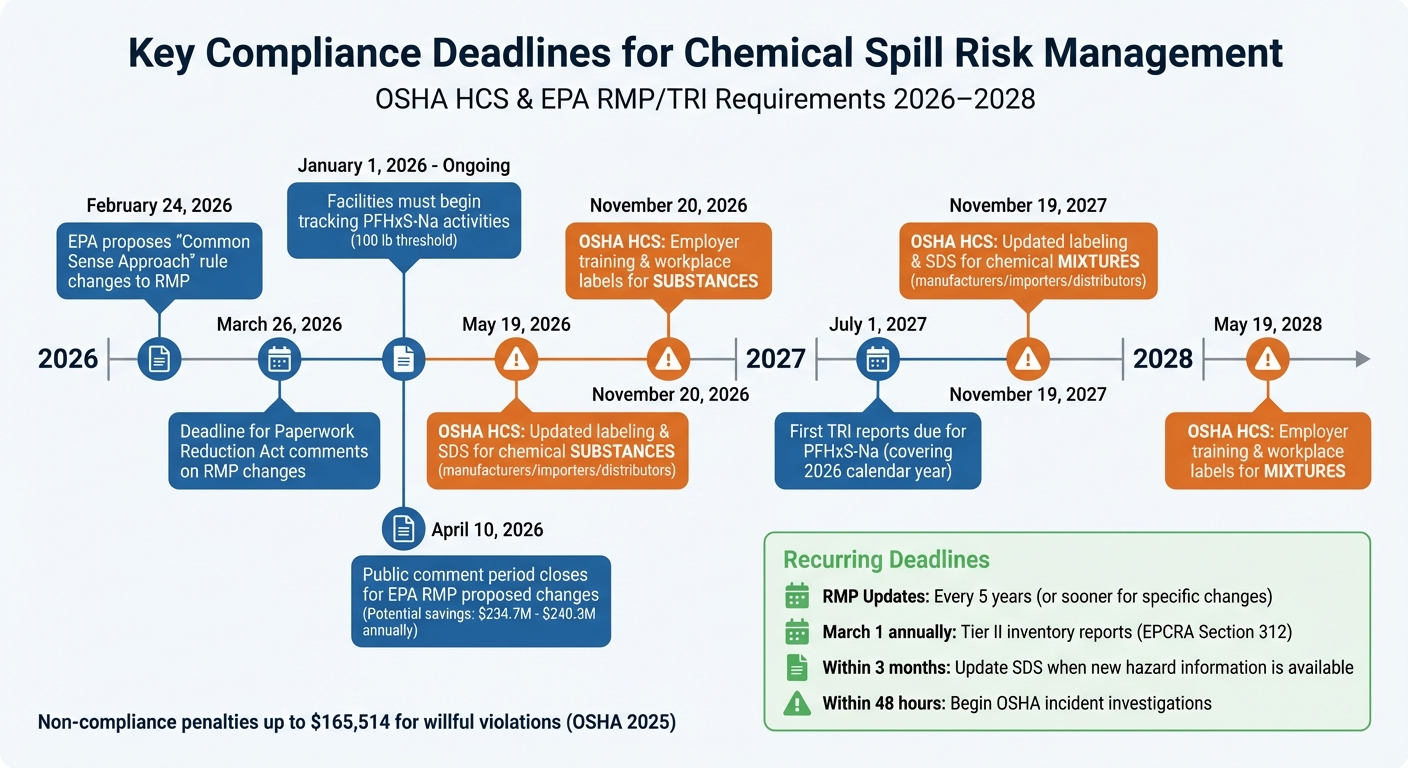
OSHA and EPA Compliance Deadlines 2026-2028 for Hazardous Chemical Facilities
Webinar: Navigating OSHA, DOT and EPA Chemical Compliance
sbb-itb-aa4586a
EPA Risk Management Program (RMP) Requirements
The EPA’s Risk Management Program, established under Section 112(r) of the Clean Air Act, focuses on facilities that store or handle regulated substances exceeding specific threshold quantities. Its goal is to prevent accidental releases that could harm communities or ecosystems. Facilities covered by the RMP must create detailed risk management plans, perform hazard analyses, and implement prevention programs that align with their assessed risk level. Compliance requirements vary based on the facility’s classification under the program.
RMP divides facilities into three program levels based on risk. Program 3 is the most demanding, requiring a comprehensive Process Hazard Analysis (PHA), Management of Change procedures, Mechanical Integrity programs, and thorough incident investigations, including root cause analysis. Across the U.S., approximately 12,000 industrial facilities operate under RMP regulations [7].
How to Determine if RMP Applies to Your Facility
Your facility is subject to RMP if it qualifies as a "stationary source" and holds more than the threshold amount of a regulated substance in a single process. For a complete list of regulated substances and their thresholds, refer to 40 CFR 68.130 [3]. Thresholds vary significantly – some substances require compliance at quantities as low as 100 lbs, while others are set at 10,000 lbs or more.
Program 3 classification applies to processes that meet OSHA’s Process Safety Management (PSM) standard or operate in high-risk industries. The EPA identifies these industries using NAICS codes, including sectors like Chemical Manufacturing (325), Petroleum and Coal Products Manufacturing (324), and Paper Manufacturing (322). Importantly, program levels are determined on a process-by-process basis, meaning a single facility could have processes classified under different program levels [6].
For Program 3 facilities, the PHA must evaluate risks to offsite public or environmental receptors by considering the siting of covered vessels. The EPA treats this "stationary source siting" requirement as equivalent to OSHA’s PSM standard [4].
Proposed Changes to RMP Rules in 2026
On February 24, 2026, the EPA proposed updates to RMP regulations under its "Common Sense Approach to Chemical Accident Prevention" rule. These changes aim to reverse several measures introduced by the 2024 Safer Communities by Chemical Accident Prevention (SCCAP) rule [3][5]. According to the EPA, the proposed revisions could result in total annualized cost savings of $234.7 million to $240.3 million, calculated at a 3% discount rate [3].
"These proposed amendments seek to improve chemical process safety by avoiding duplicative requirements, realigning RMP requirements with Occupational Safety and Health Administration (OSHA) Process Safety Management (PSM) requirements, and eliminating unnecessary burdens." – Environmental Protection Agency [3]
One of the largest projected savings, estimated at $168.7 million annually, comes from eliminating the Safer Technology and Alternatives Analysis (STAA) implementation requirements for existing facilities. Under the new proposal, STAA evaluations would only apply to new Program 3 processes that begin operation three years after the final rule takes effect [8].
Additional proposed changes include adjustments to third-party audit requirements, employee participation rules, and updates to the RMP Public Data Tool. The EPA is considering either eliminating third-party audit requirements entirely or limiting them to facilities that have experienced two RMP-reportable accidents within a five-year period [8]. These regulatory changes are expected to impact 2,257 private sector small entities and 590 small government entities [3].
The public comment period for these proposed changes closes on April 10, 2026 [5]. Facilities interested in providing feedback should submit their comments by this deadline. Comments related to information collection under the Paperwork Reduction Act were due by March 26, 2026 [3].
This content is for informational purposes only. Always refer to official regulations or consult qualified professionals before making compliance decisions.
OSHA Process Safety Management (PSM) Standards
The Occupational Safety and Health Administration (OSHA) introduced its Process Safety Management (PSM) standard (29 CFR 1910.119) in 1992, following amendments to the Clean Air Act in 1990. This regulation includes 14 interconnected elements designed to prevent major chemical accidents. These elements cover Employee Participation, Process Safety Information (PSI), Process Hazard Analysis (PHA), Operating Procedures, Training, Contractors, Pre-Startup Safety Review (PSSR), Mechanical Integrity, Hot Work Permit, Management of Change (MOC), Incident Investigation, Emergency Planning and Response, Compliance Audits, and Trade Secrets [2].
At the heart of the PSM standard is the Process Hazard Analysis (PHA), which systematically identifies and addresses risks related to fires, explosions, and significant chemical releases [2]. Facilities are required to revalidate their PHAs every five years, perform compliance audits every three years, and begin investigating incidents within 48 hours [2][10].
"Process safety management (PSM) is addressed in specific standards for the general and construction industries. OSHA’s standard emphasizes the management of hazards associated with highly hazardous chemicals and establishes a comprehensive management program that integrates technologies, procedures, and management practices." – Occupational Safety and Health Administration [9]
OSHA continues to refine PSM standards through stakeholder engagement. For instance, stakeholder meetings were held in October 2022 to discuss potential updates, and a Small Business Advocacy Review Panel was formed to evaluate the program [9]. Additionally, OSHA enforces these standards through National Emphasis Programs targeting Petroleum Refineries and Covered Chemical Facilities [9].
Which Facilities Must Follow PSM Standards
The PSM standard applies to facilities that handle 10,000 pounds or more of any hazardous chemical listed in OSHA’s PSM Appendix A. However, threshold quantities can vary significantly. For example, phosgene triggers compliance at just 100 pounds, while ammonia solutions require adherence at 15,000 pounds [2].
Industries commonly affected by these regulations include:
- Oil and gas refineries managing volatile distillation systems
- Chemical manufacturers handling reactive substances like chlorine or hydrogen sulfide
- Food processing plants utilizing large ammonia-based refrigeration systems
- Pharmaceutical companies working with unstable intermediates
- Water treatment facilities using chlorine or sulfur dioxide [10]
Retail operations, gas stations, oil and gas drilling sites, and facilities with chemicals below threshold levels are typically exempt from full PSM requirements. Facilities must maintain detailed inventories of their process streams, storage tanks, and pressure vessels to ensure compliance with Appendix A thresholds. Employee involvement in PHAs and incident investigations is also essential, as workers closest to the equipment often detect hazards first.
How PSM and EPA RMP Requirements Work Together
OSHA’s PSM and the Environmental Protection Agency’s (EPA) Risk Management Program (RMP) share many similarities, allowing facilities to align their compliance strategies. While OSHA focuses on worker safety, the EPA emphasizes protecting public health and the environment [12][13].
"The prevention program requirements for Program 3 processes under 40 CFR Sections 68.65 through 68.87 are almost identical to the requirements of OSHA’s PSM." – US EPA [13]
Facilities that comply with OSHA’s PSM standards generally meet the Prevention Program requirements under the EPA’s RMP Program 3 [13]. However, the RMP includes unique obligations, such as conducting offsite consequence analyses, developing a comprehensive management system, and submitting Risk Management Plans to the EPA [13]. Most facilities subject to both regulations fall under RMP Program 3 [12].
To streamline compliance, facilities can use their existing PSM documentation as a foundation for the RMP Prevention Program. When updating safety plans, ensure that both OSHA’s worker safety priorities and the EPA’s community protection goals are addressed in the "Management System" and "Emergency Response" sections [13]. The EPA’s General RMP Guidance, particularly Appendix D, offers detailed instructions for aligning PSM and RMP requirements [11][14].
By integrating these standards, facilities can strengthen risk mitigation strategies while addressing both worker and environmental protections. This dual focus supports effective spill risk management across regulated industries.
This content is for informational purposes only. Consult official regulations and qualified professionals before making any decisions related to compliance, sourcing, or formulation.
Hazard Communication and Labeling Compliance Deadlines
Facilities must adhere to updated Hazard Communication Standards (HCS) to stay compliant with regulatory frameworks like the EPA’s Risk Management Program (RMP) and OSHA’s Process Safety Management (PSM). OSHA’s revised HCS aligns with the seventh revision of the United Nations’ Globally Harmonized System of Classification and Labelling of Chemicals (GHS), introducing updated requirements for manufacturers, importers, distributors, and employers [15]. Key deadlines and transition options have been established to aid compliance planning.
Key Compliance Deadlines for HCS
OSHA extended its original compliance timeline by four months, announcing the updated deadlines on January 15, 2026. This extension gives facilities additional time to finalize guidance documents and review materials [15]. Deadlines differ depending on whether you handle chemical substances or mixtures:
| Product Type | Manufacturer/Importer/Distributor Deadline | Employer Training & Workplace Label Deadline |
|---|---|---|
| Substances | May 19, 2026 | November 20, 2026 |
| Mixtures | November 19, 2027 | May 19, 2028 |
"The revised dates allow OSHA more time to finalize and publish guidance documents about the updated HazCom Standard and for the regulated community to review the materials to comply with it." – Safety Partners, LLC [15]
Manufacturers and importers must update Safety Data Sheets (SDS) and hazard criteria according to the new Appendix A and B. Updates include adding particle characteristics for solid products in Section 9 and detailing hazardous reactions in foreseeable emergencies under Section 10. New labeling rules for small containers (100 mL or less) and very small containers (3 mL or less) aim to reduce the labeling burden for tiny packaging.
These updated timelines provide flexibility for facilities to implement changes effectively.
Transition Options Between HCS Versions
To ease the transition, OSHA allows phased compliance with the updated standard. Facilities can choose to comply with the 2012 version, the updated 2024 version, or a combination of both until the final deadlines. This phased approach lets facilities gradually implement changes across product lines rather than making immediate updates.
For pre-released chemicals, updated labels can be included with shipments for downstream use. Additionally, OSHA now requires the use of prescribed concentration ranges (e.g., 0.1% to 1% or 10% to 30%) on SDS when claiming trade secrets for ingredients. This aligns with international systems like Canada’s Workplace Hazardous Materials Information System (WHMIS). Non-compliance could result in penalties, which are now set at $16,550 for serious violations and up to $165,514 for willful or repeat violations [16].
This content is intended for informational purposes only. Be sure to consult official regulations and seek advice from qualified professionals before making compliance-related decisions.
Toxic Chemical Release Reporting and Monitoring
Facilities that manage toxic chemicals are required to report releases under the Emergency Planning and Community Right-to-Know Act (EPCRA). Recently, the EPA expanded the Toxics Release Inventory (TRI) to cover additional PFAS compounds, introducing new compliance responsibilities for industrial operations. Knowing which chemicals need to be reported and adhering to deadlines is essential to avoid violations. These updates further tighten the rules for chemical release reporting, increasing compliance obligations across facilities.
New Chemicals Added to Reporting Requirements
On February 23, 2026, the EPA finalized a rule adding Sodium Perfluorohexanesulfonate (PFHxS-Na, CAS No. 82382-12-5) to the TRI list under EPCRA Section 313. This aligns with earlier EPA compliance updates [18]. PFHxS-Na is classified as a "chemical of special concern" due to its low annual reporting threshold of just 100 pounds, significantly lower than the standard 10,000-pound limit [18]. This addition follows a toxicity assessment completed in January 2025 under the National Defense Authorization Act for Fiscal Year 2020 [18].
Because PFHxS-Na is a chemical of special concern, it is not eligible for the de minimis exemption. This means even trace amounts below 1% concentration must be recorded and reported [20]. Facilities are also prohibited from using the simplified Form A (Alternate Threshold Certification Statement) and must adhere to stricter limits when reporting ranges.
With this update, the TRI list now includes 206 PFAS compounds. This follows the EPA’s addition of seven PFAS chemicals in 2024 and nine more in 2025 [18].
"This addition ensures communities have the right to know what chemicals are being used and released in their neighborhoods." – EPA Assistant Administrator for Chemical Safety and Pollution Prevention Doug Troutman [18]
Facilities must now prepare to meet the reporting requirements and deadlines tied to these updates.
Reporting Deadlines You Need to Know
Facilities must begin tracking all activities involving PFHxS-Na starting January 1, 2026, with the first reports due July 1, 2027 [17][18]. This deadline covers manufacturing, processing, or use activities conducted during the 2026 calendar year, requiring detailed annual tracking for the 2027 submission.
For hazardous chemicals not impacted by this specific TRI update, annual Tier II inventory reports under EPCRA Section 312 are still due by March 1 each year, covering the prior calendar year [19]. Facilities should immediately audit their chemical inventories to determine if they handle PFHxS-Na or any of the other recently added PFAS compounds. It’s critical to request updated Safety Data Sheets (SDS) and Certificates of Analysis (COA) from suppliers, as even moderate usage could surpass the 100-pound reporting threshold.
Careful and accurate reporting plays a key role in managing chemical spill risks effectively.
This content is for informational purposes only. Consult official regulations and qualified professionals before making sourcing or formulation decisions.
Compliance Documentation Requirements
Keeping compliance records up to date is a must for meeting EPA and OSHA regulations. Facilities that handle regulated chemicals need to maintain two key sets of documents: Risk Management Plans (RMPs) and Safety Data Sheets (SDS). These documents not only ensure compliance but also play a critical role in protecting workers and nearby communities from chemical risks. Regular updates to both are essential to staying on the right side of regulatory requirements.
How to Create and Update Risk Management Plans
A compliant Risk Management Plan (RMP) includes four main components:
- Hazard Assessment: This involves an Offsite Consequence Analysis (OCA) and a record of any accidents from the past five years [14][22].
- Prevention Program: Details safety measures, which vary based on the facility’s Program Level (1, 2, or 3) [14][22].
- Emergency Response Program: Outlines protocols, equipment upkeep schedules, and how to coordinate with local emergency agencies [14][22].
- Management System: Sets up oversight for implementing all parts of the RMP [14][22].
RMPs must be updated and resubmitted electronically through RMP*eSubmit at least once every five years [21]. However, certain changes require quicker updates. For instance:
- If a regulated substance crosses its threshold quantity, the RMP must be updated by the time the threshold is exceeded [21].
- Updates are required within six months for changes needing a revised hazard analysis or OCA [21].
- Even minor updates, such as changes in emergency contact details, must be made within one month [21].
| Requirement | Deadline for RMP Update |
|---|---|
| Standard Periodic Update | Every 5 years [21] |
| New Regulated Substance Added | By the time the threshold is exceeded [21] |
| Revised Hazard Analysis or OCA | Within 6 months [21] |
| Accidental Release (History/Investigation) | Within 6 months [21] |
| Emergency Contact Changes | Within 1 month [21] |
An important note: when you submit a complete update, it resets the five-year clock for your next RMP submission. For example, if you fully update your RMP in year three due to a process change, your next required update will be five years from that new submission date [21].
At the same time, keeping your Safety Data Sheets current is just as important.
Maintaining Accurate Safety Data Sheets (SDS)
Every chemical in your facility must have an up-to-date SDS that follows OSHA’s required 16-section format [23][25]. These sections cover everything from product identification and hazard classification to physical properties, toxicology, and disposal guidelines. Even if some sections contain minimal information, all 16 must be included.
"OSHA regulations require an SDS to be revised within three months after a chemical manufacturer or employer becomes aware of significant new information concerning the hazards of a chemical." – OSHA [23]
When you receive a revised SDS containing new hazard information, you have three months to update your internal records [23]. Additionally, you must provide the updated SDS to your Local Emergency Planning Committee (LEPC), State Emergency Response Commission (SERC), and local fire department [23]. If the revision highlights a new hazard, employees must be trained on it before handling the chemical again [25].
It’s also crucial to review each SDS regularly to ensure all 16 sections are present, including often-overlooked sections like Section 12 (Ecological Information) and Section 13 (Disposal Considerations) [25]. Information from Section 2 (Hazard Identification) and Section 9 (Physical and Chemical Properties) can also be used to refine the Hazard Assessment and Prevention Program in your RMP [24][25]. This alignment helps maintain consistency between your SDS library and RMP submissions.
This content is for informational purposes only. Always consult official regulations and qualified professionals before making compliance-related decisions.
Upcoming Regulatory Changes and How to Stay Informed
On February 24, 2026, the EPA proposed a rule titled "Common Sense Approach to Chemical Accident Prevention." This rule could bring notable changes to how facilities handle spill risks. Its primary goal is to simplify compliance by removing overlapping requirements and aligning the Risk Management Program (RMP) rules more closely with OSHA’s Process Safety Management (PSM) standards. These updates are set to directly influence strategies for managing spill risks.
What’s in the EPA’s Proposed Rule
The proposed rule aims to repeal parts of the 2024 SCCAP rule, potentially saving facilities an estimated $235–$240 million annually [3][28].
"These proposed amendments seek to improve chemical process safety by avoiding duplicative requirements, realigning RMP requirements with Occupational Safety and Health Administration (OSHA) Process Safety Management (PSM) requirements, and eliminating unnecessary burdens."
[3]
Key changes include:
- Public Access to Hazard Information: Facilities will no longer need to provide chemical hazard details directly to the public. Instead, the EPA will offer a modified RMP Public Data Tool with limited search capabilities [8][27].
- Hazard Evaluations: Explicit requirements to assess natural hazards (like climate change impacts) and provide backup power for release monitoring equipment will be replaced by a broader hazard evaluation approach [8][27].
- Employee Involvement: The rule removes "stop work authority" for employees and eliminates the need to consult employees on Process Hazard Analysis recommendations and incident investigations [8][28].
With such significant adjustments, staying informed about regulatory changes is more important than ever.
How to Monitor Regulatory Updates
Keeping up with regulatory changes is essential for maintaining compliance with spill risk management standards. Here are some effective ways to stay updated:
- Federal Register Notifications: Visit federalregister.gov and use the "My FR" subscription feature to receive updates tailored to your needs [26].
- EPA Rulemaking Docket: Follow the EPA’s RMP rulemaking docket (EPA-HQ-OLEM-2025-0313) on regulations.gov. This resource provides public comments, supporting documents, and the latest updates [3][26].
For facilities planning expansions or introducing new processes, it’s crucial to document Safety Technology and Alternatives Analysis (STAA) evaluations. STAA requirements will still apply to new Program 3 processes starting three years after the rule takes effect [8]. Additionally, aligning your process safety programs with OSHA’s PSM standards will help ensure a smooth transition during these regulatory updates [3][27]. As the EPA shifts to its updated RMP Public Data Tool, monitoring this change will be vital [28][8].
This information is intended for general guidance. Always consult official regulations and qualified professionals when making compliance-related decisions.
Conclusion
Managing chemical spill risks effectively means following both OSHA and EPA regulations. OSHA’s Process Safety Management (PSM) standards focus on safeguarding workers from hazardous chemicals within facilities, while the EPA’s Risk Management Programs (RMP) aim to prevent dangers to the public and the environment. Together, these frameworks create a comprehensive approach to chemical safety [1][29].
To ensure compliance, maintain detailed records of training sessions, inspections, and incidents. A thorough chemical inventory that outlines hazards, hazardous chemical storage protocols, and response protocols is essential. Regular drills can help identify weaknesses in your procedures and clarify team responsibilities. This documentation not only prepares you for audits but also helps you stay aligned with regulatory changes.
Being proactive about regulatory updates is critical, especially with OSHA’s 2025 penalty adjustments, which include fines of up to $165,514 for willful or repeated violations [30]. Consider implementing quarterly compliance reviews to manage these changes effectively. Monitor the Federal Register for updates, take advantage of OSHA’s compliance assistance programs, and participate in public comment periods for new rule proposals.
The regulatory environment continues to change, as seen in the March 2026 updates to EPA RMP Chapter 11, which emphasize public communication [1]. Facilities in specialized industries, such as ammonia refrigeration or chemical warehousing, should incorporate sector-specific guidance into their risk management strategies.
Allan Chemical Corporation is dedicated to helping facilities navigate these evolving requirements by offering dependable chemical sourcing and expert technical support.
This content is for informational purposes only. Always consult official regulations and qualified professionals before making decisions related to chemical sourcing or formulation.
FAQs
How do I know if my facility is covered by OSHA PSM, EPA RMP, or both?
To figure out whether OSHA PSM, EPA RMP, or both apply to your facility, start by reviewing their specific criteria. OSHA PSM focuses on processes involving hazardous chemicals in the workplace, aiming to ensure employee safety. On the other hand, EPA RMP is designed to safeguard public health and the environment from chemical hazards at facilities.
In many cases, facilities that fall under OSHA PSM also need to comply with EPA RMP, unless specific exemptions apply. However, meeting the requirements of one program doesn’t automatically mean you comply with the other. Each has distinct obligations, so understanding both is crucial.
What are the fastest ways to align PSM and RMP documentation without duplicating work?
To manage PSM (Process Safety Management) and RMP (Risk Management Program) documentation effectively, start by identifying their common requirements. Both programs often share elements like hazard analyses, safety protocols, and emergency response plans. By consolidating this overlapping information into a single master document, you can reduce duplication and ensure consistency.
Use cross-references within the document to link related sections, so updates made in one area automatically align with the other. Additionally, adopting an integrated management system can simplify compliance efforts and help avoid repetitive tasks, saving both time and resources.
Which 2026–2028 deadlines should I prioritize to avoid OSHA or EPA penalties?
To steer clear of penalties from OSHA and the EPA, make sure to prioritize compliance with two key deadlines:
- The OSHA Hazard Communication Standard deadline: May 19, 2026.
- The EPA Risk Management Program requirements: A final rule was signed in February 2024, with publication still pending.
Staying on top of these evolving regulations is essential to meet these timelines and maintain compliance.


Comments are closed