
HDPE (High-Density Polyethylene) and PVC (Polyvinyl Chloride) membranes are two popular materials for below-grade waterproofing. Both create barriers to prevent water infiltration in structures like foundations, tunnels, and retaining walls. However, they differ significantly in durability, flexibility, chemical resistance, and cost.
Key Differences:
- HDPE: Rigid, durable, and resistant to harsh chemicals. Ideal for high-stress environments like deep foundations and contaminated sites. Service life: 20–30 years.
- PVC: Flexible and easier to install on complex geometries. Performs well in moderate chemical exposure and cold climates. Service life: 10–25 years.
Quick Overview:
- HDPE: High tensile strength, excellent chemical resistance, long lifespan, but harder to install.
- PVC: Easier to handle, suitable for irregular shapes, but less durable and vulnerable to plasticizer loss.
Quick Comparison:
| Feature | HDPE | PVC |
|---|---|---|
| Material Nature | Rigid, high-density | Flexible, plasticized |
| Service Life | 20–30 years | 10–25 years |
| Temperature Range | -40°F to 160°F | 40°F to 130°F |
| Chemical Resistance | Excellent | High (moderate limits) |
| Best Use | Deep foundations, harsh conditions | Curved walls, complex shapes |
Each material has strengths depending on the project’s requirements. HDPE is better for durability in challenging environments, while PVC is more suitable for intricate designs and shorter-term needs.
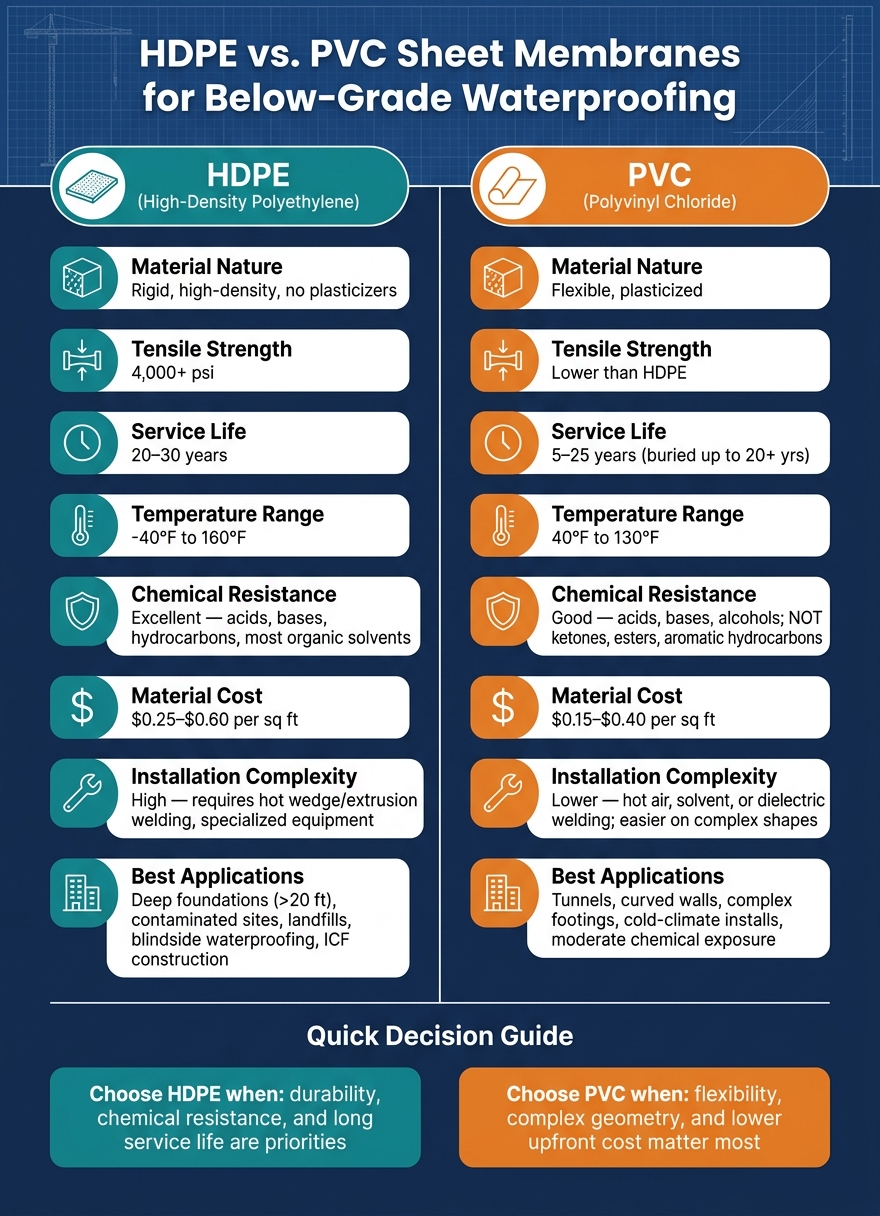
HDPE vs. PVC Sheet Membranes: Below-Grade Waterproofing Comparison
HDPE Sheet Membranes for Below-Grade Waterproofing
Properties and Advantages of HDPE Membranes
HDPE membranes are crafted from polyethylene resin with a semi-crystalline structure, designed to minimize any gaps that could allow water or chemicals to pass through. Unlike PVC, HDPE is free of plasticizers, meaning there’s nothing in the material to leach out or degrade over time.
This unique structure delivers impressive performance. HDPE membranes boast a tensile strength exceeding 4,000 psi and can stretch 700–800% before breaking. With a perm rating below 0.1 perms, they are far less permeable than PVC of equivalent thickness – by approximately two orders of magnitude [6]. These membranes maintain their functionality across a temperature range of -40°F to 160°F, making them suitable for harsh environments, whether in cold basements or sun-exposed conditions. These attributes make HDPE membranes a dependable choice for challenging applications like deep commercial foundations and contaminated sites.
In addition to their mechanical strength, HDPE membranes resist degradation from acids, bases, salts, and hydrocarbons.
"The chemical resistance of HDPE is among the best of commonly used lining materials and far better than PVC, especially against acids, bases, and hydrocarbons." – EcoGeoX [6]
Another notable feature is their continuous bonding capability. Modern HDPE membranes form a complete bond with poured concrete, eliminating potential pathways for water to travel between the membrane and the structure.
"Continuous bond to poured concrete means membrane is unaffected by ground settlement." – UniPro Group [5]
Now, let’s explore where these properties make HDPE membranes the preferred choice.
Common Applications of HDPE Membranes
HDPE membranes are ideal for projects requiring durability and high resistance to environmental stress. Their toughness makes them a top choice for deep commercial foundations, particularly those deeper than 20 feet, where the lateral earth pressure would overwhelm standard membranes. For example, commercial-grade HDPE membranes can withstand compressive loads of around 8,350 psf (400 kN/m²) [3].
They’re also well-suited for contaminated sites, where hydrocarbons, salts, or acidic leachates are present. HDPE’s chemical inertness ensures it won’t degrade, a crucial advantage over PVC in such conditions. This same property makes HDPE the preferred material for landfill liners and industrial containment systems, where chemical exposure is unavoidable [1][2].
Another application is blindside waterproofing, where the membrane is pre-applied to formwork before concrete is poured. This setup creates a bond that prevents water from migrating laterally in the event of a breach. For ICF (Insulated Concrete Form) construction, double-dimple HDPE membranes add an extra layer of protection for foam insulation, shielding it from backfill damage and soil chemicals [3].
| Application | Why HDPE Works Here |
|---|---|
| Deep commercial foundations (>20 ft) | High compressive strength resists lateral earth pressure |
| Contaminated or chemically aggressive soil | Inert to acids, bases, and hydrocarbons |
| Blindside / pre-applied waterproofing | Full concrete bond prevents lateral water migration |
| ICF construction | Dimpled profile protects foam insulation from backfill |
| Landfills and industrial containment | No plasticizer leaching; chemically inert |
How HDPE Membranes Are Installed
The robust properties of HDPE membranes require specialized installation methods tailored to specific projects. For pre-applied (blindside) systems, the membrane is placed against lagging, shotcrete, or permanent formwork before concrete is poured. This creates a seamless assembly that directly addresses hydrostatic pressure. In post-applied systems, HDPE sheets – often with a dimpled profile – are mechanically fastened to finished foundation walls using designated fasteners and termination bars. Backfilling can begin immediately since no curing time is needed [3].
Seam integrity is critical for HDPE membranes. Field seams are joined using dual-track hot wedge welding, which creates two parallel fusion bonds with an air channel in between. This channel is pressurized during quality checks to confirm an airtight seal. For repairs, corners, and pipe penetrations, extrusion welding is employed. Welding should only be done when temperatures are between 41°F and 104°F (5°C and 40°C), and the surface must be completely dry to avoid defects like cold welds or pinholes [7].
Because HDPE has a high thermal expansion rate, it’s best to schedule welding during cooler parts of the day – early mornings are ideal – to minimize the risk of wrinkles forming before backfill. For added protection, pair the membrane with a geocomposite drainage board on the exterior face. This not only shields the membrane from backfill damage but also helps relieve hydrostatic pressure at the wall [4].
Disclaimer: This content is for informational purposes only. Consult official regulations and qualified professionals before making sourcing or formulation decisions.
sbb-itb-aa4586a
PVC Sheet Membranes for Below-Grade Waterproofing
Properties and Advantages of PVC Membranes
PVC membranes stand out for their flexibility, making them a smart choice for irregular subgrades compared to rigid HDPE. With an elongation at break of 200–300% [8], PVC can stretch and adapt to uneven surfaces and intricate shapes. Field seaming is also simpler with PVC – hot air or solvent bonding can join seams quickly and efficiently [2].
Another advantage is PVC’s performance in cold temperatures. It remains flexible down to 14°F (-10°C) [8], offering reliable installation in colder climates where HDPE may fall short. However, PVC does have a downside: over time, exposure to certain chemicals or high temperatures can cause plasticizers to migrate, potentially leading to stiffening and cracking under mechanical stress.
For below-grade use, PVC membranes are typically produced in thicknesses ranging from 59 to 120 mils [9], ensuring they can handle the demands of buried environments. Material costs are relatively affordable, ranging from $0.15 to $0.40 per square foot [2]. These characteristics not only simplify installation but also make PVC membranes a practical solution for complex structural designs.
Common Applications of PVC Membranes
PVC membranes are especially useful for projects that involve geometric challenges. Applications like tunnels, curved retaining walls, intricate footing details, and structures with multiple penetrations benefit from PVC’s flexibility and ease of seaming. Its ability to conform to uneven subgrades and accommodate structural movement reduces stress on seams [8].
PVC membranes are also a reliable option for environments with moderate chemical exposure. For instance, they perform well in areas where groundwater contains acids, bases, or alcohols. However, they should not be used in environments with ketones, esters, or aromatic hydrocarbons, as these substances can accelerate plasticizer loss. When installed correctly and shielded from UV exposure, PVC membranes can last over 20 years in buried applications. ASTM D7176 provides the standard specification for non-reinforced PVC geomembranes in these contexts [11].
| Application | Why PVC Works Here |
|---|---|
| Tunnels and curved structures | High elongation adapts to irregular geometries |
| Complex footing details and penetrations | Easy seaming around tight corners |
| Cold-climate installations | Maintains flexibility at low temperatures |
| Reservoirs and non-critical containment | Affordable with sufficient buried lifespan |
| Sites with moderate chemical exposure | Resists acids, bases, and alcohols |
How PVC Membranes Are Installed
Thanks to their adaptability, PVC membranes offer several installation methods, including loose-laid, mechanically attached, or fully bonded systems [2]. For many below-grade projects, the loose-laid method is preferred. In this approach, the membrane is unrolled and positioned, with seams welded and edges secured using termination bars or anchor trenches.
Field seaming is a major advantage of PVC. Installers can use a portable hot air gun to weld seams quickly and effectively, without the need for the specialized equipment required for HDPE. Solvent welding is another option, though hot air welding is generally favored for its consistency and ease of seam testing. This simpler seaming process helps lower labor costs and makes it easier to find qualified installers.
It’s important to avoid installing PVC membranes in freezing conditions to prevent stiffening or cracking. Additionally, if the site contains contaminants like ketones or aromatic hydrocarbons, chemical compatibility should be checked to ensure the membrane’s longevity.
Disclaimer: This content is for informational purposes only. Consult official regulations and qualified professionals before making sourcing or formulation decisions.
HDPE vs. PVC: A Direct Comparison for Below-Grade Waterproofing
Performance Comparison: HDPE vs. PVC
When selecting the right sheet membrane for below-grade waterproofing, understanding the key differences between HDPE (High-Density Polyethylene) and PVC (Polyvinyl Chloride) is essential. HDPE stands out for its durability and strength, offering a service temperature range from -40°F to 160°F. This is significantly broader than PVC’s range of 40°F to 130°F [2]. HDPE also excels in chemical resistance, effectively withstanding acids, bases, and most organic solvents. On the other hand, PVC is vulnerable to ketones, esters, and aromatic hydrocarbons. Its reliance on plasticizers further accelerates embrittlement over time [2].
"High-density polyethylene is the most widely used geomembrane material worldwide… Its combination of chemical resistance, mechanical strength, UV resistance, and long-term durability make it the default choice for most containment applications." – EFI USA Technical Team [2]
Here’s a quick look at the main performance differences:
| Feature | HDPE | PVC |
|---|---|---|
| Tensile Strength | 4,000+ psi | Lower than HDPE |
| Service Temperature Range | -40°F to 160°F | 40°F to 130°F |
| Chemical Weakness | Vulnerable to strong oxidizers | Susceptible to ketones, esters, and aromatic hydrocarbons |
| Exposed Service Life | 20–30 years | 5–15 years |
| Long-Term Embrittlement Risk | Low | High (due to plasticizer migration) |
These distinctions also affect how each material performs during installation and under specific site conditions.
Installation and Site Conditions
HDPE’s rigidity can complicate installation, especially on uneven or irregular subgrades. It requires a smoother substrate and more effort to handle. By contrast, PVC’s flexibility and elongation make it easier to install on complex geometries like curved walls, tunnels, or intricate footing details.
Seaming methods further highlight the differences. HDPE typically uses hot wedge or extrusion welding, which provides strong, reliable seams but requires specialized equipment and trained technicians [2]. PVC, meanwhile, can be joined using solvent welding, hot air welding, or dielectric welding. These methods are simpler and more accessible, though solvent welding demands precision to ensure long-term performance [2]. Both materials can stiffen or crack in freezing conditions, but HDPE’s wider temperature tolerance offers better resilience once installed.
Cost and Long-Term Value
Cost is another key factor when comparing HDPE and PVC. PVC is initially more affordable, with prices ranging from $0.15 to $0.40 per square foot, compared to HDPE’s $0.25 to $0.60 per square foot. However, HDPE’s longer lifespan – 20–30 years versus PVC’s 5–15 years – makes it a more cost-effective choice over time. The risk of plasticizer migration in PVC further adds to its maintenance costs [2].
"For most containment applications where the liner will be buried or submerged, HDPE is the best overall choice based on its combination of performance, longevity, and cost." – EFI USA Technical Team [2]
PVC may still be suitable for non-critical or shorter-term projects in environments with minimal chemical exposure. However, for critical applications like foundations, tunnels, or areas near potentially contaminated groundwater, HDPE offers unmatched long-term value and reliability.
Disclaimer: This content is for informational purposes only. Consult official regulations and qualified professionals before making sourcing or formulation decisions.
How to Choose the Right Sheet Membrane for Your Project
Evaluating Site and Groundwater Conditions
Start by analyzing the site’s soil and groundwater chemistry. These factors directly impact how long the membrane will last. For example, HDPE (High-Density Polyethylene) is resistant to acids, bases, and most organic solvents, while PVC (Polyvinyl Chloride) handles acids, bases, and alcohols but can degrade when exposed to ketones, esters, or aromatic hydrocarbons [2].
Hydrostatic pressure is another key consideration. Sites with a high water table require a true bonded waterproofing membrane – not just a mechanically fastened drainage sheet. While HDPE dimpled sheets work well for drainage on low-water-table sites, they may allow water to bypass mechanical terminations and don’t qualify as fully bonded systems [4]. Always confirm that your membrane meets the necessary standard for high-pressure conditions.
Temperature fluctuations at the site also play a role. HDPE performs well under extreme temperature changes, making it ideal for areas with significant seasonal variations. PVC, however, operates within a narrower range of 40°F to 130°F and may become brittle over time [2].
Beyond environmental factors, the design of the structure itself also impacts membrane choice.
Structural and Design Requirements
Once you’ve assessed the site, think about how the structure’s geometry and settlement potential affect membrane performance.
The shape of the structure is crucial. HDPE is best suited for large, flat areas like slabs-on-grade or wide foundation slabs. However, its stiffness can be a disadvantage for curved walls, complex footings, or structures with intricate detailing [2]. In contrast, PVC’s flexibility allows it to adapt to irregular surfaces and detailed shapes [2].
If the site has variable soil conditions that could lead to differential settlement, PVC is often the better choice. Its flexibility helps it withstand substrate shifts, unlike HDPE, which may crack or fail under stress [2]. For vertical walls, PVC can be fully adhered using mechanically attached thermoplastic discs, creating a secure bond ideal for foundation walls [10]. However, keep in mind that fully adhered PVC requires a "floor quality" steel trowel finish on concrete substrates for proper bonding [10].
PVC sheets used below grade are also thicker than those used for roofing – typically 59 to 120 mils compared to the 45 to 60 mils common on roofs. This added thickness enhances resistance to punctures and hydrostatic pressure [10].
Construction Methods and Regulatory Compliance
Installation methods and adherence to regulations are just as critical as material selection.
The way the membrane is installed matters. HDPE dimpled sheets are more forgiving – they don’t need primers and can be applied to damp or rough surfaces [4]. PVC systems, on the other hand, require clean, dry, and properly finished concrete [10]. If your timeline is tight or substrate preparation is challenging, this difference could influence your decision.
Seaming methods also differ. PVC seams can be heat-welded using hot air equipment that reaches over 1,000°F, creating seam strengths comparable to welded steel [10]. HDPE requires hot wedge or extrusion welding, which demands specialized equipment and trained technicians [2]. While both methods are effective when done correctly, PVC offers additional options like solvent and dielectric welding, giving crews more flexibility for complex jobs.
Regulatory compliance is another critical factor. U.S. building codes distinguish between damp-proofing (resisting moisture vapor) and true waterproofing (resisting hydrostatic pressure). According to IRC Section R406.1, this distinction affects permitting. HDPE dimpled sheets alone may only meet damp-proofing or drainage requirements, not full waterproofing compliance [4]. True waterproofing membranes typically range from 40 to 60 mils thick to withstand standing water and bridge cracks up to 1/16 inch [4]. When specifying materials, refer to standards like ASTM D6163 for sheet waterproofing and ICC-ES AC 29 for below-grade drainage composites [4].
"HDPE dimpled membranes are the budget option and double as a drainage plane, but they rely on mechanical fastening at the top edge rather than adhesive bonding." – Dan Dadovic, Commercial Director, Ezoic Inc. [4]
No matter which membrane you choose, ensure it’s protected during installation. Use a geocomposite drainage board to shield the membrane from backfill damage caused by rocks and debris – common culprits of punctures during backfilling [4]. When ordering materials, account for 3- to 4-inch side laps, 6-inch end laps, and purchase at least 10% extra material to cover overlaps and field cuts [4].
Disclaimer: This content is for informational purposes only. Consult official regulations and qualified professionals before making sourcing or formulation decisions.
Conclusion: HDPE or PVC for Below-Grade Waterproofing?
Key Takeaways
Choosing the right membrane comes down to specific project needs.
HDPE stands out for its durability, offering tensile strength over 4,000 psi, a service life of 20–30 years, and strong resistance to acids, bases, and many organic solvents. Material costs range from $0.25–$0.60 per square foot [2].
PVC, on the other hand, shines in projects requiring flexibility and superior seam performance. Its high elongation adapts well to irregular surfaces, and heat-welded seams provide bonding strengths comparable to welded steel [10]. While it costs less upfront – $0.15–$0.40 per square foot – its shorter service life could lead to higher replacement costs in the future [2]. To avoid issues like premature degradation or plasticizer migration, it’s crucial to specify waterproofing-grade formulations [10].
When factoring in chemical exposure, geometry, and long-term value, the choice between HDPE and PVC becomes clearer. Beyond selecting the right membrane, ensuring the quality and reliability of complementary materials is essential for a successful waterproofing system.
| Factor | Choose HDPE | Choose PVC |
|---|---|---|
| Chemical exposure | Acids, bases, solvents | Acids, bases |
| Geometry | Large flat slabs, containment | Curved walls, complex details |
| Service life priority | Long-term (20–30 years) | Shorter-term or budget-driven |
| Seam flexibility | Hot wedge/extrusion welding | Hot air, solvent, or dielectric welding |
| Temperature range | -40°F to 160°F | 40°F to 130°F |
How Allan Chemical Corporation Supports Material Sourcing

A successful waterproofing strategy depends on more than just selecting the right membrane – it requires reliable sourcing of adhesives, primers, chemical grouts, and specialty compounds. These components are vital to maintaining the integrity of the entire system.
Allan Chemical Corporation brings over 40 years of expertise in specialty chemical sourcing. With direct relationships with trusted manufacturers, they provide flexible batch sizes tailored to your needs and a just-in-time delivery model to help avoid delays and overstocking. Their technical support includes documentation and usage guidance, ensuring smooth progress for your below-grade waterproofing projects.
Disclaimer: This content is for informational purposes only. Consult official regulations and qualified professionals before making sourcing or formulation decisions.
Webinar #12 HDPE v PVC
FAQs
How do I confirm chemical compatibility with my site’s groundwater?
To ensure the right fit, start by analyzing your site’s groundwater chemistry and comparing it with the resistance characteristics of different geomembranes. HDPE (High-Density Polyethylene) stands up well to acids, bases, organic solvents, and biological breakdown, making it a versatile choice for various conditions. On the other hand, PVC (Polyvinyl Chloride) resists acids, bases, and alcohols but has weaker resistance to ketones and hydrocarbons. A detailed site-specific analysis and consultation with experts are essential to confirm that the selected material aligns with your groundwater’s chemical properties.
When do I need a fully bonded waterproofing membrane vs a drainage sheet?
A fully bonded waterproofing membrane creates a seamless, watertight barrier that prevents water from seeping through. This is especially important in areas exposed to high hydrostatic pressure or where direct adhesion to the substrate is required. Common applications include basement floors and vertical walls, where durability and impermeability are critical.
On the other hand, drainage sheets are designed to manage water movement around a structure. By reducing the pressure exerted on waterproofing membranes, they improve long-term performance. These sheets work best when paired with membranes, ensuring effective water management and vapor control over time.
What should I look for in seam testing and field quality control?
For HDPE and PVC geomembranes, maintaining seam integrity and ensuring material performance are critical. Achieving this involves proper surface preparation, maintaining consistent welding temperatures, and conducting detailed seam inspections. Welding techniques such as hot wedge, extrusion, and solvent welding must be applied to create strong seams and prevent leaks. While PVC allows for easier handling when creating controlled seams, HDPE demands more precision, particularly at pipe penetrations and seam interfaces, to minimize the risk of failures.




Comments are closed