
Maintaining spill inspection records is mandatory for facilities handling oil or chemicals. Under the SPCC Rule (40 CFR Part 112) and UST regulations (40 CFR § 280.35), facilities must document inspections to prevent discharges into navigable waters. These records are essential during EPA audits to prove compliance and ensure equipment functions properly.
Key requirements include:
- SPCC Plan: Facilities must have a written plan outlining spill prevention and response measures, reviewed every five years.
- Inspection Logs: Records must include inspection dates, inspector names, equipment conditions and corrosion, and corrective actions taken. Logs must be signed and stored on-site or at the nearest staffed location.
- Retention Period: All records must be kept for at least three years.
- Updates: Any operational changes must be reflected in the SPCC Plan within six months.
Inaccurate or missing records can lead to fines, legal risks, and noncompliance. Facilities should consider using digital tools for easier record management and accessibility during audits.
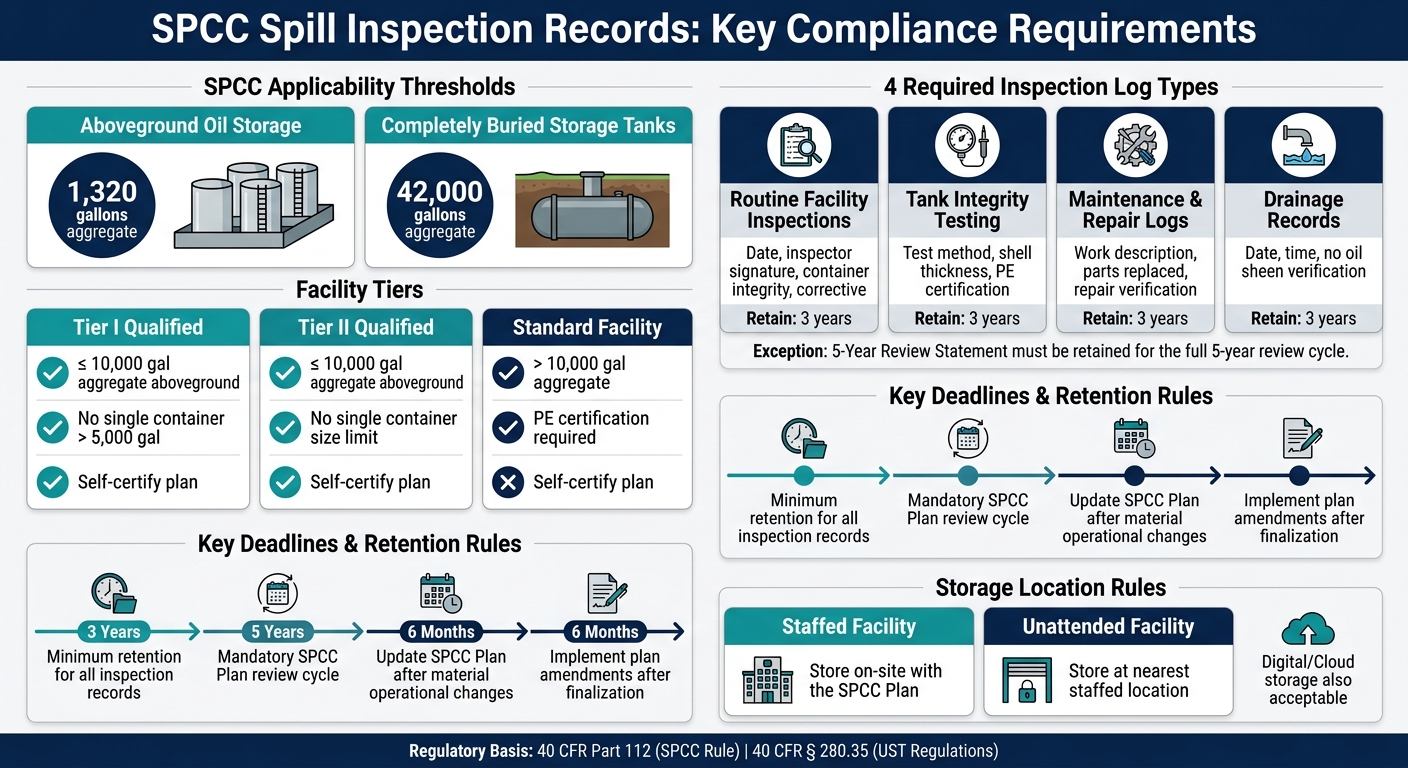
SPCC Inspection Records: Key Requirements at a Glance
Good vs Bad Environmental Inspections: Pass with Flying Colors! | Resource Management Associates
sbb-itb-aa4586a
Understanding SPCC Requirements for Spill Inspection Records
The SPCC rule (40 CFR Part 112), introduced in 1973 under the Clean Water Act [2], is designed to prevent oil discharges into navigable waters.
"The goal of this regulation is to prevent oil from reaching navigable waters and adjoining shorelines, and to contain discharges of oil." – US EPA [2]
Facilities subject to this regulation must develop and maintain a written SPCC Plan, which outlines both preventive and responsive measures [2][3]. Below, we’ll cover which facilities fall under SPCC requirements and their specific recordkeeping responsibilities.
Facilities Covered Under SPCC
SPCC applies to non-transportation facilities that manage or store oil in quantities that could potentially discharge into U.S. navigable waters [2]. The rule’s applicability is determined by the facility’s oil storage capacity, with only containers holding 55 gallons or more included in the calculation [1].
| Trigger Condition | Threshold |
|---|---|
| Aboveground oil storage | > 1,320 gallons aggregate |
| Completely buried storage tanks | > 42,000 gallons aggregate |
Smaller operations may qualify as Tier I or Tier II Qualified Facilities, which are limited to a total of 10,000 gallons of aggregate aboveground storage. The distinction lies in container size: Tier I facilities cannot have any single container exceed 5,000 gallons, while Tier II facilities have no such restriction [3]. Qualified facilities are allowed to self-certify their SPCC Plans. However, facilities with aggregate capacities above 10,000 gallons must have their plans certified by a licensed Professional Engineer (PE) [3].
Key Recordkeeping Obligations Under SPCC
SPCC regulations require facilities to establish written procedures for inspections and testing, aligned with recognized industry standards [5]. According to 40 CFR 112.6:
"You must certify that… You have established procedures for required inspections and testing in accordance with industry inspection and testing standards or recommended practices." [5]
The SPCC Plan must remain on-site (or at the nearest field office for unattended sites) and must be reviewed at least every five years. Any material changes to the facility or operations must be documented and incorporated into the Plan within six months [3][4]. Each review must include a signed statement indicating whether amendments to the Plan are necessary [4].
These recordkeeping requirements form the foundation for understanding the data fields that must be included in spill inspection records.
What Spill Inspection Records Must Include
Keeping thorough and accurate records is essential for effective spill management and meeting spill plan requirements. This section outlines the critical information your inspection records should contain and highlights the distinctions between routine inspections and those prompted by specific events.
Required Data Fields in Inspection Logs
Every inspection log should, at a minimum, include the following details:
- Date of inspection
- Inspector’s name
- Equipment or area inspected
- Condition of each component observed
If any issues are identified – such as cracks, leaks, or corrosion – the log must also note the corrective actions taken or planned. To ensure compliance with 40 CFR Part 112, these records must be signed by a supervisor or the inspector for validation [1].
The EPA provides Appendix G inspection checklists as a helpful tool for structuring these logs. These checklists are available in PDF, Microsoft Word, and Excel formats, organized by facility type – such as Onshore (non-production), Onshore Production/Drilling, Offshore, and Tier I Qualified Facilities [1]. Using the Excel format can streamline data entry and make it easier to manage and store records digitally.
"Model SPCC Plans in Appendices D, E, and F, as well as examples of SPCC Plan language in the guidance, are provided as suggestions and illustrations only." – US EPA [1]
One frequently overlooked field involves dike drainage events. Logs must confirm that accumulated water was inspected for oil sheen before opening the drainage valve. Additionally, they must include a record of supervision during drainage and explicitly state whether oil was absent in the drained water – not just that water was removed [1].
Routine vs. Special Inspection Records
The type of inspection determines the structure and content of the records. Routine visual inspections are scheduled periodically, often monthly, and focus on equipment integrity by identifying leaks, corrosion, or structural issues in tanks and containment systems. Special inspections, on the other hand, are initiated by specific events, such as heavy rainfall in a diked area or an actual spill.
| Record Type | Trigger | Key Data Fields | Regulatory Basis |
|---|---|---|---|
| Routine Visual Inspection | Scheduled (monthly/periodic) | Date, inspector name, equipment ID, observed condition, corrective actions | 40 CFR 112.7(e) |
| Dike Drainage Log | Event-driven (rainfall/discharge) | Sheen observation, valve open/close times, supervisor signature | 40 CFR 112.8(c)(10) |
| Integrity Testing Record | Periodic (e.g., every 5–10 years) | Test method (e.g., ultrasonic), shell thickness measurements, PE certification | Industry standards (e.g., API 653, STI SP001) |
For facilities using alternative inspection methods, it’s essential to document the technical rationale and secure certification from a Professional Engineer (PE) [1].
Retaining, Storing, and Reviewing Inspection Records
Make sure to maintain signed inspection logs that are easily accessible for regulatory reviews.
Retention Period Requirements
According to 40 CFR Part 112, facilities must keep all inspection and test records for at least three years [1]. This includes both routine visual inspection logs and integrity testing results. To remain compliant, every record must be signed [1].
"All SPCC inspection records must be kept for at least three years and be readily available for EPA inspection upon request (40 CFR § 112.7(e))." – Ecesis [6]
Keeping Records Accessible During Audits
Inspection records should be stored on-site alongside the SPCC Plan. For facilities without on-site staff, these records must be kept at the nearest staffed location [1]. The EPA requires that records be immediately accessible during audits.
Many facilities now use digital storage solutions, such as cloud-based systems, which make records easy to search and protect them from physical damage.
"During an EPA audit or enforcement action following a spill, your inspection documentation is the primary evidence of regulatory compliance and due diligence." – Ecesis [6]
Having accessible records also helps streamline updates to the SPCC Plan when necessary.
Updating SPCC Plans Based on Inspection Findings
Inspection records do more than demonstrate compliance – they also highlight areas where SPCC Plans may need adjustments. If inspections reveal changes that affect a facility’s discharge potential, the plan must be updated within six months of identifying the issue, with implementation completed no later than six months after the amendment is finalized [4].
Additionally, SPCC Plans must undergo a review at least once every five years, even if no significant changes have occurred [4]. During this review, use past inspection records to evaluate whether the plan’s prevention measures still align with current site conditions. The required statement to document this review is: "I have completed review and evaluation of the SPCC Plan for (name of facility) on (date), and will (will not) amend the Plan as a result" [4]. Including this statement in an appendix ensures it’s readily available during audits.
| Requirement | Standard |
|---|---|
| Retention period | Minimum 3 years |
| Storage location (staffed facility) | On-site with the SPCC Plan |
| Storage location (unattended facility) | Nearest staffed facility |
| Plan amendment trigger | Within 6 months of a material change |
| Mandatory plan review cycle | At least every 5 years |
Common Compliance Challenges and Risks
Even the best-designed SPCC (Spill Prevention, Control, and Countermeasure) Plans can fall short if daily documentation is incomplete. This section highlights common pitfalls in recordkeeping and the potential consequences of those lapses.
Recurring Documentation Problems
Some of the most frequent issues include unsigned inspection logs, missing data, and poor document retention practices. Beyond these basics, facilities often neglect to record the specific steps taken to prevent overfills or fail to document the results of regular testing for system effectiveness. Another common oversight is delaying the certification of technical amendments.
For Tier I qualified facilities, not using the EPA’s Appendix G template – or omitting a detailed cross-reference section in an alternative plan – leads to frequent noncompliance. Tier II facilities, on the other hand, sometimes exacerbate the issue by improperly self-certifying parts of a plan that legally require review and approval by a licensed Professional Engineer (PE).
One of the most critical errors is the absence of a management approval signature, which can render the entire record set invalid and noncompliant [1].
These documentation gaps not only complicate compliance efforts but also leave facilities vulnerable to serious legal and operational risks.
Risks of Noncompliance
Inadequate recordkeeping can result in legal and regulatory challenges – even in the absence of a spill. The EPA has emphasized this point clearly:
"The statutory provisions and EPA regulations described in this guidance document contain legally binding requirements." – US EPA [1]
Under 40 CFR Part 112, facilities must both create and implement their SPCC Plans. Documentation serves as the primary evidence that a plan is being followed as required [1][7]. Without accurate and complete records, facilities cannot demonstrate compliance during audits or enforcement actions. Missing logs or PE certifications can lead to enforcement measures, including fines, environmental damage, safety risks for employees, and long-term harm to the facility’s reputation [8].
These risks highlight the importance of implementing proper documentation practices, which will be explored in the next section.
Documentation Methods and Tools
Keeping records isn’t just about knowing what to log – it’s about how you manage and maintain those records. Facilities today generally rely on two systems: paper-based methods or digital tools. Each comes with its own strengths and challenges.
Comparison of Inspection Record Types
The table below breaks down the four key inspection log types required under SPCC regulations. It highlights the essential details these logs must include, how long they need to be retained, and where they should be stored.
| Inspection Log Type | Key Content Fields | Retention Period | Storage Location |
|---|---|---|---|
| Routine Facility Inspections | Date, inspector signature, container integrity, leak detection, corrective actions | 3 years [9] | On-site or accessible digital repository |
| Tank Integrity Testing | Method (e.g., STI SP001, API 653), shell thickness, PE certification, test results | 3 years [9] | SPCC Plan file or maintenance records |
| Maintenance & Repair Logs | Description of work, parts replaced, date of completion, verification of repair | 3 years [9] | Maintenance office or EHS software |
| Drainage Records | Date, time, inspector, verification of no oil sheen before discharge from diked areas | 3 years [9] | Near secondary containment or digital log |
There’s one notable exception: the five-year review statement. This document, which confirms the completion of a mandatory SPCC Plan review, must be kept for the full five-year review cycle, not just three years [4].
These records form the backbone of compliant SPCC documentation and play a critical role in any spill prevention plan.
Paper vs. Digital: Practical Considerations
When deciding between paper and digital recordkeeping, the differences are mostly logistical. Paper systems require physical retrieval during audits, and there’s always the risk of misplacing or damaging records. On the other hand, digital systems offer several advantages:
- Instant access to historical records.
- Automated reminders for upcoming inspections.
- Version control to track amendments.
- Support for secure electronic signatures to meet regulatory requirements [4][10][11].
Digital tools not only streamline record management but also ensure that records are readily available during EPA audits, aligning with earlier strategies to maintain accessibility.
Aligning Records with Your SPCC Plan
Accurate recordkeeping is only part of the equation – your logs must also align with your SPCC Plan to ensure compliance. As mentioned earlier, EPA audits require that records clearly match the procedures outlined in the Plan.
For Tier I Qualified Facilities (those with an aggregate aboveground storage capacity of 10,000 gallons or less), the simplest option is the EPA’s Appendix G template. This format integrates the SPCC Plan with its recordkeeping requirements, creating a single, audit-friendly document [5]. Facilities using custom forms or proprietary software must include a cross-reference section in their Plan, linking each form to the relevant regulatory requirement in 40 CFR Part 112 [5].
"The plan is the foundation of your entire spill prevention program: it documents what oil you store, how it is contained, how you prevent discharges, and what you do if a spill occurs." – Ecesis [9]
Another critical aspect of alignment involves material changes. If a facility adds storage containers, modifies piping, or changes the type of product stored, the SPCC Plan must be updated within six months [4][5]. Keeping records consistent with the most current version of the Plan is non-negotiable. The EPA emphasizes that neglecting to update records after such changes poses a direct compliance risk [5].
Conclusion: Meeting SPCC Requirements Through Accurate Recordkeeping
Keeping detailed spill inspection records shows that your facility takes oil storage management seriously. As noted, "During an EPA audit or enforcement action following a spill, your inspection documentation is the primary evidence of regulatory compliance and due diligence." [6] Without proper documentation, even a well-operated facility can appear noncompliant.
According to 40 CFR § 112.7(e), you must retain inspection logs, maintenance records, integrity test results, and corrective action reports for at least three years. These records should be readily accessible to the EPA when requested [6]. This isn’t just about meeting a requirement – it’s about proving that your equipment is in good condition, your team is addressing issues promptly, and your spill prevention program is effective.
To stay compliant, ensure your documentation is always up to date. Any changes to your facility’s operations should be reflected in your SPCC Plan and corresponding records. Outdated or inconsistent documentation is a common issue that can lead to compliance violations during audits.
Whether you rely on paper logs or digital systems, make sure your records are complete, well-organized, and easily accessible. Using standardized checklists and clear tracking for corrective actions can help keep your records aligned with your SPCC Plan, providing strong evidence of compliance.
Disclaimer: This content is for informational purposes only. Consult official regulations and qualified professionals before making sourcing or formulation decisions.
FAQs
Does my facility need an SPCC Plan?
Your facility needs an SPCC Plan (Spill Prevention, Control, and Countermeasure Plan) if it manages oil or oil products and meets one of these conditions:
- Aboveground storage capacity of more than 1,320 U.S. gallons.
- Completely buried storage capacity of over 42,000 U.S. gallons.
This requirement applies if there’s a realistic chance of oil discharge into navigable waters. Allan Chemical Corporation provides technical-grade solutions to help meet safety and regulatory compliance requirements.
What counts as a “material change” requiring an SPCC update?
A “material change” refers to any adjustment in a facility’s design, construction, operations, or maintenance that could notably affect the likelihood of oil discharge into navigable waters or shorelines. Common examples include:
- Adding, removing, or moving storage containers
- Installing or replacing piping systems
- Modifying secondary containment structures
- Adjusting products, services, or operational procedures
These updates must be documented within six months and fully implemented within six months after documentation.
Can I use digital inspection logs and e-signatures for EPA audits?
Yes, digital systems are a practical solution for managing inspection logs and records. Regulations mandate keeping signed, precise records to prove compliance, and digital platforms excel at this by providing secure audit trails. These systems can preserve time-stamped actions and document versions, making them easily accessible for review. For companies such as Allan Chemical Corporation, these tools streamline compliance efforts by centralizing data and ensuring preparedness for audits or regulatory reviews.


Comments are closed