
Exporting chemicals from the U.S.? If your product is regulated under TSCA Section 12(b), you must notify the EPA before shipment. This applies to substances subject to specific TSCA rules or orders, including Persistent Bioaccumulative Toxic (PBT) chemicals, mercury, asbestos, and polychlorinated biphenyls (PCBs). Notifications ensure importing countries are informed about potential risks and U.S. regulations.
Key Points:
- Notification Timeline: Submit notices within 7 days of intent to export or shipment date.
- EPA’s Role: Informs the importing government within 5 working days of receiving your notice.
- Scope: Includes chemicals under TSCA Sections 4, 5(e), 5(f), 6, or 7. Impurities, no matter how small, must also be reported.
- Exemptions: Articles or substances below de minimis thresholds are typically exempt.
Staying compliant protects your business from penalties and ensures smooth international operations.
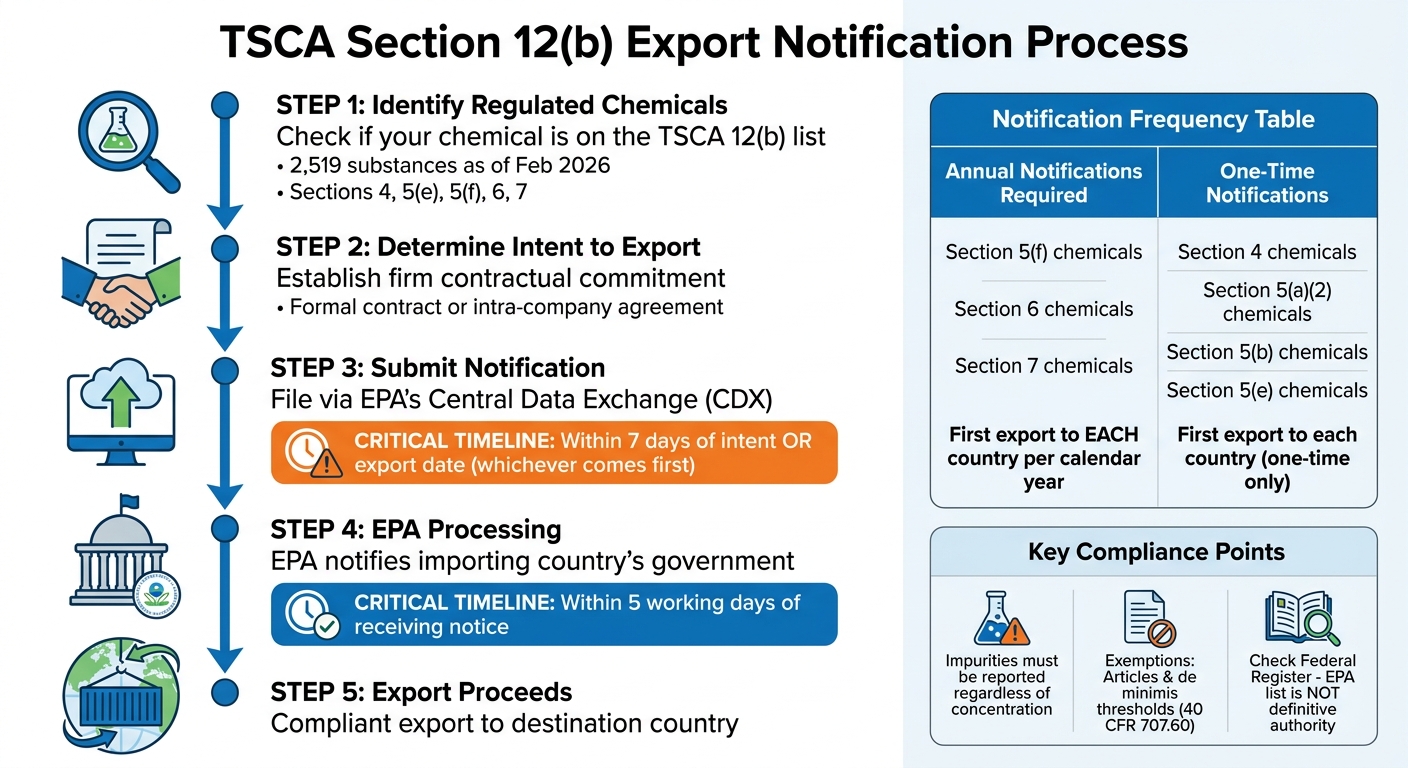
TSCA Section 12(b) Export Notification Process and Timeline
1. Persistent Bioaccumulative Toxic (PBT) Chemicals
Chemical Category or Specific Substance Classification
Persistent Bioaccumulative Toxic (PBT) chemicals are substances that remain in the environment for extended periods, accumulate in living organisms, and are harmful to both humans and wildlife. Their persistence and ability to move up the food chain make them particularly concerning. Some commonly regulated PBT chemicals under TSCA Section 12(b) export notification include decabromodiphenyl ether (CAS No. 13654-09-6), hexabromobiphenyl (CAS No. 36355-01-8), polychlorinated biphenyls (PCBs) (CAS No. 1336-36-3), and mercury (CAS No. 7439-97-6). Industries impacted by these regulations include chemical manufacturing, electronics (due to the use of flame retardants), waste management (handling PCBs), and industrial operations involving mercury or PFAS-related materials.
Regulatory Requirement under TSCA Section 12(b)
PBT chemicals are managed under TSCA Section 6, which addresses hazardous substances and mixtures already in use. Section 12(b) specifically requires exporters to notify the EPA when these chemicals are shipped outside the United States. For PBTs regulated under Section 6, exporters must file a notification for the first shipment to each country within a calendar year. Upon receiving this notification, the EPA informs the importing country’s government within five working days, detailing the chemical’s regulatory status in the U.S. This process highlights the stringent rules exporters must navigate, with additional guidance tailored to specific industries.
Relevance for Exporters and Regulated Industries
Exporters are required to submit their notices within seven days of either forming the intent to export or the actual export date, whichever comes first. The "intent to export" is defined as a firm contractual agreement or a comparable intra-company arrangement to ship the chemical. Notifications must be submitted electronically via the EPA’s Central Data Exchange (CDX) to meet compliance requirements.
This content is intended for informational purposes only. Always consult official regulations and qualified professionals when making sourcing or formulation decisions.
sbb-itb-aa4586a
2. Section 4 Test Rule Chemicals
Chemical Category or Specific Substance Classification
Section 4 chemicals are substances or mixtures that fall under the final TSCA Section 4 test rules or enforceable consent agreements (ECAs) [2][5]. Manufacturers are required to conduct testing on these chemicals to provide necessary health and environmental data. Examples include C9 Aromatic Hydrocarbon Fraction, Commercial Hexane, Di(heptyl, nonyl, undecyl) Phthalate, Tetrabromobisphenol B, and Fluoropolymer Composite Substances [1]. It’s important to note that impurities in Section 4 chemicals must be reported, regardless of their concentration [1].
Regulatory Requirement under TSCA Section 12(b)
TSCA Section 12(b) mandates that exporters of Section 4 chemicals notify the EPA [2]. This notification requires only one submission per country, and once received, the EPA informs the importing government within five working days. Export notices must be postmarked within seven days of either the intent to export or the actual export date [2]. These strict rules highlight the importance of staying up-to-date with regulatory timelines and requirements.
Relevance for Exporters and Regulated Industries
Section 4 requirements expire after a specific period [2][5]. To avoid unnecessary notifications, exporters should consult the EPA’s Sunset Table to confirm whether the requirement still applies. Additionally, they should verify that the substance is not regulated under TSCA Sections 5, 6, or 7 or other TSCA Inventory requirements, as these sections may still impose notification obligations [2][5]. The term "exporter" refers to the principal party responsible for controlling the shipment of a chemical outside U.S. customs territory [2]. Companies managing these shipments should also review the checklist for TSCA import compliance to ensure end-to-end regulatory adherence.
This content is for informational use only. Always refer to official regulations and consult qualified professionals for decisions related to sourcing or formulation.
3. Section 5(e) Consent Order Chemicals
Chemical Category or Specific Substance Classification
Section 5(e) Consent Order chemicals refer to substances regulated under Section 5 of the Toxic Substances Control Act (TSCA) when the EPA determines they pose unreasonable risks or lack adequate data [1][3]. A key distinction of these chemicals is that their impurities are not exempt from export notification requirements, regardless of concentration levels [1]. This sets them apart from many other TSCA reporting categories and highlights the importance of meticulous compliance.
Regulatory Requirement under TSCA Section 12(b)
Under TSCA Section 12(b), exporters of Section 5(e) chemicals must notify the EPA [1][3]. For each importing country, exporters are required to submit a separate notice [3]. Once the EPA receives this notification, it must inform the importing country’s government within five working days. Additionally, notices must be postmarked no later than seven days after the intent to export or the actual export date, whichever occurs first [3].
Relevance for Exporters and Regulated Industries
Exporters play a critical role in ensuring TSCA compliance. An exporter is defined as the principal entity responsible for managing and controlling the transfer of a chemical substance outside U.S. borders [3]. This intent must be backed by a formal contract or a similar internal agreement [3]. Importantly, if a notice for a specific country was submitted before January 6, 2007, no new notice is required for exporting Section 5(e) substances to that same country [3]. To confirm the status of a substance, exporters should consult the EPA’s Substance Registry Services (SRS) or refer to the relevant 40 CFR 700–799 regulations, as the TSCA 12(b) list is not the definitive authority [1].
This content is for informational purposes only. Consult official regulations and qualified professionals before making sourcing or formulation decisions.
4. Section 5(f) Rule Chemicals
Chemical Category or Specific Substance Classification
Section 5(f) of the Toxic Substances Control Act (TSCA) focuses on new chemical substances or uses that the EPA identifies as posing an unreasonable risk to health or the environment. What sets Section 5(f) apart is its annual notification requirement, which applies while more comprehensive Section 6 rules are being developed. This regulation ensures ongoing oversight, unlike the one-time notifications required under other TSCA sections. Importantly, even minor impurities in Section 5(f) chemicals must be reported.
Regulatory Requirement under TSCA Section 12(b)
Section 5(f) chemicals, like those under Section 5(e), require annual notifications. Exporters must also comply with TSCA Section 12(b), which mandates an export notice for each destination country. These notices must be postmarked within seven days of the intent to export, and the EPA must be notified within five working days. The annual notification requirement for Section 5(f) chemicals makes it distinct from other TSCA provisions.
Relevance for Exporters and Regulated Industries
Exporters handling Section 5(f) chemicals need a reliable chemical compliance checker to ensure they submit the "first export of the year" notification for every destination country. The exporter, defined as the principal party responsible for controlling the shipment, must base their notice on a binding contract or equivalent intra-company agreement. Relying solely on the EPA’s 12(b) list is not sufficient; exporters should refer to the specific regulations in 40 CFR 700-799 and the Federal Register for the latest Section 5(f) actions.
Availability of Compliance Resources or Sourcing Support
The EPA provides several tools to help with compliance. Notifications can be submitted electronically through the EPA’s Central Data Exchange (CDX) 12(b) module. For assistance, contact the TSCA Hotline at 202-554-1404 or email TSCA-Hotline@epa.gov. Additionally, the EPA’s Substance Registry Services (SRS) is a searchable database that helps identify if a chemical is subject to TSCA 12(b) requirements.
This content is for informational purposes only. Always consult official regulations and qualified professionals before making any sourcing or formulation decisions.
5. Section 6 Rule Chemicals
Chemical Category or Specific Substance Classification
Section 6 of TSCA addresses chemical substances or mixtures identified as posing unreasonable risks to human health or the environment. Once the EPA proposes or finalizes a rule under this section, the affected chemicals become subject to export notification requirements. Examples of such substances include Polychlorinated Biphenyls (PCBs), mercury, and asbestos [2]. Importantly, unlike some other TSCA categories, impurities in Section 6 chemicals are not exempt from these export notification rules [1].
Regulatory Requirement under TSCA Section 12(b)
Exporters of Section 6 chemicals must notify the EPA for the first export to each country within a calendar year [2]. This notification must be backed by a firm contractual commitment. Once the EPA receives the notice, it has five working days to inform the importing government about the chemical and any related U.S. regulatory actions [2]. This tight timeline highlights the importance of accurate and timely tracking of export notifications each year.
Relevance for Exporters and Regulated Industries
To comply with these regulations, exporters must maintain detailed annual records. Section 6 chemicals, like other TSCA-regulated substances, require yearly export notifications. The "exporter" is defined as the entity with the authority and responsibility to control shipments leaving the United States [2]. To ensure compliance, exporters should verify chemical statuses through the SRS database and refer to regulatory details in 40 CFR 700-799 [1].
Availability of Compliance Resources or Sourcing Support
Exporters can use the EPA’s Central Data Exchange (CDX) system for Section 6 compliance, guided by the 12(b) user manual [2]. For assistance, contact the TSCA Hotline at 202-554-1404 or via email at TSCA-Hotline@epa.gov [4]. The Substance Registry Services (SRS) allows users to search by CAS number or synonym and download lists in formats like XML, Excel, or JSON [1]. Before filing, review article exemptions under 40 CFR 707.60(b) [2].
This content is for informational purposes only. Always consult official regulations and qualified professionals before making sourcing or formulation decisions.
6. Chemical Mixtures Subject to Export Notification
Chemical Category or Specific Substance Classification
Mixtures containing regulated chemicals fall under the same strict notification requirements outlined in TSCA Section 12(b) as single substances. These mixtures require export notification if they include chemicals regulated under TSCA Sections 4, 5, 6, or 7. Specifically, notification is necessary when a mixture contains a chemical subject to data requirements under Section 4 or 5(b), an order under Section 5, or a proposed or finalized rule under Sections 5 or 6. Importantly, impurities in these mixtures must be reported regardless of their concentration levels. This aspect sets TSCA Section 12(b) apart from other reporting obligations, making it crucial for exporters to review all components, including trace impurities, within their mixtures or use a chemical safety classification finder for guidance.
Regulatory Requirement under TSCA Section 12(b)
Exporters must follow specific notification protocols depending on the TSCA section applicable to the mixture’s components:
- For mixtures containing substances regulated under Sections 5(f), 6, or 7, a notice must be submitted for the first export to each country every calendar year.
- For mixtures with substances regulated under Sections 4, 5(a)[2], 5(b), or 5(e), a one-time notice is required for the first export to each country.
These notifications must be postmarked within seven days of the intent to export or the actual export date.[2] After submission, the EPA has five working days to inform the importing government about the chemical and any related U.S. regulatory actions.
Relevance for Exporters and Regulated Industries
"Section 12(b) of TSCA requires that any person who exports or intends to export a chemical substance or mixture that is subject to certain rules or orders under TSCA submit a notification regarding the export to EPA." – US EPA[1]
For mixtures, the exporter is considered the party responsible for managing the shipment. Exporters can verify the regulatory status of mixture components using the EPA’s Substance Registry Services (SRS), which, as of February 14, 2026, includes 2,519 substances requiring notification.[1] However, notification is typically not required for substances in mixtures below the de minimis concentration thresholds outlined in 40 CFR 707.60(c) or for substances embedded in articles not intended for release.
Availability of Compliance Resources or Sourcing Support
Notifications must be submitted electronically through the EPA’s Central Data Exchange (CDX). These submissions should include the exporter’s details, the mixture’s name, export date(s), destination country, and the relevant TSCA section.[2] Exporters should also verify if any chemical substance in the mixture has reached its "sunset" under Section 4, as it may still trigger other TSCA notification requirements. Understanding these rules is essential for navigating the regulated chemical market effectively.
This content is for informational purposes only. Always consult official regulations and qualified professionals before making sourcing or formulation decisions.
7. Allan Chemical Corporation‘s Sourced Chemicals for Regulated Industries
Relevance for Exporters and Regulated Industries
Allan Chemical Corporation simplifies the export notification process for its clients by adhering to TSCA regulatory requirements. The company specializes in sourcing chemicals for industries like pharmaceuticals, food, cosmetics, ceramics, and electronics. With over 40 years of experience, Allan Chemical Corporation understands the challenges exporters face when navigating the 2,519 entries on the EPA’s TSCA 12(b) list as of February 2026. This list includes chemicals regulated under Sections 4 (test rules), 5 (consent orders and SNURs), 6 (rules for substances like PCBs, mercury, and asbestos), and 7 (pending actions). By addressing these complexities, the company provides exporters with dependable compliance support.
Clients working with Allan Chemical Corporation gain access to technical assistance that identifies chemicals requiring notification under TSCA Section 12(b). Additionally, the company’s partnerships with vetted manufacturers ensure traceability and supply the necessary documentation for TSCA verification.
Availability of Compliance Resources or Sourcing Support
Allan Chemical Corporation enhances its technical expertise with practical resources to help clients meet compliance standards. The company supplies technical-grade and compendial-grade chemicals that align with USP, FCC, ACS, and NF standards. Alongside these products, it provides essential documentation, such as Certificates of Analysis and Safety Data Sheets, which exporters can use to confirm TSCA Section 12(b) compliance through the EPA’s Substance Registry Services and the 12(b) list. It’s worth noting that compliance is governed by 40 CFR 700-799, not solely the EPA’s published list.
The company’s just-in-time delivery system and adaptable batch sizes are particularly useful for exporters working within tight notification deadlines. Its customer-focused approach also supports regulated industries by helping them track Section 4 "sunset" dates and monitor regulatory changes that could trigger new notification requirements, even after testing obligations have ended.
This content is for informational purposes only. Always consult official regulations and qualified professionals before making sourcing or formulation decisions.
8. How to Access the EPA TSCA 12(b) List
Importance for Exporters and Regulated Industries
To meet the notification requirements under TSCA 12(b), exporters need reliable access to the EPA’s Substance Registry Services (SRS). This database is critical for ensuring compliance with the regulations outlined earlier.
The TSCA 12(b) list, maintained within the SRS, currently features 2,519 entries (as of February 14, 2026). The most recent administrative review occurred on March 11, 2025. Exporters can search this database using CAS numbers, EPA IDs, PMN numbers, or substance names. Additionally, the list can be downloaded in formats like Excel, XML, or JSON, making it easier to compare inventory lists with regulated substances.
That said, the EPA emphasizes that the list itself is not definitive. According to the agency, "The list is NOT the governing authority; the regulations as published in the Federal Register are — as well as actions taken by EPA" [1]. This means exporters must also consult 40 CFR Parts 700-799 and keep an eye on the Federal Register for updates that may not yet be reflected in the SRS database. Using this resource effectively helps ensure compliance with inventory checks and electronic notification requirements.
Tools and Resources for Compliance
To streamline the notification process, exporters are encouraged to submit TSCA 12(b) notifications electronically via the Central Data Exchange (CDX). The CDX 12(b) user guide provides step-by-step instructions for technical support [2]. The SRS also offers "Substance Search" and "Advanced Search" tools, which allow users to filter by specific regulatory sections. These tools can help identify whether a chemical is subject to additional TSCA requirements. For instance, chemicals regulated under Section 4 test rules should be reviewed further using the "Sunset Dates/Status" table.
Export notices must be postmarked no later than seven days after deciding to export or on the actual export date, whichever comes first [2]. For additional guidance, exporters can reach out to the TSCA Hotline at 202-554-1404 or email TSCA-Hotline@epa.gov.
This content is for informational purposes only. Always refer to official regulations and consult qualified professionals for sourcing or compliance decisions.
Import and Export Certification, Allegations/Substantial Risk
Compliance Tips for Chemical Exporters
Keeping accurate records is a cornerstone of complying with TSCA Section 12(b). Exporters need to document key details such as the exporter’s name and address, the chemical’s identity (both name and CAS number), export dates, destination countries, and the specific TSCA section (4, 5, 6, or 7) that necessitates the notice [2]. These records should also account for all components of a mixture, including trace impurities that might be relevant for TSCA reporting [2]. This level of precision ensures timely and accurate notifications.
Export notices must be postmarked within seven days of either forming the intent to export or the actual export date, whichever comes first [2]. The frequency of notifications depends on the regulatory trigger. For chemicals regulated under Sections 5(f), 6, or 7, exporters must submit annual notices for each chemical and destination country. Meanwhile, chemicals under Sections 4, 5(a), 5(b), or 5(e) only require a one-time notice per destination country [2]. Exporters should retain copies of all submissions made through the EPA’s Central Data Exchange (CDX) for their records [2].
Staying informed is equally important. Regularly check the Federal Register, as the EPA’s 12(b) list is not exhaustive. As the US EPA clarifies:
"The list is NOT the governing authority; the regulations as published in the Federal Register are — as well as actions taken by EPA." [1]
Exporters should monitor the Federal Register for updates on TSCA Section 4, 5, 6, or 7 actions and track "sunset dates" for Section 4 chemicals to know when testing requirements end [2]. For additional guidance, the TSCA Hotline is available at 202-554-1404 or TSCA-Hotline@epa.gov [2].
Manufacturers must also label new chemicals "for export" to qualify for exemptions from pre-manufacture notice (PMN) requirements [2]. It’s essential to confirm whether shipments meet de minimis concentration exemptions under 40 CFR 707.60(c) or the article exemption under 40 CFR 707.60(b) [2]. For detailed guidance on electronic submissions, the CDX 12(b) user guide provides step-by-step instructions [2].
This content is for informational purposes only. Consult official regulations and qualified professionals before making sourcing or formulation decisions.
Conclusion
TSCA Section 12(b) export notifications are a legal requirement for exporters shipping regulated chemicals beyond U.S. customs territory. As of February 14, 2026, the list of regulated substances includes 2,519 entries. Knowing which chemicals require notification is crucial to avoid civil penalties, legal action, or shipment refusals[1].
Exporters must follow strict timelines. Notices must be postmarked no later than seven days after forming a definite intent to export or on the actual date of export, whichever comes first[2]. Once submitted, the U.S. Environmental Protection Agency (EPA) is obligated to notify the receiving government within five working days, ensuring transparency in international regulations.
Even trace impurities must be reported, regardless of their concentration[1]. While the TSCA 12(b) list serves as a reference, the definitive regulations are outlined in the Federal Register and 40 CFR 700–799[1].
Adhering to these requirements not only mitigates regulatory risks but also ensures uninterrupted business operations. For industries like pharmaceuticals, food, cosmetics, ceramics, and electronics, compliance with TSCA Section 12(b) safeguards both operational continuity and market reputation. Allan Chemical Corporation, with over 40 years of expertise, provides just-in-time delivery and regulatory support, offering technical-grade and compendial-grade solutions (USP, FCC, ACS, NF) to meet the needs of exporters.
This content is for informational purposes only. Always consult official regulations and seek qualified professional advice before finalizing export decisions.
FAQs
How do I know if my chemical or mixture triggers TSCA 12(b)?
To figure out whether your chemical or mixture requires a TSCA Section 12(b) export notification, you need to confirm if it falls under any TSCA rules, orders, or regulations. These include:
- Data obligations under Sections 4 or 5(b)(2).
- Orders issued under Section 5.
- Proposed or finalized rules under Sections 5 or 6.
- Pending actions under Sections 5 or 7.
This requirement applies no matter the impurity concentration.
What counts as “intent to export” under TSCA 12(b)?
"Intent to export" under TSCA 12(b) refers to the decision or plan to export a chemical substance or mixture regulated under the Toxic Substances Control Act (TSCA). Exporters are required to notify the Environmental Protection Agency (EPA) within seven days of deciding to export or by the actual export date – whichever comes first. This notification helps ensure compliance with TSCA rules for regulated chemicals.
Do I need to notify the EPA if only an impurity is regulated?
No, you don’t need to notify the EPA if the only regulated substance is an impurity, regardless of its amount or concentration.


Comments are closed