
The African Union (AU) is working to standardize pesticide regulations across its member states to improve agriculture and trade. This effort addresses inconsistencies in pesticide rules, which currently vary by country, creating barriers for farmers and exporters. Harmonized regulations aim to simplify pesticide registration, align Maximum Residue Limits (MRLs), and reduce trade rejections due to non-compliance.
Key actions include:
- Unified Standards: Establishing shared guidelines for pesticide approval and use.
- Data Sharing: Allowing countries to accept scientific reviews and registrations from other member states.
- Biopesticides: Promoting safer alternatives with fewer trade restrictions.
- Regional Collaboration: Engaging Regional Economic Communities (RECs) like SADC and ECOWAS to implement AU strategies.
These changes are expected to enhance food safety, streamline trade, and provide farmers access to safer pest control methods.
Key Players in the Harmonization Process
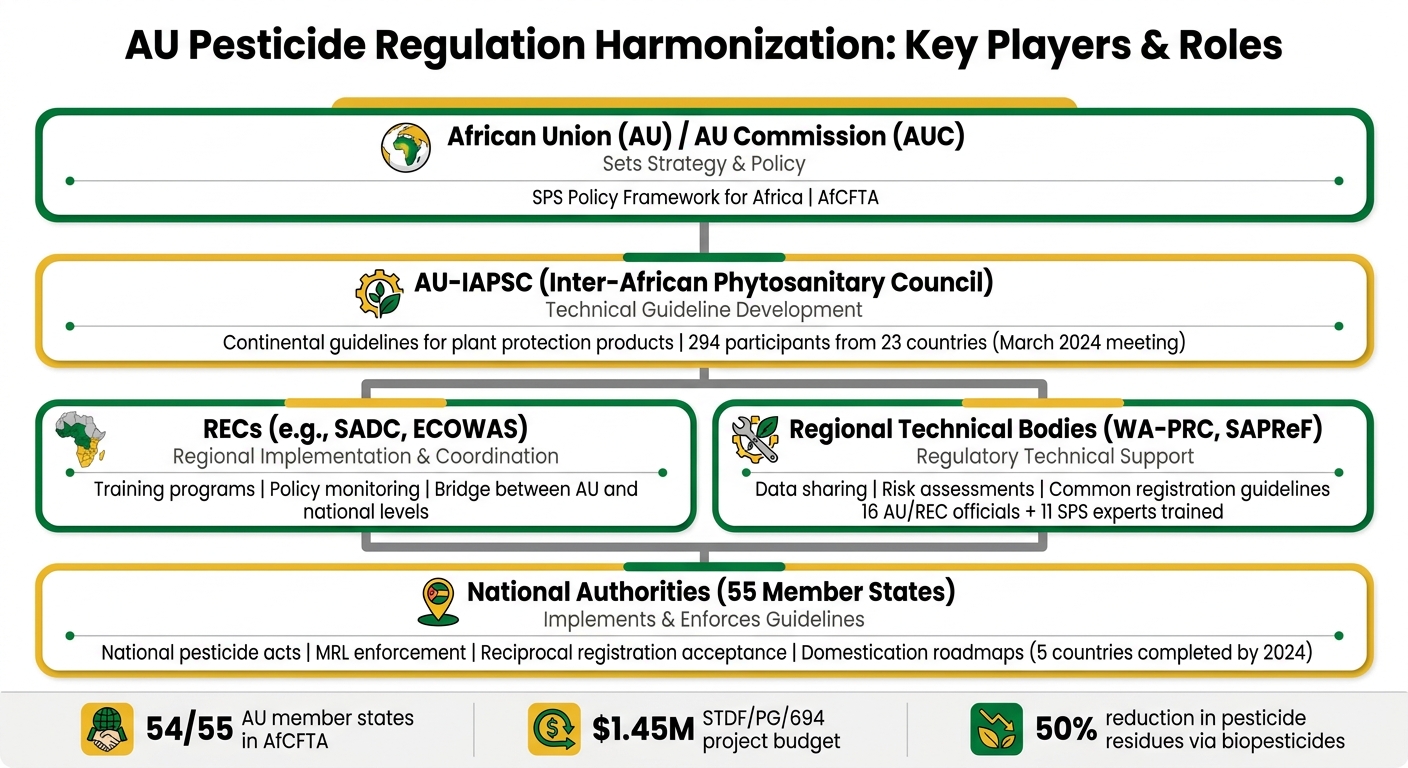
AU Pesticide Regulation Harmonization: Key Players & Roles
Bringing pesticide regulations into alignment across 55 member states is no small feat. It demands coordinated efforts from institutions at every level, from the African Union (AU) to individual national governments. Here’s how these key players contribute.
The African Union‘s Coordinating Role
The African Union (AU) provides strategic direction through its Sanitary and Phytosanitary (SPS) Policy Framework for Africa. This framework is a blueprint for aligning regulatory systems and advancing trade under the African Continental Free Trade Area (AfCFTA). As AU Commissioner Josepha Sacko puts it:
"The AU SPS Policy Framework lays out a roadmap to maximize the efficiency and effectiveness of SPS systems on the continent to enhance protect human health and facilitate intra-African agricultural and food trade." [4]
The AU Commission (AUC) oversees efforts to align pesticide regulations with global standards, working with both regional and national bodies. Meanwhile, the AU Inter-African Phytosanitary Council (AU-IAPSC) acts as the technical leader, developing guidelines for the registration and management of plant protection products. For instance, in March 2024, the AU-IAPSC hosted a meeting with 294 participants from 23 countries to advance unified biopesticide guidelines [1][2].
Regional Economic Communities and Technical Bodies
The AU collaborates closely with its eight Regional Economic Communities (RECs) – such as SADC and ECOWAS – to translate continental strategies into regional action [5][7]. These communities play a critical role in harmonization by coordinating policies, running training programs, and monitoring progress. They serve as the bridge between the AU’s overarching goals and the specific actions taken by member states.
Technical bodies within the RECs handle the nuts and bolts of regulatory work. For example, the West African Pesticides Registration Committee (WA-PRC) and the Southern African Pesticide Regulators Forum (SAPReF) provide platforms for sharing data, standardizing ecological risk assessments, and creating common registration guidelines. Through these efforts, 16 AU and REC officials, along with 11 SPS experts, have received specialized training to strengthen regulatory systems [2][5].
Working with National Authorities
At the national level, governments turn regional guidelines into enforceable laws, manage pesticide registrations, and ensure compliance with Maximum Residue Limits (MRLs). They also oversee licensing for importation and manufacturing, conduct market surveillance, and enforce safety standards [6].
The SADC Secretariat has emphasized the importance of this localized responsibility:
"Member States are responsible for the implementation of these Guidelines." [6]
One practical example of harmonization in action is the reciprocal acceptance of pesticide registrations. This approach allows national regulators to recognize approvals granted by other member states, reducing delays in bringing safer products to market. For instance, targeted outreach helped Tanzania increase its registered biopesticides from 37 to 42 [2].
| Entity | Primary Role | Key Mechanism |
|---|---|---|
| African Union (AU) / AUC | Sets strategy and policy | SPS Policy Framework for Africa; AfCFTA [4] |
| AU-IAPSC | Technical leadership and guideline development | Continental guidelines for plant protection products [1][2] |
| RECs (e.g., SADC, ECOWAS) | Regional implementation and technical support | SAPReF, WA-PRC, regional registration guidelines [2][6] |
| National Authorities | Implements and enforces guidelines | National pesticide acts, MRL enforcement, reciprocal acceptance [4][2] |
sbb-itb-aa4586a
Tools and Mechanisms Used to Harmonize Pesticide Regulations
The African Union (AU) and its collaborators use specific tools to create a unified approach to pesticide regulations. These efforts build on the roles previously outlined, ensuring a consistent regulatory framework across the continent.
Common Registration Standards
The AU-IAPSC has developed continental guidelines inspired by successful regional models, such as those from the WA-PRC. These guidelines aim to establish unified pesticide registration standards that comply with WTO agreements. The goal is to create a single system that all AU member states can adopt. A key focus of these standards is replacing older, more hazardous pesticides with safer and more effective options, benefiting farmers across Africa.
"A continental-level mechanism needs to be established, building on successes of other existing pesticide registration initiatives on the harmonization of registration of pesticides at national and REC levels, consistent with international standards, and based on WTO agreements." [1]
Additionally, the mutual recognition of data plays a crucial role in speeding up product approvals, allowing for faster cross-border acceptance.
Shared Data Requirements and Risk Assessments
Sharing data across borders simplifies the review process. For example, under frameworks like the SADC Harmonized Guidelines, countries can accept scientific data or registration approvals from other member states instead of conducting separate, full reviews. This approach significantly reduces the time and expense involved in approving pesticides for use in multiple countries. These processes are guided by the AU’s SPS Policy Framework and adhere to international standards such as Codex Alimentarius, the IPPC, and the WOAH [3].
A 2024 study highlighted the benefits of biopesticides, showing a 50% reduction in pesticide residues on avocados and mangoes in Southern Africa. This change helped meet international Maximum Residue Limits (MRLs), with seven large-scale growers adopting these practices [2].
Aligned Residue Limits and Labeling Standards
Standardizing MRLs and labeling rules ensures compliance with international trade requirements. The AU bases its residue standards on Codex Alimentarius guidelines and integrates them into AfCFTA’s Annex 7, which outlines SPS measures for the continental free trade area [3]. AfCFTA, which includes 54 of the 55 AU member states, mandates the elimination of tariffs on 90% of goods. Harmonized SPS standards are essential for the agreement’s success [3].
Aligned labeling standards ensure pesticide products carry consistent and clear information across all markets. This reduces the risk of misuse and promotes safer application practices. Together, these measures translate scientific and regulatory efforts into tangible improvements in cross-border trade and agricultural practices.
How Harmonized Registration and Compliance Systems Work
Harmonized standards allow member states to use a unified process for evaluating pesticides and overseeing their post-approval use. These systems leverage existing tools to streamline registration and compliance across borders.
Dossier Review and Scientific Data Requirements
A pesticide dossier contains all the scientific evidence a manufacturer needs to submit for product approval. Under harmonized frameworks in the African Union (AU), these dossiers adhere to standardized guidelines based on the FAO/WHO International Code of Conduct on Pesticide Management and the Globally Harmonized System of Classification and Labelling of Chemicals (GHS). These international standards ensure consistency in identifying and communicating chemical hazards [6].
The dossiers must provide a comprehensive overview of the pesticide’s life cycle, from production to disposal. They also need to include key information, such as hazard classification data, toxicology reports, and assessments of environmental impact. Special attention is given to risk reduction measures aimed at protecting vulnerable populations, including children and agricultural workers [6].
This standardization offers practical benefits, such as reciprocal data acceptance. By recognizing data validated by neighboring states with similar agricultural conditions, regulators can avoid duplicative testing. As the Standards and Trade Development Facility (STDF) notes:
"These guidelines enable the reciprocal acceptance of data generated, or registrations concluded elsewhere, streamlining the registration process and promoting the use of biopesticides." [2]
Post-Registration Monitoring and Market Surveillance
Registering a pesticide is just the beginning. Harmonized systems also establish clear processes for tracking compliance after a product enters the market. Effective enforcement is crucial to maintaining these frameworks. National authorities are responsible for monitoring residues, conducting surveillance, and enforcing standards, while also sharing data regionally [6].
Regional bodies, such as the Southern African Pesticide Regulators Forum (SAPReF), help coordinate cross-border efforts. They facilitate data sharing and ensure enforcement through regional mechanisms. To make these guidelines enforceable within individual countries, member states create domestication roadmaps, which integrate regional rules into national legislation. By 2024, five countries had already completed these roadmaps as part of the STDF/PG/694 project [2].
Market surveillance also addresses a critical issue: the circulation of low-quality or unregistered pesticides, which pose safety and efficacy risks, especially in low-income regions. Enforcement strategies include border inspections, quarantine measures, and risk analysis systems designed to identify and remove non-compliant products [3].
Challenges and Priorities in Pesticide Regulation Harmonization
Barriers to Harmonization
Even with established tools and shared standards, achieving full harmonization in pesticide regulations remains a tough task. One of the key obstacles is the inconsistency in pesticide rules across member states, which slows progress and often forces reliance on outdated chemicals [1].
Another major challenge lies in adapting regional guidelines to fit the diverse national legal frameworks of member states. This process, known as domestication, requires significant time, expertise, and dedication [8][2]. Additionally, differing Maximum Residue Limits (MRLs) create economic risks, particularly in trade-reliant regions like the Southern African Development Community (SADC), where agriculture contributes about 13% of export earnings [2].
The technological gap further complicates matters. Many countries lack specific regulatory frameworks for biopesticides and biological control agents, leaving no clear path for their registration. Despite evidence supporting their use, adoption remains limited [2]. Addressing these issues – legal diversity, resource limitations, and regulatory gaps – is crucial to achieving the African Union’s (AU) harmonization objectives.
Capacity Building and Regional Coordination
Tackling these challenges requires long-term investment in both human resources and institutional capacity. A strong example of this effort is the STDF/PG/694 project, led by the International Centre for Genetic Engineering and Biotechnology (ICGEB). Running from March 2021 to August 2024, this initiative operates in six SADC countries – Botswana, Mozambique, South Africa, Tanzania, Zambia, and Zimbabwe – with a budget of $1.45 million. Its goal is to establish harmonized guidelines for biopesticide registration [2].
These regional initiatives lay the groundwork for broader, continent-wide solutions. As highlighted in the African Journal of Rural Development:
"A continental-level mechanism needs to be established, building on successes of other existing pesticide registration initiatives on the harmonization of registration of pesticides at national and REC levels, consistent with international standards, and based on WTO agreements." [1]
The AU Inter-African Phytosanitary Council (AU-IAPSC) plays a central role in this effort, working with partners like CABI Africa and ICGEB to expand regional successes across the continent [1][2]. These efforts emphasize the importance of refining current approaches and strengthening collaboration on a continental scale.
Conclusion: What Lies Ahead for Pesticide Regulation in the African Union
The African Union’s efforts to streamline pesticide regulations are reshaping trade, food safety, and agricultural development across the continent. By aligning Maximum Residue Limits (MRLs), the risk of rejected export shipments is minimized, while unified registration standards give farmers access to safer and more effective plant protection products. Considering agriculture contributes between 4% and 27% of GDP in Southern African Development Community (SADC) member states, these advancements carry significant weight [2]. These changes lay the groundwork for broader regional adoption.
Future progress hinges on scaling successful initiatives. For example, the STDF/PG/694 project demonstrated that biopesticides can reduce pesticide residues by up to 50% without compromising pest control [2]. Additionally, five participating countries have already created national roadmaps to integrate harmonized guidelines into their regulatory systems, signaling that regional advancements can lead to enduring policy reforms.
Harmonized Sanitary and Phytosanitary (SPS) measures are also becoming a cornerstone of the African Continental Free Trade Agreement (AfCFTA). According to the United Nations Economic Commission for Africa, the AfCFTA could boost intra-African trade by 52%, with unified pesticide standards playing a critical role in facilitating this growth [3].
The African Union Inter-African Phytosanitary Council (AU-IAPSC) is actively working toward a continent-wide registration system. This initiative builds on shared data frameworks, common registration guidelines, and regional compliance systems discussed throughout this article. As Niassey S. and colleagues from the AU-IAPSC note:
"The continental harmonization of guidelines for the registration and management of plant protection products could be a powerful tool for addressing some challenges, as the aligning processes are involved with the best practices." [1]
These efforts rest on a strong foundation. Regional achievements, such as Tanzania’s increase in registered biopesticides and the adoption of biopesticide-based residue management by large-scale growers, are paving the way for a unified framework across African Union member states [2]. This ongoing process highlights the dynamic and evolving nature of harmonization efforts.
Disclaimer: This content is for informational purposes only. Consult official regulations and qualified professionals before making sourcing or formulation decisions.
FAQs
How will AU harmonization change pesticide approvals?
The African Union (AU) is working to unify pesticide regulations across its member states, aiming to simplify the approval process through shared, science-driven standards. This initiative ensures uniform safety evaluations, consistent residue limits, and streamlined protocols, cutting down on delays and minimizing trade obstacles.
By bringing national regulations in line with global frameworks like those of the FAO and WHO, the AU is encouraging safer pesticide practices and strengthening regional collaboration. This effort also establishes a clear and cohesive system for pesticide approvals across the continent.
Will MRL alignment reduce export rejections?
Aligning Maximum Residue Levels (MRLs) plays a key role in reducing export rejections. By ensuring products meet international standards, this alignment simplifies registration procedures and encourages mutual recognition of compliance data. The result? Smoother trade operations and broader market opportunities.
How do countries enforce rules after registration?
After registration, countries ensure adherence to regulations through post-registration monitoring. This process includes reviewing product registrations, conducting market sampling, and verifying compliance with established safety and quality standards. Furthermore, authorities implement control measures to oversee the distribution and proper usage of pesticides.



Comments are closed