
Indoor Air Quality (IAQ) in chemical workspaces is critical for safety, health, and product integrity. IAQ is measured as Air Cleanliness by Chemical Concentration (ACC), expressed in g/m³, focusing on airborne chemical contaminants. Poor IAQ can lead to serious health risks, regulatory violations, and compromised product quality, especially in industries like pharmaceuticals and microelectronics.
Key standards include OSHA’s 29 CFR 1910.1000, setting limits for chemical exposure, and recommendations from NIOSH and ACGIH, which often exceed OSHA’s minimums. For cleanrooms, ISO 14644-8 provides ACC grading levels, while ISO 16000-6 outlines methods for detecting volatile organic compounds (VOCs). Effective IAQ management combines engineering controls like ventilation, administrative measures, and continuous monitoring.
To maintain compliance:
- Monitor exposure to VOCs, inorganic gases, and secondary contaminants.
- Use ventilation systems like Local Exhaust Ventilation (LEV) and perform regular checks.
- Implement a written IAQ program with routine maintenance and sensor calibration.
Proper IAQ safeguards workers, ensures regulatory compliance, and protects sensitive processes from contamination.
Indoor Air Quality Training from SafetyVideos.com
sbb-itb-aa4586a
Key IAQ Standards and Guidelines for Chemical Workspaces
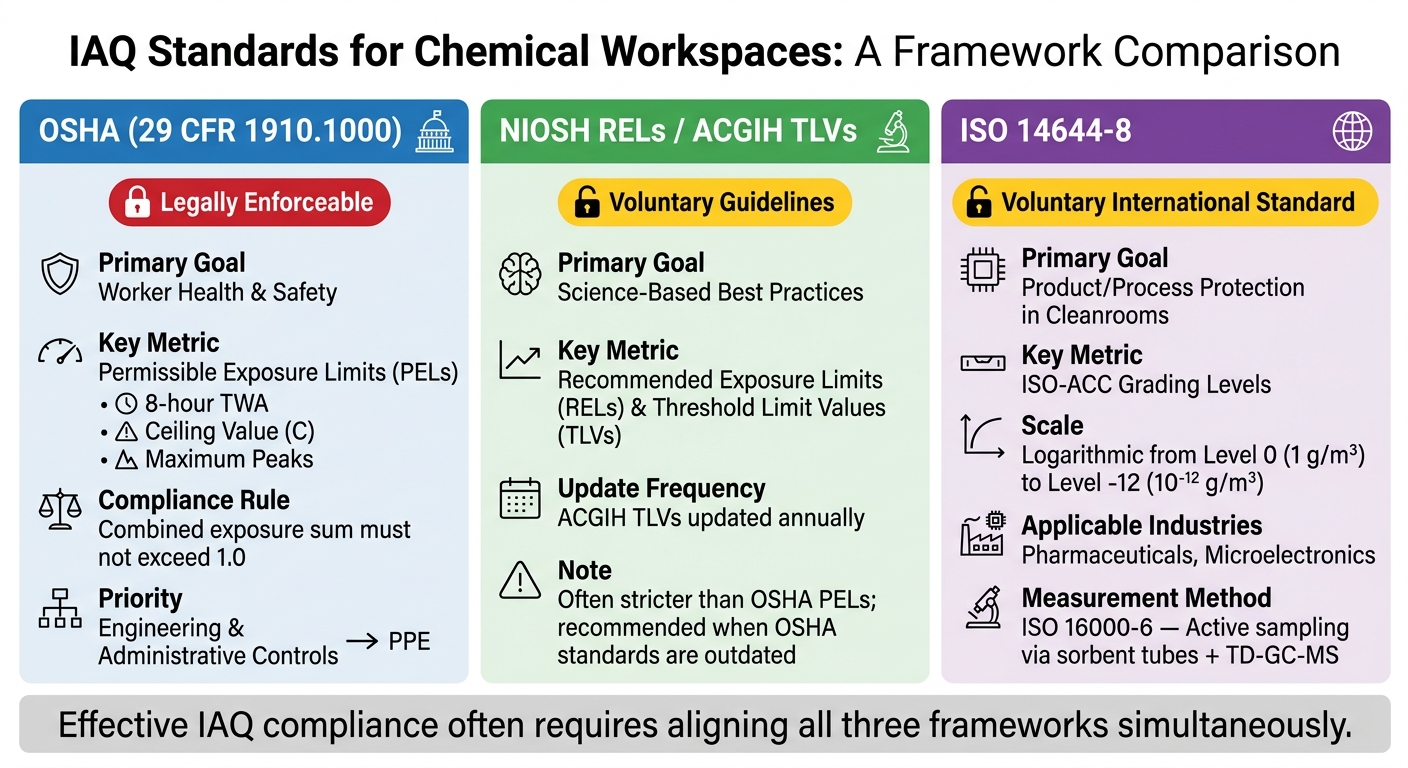
IAQ Standards Comparison: OSHA vs NIOSH/ACGIH vs ISO for Chemical Workspaces
Chemical workspaces in the U.S. are governed by a mix of mandatory regulations and voluntary guidelines, each designed to ensure safe and effective indoor air quality (IAQ) management.
OSHA Regulations and Workplace Air Quality Standards
The Occupational Safety and Health Administration (OSHA) enforces IAQ through 29 CFR 1910.1000, which sets Permissible Exposure Limits (PELs) for various airborne chemicals. These limits are defined using three metrics:
- 8-hour Time Weighted Average (TWA): The average exposure over a standard workday.
- Ceiling value (C): The maximum concentration not to be exceeded at any time.
- Maximum Peaks: Short-term exposure limits for specific chemicals [4].
When dealing with multiple contaminants, OSHA requires calculating a combined exposure value. If the sum exceeds 1.0, it indicates noncompliance [4]. Importantly, OSHA prioritizes engineering and administrative controls over personal protective equipment (PPE), as noted in their guidance:
"To achieve compliance… administrative or engineering controls must first be determined and implemented whenever feasible." – OSHA 1910.1000(e) [4]
In addition to OSHA’s legally binding standards, other organizations provide stricter recommendations based on updated research.
NIOSH and ACGIH Exposure Guidelines
The National Institute for Occupational Safety and Health (NIOSH) and the American Conference of Governmental Industrial Hygienists (ACGIH) offer exposure limits that often exceed OSHA’s in terms of stringency. These include:
- NIOSH Recommended Exposure Limits (RELs): Based on scientific studies to protect worker health.
- ACGIH Threshold Limit Values (TLVs): Updated annually to reflect the latest toxicological data.
While these guidelines are not enforceable by law, OSHA encourages their adoption when they provide better protection or when no OSHA standard exists for a particular substance [1]. Many chemical facilities choose to follow these recommendations to minimize risks, especially when OSHA’s PELs are outdated compared to newer health research.
Beyond domestic standards, international frameworks provide additional guidance for specialized environments like cleanrooms.
ISO Standards and International Frameworks
For facilities requiring controlled environments, such as those in pharmaceuticals or microelectronics, ISO 14644-8 offers a grading system for Airborne Chemical Concentrations (ACC). It uses a logarithmic scale ranging from ISO-ACC Level 0 (1 g/m³) to Level -12 (10⁻¹² g/m³) to define maximum chemical concentrations [2]. This standard is essential for settings where even trace chemical contamination can impact product quality.
To measure these concentrations, ISO 16000-6:2021 outlines a detailed methodology. It involves active sampling using sorbent tubes, followed by thermal desorption and gas chromatography paired with mass spectrometry (MS). This method is effective for detecting vapor-phase organic compounds, including volatile organic compounds (VOCs) and semi-volatile organic compounds (SVOCs), at levels ranging from micrograms to milligrams per cubic meter [6].
The table below highlights the differences between these frameworks:
| Framework | Legal Status | Primary Goal | Key Metric |
|---|---|---|---|
| OSHA (29 CFR 1910.1000) | Legally enforceable | Worker health and safety | PELs (TWA, Ceiling, Peak) [4] |
| NIOSH RELs / ACGIH TLVs | Voluntary guidelines | Science-based best practices | RELs and TLVs [1] |
| ISO 14644-8 | Voluntary international standard | Product/process protection in cleanrooms | ISO-ACC Grading Levels (0 to -12) [2] |
These frameworks provide essential tools for maintaining IAQ in chemical workspaces, ensuring both worker safety and product integrity.
Disclaimer: This content is for informational purposes only. Consult official regulations and qualified professionals before making sourcing or formulation decisions.
Key IAQ Parameters to Monitor in Chemical Workspaces
Monitoring indoor air quality (IAQ) in chemical workspaces isn’t just about knowing the rules – it’s about measuring the right factors to ensure safety and compliance. Here are the most critical parameters to keep an eye on in these environments.
Chemical Contaminants and Exposure Limits
Chemical workspaces often deal with a range of airborne hazards. Volatile Organic Compounds (VOCs) like formaldehyde, toluene, acetone, and isopropyl alcohol are some of the most common offenders [8]. Other categories to monitor include Very Volatile Organic Compounds (VVOCs) such as propane and butane, Semi-Volatile Organic Compounds (SVOCs) like phthalates and PCBs, and inorganic reactive gases such as ammonia, chlorine, and carbon monoxide [5][8].
When multiple chemicals are present, it’s important to assess their combined exposure. A useful tool for prioritizing which substances to monitor is the Vapor Hazard Ratio (VHR). This ratio compares a chemical’s equilibrium concentration to its airborne exposure limit. The higher the VHR, the greater the potential risk, making those chemicals a priority for monitoring [7].
To track chemical exposures effectively:
- Use active sampling for long-term exposure assessments (TWA compliance).
- Employ direct-reading instruments to capture short-term spikes and ceiling limit exceedances [7][9].
Always calibrate personal sampling pumps before and after each use, and allow a 15-minute acclimation period to adjust to the workspace temperature [7].
Ventilation and Comfort Indicators
Ventilation plays a big role in managing chemical contaminants. Carbon dioxide (CO₂) levels are a key indicator of ventilation efficiency. By measuring CO₂ in return air, supply air, and outdoor air, you can determine how much fresh air is being delivered to the workspace [10]. A CO₂ concentration of around 1,000 ppm during the workday often signals insufficient ventilation [10].
"The old mantra ‘dilution is the solution to pollution’ is still valid, and dilution ventilation is always required as a backup and enhancement for source controls." – D. Jeff Burton, MS, PE, FAIHA [10]
Other factors, like temperature and barometric pressure, also matter because they can influence the performance of air sampling equipment. For example, most sampling pumps aren’t designed for temperatures below 32°F, and operations outside the 41°F to 95°F range require reviewing equipment specifications to ensure accurate sampling [7].
Biological and Secondary Contaminants
Chemical hazards aren’t the only concern. Workspaces should also monitor for other airborne and surface threats:
- Biological contaminants, classified as "biotoxic (bt)" under ISO 14644-8, can impact worker health and compromise sensitive production processes [2]. These contaminants are generally measured as particles rather than chemical concentrations, requiring specialized monitoring methods [2].
- Secondary contaminants – reaction byproducts like ozone or oxidation products – form when chemicals interact with each other or environmental factors. For identifying unexpected organic byproducts, thermal desorption gas chromatography-mass spectrometry (TD-GC-MS) is the preferred method. This technique helps pinpoint unanticipated analytes, allowing for targeted follow-up sampling [7].
For surface contaminants, different methods work best depending on the material:
- Use wipe sampling for smooth surfaces like stainless steel.
- Opt for vacuum or tape lift techniques on textured materials [11].
Disclaimer: This content is for informational purposes only. Consult official regulations and qualified professionals before making sourcing or formulation decisions.
Engineering and Administrative Controls for IAQ Compliance
After identifying the key indoor air quality (IAQ) parameters, the next step is implementing effective controls to address air quality concerns. In chemical workspaces, this involves a mix of physical engineering solutions and structured administrative procedures.
Ventilation and Air Cleaning Solutions
Local Exhaust Ventilation (LEV) is a primary method for controlling contaminants at their source. An LEV system typically includes a hood, ductwork, a dust collector, an exhauster, and a discharge stack. This setup captures airborne contaminants before they enter a worker’s breathing zone [12]. To ensure efficiency, the hood must be positioned no more than 1.5 duct diameters from the emission source. Any further, and the capture velocity drops significantly – by a factor of 10 when the distance increases from one to two duct diameters [14].
For vapors with lower toxicity that are more dispersed, dilution ventilation (also known as general exhaust ventilation) can be an effective solution. This method introduces clean air to lower contaminant levels to acceptable thresholds. However, to maintain proper airflow, makeup air near an exhaust hood should flow at less than 75 feet per minute (fpm). Additionally, exhaust stacks should be placed at least 10 feet above any roofline or air intake within 50 feet to avoid re-entraining contaminants into the building [13][14].
In spaces like chemical storage areas, where emissions are concentrated, pollution isolation is a practical option. This involves physically separating high-emission zones with self-closing doors and ensuring that air from these areas is exhausted directly outdoors, never recirculated into occupied spaces [13].
While setting up these ventilation systems is critical, their effectiveness must be regularly verified to ensure ongoing performance.
Monitoring and Verifying IAQ Performance
Even the best engineering controls require consistent monitoring to confirm they’re working as intended. Tools like smoke tubes offer a quick visual check to see if contaminants are being captured by a hood or escaping into the workspace. For more precise measurements, velometers and manometers can assess face velocity and static pressure, respectively [14]. Regular inspections of ductwork are also essential – a dull thud when tapping a duct often signals the presence of settled dust or liquid buildup that needs to be addressed [14]. Additionally, shifts in static pressure drop across exhaust ducts may indicate partial blockages that require attention [12]. For HVAC systems, CO₂ decay testing is a reliable way to measure how much fresh outdoor air is reaching specific zones [10].
Administrative Controls and Work Practices
Engineering solutions alone aren’t enough – administrative controls play a key role in maintaining and optimizing IAQ systems. Standard Operating Procedures (SOPs) should outline normal operations, startup and shutdown protocols, and emergency response steps [17]. As OSHA explains:
"Operating procedures describe tasks to be performed, data to be recorded, operating conditions to be maintained, samples to be collected, and safety and health precautions to be taken." [17]
Another effective administrative measure is limiting exposure. Reducing the number of workers in high-risk areas and restricting non-essential access can significantly decrease overall exposure without requiring additional equipment [15]. Routine cleaning of contaminated surfaces and preventing dust accumulation are also essential to avoid secondary contamination [12]. When introducing new processes, chemicals, or equipment, a Management of Change (MOC) review should be conducted to assess potential IAQ impacts before implementation [17].
Disclaimer: This content is for informational purposes only. Consult official regulations and qualified professionals before making sourcing or formulation decisions.
How to Build and Maintain an IAQ Program
Once engineering and administrative controls are in place, a formal Indoor Air Quality (IAQ) program ensures these measures are consistently maintained and refined. According to the Canadian Centre for Occupational Health and Safety (CCOHS):
"The overall goal is to establish a program that considers the entire lifecycle of the chemical or process – beginning with purchasing and including identification, labelling, inventory, use, storage, record-keeping requirements, and disposal." [16]
CCOHS emphasizes that creating such a program doesn’t have to be complicated or expensive: "A chemical safety program does not have to be complicated or costly." [16]
Baseline Assessment and Risk Analysis
Start by conducting a baseline chemical inventory. This involves listing every chemical used in your facility, noting its physical state, storage location, and Safety Data Sheet (SDS) information. Knowing the physical form of each chemical helps determine the appropriate ventilation requirements [16].
Next, prioritize chemicals that require closer monitoring. A useful tool for this is the Vapor Hazard Ratio (VHR), which compares a chemical’s equilibrium vapor concentration to its occupational exposure limit (OEL). Chemicals with high VHRs are more likely to pose overexposure risks under normal conditions, making them ideal candidates for initial air monitoring [7]. Use direct-reading instruments during walkthroughs to identify high-risk areas and employees before conducting more comprehensive sampling [7]. These assessments lay the groundwork for building a strong IAQ program.
Program Design and Alignment with Standards
Using the baseline data, create a written IAQ program with clear objectives. Assign specific responsibilities to employers, supervisors, workers, and safety committees [16]. Your monitoring plan should measure 8-hour Time-Weighted Averages (TWA) for permissible exposure limits and 15-minute TWAs for Short-Term Exposure Limits (STELs) [7].
An effective program also includes a pre-purchase review process, which evaluates the potential IAQ impact of new chemicals before they are introduced. This approach allows you to apply the hierarchy of controls early on, such as substituting less hazardous chemicals before they are implemented [16]. For facilities that handle highly hazardous substances, OSHA 1910.119(e) mandates a formal Process Hazard Analysis (PHA) – using tools like HAZOP or structured checklists – every five years [3].
Routine Maintenance and Continuous Improvement
Proper maintenance of ventilation systems is essential. Regularly scheduled tasks include weekly verification of outdoor air damper positions, monthly checks of filter differential pressure, and quarterly confirmation of fume hood face velocity [19][21]. Instead of relying on a fixed schedule, replace filters based on differential pressure readings, as filters may load faster depending on process activity [19].
Sensor calibration is another critical aspect. Calibrate CO₂, Total Volatile Organic Compounds (TVOC), and humidity sensors semi-annually using NIST-traceable references. Continuous IoT monitoring can help identify potential compliance issues before they arise [19][20]. Maintain monitoring records for at least three years and keep incident investigation reports related to chemical releases for five years [18][3].
| Maintenance Task | Frequency |
|---|---|
| Outdoor air damper verification | Weekly |
| Filter differential pressure check | Monthly |
| Fume hood face velocity check | Quarterly |
| CO₂/TVOC sensor calibration | Semi-annual |
| HEPA filter integrity test | Every 6–12 months |
| Cooling coil cleaning | Annual |
| Program compliance audit | Every 3 years (OSHA requirement) |
Treat the IAQ program as a dynamic document. Any changes to processes or equipment should trigger a Management of Change (MOC) review to reassess their impact on IAQ [3].
Disclaimer: This content is for informational purposes only. Consult official regulations and qualified professionals before making sourcing or formulation decisions.
Conclusion: Key Takeaways for IAQ in Chemical Facilities
Maintaining indoor air quality (IAQ) in chemical facilities is an ongoing process that relies on layered controls working together. This includes engineering solutions, administrative measures, and rigorous maintenance, all forming a cohesive system designed to ensure safety and compliance.
Studies show that human activity can increase particle emissions by 10–27 times compared to stationary levels [22]. While quarterly manual checks are standard, they often miss real-time spikes in contaminants. Continuous monitoring using IoT devices, calibrated annually to NIST-traceable standards, can identify issues like sensor drift before they lead to violations. This real-time approach complements effective pressure management, which is vital for maintaining system functionality.
Pressure management plays a crucial role in preventing cross-contamination between areas. Maintaining differential pressures of 5 to 20 Pa between zones with different cleanliness requirements keeps contaminated air from entering controlled spaces [22]. However, even the most robust pressure systems can fail if filters are clogged, ducts are poorly balanced, or personnel density exceeds the system’s design. Regular checks of actual airflow, rather than relying solely on Building Automation System (BAS) setpoints, are necessary to ensure proper functionality.
Precise pressure control is just one component of a broader IAQ strategy. As Dr. Sanjay Mehta, a Certified Industrial Hygienist, explains:
"Poor IAQ is a documented productivity liability, and the maintenance programme that prevents it has a quantifiable return." [24]
For facilities handling specialty chemicals – especially those used in pharmaceuticals, food production, or electronics – working with reliable suppliers adds an extra layer of confidence. Allan Chemical Corporation (allanchems.com) supports regulated industries with solutions aligned to stringent standards. Treat your IAQ program as a dynamic framework, regularly updated based on monitoring data and operational changes. The ultimate goal is to minimize contaminants through multiple, well-maintained layers of defense [23].
Disclaimer: This content is for informational purposes only. Consult official regulations and qualified professionals before making sourcing or formulation decisions.
FAQs
Which standard should we follow: OSHA, NIOSH/ACGIH, or ISO?
For chemical workplaces in the U.S., compliance with OSHA standards is essential. Key regulations include 29 CFR 1910.1450, which focuses on laboratory safety, and 29 CFR 1910.1000, addressing air contaminants. These rules cover critical areas like exposure limits, chemical hygiene plans, and employee training.
While OSHA sets mandatory requirements, organizations like NIOSH and ACGIH provide additional, non-binding guidance that can enhance workplace safety. These recommendations often serve as best practices to supplement OSHA standards. On a global level, ISO offers frameworks that support international safety efforts, though they are less tailored to U.S. regulations.
By adhering to OSHA regulations and integrating NIOSH/ACGIH recommendations, workplaces can maintain both safety and regulatory compliance.
How do we choose which chemicals to monitor first?
To ensure safety, give priority to monitoring chemicals that pose serious risks due to acute toxicity, flammability, or reactivity. Pay extra attention to areas where there is frequent staff turnover or where contract workers are present. Use risk assessments and reliable information about the workspace to guide your focus. This approach helps tackle the most dangerous substances first, reducing potential hazards effectively.
What’s the minimum IAQ program we need to stay compliant?
The minimum indoor air quality (IAQ) program for compliance should cover the following:
- Continuous monitoring: CO₂ levels must stay below 900 ppm at all times.
- Humidity control: Keep humidity levels within the ranges specified by ASHRAE 55 guidelines.
- Ventilation and filtration checks: Perform regular inspections to verify proper ventilation rates and ensure filters are functioning correctly.
It’s crucial to document all actions, including any corrective measures taken, to align with standards such as ASHRAE 62.1 and ISO 14644-8.


Comments are closed