
Biodegradable polymers, such as Chitosan and PLGA (Poly(lactic-co-glycolic acid)), are materials designed to deliver drugs directly to specific tissues or cells. These polymers protect drugs from breaking down prematurely and release them in a controlled manner. Once their role is complete, they decompose into harmless byproducts like water and carbon dioxide. This makes them safer and more efficient compared to non-degradable systems, which often require surgical removal and pose risks of long-term toxicity.
Key Highlights:
- Natural Polymers: Examples include Chitosan and Alginate, known for biocompatibility but subject to variability.
- Synthetic Polymers: PLGA and PCL offer predictable degradation rates and are FDA-approved for medical use.
- Applications:
- Cancer Treatment: Targeted delivery using nanoparticles to tumor sites.
- Ophthalmology: Sustained drug release for eye conditions.
- Neurology: Crossing the blood-brain barrier to treat neurodegenerative diseases.
- Vaccines: Platforms for mRNA and antigen delivery.
- Mechanisms: Drug release occurs via diffusion, swelling, or erosion, with surface modifications like PEGylation enhancing targeting precision.
By reducing side effects, improving drug availability, and offering controlled release, biodegradable polymers are transforming drug delivery systems across multiple therapeutic areas.
Polymeric Drug Delivery Systems: How Do They Work? – Advanced Drug Carriers – BOC Sciences
sbb-itb-aa4586a
Core Design Principles for Biodegradable Polymer-Based Drug Delivery
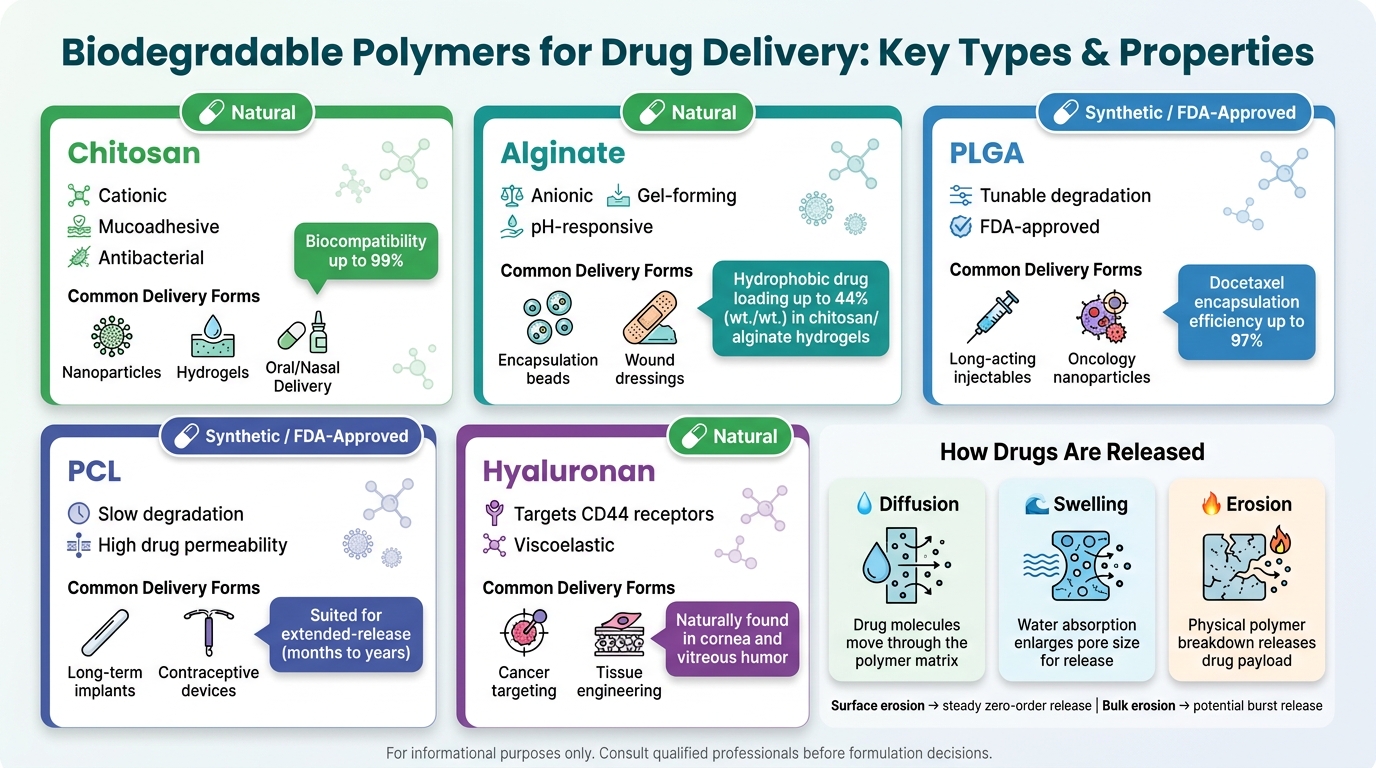
Biodegradable Polymers for Drug Delivery: Key Types & Properties
Types of Biodegradable Polymers Used in Drug Delivery
When designing a drug delivery system, selecting the right polymer is critical for achieving optimal results. Polymers used in these systems generally fall into two categories: natural and synthetic. Natural polymers, such as chitosan and alginate, are known for their biocompatibility and renewable nature. However, their production can sometimes be inconsistent due to batch-to-batch variability. On the other hand, synthetic polymers like PLGA, PLA, and PCL offer more predictable degradation rates and mechanical properties, making them easier to tailor for specific drug release profiles [3].
| Polymer | Key Characteristics | Common Delivery Forms |
|---|---|---|
| Chitosan | Cationic, mucoadhesive, antibacterial | Nanoparticles, hydrogels, oral/nasal delivery [6] |
| Alginate | Anionic, gel-forming, pH-responsive | Encapsulation beads, wound dressings [6] |
| PLGA | Tunable degradation, FDA-approved | Long-acting injectables, oncology nanoparticles [2] |
| PCL | Slow degradation, high drug permeability | Long-term implants, contraceptive devices [2] |
| Hyaluronan | Targets CD44 receptors, viscoelastic | Cancer targeting, tissue engineering [6] |
Each polymer comes with its own set of advantages and trade-offs. For instance, dual cross-linked chitosan/alginate hydrogels have shown a hydrophobic drug loading capacity of 44% (wt./wt.), while chitosan-based hydrogels boast biocompatibility rates as high as 99% [6]. These properties are essential when creating formulations that demand high drug loading or exceptional biocompatibility. The unique characteristics of these polymers enable controlled degradation and predictable drug release.
How Polymers Degrade and Release Drugs
Drug release from biodegradable polymers occurs through three primary mechanisms: diffusion (movement of drug molecules through the polymer matrix), swelling (water absorption that enlarges pore size), and erosion (physical breakdown of the polymer) [2]. Understanding the dominant mechanism is essential for predicting how the drug behaves in the body.
Bulk erosion involves water penetrating the entire polymer matrix at once, which can lead to unpredictable release bursts. In contrast, surface erosion progresses gradually from the outer layer inward, offering a steady, zero-order drug release profile – where the drug is released at a constant rate over time [2].
Molecular weight plays a significant role in determining the degradation rate and drug retention time.
"The molecular weight of the polymer has a significant impact on the drug release mechanism of the NPs. Higher the molecular weight of the polymer, higher is the retention time of the drug in the systemic circulation." – Priyanka A. Shah, Research Associate, Gujarat University [4]
Stimuli-responsive polymers allow for even greater precision, breaking down rapidly in response to specific triggers. For example, polymers containing disulfide bonds degrade quickly in the presence of intracellular glutathione (GSH), a reducing agent found in high concentrations in tumor cells. This enables targeted drug release within the cells [7]. Similarly, acid-sensitive bonds promote faster degradation in acidic environments, such as those found in tumors or lysosomes, where the pH ranges from 5.0 to 6.8, compared to the normal physiological pH of 7.4 [8]. Defining these parameters is a key step in designing effective drug delivery strategies.
Drug Targeting Strategies
After ensuring controlled release, the next step is precise targeting to deliver the drug to its intended site. Passive targeting relies on the Enhanced Permeability and Retention (EPR) effect, where nanoparticles naturally accumulate in tumor tissues due to their leaky blood vessels and limited lymphatic drainage [1].
Active targeting enhances this effect by attaching ligands – such as antibodies, folate, transferrin, or RGD peptides – to the polymer surface. These ligands bind to specific receptors that are overexpressed on target cells, improving cellular uptake and reducing the impact on non-target tissues [5].
Surface modifications can further refine targeting strategies. For example, PEGylation, which involves coating nanoparticles with polyethylene glycol, creates "stealth" particles that evade immune detection and extend circulation time [8]. Emerging zwitterionic coatings, such as SBMA grafting, offer additional benefits by reducing protein adsorption on the particle surface, minimizing immune system interference [8].
Biodegradable polymers naturally contain functional groups like hydroxyl, amino, and carboxyl, which enable these surface modifications without affecting the polymer’s degradation behavior [6].
Disclaimer: This content is for informational purposes only. Consult official regulations and qualified professionals before making sourcing or formulation decisions.
Therapeutic Applications of Biodegradable Polymers in Drug Delivery
Oncology Applications
Cancer treatment has become a focal point for advancements in biodegradable polymer research. Polymers like PLGA (Poly(lactic-co-glycolic acid)), PLA (Polylactic acid), and PCL (Polycaprolactone) are used to encapsulate and protect anticancer drugs. These systems prolong drug circulation in the body and concentrate therapeutic agents at tumor sites, leveraging both passive targeting through the Enhanced Permeability and Retention (EPR) effect and active targeting with ligands like folic acid or antibodies [9][10].
The results are impressive. For instance, PEGylated PLGA nanoparticles enhance curcumin’s bioavailability by 55.4 times [10]. Similarly, star-shaped PLGA copolymers achieve a docetaxel encapsulation efficiency of 97%, outperforming linear block copolymers, which achieve 83% [10]. Encapsulating cisplatin in nanoparticles also reduces common side effects like weight loss and kidney damage compared to administering the drug in its free form [10].
"Biodegradable polymers such as Polycaprolactone (PCL), Polylactic acid (PLA), and Poly(lactic-co-glycolic acid) (PLGA) are attracting attention as key platforms for anticancer drug delivery systems due to their excellent biocompatibility and controllable degradation rates." – Pharmaceutics, MDPI [9]
Interestingly, the shape of nanoparticles can influence their effectiveness. Needle-shaped PLGA nanoparticles exhibit 150% higher cellular uptake compared to spherical ones, though this may increase the risk of lysosomal membrane damage [10].
Biodegradable polymers are not limited to oncology – they also address challenges in other medical fields, such as ocular treatments.
Ocular Drug Delivery
The eye presents unique challenges for drug delivery. Traditional eye drops, for example, deliver less than 5% of the dose to intraocular tissues due to rapid tear drainage and biological barriers [12]. Biodegradable polymer systems overcome these issues by ensuring stable and prolonged drug release at the target site.
Innovative solutions include PLGA microspheres, in situ gels, and "nanowafers" – thin, disc-shaped films that dissolve slowly on the eye’s surface. These formulations provide extended drug release without requiring removal, as the polymers naturally degrade into harmless byproducts [11][12]. This is particularly beneficial for chronic conditions requiring long-term treatment.
Natural polymers also play a pivotal role in ocular drug delivery. Hyaluronic acid, a substance naturally found in the cornea and vitreous humor, extends a drug’s residence time on the eye surface [11]. Chitosan, known for its mucoadhesive properties, binds to the negatively charged mucus layer, enhancing localized drug absorption while minimizing systemic exposure.
These advancements highlight the adaptability of biodegradable polymers, which are also making headway in Central Nervous System (CNS) therapies.
CNS and Brain Targeting
Delivering drugs to the brain remains one of the toughest challenges in medicine due to the blood–brain barrier (BBB). This tightly regulated membrane protects the brain but also blocks most therapeutic agents.
"The blood–brain barrier (BBB) represents a major challenge in effective drug delivery systems intended for treating neurological disorders. It restricts the transport of therapeutic agents to the brain." – MDPI Polymers [14]
Biodegradable polymeric nanoparticles offer promising solutions for crossing the BBB. One approach involves surface modification, such as coating PLGA nanoparticles with Poloxamer 188 (P188). This surfactant adsorbs apolipoprotein E and inhibits P-glycoprotein efflux, enabling 17.2 ± 0.6% of nanoparticles to reach the brain within 48 hours in rat models [13]. Another method uses receptor-mediated targeting. For example, transferrin-conjugated PLA-TPGS nanoparticles demonstrated 229% higher efficiency than the clinical drug Taxotere® in treating glioma cells after 24 hours [15].
The intranasal route is emerging as an alternative to intravenous delivery. Chitosan-based nanoparticles adhere to the nasal mucosa due to their positive charge and can travel along olfactory neurons, bypassing the BBB entirely [14]. To ensure effective mucosal penetration through this route, maintaining a nanoparticle size below 300 nm is critical [14].
Disclaimer: This content is for informational purposes only. Consult official regulations and qualified professionals before making sourcing or formulation decisions.
Material Selection, Manufacturing, and Regulatory Considerations
How to Select Polymers and Excipients
Choosing the right polymer is essential to ensuring safety, effectiveness, and regulatory compliance for drug delivery systems.
"The selection of the biomaterial to be used for drug delivery is a very important step because of the potential toxicity of the products resulting from their degradation." – MDPI [6]
The first consideration is biocompatibility. Beyond ensuring the polymer itself is non-toxic and won’t provoke an immune response, its degradation byproducts must also be harmless. For example, PLGA (Poly(lactic-co-glycolic acid)) breaks down into lactic acid and glycolic acid, which the body can naturally process. This makes PLGA a popular choice for biodegradable systems [6][17]. Toxicology testing should focus not only on the polymer but also on its breakdown products before any clinical trials begin.
Here’s a summary of the key factors influencing polymer selection:
| Factor | Key Consideration | Impact on Delivery System |
|---|---|---|
| Molecular Weight | Chain length and distribution | Affects degradation speed and drug release duration [4] |
| Surface Charge | Cationic, anionic, or neutral | Influences interactions with cell membranes and immune clearance [4] |
| Solubility | Hydrophilic vs. hydrophobic | Determines compatibility with specific drugs [17] |
| Functional Groups | –OH, –NH₂, –COOH | Allows for ligand attachment in targeted delivery [6] |
| Mechanical Strength | Flexibility and durability | Ensures structural integrity during production and use [17] |
To simplify regulatory approval and speed up development, it’s often better to use FDA-approved polymers. A common approach is blending two approved polymers to tweak properties like flexibility or release rates without introducing new safety concerns [3][16].
Allan Chemical Corporation provides pharmaceutical-grade polymers (USP, NF) with certificates of analysis, ensuring batch consistency – an important factor for regulated applications.
Manufacturing Methods for Polymer-Based Drug Delivery Systems
Once the polymer is selected, the manufacturing method determines how well the delivery system performs. The choice depends on the drug’s characteristics and the intended delivery route.
Emulsion-solvent evaporation is a widely used technique. For hydrophobic drugs, a single oil-in-water (o/w) emulsion works well. However, hydrophilic drugs like proteins or peptides require a double emulsion (w/o/w) to prevent drug loss into the aqueous phase. As J. Park from Purdue University notes, "PLGA copolymers significantly affect the stability and biological activity of the drugs (e.g., peptide and proteins), primarily due to the hydrophobicity of the polymers and the presence of acidic degradation products" [18]. This highlights the importance of optimizing formulations, especially for protein-based drugs.
Spray drying is another option, offering scalability and good control over particle size. However, practical challenges like product loss due to adhesion to dryer walls can arise [18]. For sensitive bioactives, electrospraying provides a gentler alternative, producing uniform nanoparticles under mild conditions [19].
Emerging technologies like 3D printing bring exciting possibilities. Techniques such as Fused Deposition Modeling (FDM) and Stereolithography (SLA) allow for highly customized geometries and precise drug distribution. In June 2023, researchers at Rice University demonstrated the PULSED platform, which encapsulated the biologic drug bevacizumab and achieved over 90% bioactive release after a two-week delay. By adjusting PLGA molecular weight and end groups, they fine-tuned release times from 10 to 36 days [20].
A critical variable in these methods is the LA:GA ratio in PLGA. A 50:50 ratio results in a polymer that degrades quickly, while increasing lactide content slows degradation and extends drug release. For example, raising PLGA crystallinity from 40% to 50% can reduce the diffusion coefficient of lidocaine by nearly half [19].
The manufacturing process must also align with regulatory quality standards to ensure clinical success.
U.S. FDA Regulatory and Quality Requirements
Meeting regulatory guidelines is the final step in developing a polymer-based drug delivery system. The FDA uses ASTM International standards to evaluate absorbable polymeric materials, particularly those that degrade via hydrolysis, like PLGA and PLA. Currently, ASTM F2902-16 is the benchmark, but this will be replaced by ASTM F2902-24 after December 19, 2027 [21].
Regulatory submissions must include detailed analytical data. This typically involves:
- Chemical Identification: Infrared (IR) spectroscopy and NMR (¹H and ¹³C).
- Purity Testing: Residual monomers, solvents, heavy metals, and water content (via Karl-Fischer titration).
- Molecular Properties: Molar mass distribution analyzed by Gel Permeation Chromatography (GPC) [22][23].
Biocompatibility testing is required for the finished product – not just the raw material. Manufacturing processes like molding and sterilization can alter the polymer’s biological properties, so testing the raw resin alone is insufficient [22][23]. For degradation studies, the FDA refers to ASTM F1635, which simulates in vivo conditions by conditioning samples in buffered solutions at 98.6°F (37°C). Devices expected to endure mechanical stress must undergo additional testing, as stress can accelerate degradation [25].
For drug delivery systems, the FDA demands data beyond material characterization. This includes drug loading, release kinetics, and safety and efficacy data for the combined polymer-drug system [21][24]. Insufficient characterization is a common reason submissions fail, underscoring the need for thorough preparation.
Disclaimer: This content is for informational purposes only. Consult official regulations and qualified professionals before making sourcing or formulation decisions.
Emerging Directions in Biodegradable Polymer Drug Delivery
Stimuli-Responsive Polymers
Biodegradable drug delivery systems are advancing toward precise, on-demand drug release. Stimuli-responsive polymers are at the heart of this innovation, designed to remain dormant under normal conditions and activate only in response to specific biological cues.
A major development is the shift from single-trigger systems to AND-gate nanoparticles, which require two simultaneous conditions to release their payload. Single-stimulus designs, like those triggered solely by pH, can be unreliable since acidic environments are not unique to tumors. AND-gate systems, however, demand dual triggers, such as acidic pH and hypoxia. For example, research published in Nature Nanotechnology (January 2026) showcased nanoparticles that activated the STING immune pathway only under both acidic pH (below 6.9) and hypoxic conditions (via NQO1 enzyme activity). In studies on metastatic Lewis lung carcinoma, this approach significantly reduced tumor nodules while minimizing systemic toxicity compared to free drug agonists [27].
Enzyme-responsive polymers are also gaining momentum. These systems utilize enzymes like MMP-9, which are overexpressed in metastatic tissues, to trigger drug release. A study in the Chemical Engineering Journal (April 2026) revealed the potential of "NP-R-M", a polymeric nanomedicine responsive to MMP-9, to deliver a ferroptosis inducer (RSL3) and melittin peptide directly to liver metastases. This method reduced metastatic burden by 70% in murine liver models and recruited CD8+ T cells to the tumor site [28]. With metastatic disease accounting for over 90% of cancer-related deaths [27], such targeted approaches are crucial.
Here’s a breakdown of key stimuli types and their mechanisms:
| Stimulus | Mechanism | Where It’s Used |
|---|---|---|
| pH-Responsive | Acid-labile bond cleavage | Endosomal/lysosomal release (pH ~5.0) |
| Hypoxia-Responsive | Reduction of nitro-imidazole groups | Solid tumor cores |
| Redox-Responsive | Disulfide bond cleavage by glutathione (GSH) | Intracellular cancer cell release |
| Enzyme-Responsive | Cleavage by MMP-9 or Cathepsin B | Metastatic niche targeting |
| Thermo-Responsive | Phase transition at LCST | Hyperthermia-triggered release |
Another exciting innovation involves zwitterionic coatings. These coatings, like sulfobetaine methacrylate (SBMA), are integrated into biodegradable backbones such as PLA/PEAd to enhance antifouling properties. This helps nanoparticles evade immune clearance and circulate longer. Research from Aristotle University of Thessaloniki (September 2025) demonstrated SBMA-functionalized PLA/PEAd nanoparticles for paclitaxel delivery, achieving up to 79% drug release at pH 5.0 (tumor-like conditions) while limiting release to 18–35% at physiological pH 7.4 [8].
These developments in trigger mechanisms are setting the stage for more precise and effective drug delivery systems.
Advanced Engineering Approaches for Targeted Delivery
Beyond stimuli-responsive designs, advanced engineering techniques are refining drug targeting to improve outcomes. Molecularly imprinted polymers (MIPs), often referred to as "synthetic antibodies", are one such innovation. These polymers are crafted with recognition cavities tailored to specific drug molecules, allowing for selective binding and controlled release. This makes MIPs particularly valuable for therapies where off-target effects need to be minimized [30].
AI and machine learning are also transforming drug delivery research. Scientists are using machine learning models to predict nanoparticle behavior, optimize drug loading, and streamline the experimental process. According to a research group:
"The integration of electrohydrodynamic theory, multiphysics simulations, and data-driven methods such as machine learning provides new opportunities for rational design and process optimization of PLGA-based delivery systems." – MDPI Polymers [19]
Nanocarrier-based systems have shown the potential to boost drug dissolution rates by 3–20 times and improve bioavailability by 1.5–8 times compared to traditional methods [31]. However, challenges remain: over 95% of nanoparticle delivery attempts fail to reach the intended target tissue [29]. This gap highlights the importance of AI-assisted design and engineering advancements.
Theranostic platforms, which combine diagnostic imaging with therapeutic delivery, are another growing area. Polymer-metal hybrid nanoparticles, for instance, can enable imaging techniques like MRI or CT while simultaneously releasing drugs. This dual functionality allows clinicians to monitor treatment progress in real time [5].
Bio-Based Polymers and Supply Chain Sustainability
As drug delivery technologies evolve, there’s a growing shift toward bio-based polymers, which balance performance with environmental responsibility. Pharmaceutical manufacturing generates significant waste, prompting the adoption of renewable materials like PLA, polyhydroxyalkanoates (PHAs), chitosan, and alginate. These materials are favored for their biocompatibility and lower carbon footprint compared to petrochemical-derived alternatives. As noted by researchers:
"The shift toward environmental sustainability has catalyzed a marked transition toward natural biopolymers, moving away from the prevalent use of synthetic polymers across various sectors, including the pharmaceutical industry." – Cornelia Bejenaru et al. [32]
Cost remains a challenge, as bio-based raw materials are currently 15–25% more expensive than petrochemical options [26]. However, advancements in sustainable manufacturing techniques, such as continuous production and biocatalysis, could lower production costs by up to 15% over time [26].
The supply chain is also adapting. Manufacturers are implementing digital traceability systems and adopting green synthesis methods like enzymatic polymerization and microwave-assisted synthesis to meet growing ESG demands [26]. One persistent issue is batch variability in natural polymers, where differences in molecular weight and crosslinking chemistry can affect formulation consistency. For pharmaceutical applications, where reproducibility is critical, sourcing from suppliers with rigorous documentation and compendial-grade materials is essential. Allan Chemical Corporation addresses this need by providing USP- and NF-grade polymer excipients with full certificates of analysis, ensuring reliable quality for bio-based systems.
Disclaimer: This content is for informational purposes only. Consult official regulations and qualified professionals before making sourcing or formulation decisions.
Conclusion
Biodegradable polymers have reshaped the landscape of targeted drug delivery. Take PLGA nanoparticles, for instance – they can transport chemotherapy drugs straight to tumors. This approach tackles major clinical hurdles like poor drug solubility, systemic toxicity, and narrow therapeutic windows, challenges that traditional dosage forms often fail to address.
Abhay Thakur from the School of Pharmaceutical and Health Sciences emphasizes:
"Biodegradable polymers play a crucial role in effective drug delivery, helping to manage drug release and decreasing potential toxic reactions." [2]
This perspective aligns with the growing focus on biodegradable polymer systems as they work to solve persistent issues in drug delivery. These advances not only improve solubility and reduce toxicity but also extend therapeutic windows.
While progress has been significant, moving from lab research to real-world applications remains a tough journey. AAPS PharmSciTech notes:
"the success rate of regulatory approvals of polymeric drug delivery systems is, however, modest despite encouraging pre-clinical outcomes… usually linked to inadequate physicochemical characterisation, safety issues and vague regulatory pathways." [5]
To overcome these obstacles, early engagement with the FDA and meticulous material characterization are critical. Batch-to-batch variability in natural polymers, unpredictable molecular weight distributions, and unidentified impurities can derail even the most promising formulations. Using USP- and NF-grade excipients with full certificates of analysis is essential for any serious drug delivery initiative.
Companies like Allan Chemical Corporation play a vital role in supporting pharmaceutical developers. They provide compendial-grade polymer excipients and ensure just-in-time delivery, helping maintain the consistency needed for successful clinical translation.
Scientific advancements now make it possible to create more effective therapies. However, achieving real patient outcomes requires not just innovative materials but also clear regulatory strategies and unwavering attention to formulation quality.
Disclaimer: This content is for informational purposes only. Consult official regulations and qualified professionals before making sourcing or formulation decisions.
FAQs
How do I choose between chitosan and PLGA for a drug delivery system?
Choosing the right material for drug delivery often comes down to Chitosan and PLGA, each with distinct advantages.
Chitosan is a natural polysaccharide known for its bioadhesive properties, antimicrobial effects, and ease of chemical modification. These traits make it particularly useful in applications requiring close interaction with biological tissues.
On the other hand, PLGA (Poly(lactic-co-glycolic acid)) is a synthetic polyester prized for its ability to provide controlled drug release. By tweaking the lactic-to-glycolic acid ratio in its structure, you can fine-tune how quickly or slowly the drug is released.
Both materials have earned approval from the FDA and EMA, confirming their safety for pharmaceutical use. When deciding between them, think about factors like biocompatibility, degradation rates, and the release profile you need for your specific application.
What controls how fast a biodegradable polymer releases a drug in the body?
The rate at which a drug is released from a biodegradable polymer is influenced by several factors. These include the polymer’s breakdown speed, the chemical and physical characteristics of both the drug and the polymer, and the design and dimensions of the delivery system. External conditions, such as pH levels, temperature, light exposure, magnetic fields, or enzyme activity, can further affect the release process. Allan Chemical Corporation plays a key role in pharmaceutical development by providing specialty chemicals essential for creating dependable drug delivery systems.
What data does the FDA expect for biodegradable polymer drug delivery products?
The FDA requires comprehensive data to confirm both the quality and safety of products. For pharmaceuticals, this means submitting detailed pharmaceutical development reports. These reports should cover aspects like excipients (inactive ingredients) and product characterization, which are included in section 3.2.P.2 of the application.
For polymer materials or devices that come into contact with tissue, the FDA mandates chemical characterization and biocompatibility data. This includes details on extraction conditions and chemical analysis, accompanied by proper documentation and reporting.




Comments are closed