
HPLC-MS/MS (High-Performance Liquid Chromatography-Tandem Mass Spectrometry) is a powerful analytical technique used to detect and quantify pharmaceutical contaminants in water. These contaminants, including drugs like ibuprofen, antibiotics, and hormones, often enter water systems through human excretion or improper disposal. Despite wastewater treatment, many of these compounds persist in treated water, posing risks to aquatic life and public health.
Key highlights of HPLC-MS/MS include:
- Trace-Level Detection: Capable of identifying contaminants at parts-per-trillion concentrations (as low as 0.034 ng/L).
- Advanced Sensitivity: Uses methods like Multiple Reaction Monitoring (MRM) for precise identification and quantification.
- Sample Preparation: Techniques like solid-phase extraction (SPE) and isotope-labeled standards minimize interference from complex water matrices.
- Regulatory Monitoring: Supports compliance by providing high-accuracy data for environmental and public health assessments.
Pharmaceutical residues, such as ibuprofen and metformin byproducts, have been detected worldwide, with concentrations varying by region and water source. While some compounds are removed effectively during treatment, others, like antibiotics and synthetic hormones, remain challenging to eliminate. HPLC-MS/MS enables researchers and regulators to monitor these pollutants, informing improved treatment methods and policy decisions.
Why It Matters: The persistence of pharmaceuticals in water systems highlights the need for advanced detection tools like HPLC-MS/MS to ensure water safety and protect ecosystems.
Overview of HPLC-MS/MS Technology
How HPLC-MS/MS Works
HPLC-MS/MS integrates two analytical techniques into a single workflow. The process begins with liquid chromatography, where either HPLC or UPLC separates complex pharmaceutical mixtures. This is typically achieved using a reversed-phase gradient, often involving a mobile phase of formic acid or ammonium formate–modified water combined with methanol [2]. Once separated, an ESI (Electrospray Ionization) source converts molecules into charged gas-phase ions, usually in positive mode. These ions are then sent into a triple-quadrupole tandem mass spectrometer, where they are filtered and fragmented based on their mass-to-charge ratio.
The standout detection method here is Multiple Reaction Monitoring (MRM). It tracks how a specific precursor ion breaks down into unique product ions, confirming both the identity and quantity of the compounds being analyzed [2].
Matrix effects – interferences caused by sample components – can impact target signals. To address this, analysts add stable isotope–labeled internal standards (SILs) directly to the samples. In wastewater analysis, matrix effects can vary significantly, ranging from 64% to 228%, making the use of SILs essential for accurate results [4]. These robust processes ensure the method’s high sensitivity, which is critical for trace-level detection.
Advantages for Trace-Level Analysis
HPLC-MS/MS excels in detecting trace levels of compounds, overcoming challenges associated with low concentrations. Modern techniques can analyze up to 110 pharmaceuticals intended for human use from just 100 microliters of sample via direct aqueous injection [2]. Detection limits (LODs) can reach as low as 0.034 ng/L, with recovery rates exceeding 90% in both groundwater and surface water. These methods also demonstrate high reliability, with R² values consistently above 0.99 [5][2].
For example, in April 2025, researchers at Fujian Medical University introduced an SPE-UPLC-MS/MS method capable of quantifying 98 pharmaceutical and personal care product (PPCP) residues in drinking water. This method achieved LODs ranging from 0.034 to 4.001 ng/L and recovery rates between 60.7% and 119.0% [5].
Role of Quality Chemicals in HPLC-MS/MS
The purity of reagents plays a crucial role in the performance of HPLC-MS/MS. Mobile phase modifiers like formic acid, ammonium formate, and ammonium acetate must be of high purity to stabilize the ESI process and ensure consistent signals. Additionally, HPLC-grade methanol and 18.2 MΩ ultrapure water are essential for preparing mobile phases and standards [2][6]. Even trace impurities in these reagents can generate background noise, obscuring the detection of target compounds.
Glassware preparation is equally important. To prevent basic pharmaceutical compounds from adhering to glass surfaces, analysts treat glassware with a 5% solution of dimethylchlorosilane (DMCS) in toluene [6]. This step ensures that compounds reach the detector without interference.
Maintaining consistent reagent quality across batches is vital for method validation and reliable results. This principle is central to pharmaceutical water monitoring, where even minor inconsistencies can disrupt workflows. Companies like Allan Chemical Corporation supply high-purity reagents, including ACS- and USP-grade solvents and modifiers, to meet the stringent demands of trace-level analysis. These products help laboratories maintain validation standards and avoid operational setbacks.
| Chemical | Purpose in HPLC-MS/MS | Quality Requirement |
|---|---|---|
| Methanol (MeOH) | Mobile phase and standard solvent | HPLC-grade [6] |
| Water (H₂O) | Mobile phase and sample dilution | 18.2 MΩ ultrapure [6] |
| Formic Acid | ESI mobile phase modifier | >95% purity [6] |
| Ammonium Formate | ESI mobile phase modifier | High-purity [2] |
| Ammonium Acetate | ESI mobile phase modifier | High-purity [6] |
| Dimethylchlorosilane (DMCS) | Glassware deactivation | 5% in toluene [6] |
Disclaimer: This content is for informational purposes only. Consult official regulations and qualified professionals before making sourcing or formulation decisions.
sbb-itb-aa4586a
Recent Advances in HPLC-MS/MS Methods
Key Analytical Methods
Advancements in multi-residue methods now enable the quantification of nearly 100 compounds in a single analytical run. For instance, in April 2025, researchers at Fujian Medical University introduced an SPE-UPLC-MS/MS method capable of simultaneously quantifying 98 pharmaceutical and personal care product (PPCP) residues in drinking water. This method demonstrated impressive correlation coefficients (R² > 0.99) across a concentration range of 0–100 μg/L [5].
Another noteworthy development comes from a September 2021 study conducted in South West England. Researchers validated a UPLC-MS/MS method that covers 84 analytes, including 58 antibiotics and 26 of their metabolites, across river water, wastewater, and sediment samples [6]. The inclusion of metabolites is significant, as it helps distinguish between direct disposal and excreted compounds, offering deeper insights into contamination sources.
Performance Metrics from Recent Studies
Recent studies have also focused on validating these advanced methods through performance metrics. Detection limits (LOD) and recovery rates vary depending on the type of water matrix, with drinking water analysis achieving the lowest detection thresholds due to minimal matrix interference. Below is a summary of key performance data from three recent studies:
| Study Focus | Matrix | Analytes | LOD Range | Recovery Rate | Precision (RSD) |
|---|---|---|---|---|---|
| PPCPs in Drinking Water [5] | Drinking Water | 98 | 0.034–4.001 ng/L | 60.7%–119.0% | < 20% |
| Respiratory Pharmaceuticals [4] | Wastewater | 10 | 0.7–19 ng/L | 82%–194% | 0.14%–7.2% |
| Micropollutants in Bioreactors [7] | Sewage/Effluent | 19 | 7–143 ng/L | Generally < 100% | < 15% |
The wide recovery ranges observed in wastewater (82%–194%) highlight the significant matrix effects present in such samples. To address these issues, stable isotope-labeled standards (SILs) are often required for accurate correction [4].
Advances in Sample Preparation
Improvements in sample preparation continue to play a critical role in enhancing analytical outcomes. For liquid matrices, solid-phase extraction (SPE) using Oasis HLB cartridges remains a widely used technique. This method effectively concentrates trace analytes while removing bulk interferences. For solid matrices, such as river sediment, microwave-assisted extraction (MAE) has proven to be particularly effective. MAE not only improves chromatographic peak symmetry but also lowers quantification limits, achieving levels as low as 0.008 ng/g in river sediment [6].
An emerging trend in this field is the adoption of online SPE, which integrates the extraction process directly into the liquid chromatography system. This automation reduces manual handling, enhances reproducibility, and increases throughput. For example, a 2026 study by São Paulo State University (UNESP) optimized an online SPE-LC-MS/MS method for 19 micropollutants in anaerobic bioreactors. The study found that a mobile phase of 50:50 acetonitrile:methanol with 0.1% formic acid provided optimal resolution and sensitivity for compounds such as paracetamol and diclofenac [7]. Allowing a 30-minute equilibration period after spiking SILs before filtration ensured proper analyte partitioning.
These advancements in sample preparation are paving the way for improved regulatory monitoring and enhanced quality assurance in environmental and pharmaceutical analyses.
Disclaimer: This content is for informational purposes only. Consult official regulations and qualified professionals before making sourcing or formulation decisions.
Aquatic Pharmaceuticals Identification by HPLC-ESI-Q-TOF-MS | Protocol Preview
Pharmaceutical Occurrence in Water Systems
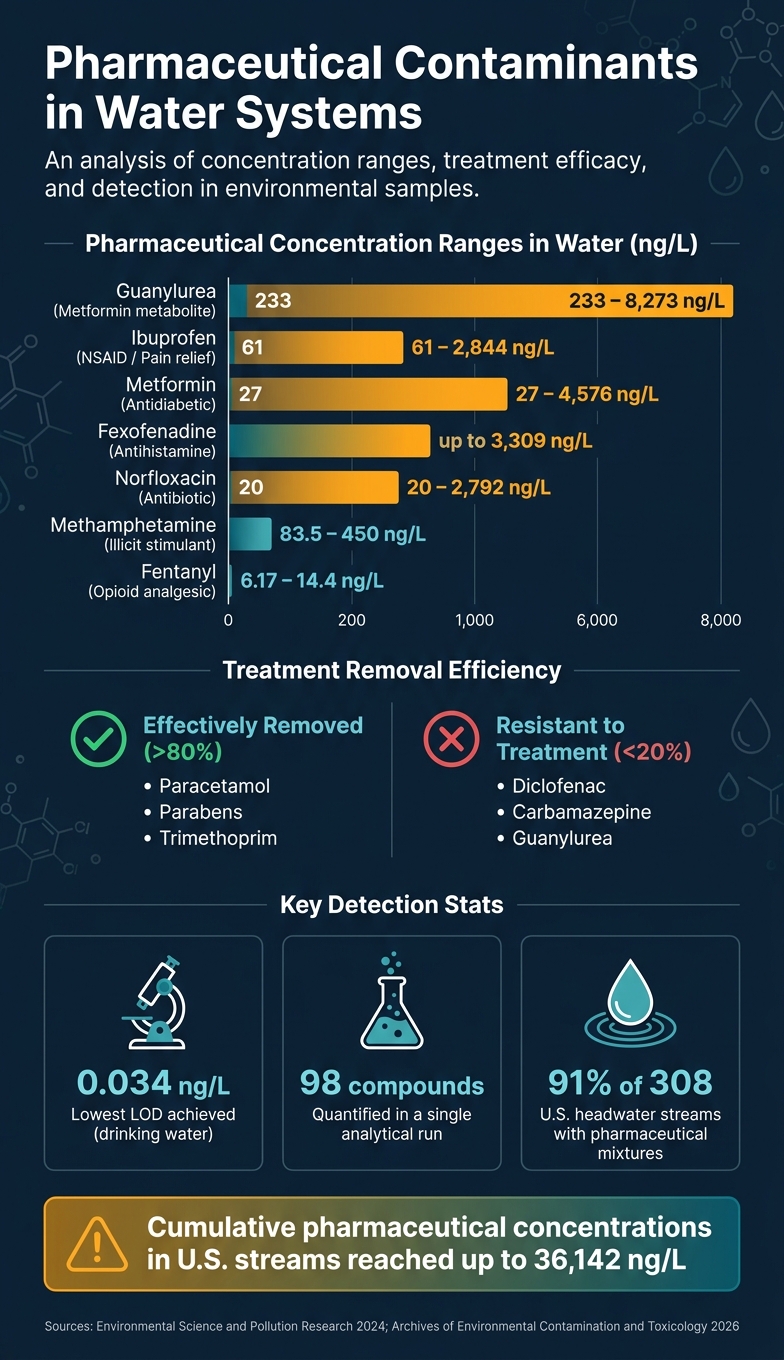
Pharmaceutical Contaminants in Water: Concentrations & Detection Limits
Occurrence and Concentration Trends
Pharmaceutical residues are becoming more prevalent in water systems worldwide. A 2024 study in Environmental Science and Pollution Research tracked 78 pharmaceuticals in Spain’s Llobregat and Besòs Rivers from November 2021 to March 2022. Notably, ibuprofen levels reached 2,844 ng/L in the Llobregat River, while guanylurea – a byproduct of the antidiabetic drug metformin – peaked at 8,273 ng/L near the Sant Adrià del Besòs sampling site [8]. These concentrations were closely linked to areas with dense populations and significant industrial activity.
This issue is not confined to Europe. A February 2026 study in the Archives of Environmental Contamination and Toxicology analyzed the Santa Cruz River in the United States, reporting methamphetamine levels between 83.5 and 450 ng/L, alongside antibiotics ranging from 6.94 to 626 ng/L [9]. The findings attributed these high pharmaceutical concentrations to wastewater treatment plant (WWTP) discharges and unsheltered homelessness along the riverbanks. Across the U.S., pharmaceutical mixtures were found in 91% of 308 headwater streams sampled, with cumulative concentrations reaching up to 36,142 ng/L [11].
| Pharmaceutical / Metabolite | Typical Concentration Range (ng/L) | Source / Use |
|---|---|---|
| Guanylurea | 233 – 8,273 | Metformin metabolite (antidiabetic) |
| Ibuprofen | 61 – 2,844 | NSAID (pain relief) |
| Metformin | 27 – 4,576 | Antidiabetic |
| Norfloxacin | 20 – 2,792 | Antibiotic |
| Fexofenadine | Up to 3,309 | Antihistamine |
| Methamphetamine | 83.5 – 450 | Stimulant / illicit drug |
| Fentanyl | 6.17 – 14.4 | Opioid analgesic |
These findings highlight the urgent need for effective water treatment solutions.
Fate and Transformation During Treatment
The behavior of pharmaceuticals during treatment processes varies significantly. Some compounds, like paracetamol, parabens, and trimethoprim, are efficiently removed in biological treatment systems, achieving over 80% removal rates [7]. However, others, such as diclofenac (an anti-inflammatory) and carbamazepine (an antiepileptic), are much harder to break down, with removal rates often below 20% [7].
Metabolites further complicate the picture. Guanylurea, for example, often appears in higher concentrations in treated water than its parent compound, metformin. This happens because guanylurea is both excreted in large amounts and resistant to standard treatment methods [8]. Additionally, factors like pH, sulfide presence, and whether the system operates aerobically or anaerobically all influence the degradation and transformation of these compounds [7].
Public Health and Ecological Risks
The inability to fully remove pharmaceuticals from water systems has serious consequences for both human and environmental health. Antibiotics like azithromycin can accelerate antimicrobial resistance (AMR) by spreading resistance genes among aquatic bacteria, which directly impacts medical treatments [10]. Corticosteroids, such as dexamethasone, disrupt fish reproductive systems, affecting vitellogenin synthesis and gonadal development [10]. Metformin, detected at 68% of U.S. study sites, reflects the intersection of aquatic ecosystem health and chronic disease prevalence [11].
"The presence of [pharmaceutical compounds] in water may disrupt biological processes in non-target lower organisms upon exposure, as well as posing a potential risk to biotic components, leading to disruption of ecosystem functions." – Discover Applied Sciences [10]
Another concern is the "cocktail effect", where the combined toxicity of multiple pharmaceuticals creates risks greater than individual compounds alone. Current risk assessments often fail to account for these mixtures. In some rivers across the Middle East and North Africa, risk quotients (RQ) for certain pharmaceuticals have exceeded 1,000, signaling severe toxicity to aquatic life [10]. These findings emphasize the need for multi-residue monitoring techniques to better assess environmental impacts.
Advanced HPLC-MS/MS methods are critical tools for tracking and addressing pharmaceutical pollution in water systems.
Disclaimer: This content is for informational purposes only. Consult official regulations and qualified professionals before making sourcing or formulation decisions.
Regulatory Considerations and Quality Assurance
Role in Regulatory Monitoring
HPLC-MS/MS plays a crucial role in regulatory water monitoring by detecting pharmaceuticals at concentrations far lower than older methods could reliably measure. With quantification limits as low as 0.017 ng/L in river water and 0.044 ng/L in wastewater [6], this technology provides the high-resolution data regulators need to evaluate compounds on contaminant candidate lists and conduct meaningful risk assessments.
Beyond routine monitoring, HPLC-MS/MS supports Wastewater-Based Epidemiology (WBE), a "One Health" approach that uses water quality data to track community-wide drug use, disease markers, and antimicrobial resistance (AMR) hotspots. As highlighted by Analytical and Bioanalytical Chemistry:
"WBE has a significant potential to determine the spatiotemporal distribution patterns of antibiotics and resistance genes, such as via predictive modeling of early warning systems for infectious disease, as well as identifying hotspots of AMR emergence and dissemination." – Analytical and Bioanalytical Chemistry [6]
This method distinguishes between contamination sources, such as normal human excretion versus improper pharmaceutical disposal, by simultaneously quantifying both parent drugs and their metabolites. These insights help regulators shape enforcement strategies and public health policies. Such detailed monitoring naturally emphasizes the importance of validated methods and rigorous quality standards.
Method Validation and Quality Standards
Reliable monitoring hinges on validated methods that meet strict quality requirements. Building on the high sensitivities outlined earlier, method validation ensures consistent performance under regulatory conditions. Validated HPLC-MS/MS workflows often achieve recovery rates exceeding 90% across various water types, including reagent water, groundwater, and surface water [2]. Maintaining this level of performance across diverse samples demands tight controls at every stage.
Several practices enhance accuracy and reliability. For instance, applying a 1/x weighting factor to calibration curves improves precision at the lower detection limits [6]. Proper sample storage is equally important, with acceptable recoveries maintained at 39°F (4°C) for up to nine days after collection [2].
Precise compound identification is critical for regulatory and suspect screening workflows. Narrow tolerances – ±0.25 minutes for retention time and 10–15 ppm for mass accuracy [3] – ensure reliable identification. A tiered classification system further strengthens confidence in compound detection. Below is a summary of key validation benchmarks used in compliant HPLC-MS/MS workflows:
| Validation Parameter | Typical Requirement |
|---|---|
| Mass Tolerance (Precursor) | ≤ 10 ppm [3] |
| Mass Tolerance (Fragments) | ≤ 15 ppm [3] |
| Retention Time Window | ± 0.25 min [3] |
| Signal-to-Noise (S/N) | > 5 for fragment ions [3] |
| Recovery Range | 70% – 120% [3] |
Isotope-dilution quantitation is often the most reliable method for addressing matrix effects and ensuring regulatory data consistency across different water types. The U.S. Geological Survey explains the importance of selecting isotope-dilution standards with chemical properties similar to their target compounds:
"Each isotope-dilution standard was selected, when possible, for its chemical similarity to the unlabeled pharmaceutical of interest, and added to the sample after filtration but prior to analysis." [2]
Support from Specialty Chemical Suppliers
The accuracy of HPLC-MS/MS results ultimately relies on the quality of the materials used. LC-MS/MS grade solvents, such as methanol and acetonitrile, are critical for minimizing baseline noise and preventing capillary clogging. Ultra-pure 18.2 MΩ water is essential to avoid contamination in trace-level detection. Additionally, mobile phase modifiers must meet stringent purity standards to ensure consistent ionization efficiency in electrospray mode [2][6].
Allan Chemical Corporation provides compendial-grade and technical-grade materials – including ACS, USP, and NF grades – that meet the rigorous demands of these workflows. With over 40 years of experience in regulated industries and just-in-time delivery capabilities, Allan Chemical ensures laboratories have access to the consistent quality materials needed to maintain compliance in long-term monitoring programs.
Disclaimer: This content is for informational purposes only. Consult official regulations and qualified professionals before making sourcing or formulation decisions.
Conclusion: The Path Forward for Water Quality Monitoring
Advancements in method validation and the use of high-purity reagents have transformed water quality monitoring. Technologies like HPLC-MS/MS have become essential for detecting pharmaceutical contaminants in water, offering unmatched sensitivity and efficiency across different water types [1][5]. However, the success of these methods depends on more than just advanced equipment. Robust workflows that include validated methods, proper sample handling, and the use of high-purity reagents are equally important. Even small errors – such as using contaminated solvents or storing samples improperly – can compromise critical data that supports key decisions. Together, these advancements strengthen water quality monitoring efforts and highlight the importance of regulatory oversight and public health protection.
The future points toward faster techniques, such as online solid-phase extraction (SPE) and direct aqueous injection, which are making large-scale monitoring more practical. These approaches reduce manual intervention, boost reproducibility, and allow for the simultaneous screening of multiple compounds – an essential capability as the list of potential contaminants continues to grow. By streamlining workflows, these methods enhance the regulatory framework and further protect public health.
Maintaining consistent material quality remains a cornerstone of reliable monitoring. Laboratories rely on uninterrupted access to high-quality materials to sustain their analytical performance over time. Allan Chemical Corporation provides the compendial- and technical-grade chemicals – such as ACS, USP, and NF grades – needed to support compliance-driven workflows. With over 40 years of experience in regulated industries and a focus on just-in-time delivery, Allan Chemical helps labs avoid supply chain disruptions that could jeopardize critical programs.
Disclaimer: This content is for informational purposes only. Consult official regulations and qualified professionals before making sourcing or formulation decisions.
FAQs
What’s the difference between HPLC-MS/MS and older water testing methods?
HPLC-MS/MS (High-Performance Liquid Chromatography with Tandem Mass Spectrometry) stands out for its precision, accuracy, and efficiency. This advanced technique can identify pharmaceutical residues at extremely low concentrations (nanograms per liter), handle the analysis of multiple compounds in a single run, and facilitate rapid, high-throughput testing. Older methods, such as HPLC with UV detection, fall short in comparison due to their higher detection limits, reduced sensitivity, and slower processing times, making them less suitable for detecting low-level contaminants in water.
How do labs reduce matrix effects when testing wastewater?
Labs tackle matrix effects in wastewater testing through several strategies. They use internal standards, such as stable isotope-labeled compounds, to account for variability. Techniques like online solid-phase extraction help clean up samples, reducing interference. Additionally, methods such as standard addition and internal standardization are employed to mitigate issues like signal suppression or enhancement, ensuring results are both precise and dependable.
Which pharmaceuticals are hardest to remove in wastewater treatment?
Pharmaceuticals such as Diclofenac and Carbamazepine present significant challenges in wastewater treatment. Their low biodegradability and high resistance to breakdown mean they often persist through standard treatment processes, making effective removal difficult.




Comments are closed