
Non-Newtonian fluids, unlike Newtonian ones like water, don’t have a constant viscosity. Their viscosity changes based on shear rate, applied force, or duration of stress. This makes measuring them complex, especially since traditional viscometers are designed for constant-viscosity fluids. Common examples include ketchup (shear-thinning), cornstarch mixtures (shear-thickening), and toothpaste (Bingham plastic).
Key challenges in measuring these fluids include:
- Variable viscosity: Depends on shear rate and stress history.
- Temperature sensitivity: Small temperature shifts can skew results.
- Shear history effects: Prior handling impacts measurements.
The two main methods for measurement are capillary viscometry and rotational rheometry:
- Capillary viscometry: Measures viscosity by forcing fluid through a tube, ideal for high-shear applications like extrusion.
- Rotational rheometry: Uses rotating surfaces to measure shear stress and is better for low-shear, detailed studies.
Each method suits different fluid behaviors. For example, capillary viscometry works well for high-shear processes, while rotational rheometry excels in studying thixotropic or viscoelastic fluids. Proper sample handling, precise temperature control, and selecting the right method are critical for accurate results.
Non-Newtonian Fluids: Why Ketchup, Blood, and Slime Behave Similar?
sbb-itb-aa4586a
Key Challenges in Measuring Non-Newtonian Fluids
Measuring non-Newtonian fluids isn’t straightforward because their behavior doesn’t fit neatly into the assumptions standard tools rely on. Unlike Newtonian fluids, whose viscosity remains constant, non-Newtonian fluids change their viscosity based on factors like shear rate and handling. These properties expose gaps in traditional measurement methods, as outlined below.
Limitations of Standard Viscometers
Most viscometers are designed for Newtonian fluids, where viscosity stays the same regardless of flow speed. This approach doesn’t work for non-Newtonian fluids, where viscosity changes with shear rate. A standard viscometer typically provides a single measurement at one shear rate, which misses the broader picture of how these fluids behave under different conditions [3].
The issue isn’t just about incomplete data. As Dominique Dupuis, Emeritus University Professor, and Alain Ponton, CNRS Research Director, explain:
"The recommended method is sometimes empirical, and can lead to considerable errors of assessment with non-Newtonian fluids." [3]
Instruments like the Stormer viscometer, while useful for basic quality checks, fail to capture the full shear stress–shear rate profile needed to understand non-Newtonian fluids. Additionally, many of these fluids are viscoelastic or thixotropic, meaning their viscosity depends on how they were handled before testing – a factor standard viscometers don’t account for [4].
How Temperature and Shear Rate Affect Measurements
Two critical variables – temperature and shear rate – can drastically affect viscosity measurements if not tightly controlled. Even small temperature changes can skew results, and with non-Newtonian fluids, viscosity also shifts with shear rate, creating a complex measurement challenge [5][6].
| Factor | Effect on Measurement | How to Address It |
|---|---|---|
| Shear Rate | Viscosity changes with flow speed; single-point tests miss variations | Use a rheometer to measure across multiple shear rates [3] |
| Temperature | Small thermal shifts can alter viscosity readings | Implement precise temperature control systems [6] |
| Kinetic Energy | Energy loss to fluid acceleration skews results | Apply correction factors to account for energy loss [6] |
| Instrument Alignment | Misalignment affects hydrostatic pressure readings | Ensure instruments are perfectly vertical [6] |
In capillary measurements, kinetic energy corrections are particularly important. Some of the applied force moves the fluid instead of overcoming viscosity, which leads to errors if not corrected. For context, the primary international standard for water viscosity has an uncertainty of just ±0.17%, highlighting how precise conditions must be, even for simple fluids [6].
Sample Preparation and Handling
The way non-Newtonian fluids are prepared and handled before testing is just as critical as the measurement itself. These fluids often have a "shear history", meaning their viscosity is influenced by prior mixing, pumping, or agitation [4]. Controlling this shear history is essential for obtaining accurate and consistent results.
A 2021 study by the Technical University of Denmark (DTU) and Fluidan Aps demonstrated this point. Researchers tested acrylic-based viscoelastic coatings using both a novel capillary rheometer and an advanced off-line rheometer. When sample holding time and shear history were carefully controlled, the two methods produced similar results at higher shear stresses (15.0 to 350.0 Pa). However, at lower shear stresses (1.0 to 15.0 Pa), discrepancies ranged from 15% to 74% when these factors weren’t managed [4]. The study concluded:
"The novel capillary rheometer was found to provide results in good quantitative agreement with the advanced rheometer when sample holding time, and thereby shear history, was properly controlled." [4]
For thixotropic fluids, allowing a uniform rest period after loading is crucial. This stabilizes their internal structure, ensuring measurements reflect their true resting or working state. Without this step, readings may capture a transitional phase, not the fluid’s actual properties [3][4].
Techniques for Measuring Non-Newtonian Fluids
Selecting the right method to measure non-Newtonian fluids is crucial, given their complex flow behaviors. Two primary techniques dominate the field: capillary viscometry and rotational rheometry, each tailored to specific applications.
Capillary Viscometry
Capillary viscometry works by forcing a fluid through a calibrated tube, measuring the pressure drop and flow rate to calculate viscosity [7]. This method relies on pressure-driven flow, where the shear rate varies across the tube – highest at the walls and lowest at the center. This uneven velocity profile becomes especially intricate with non-Newtonian fluids [2].
As NETZSCH Analyzing & Testing explains:
"Capillary rheometers measure the shear viscosity and elasticity of viscous materials at high shear rates." [7]
This technique is particularly effective for simulating high-shear industrial processes like extrusion, injection molding, and film blowing. It captures key data such as die swell and melt strength [7], making it indispensable in scenarios where standard tools might fail to replicate real-world conditions. However, for lower shear rates or more detailed material characterization, rotational methods are better suited.
Rotational Rheometry
Rotational rheometry places the fluid sample between two surfaces – commonly a cone and plate or parallel plates. One surface rotates at a controlled speed, and the torque required to overcome the fluid’s resistance is measured, providing insights into shear stress and dynamic viscosity [7].
This method excels in research settings, offering precise control over shear rates to detect molecular-level changes. As RheoSense notes:
"For non-Newtonian fluids, the local viscosity varies with this local shear rate, which in turn alters the overall velocity distribution and flow resistance." [2]
Rotational rheometers are the gold standard for laboratory analysis, particularly when studying viscoelastic or thixotropic fluids. They are ideal for low deformation levels, overcoming the structural sensitivity limitations of standard viscometers.
Automated and Advanced Measurement Methods
For applications requiring higher precision or automation, advanced tools expand on traditional capillary and rotational techniques. Automated capillary viscometers, for example, manage sample loading, timing, and temperature control, reducing operator variability. These are particularly useful for on-line quality control in continuous production settings, such as coatings manufacturing [4].
When velocity profile distortions pose challenges, Coriolis mass flow instruments offer a solution by measuring mass flow through inertial forces, bypassing errors caused by variable velocity profiles [1]. However, electromagnetic and ultrasonic flow meters can struggle with accuracy when fluids shift between flow regimes, limiting their use in precision-demanding industries [1].
Capillary vs. Rotational Methods: A Direct Comparison
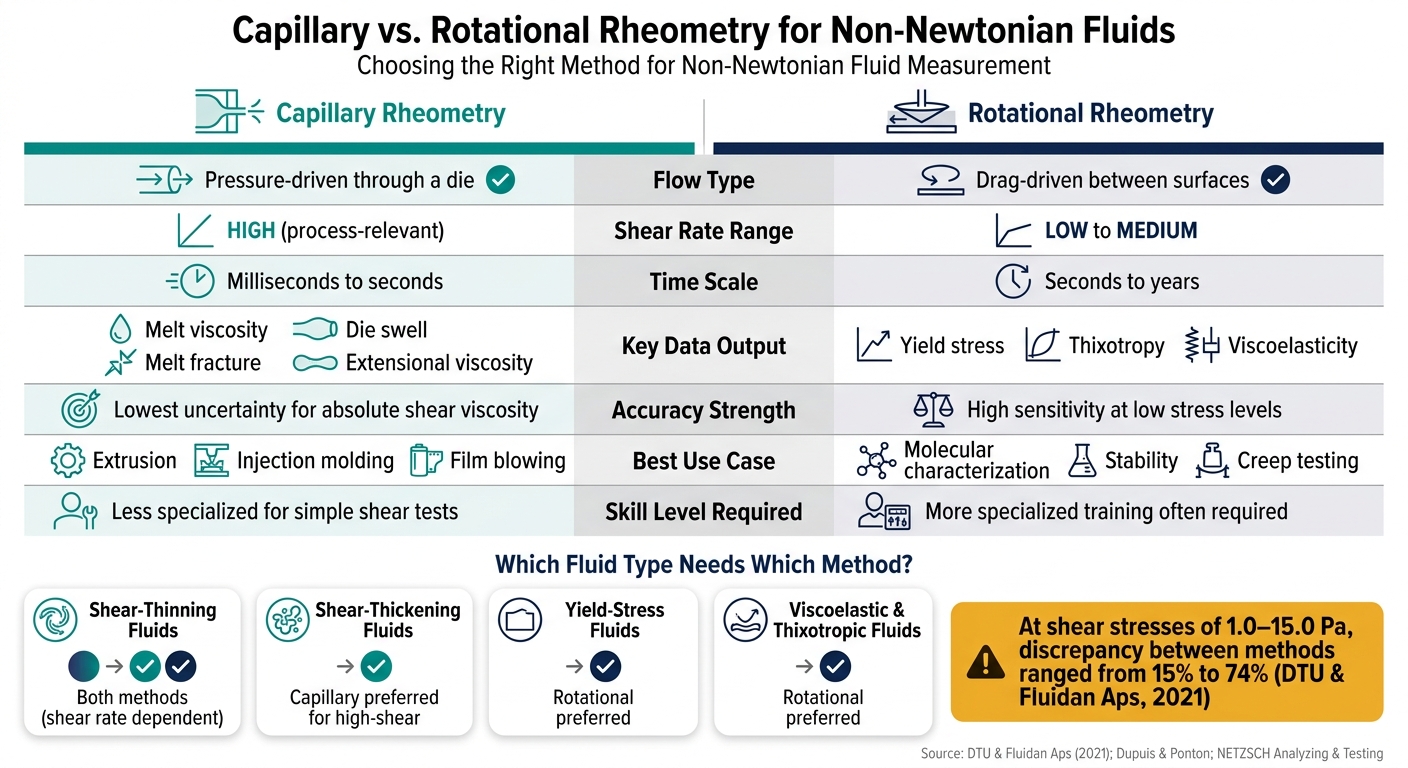
Capillary vs. Rotational Rheometry: Which Method Is Right for Your Fluid?
Advantages and Disadvantages of Each Method
Capillary rheometers rely on pressure to drive flow, while rotational rheometers use torque. This fundamental difference shapes the shear rates they can achieve and the types of data they produce.
| Feature | Capillary Rheometry | Rotational Rheometry |
|---|---|---|
| Flow Type | Pressure-driven through a die | Drag-driven between surfaces |
| Shear Rate Range | High (process-relevant) | Low to medium |
| Time Scale | Milliseconds to seconds | Seconds to years |
| Key Data Output | Melt viscosity, die swell, melt fracture, extensional viscosity | Yield stress, thixotropy, viscoelasticity |
| Accuracy | Lowest uncertainty for shear viscosity [3] | High sensitivity at low stress levels |
| Best Use Case | Extrusion, injection molding, film blowing | Molecular characterization, stability, creep |
| Skill Level Required | Less specialized for simple shear tests [3] | More specialized training often required |
As Dominique Dupuis and Alain Ponton point out, only rotational rheometers can measure extremely low stress levels [3]. On the other hand, capillary systems excel at minimizing uncertainty in absolute shear viscosity measurements [3]. For routine process testing, capillary methods are often more economical. However, rotational rheometers, while more expensive, are indispensable for detailed rheological studies. Research and development labs that need a comprehensive understanding of a fluid’s behavior typically find the investment in rotational equipment worthwhile.
Which Method Works Best for Each Fluid Type
The choice between capillary and rotational methods often comes down to the specific behavior of the fluid being tested.
Shear-thinning fluids – such as polymer melts or certain paints – can be analyzed using either method. The decision depends on the required shear rate. Capillary rheometers are ideal for capturing high-shear behavior, making them well-suited for high-speed manufacturing processes like extrusion or injection molding. Rotational rheometers, however, are better for low-shear, long-duration studies.
Shear-thickening fluids follow a similar pattern: capillary methods are better for high-shear applications. For yield-stress fluids, rotational rheometers are the preferred choice. They can apply precise low-level stresses to determine when the fluid transitions from a solid-like state to flowing behavior [3]. Similarly, rotational systems are essential for studying viscoelastic and thixotropic fluids, where tracking subtle structural changes over time is critical [7].
A study conducted in February 2021 by researchers at the Technical University of Denmark (DTU) and Fluidan Aps highlighted these differences. When testing capillary rheometry on acrylic-based coatings, the results closely matched those from advanced rotational rheometers at shear stresses between 15.0 and 350.0 Pa. However, at lower stresses – between 1.0 and 15.0 Pa – the discrepancy grew significantly, ranging from 15% to 74%. This underscores the limitations of capillary methods in low-stress conditions [4].
Conclusion
Key Takeaways
When choosing between capillary and rotational techniques for measuring non-Newtonian fluids, it’s crucial to align the method with the fluid’s specific shear behavior and intended application. Capillary rheometry excels in application-specific testing, offering precise absolute viscosity measurements [3] and is particularly suited for fast, on-line quality control in process-related scenarios [4]. It’s the go-to method for rapid deformation scenarios (milliseconds to seconds). On the other hand, rotational techniques are better suited for near-rest or extended shear conditions, where properties like low-stress behavior, thixotropy, or viscoelasticity are key factors [7]. These insights underscore the importance of tailoring measurement techniques to accurately assess a fluid’s shear properties, ensuring reliable outcomes in industrial settings.
"The faster the material’s response, the higher the required rate of deformation, which limits the use of rotational rheometers for rapid processes." – NETZSCH Analyzing & Testing [7]
How Allan Chemical Corporation Supports Your Measurement Needs

Accurate rheological measurements depend not only on the right techniques but also on consistent, high-quality materials. In industries like pharmaceuticals, food, and cosmetics, where precision is non-negotiable, the chemicals used to prepare or formulate non-Newtonian fluids must adhere to strict quality standards. This ensures reproducibility and reliability in fluid characterization.
Allan Chemical Corporation provides a wide range of technical-grade and compendial-grade chemicals, including USP, FCC, ACS, and NF grades, to support these needs. With over 40 years of expertise and a commitment to just-in-time delivery, Allan Chemical Corporation helps labs and production teams maintain the material consistency essential for dependable rheological testing.
Disclaimer: This content is for informational purposes only. Consult official regulations and qualified professionals before making sourcing or formulation decisions.
FAQs
How do I choose between capillary and rotational rheometry for my sample?
To decide between capillary rheometry and rotational rheometry, focus on your material’s behavior and the type of data you need. Capillary rheometers excel in analyzing high-shear-rate flows, making them perfect for studying viscous materials like polymers. On the other hand, rotational rheometers are versatile, capable of performing viscoelastic measurements and oscillatory tests, which are ideal for complex non-Newtonian fluids. Your choice should depend on whether your priority is high-shear-rate analysis or a deeper understanding of viscoelastic properties.
What shear-rate range should I test to match real process conditions?
The shear-rate range you need will vary based on your application and how your fluid behaves. Rotational viscometers are commonly used to assess flow behavior across different shear rates. To get accurate measurements, determine the shear rates that match your process – from lower rates reflecting static conditions to higher rates for dynamic operations – and conduct tests within that range to mimic real-world processing conditions.
How can I control shear history so results are repeatable?
To get consistent results when working with non-Newtonian fluids, it’s important to keep shear conditions steady throughout testing. Stick to a set shear rate and avoid abrupt shifts in shear stress, as these can alter how the fluid behaves. Use rheometers that offer accurate shear control, and adhere to established testing protocols to manage shear history effectively and ensure reliable measurements.




Comments are closed