
Thermal management in cement is critical for preventing structural issues like cracking and long-term damage. When cement hydrates, it generates significant heat, especially in mass concrete placements over 5 feet thick. Without proper control, internal temperatures can exceed 70–80°C (158–176°F), creating thermal stress and risking Delayed Ettringite Formation (DEF).
Additives play a key role in managing this heat by slowing hydration reactions and reducing peak temperatures. Options include phosphonates, hydroxycarboxylic acids, and supplementary cementitious materials like Ground Granulated Blast Furnace Slag (GGBS). These solutions help maintain safe temperature differentials, improve durability, and reduce repair costs. Key strategies also involve pre-cooling techniques, real-time temperature monitoring, and proper additive dosing.
Key Points:
- Cement hydration generates up to 280 kJ/kg of heat in 7 days.
- Temperature differences exceeding 35°F (19–20°C) can cause cracking.
- Additives like phosphonates and GGBS reduce heat buildup.
- Pre-cooling methods and monitoring are vital for large projects.
This approach ensures safer, longer-lasting concrete structures, especially for dams, bridges, and large-scale infrastructure.
How Heat Develops During Cement Hydration
What Happens During Heat of Hydration
The heat generated during cement hydration largely depends on the proportions of clinker minerals, especially tricalcium silicate (C₃S) and tricalcium aluminate (C₃A). For Ordinary Portland Cement, this process can release up to 321 kJ/kg of heat within 28 days [1].
In mass concrete placements – those thicker than 5 feet (1.5 meters) – the material’s low thermal conductivity traps heat inside. This can cause internal temperatures to soar to 70–80°C (158–176°F) within just 48 hours. Meanwhile, the surface, exposed to ambient air or cooling methods, typically stays between 15–25°C (59–77°F) [1] [2]. This stark temperature difference creates tensile stresses, which the concrete, being weak in tension, cannot handle. To avoid cracking, industry guidelines usually cap the allowable temperature gap between the core and surface at 19–20°C (35°F). If internal temperatures exceed roughly 70°C (160°F), the risk of Delayed Ettringite Formation (DEF) rises, potentially leading to long-term expansion and internal cracking [1].
Understanding these thermal dynamics is essential when selecting additives and designing mixes to manage heat, as highlighted in later sections.
Common Problems with Heat Control
Large temperature gradients in concrete often lead to serious structural issues. For example, thermal cracking can compromise the watertightness of structures like dams, creating pathways for seepage. This not only accelerates internal erosion but also exposes reinforcement steel to corrosion [1]. Financially, the stakes are high: thermal cracking and subsequent repairs can consume 15–30% of a concrete project’s budget, whereas a proactive prevention strategy typically costs just 2–5% [1].
Environmental conditions can exacerbate these challenges. In tropical regions or high-altitude areas, significant day-to-night temperature swings – sometimes over 25°C (77°F) – can lead to rapid surface cooling. Similarly, cold-weather conditions, combined with wind or rain, can intensify surface cooling, widening the temperature gradient. On the other hand, warm weather and higher initial placement temperatures accelerate heat generation and increase late-stage tensile stresses [1] [2].
A notable case is the Jinan Yellow River Fenghuang Bridge project in February 2025. Here, internal temperatures in a C60 concrete section reached 77.3°C within 2–3 days, while C35 foundation slabs peaked at 64.3°C. A wireless monitoring system was employed, ensuring a safety factor of 1.35 against thermal cracking [2].
This content is for informational purposes only. Consult official regulations and qualified professionals before making sourcing or formulation decisions.
sbb-itb-aa4586a
Using Additives to Control Hydration Heat
How Additives Help Manage Heat
Hydration control additives are essential for managing the heat generated during cement hydration. These additives slow down the chemical reactions responsible for heat production, extending the dormancy period and ensuring heat is released gradually. This process helps keep peak temperatures below 70°C, maintaining a safe temperature differential of 35°F (19–20°C) between the core and surface of the cement structure [1].
The underlying mechanisms involve specific chemical interactions. For instance, phosphonates form an insoluble layer on clinker phases or disrupt the nuclei of Calcium-Silicate-Hydrate (C-S-H) and Calcium Hydroxide, slowing crystal growth and reducing heat release. Other organic additives work by adsorbing onto hydration products or clinker grains, creating a barrier that limits water access and slows reactions [4]. As Daniel Axthammer and Joachim Dengler from BASF Construction Additives GmbH explain:
“The most significant application for retarders is to compensate for high temperatures. Increased temperatures reduce the open times, which can be counteracted by the addition of retarding molecules” [4].
In addition to temperature control, these additives improve workability under extreme conditions. This is especially important for large-scale projects that require extended transport or pumping times. The gradual control of hydration heat is achieved through different types of additives, each with distinct properties and applications.
Types of Additives and What They Do
Different additives use unique mechanisms to manage hydration heat and maintain safe thermal ranges.
Phosphonates are highly effective retarders with predictable performance based on dosage. For example, EDTMP can delay cement setting by 1.4 hours per mmol/L, with dosages under 4 mmol/L achieving delays of about 4 hours. HEDP (1-Hydroxyethylidene-1,1-diphosphonic acid) performs similarly, with its hydroxy groups enhancing calcium and aluminum solubility. However, not all phosphonates are equally effective; HPA (Hydroxyphosphonoacetic acid) and PPA show limited retarding effects due to their hydrophobic nature [4].
Hydroxycarboxylic acids like tartrates, gluconates, and citrates are widely used to adjust setting times and manage early heat. Calcium lignosulfonate is another popular retarder, particularly effective in hot weather conditions (68–104°F or 20–40°C). It works by delaying the hydration of key compounds like tricalcium silicate (C₃S), dicalcium silicate (C₂S), and tricalcium aluminate (C₃A) [3][4].
Supplementary Cementitious Materials (SCMs), while part of the cementitious system, act as additives in mass concrete applications. For instance, replacing 50% of Ordinary Portland Cement with Ground Granulated Blast-furnace Slag (GGBS) can cut heat generation by 40–50%, reducing it from approximately 280 kJ/kg to 140–170 kJ/kg at 7 days. Similarly, Portland Pozzolana Cement (PPC) produces about 190–225 kJ/kg of heat at 7 days, which is 30% less than standard OPC. For immediate temperature reduction in large-scale pours, liquid nitrogen injection is often used as a pre-cooling method [1].
This content is for informational purposes only. Consult official regulations and qualified professionals before making sourcing or formulation decisions.
How to Use Additives Correctly
Dosage Rates and Mix Adjustments
Accurate dosing of additives is essential for effective thermal control in concrete. For example, Lignosulfonate retarders are typically used at 0.2% to 0.3% of the cement’s weight. This dosage extends the setting time by 2 to 3 hours, which helps manage heat buildup without compromising the concrete’s strength [5]. Similarly, superplasticizers can reduce water content by 12–30%, but they should be added at the job site to prevent rapid slump loss [5].
When calculating additive dosages, use the percentage by weight of cement (%bwc) and include any mixing water that exceeds 3 L/m³ in the water-to-cement ratio [6]. For additives with dosages below 0.2% of cement weight, dissolve them in part of the mixing water to ensure even distribution throughout the concrete [6].
Adjust your mix based on temperature conditions. In hotter weather or for large concrete pours, retarders can slow down the setting process, reducing the risk of cracking caused by temperature spikes [5]. On the other hand, when temperatures drop below 41°F (5°C), avoid retarders and opt for early strength agents that speed up hydration [5]. If multiple admixtures are used, compatibility tests are crucial to avoid negative interactions that could compromise the mix’s performance [6].
Once the correct dosage is determined, continuous temperature monitoring becomes vital to protect the integrity of the concrete.
Monitoring and Controlling Temperature
After fine-tuning your mix, keeping track of real-time temperatures is key to managing hydration heat. In addition to traditional embedded sensors, advanced non-destructive tools like electrical resistivity and ultrasonic pulse velocity (UPV) can monitor hydration and setting time, especially in hot conditions [3]. Computational models like finite element analysis (as outlined in ACI 207.2R) can predict temperature distribution by considering factors such as heat evolution, placement dimensions, and environmental conditions like wind and sunlight [1].
Pre-cooling methods also play a crucial role in temperature control for large-volume pours. Techniques include using chilled water (35–41°F or 2–5°C), replacing 50–75% of mixing water with flake ice, or cooling aggregates with cold-air blasting. These methods can lower the concrete mix temperature by 9–14°F (5–8°C) [1]. In tropical climates, aim for a placement temperature between 50–59°F (10–15°C) using a combination of these strategies [1]. For long-term thermal control, embedded cooling pipes (made from steel or HDPE, 1–2 inches or 25–50 mm in diameter) can be installed in serpentine patterns. Maintain water inlet temperatures between 41–50°F (5–10°C) and keep the temperature difference between inlet and outlet water below 36°F (20°C) [1].
Surface protection is just as important as internal cooling. Use insulating blankets, windbreaks, or curing compounds to prevent evaporative cooling and maintain consistent temperature gradients. The temperature difference between the core and surface should not exceed 35°F (19–20°C) [1]. In environments with significant daily temperature fluctuations (like deserts or high-altitude areas), prioritize surface insulation to prevent rapid cooling at night, even during summer [1]. If post-cooling pipes are used, ensure the cooling rate does not exceed 20°F (11°C) over 12 hours to avoid thermal shock [1].
This content is for informational purposes only. Always consult official guidelines and professionals for specific recommendations.
Mass Concrete: Does My Project Need a Thermal Control Plan?
Fixing Common Heat Management Problems
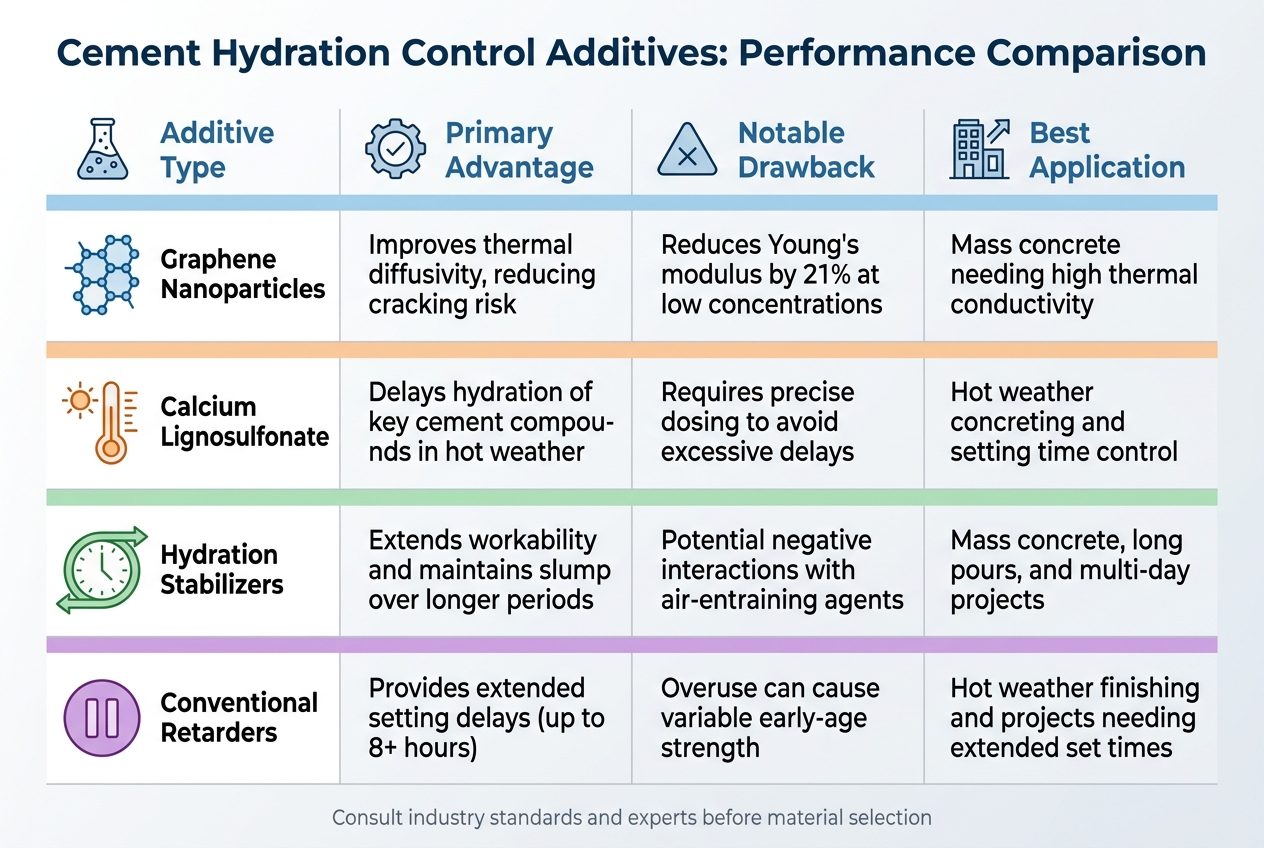
Cement Hydration Control Additives Comparison Chart
Dealing with Delayed Setting Times
Additives like Calcium Lignosulfonate or Graphene Nanoparticles can sometimes cause excessive delays in setting, potentially disrupting construction schedules [7][3]. To catch these delays early, rely on real-time monitoring tools rather than just visual inspections.
Non-destructive testing methods such as electrical resistivity and ultrasonic pulse velocity (UPV) are effective in identifying setting delays [3]. For on-site evaluations, the Vicat needle test (ASTM C191) remains a reliable standard [3]. If you notice setting times exceeding your target, consider adding chemical accelerators or increasing the cement content in the mix [8]. However, always coordinate these adjustments with your ready-mix supplier to ensure consistency.
Pre-job trials are crucial for determining the right additive dosages. Use the actual cement and aggregates from your project site to account for variables like aggregate type, humidity, and temperature [8]. Remember, finer cement particles tend to set faster than coarser ones, which can help counterbalance overdosing effects. These steps not only address delayed setting but also support broader efforts to manage temperature-related challenges.
Handling Temperature Variations in Different Conditions
Temperature fluctuations can significantly impact additive performance, especially under varying weather and site conditions. For example, high ambient temperatures between 86–104°F (30–40°C) speed up the hydration process, often requiring higher doses of retarders to maintain workability [3]. This creates a need for precise dosage calibration.
“The accelerated hydration process under high temperature curing conditions can lead to premature hydration products, therefore, retarding admixtures are recommended to control the setting time.”
– Hong Jae Yim, Department of Civil Engineering, Pusan National University [3]
Effective thermal control starts with predictive tools. Use computational thermal modeling with finite element analysis to forecast temperature distribution based on factors like wind, solar exposure, placement geometry, and heat evolution [1]. Adjust pre-cooling measures – such as chilled water, ice substitution, or liquid nitrogen – based on real-time temperature readings [1]. In areas where daily temperature swings exceed 45°F (25°C), surface protection with insulating blankets or windbreaks can prevent rapid cooling during nighttime [1].
Late-age heat gain is another concern. For instance, increasing the water-to-cement ratio from 0.5 to 0.6, combined with up to 10% Graphene content, can elevate the 7-day heat of hydration by 50 J/g, potentially leading to delayed thermal cracking [7]. Continuous monitoring of both ambient and concrete temperatures is essential, and hotter conditions may require dosage adjustments during the pour [8].
Additive Comparison Table
Here’s a breakdown of different additives to help you choose the right one for managing delayed setting and temperature-related challenges:
| Additive Type | Primary Advantage | Notable Drawback | Best Application |
|---|---|---|---|
| Graphene Nanoparticles | Improves thermal diffusivity, reducing cracking risk [7] | Reduces Young’s modulus by 21% at low concentrations [7] | Ideal for mass concrete needing high thermal conductivity [7] |
| Calcium Lignosulfonate | Delays hydration of key cement compounds in hot weather [3] | Requires precise dosing to avoid excessive delays [3] | Best for hot weather concreting and setting time control [3] |
| Hydration Stabilizers | Extends workability and maintains slump over longer periods [8] | Potential negative interactions with air-entraining agents [8] | Suitable for mass concrete, long pours, and multi-day projects [8] |
| Conventional Retarders | Provides extended setting delays (up to 8+ hours) [8] | Overuse can cause variable early-age strength [8] | Works well for hot weather finishing and projects needing extended set times [8] |
This information is for guidance only. Always consult industry standards and experts before making decisions on materials or formulations.
Conclusion
Key Takeaways
Effective thermal management is crucial for ensuring the durability and performance of concrete structures. By focusing on hydration control additives and mix adjustments, you can manage the heat generated during cement curing, particularly in mass concrete applications where internal temperatures can rise significantly within the first 48 hours [1]. Controlling this heat helps minimize temperature differentials, reducing tensile stresses that can lead to cracking.
Additives such as calcium lignosulfonate and Phase Change Materials (PCMs) play a key role in extending workability and limiting thermal deformation by regulating hydration heat [3] [9]. Additionally, specialized materials that lower the thermal conductivity of the concrete matrix can address thermal bridges, which may account for up to 30% of heat loss in large commercial structures [9].
Using additive-based passive cooling methods offers a cost-effective alternative to active cooling systems [10]. Optimizing mix designs – such as replacing 50% of Portland cement with Ground Granulated Blast Furnace Slag (GGBS) – can cut heat generation by 40–50% [1]. It’s essential to factor all liquid admixtures into the water-cement ratio and ensure compatibility when combining multiple admixtures [6].
To ensure the success of your thermal management strategy, conduct thorough pre-job trials and employ real-time non-destructive testing. Use site-specific materials during trials, monitor the setting process with methods like electrical resistivity, and adjust dosages based on live temperature readings. These steps help confirm that your approach will perform effectively.
For hydration control additives that deliver reliable results, consider technical-grade solutions from Allan Chemical Corporation. Their expertise and focus on quality can help you achieve optimal thermal performance in your cement mixes. Visit their website at https://allanchem.com for more information.
This content is for informational purposes only. Always consult official regulations and qualified professionals before making sourcing or formulation decisions.
FAQs
How do I choose the right retarder for my cement mix?
To choose the right retarder, start by determining the specific purpose it needs to serve. Retarders are used to delay the setting of cement while keeping its strength and workability largely unaffected. Key factors to evaluate include the type of cement, environmental conditions (such as elevated temperatures), and the required delay time. Common options include tartaric acid salts and citric acid salts. Make sure the retarder is compatible with your mix, adhere to recommended dosage instructions, and check that it meets standards like BS EN 934 Part 2 for best performance.
What’s the safest way to dose multiple admixtures together?
To ensure the safe and effective dosing of multiple admixtures, work closely with your ready-mixed concrete supplier to confirm their compatibility with your project’s needs. Always test admixtures in advance and adhere strictly to the manufacturer’s instructions regarding dosage and mixing procedures. Follow the correct mixing sequence – commonly water, cement, admixtures, and then aggregates – to achieve even distribution. Conduct trial mixes to validate performance and prevent any negative interactions. Avoid specifying particular brands unless their compatibility has been thoroughly confirmed.
How can I monitor and control core-to-surface temperature on a pour?
To keep track of core-to-surface temperature during a pour, embedded temperature sensors, such as thermocouples, are essential. These provide real-time data on internal temperatures. For temperature control, hydration temperature rise inhibitors can be applied to limit heat generation during the curing process. By using these sensors alongside the inhibitors, you can effectively manage temperature increases, reduce the risk of thermal stresses, and ensure safe curing conditions – especially important for large-scale projects like dam construction.




Comments are closed