
Natural pigments, derived from plants, minerals, and microorganisms, are replacing synthetic dyes in cosmetics due to their eco-friendly properties and functional advantages. Unlike synthetic pigments, which rely on petrochemicals and produce toxic byproducts, natural pigments are biodegradable and safer for both humans and the environment. Microbial pigments, produced through fermentation, offer year-round production and can utilize waste materials, reducing resource strain. Plant-based pigments, while renewable, face challenges such as seasonal limitations and lower yields. The global market for natural cosmetics is expected to reach $54.5 billion by 2027, driven by demand for safer, greener ingredients.
Key points:
- Synthetic pigments: Made from petrochemicals; non-biodegradable; contain harmful chemicals like benzene and heavy metals.
- Plant-based pigments: Renewable and non-toxic; derived from roots, leaves, and fruits; sensitive to environmental factors.
- Microbial pigments: Produced via fermentation; scalable; use industrial byproducts; offer consistent quality.
Quick Comparison:
| Feature | Synthetic Pigments | Plant-Based Pigments | Microbial Pigments |
|---|---|---|---|
| Source | Petrochemicals | Plants (leaves, roots) | Microorganisms (bacteria) |
| Biodegradability | Low | High | High |
| Production Scalability | High | Moderate (seasonal limits) | High (year-round production) |
| Environmental Impact | High (toxic byproducts) | Lower (land/water use) | Minimal (waste recycling) |
Natural pigments are shaping the future of cosmetics, offering safer alternatives without compromising on performance. This is particularly important when trying to formulate long-wear cosmetic colorants that maintain their integrity over time. However, challenges like stability and production costs remain for plant-based and microbial options. Advances in encapsulation and fermentation technologies are addressing these hurdles, paving the way for broader adoption.
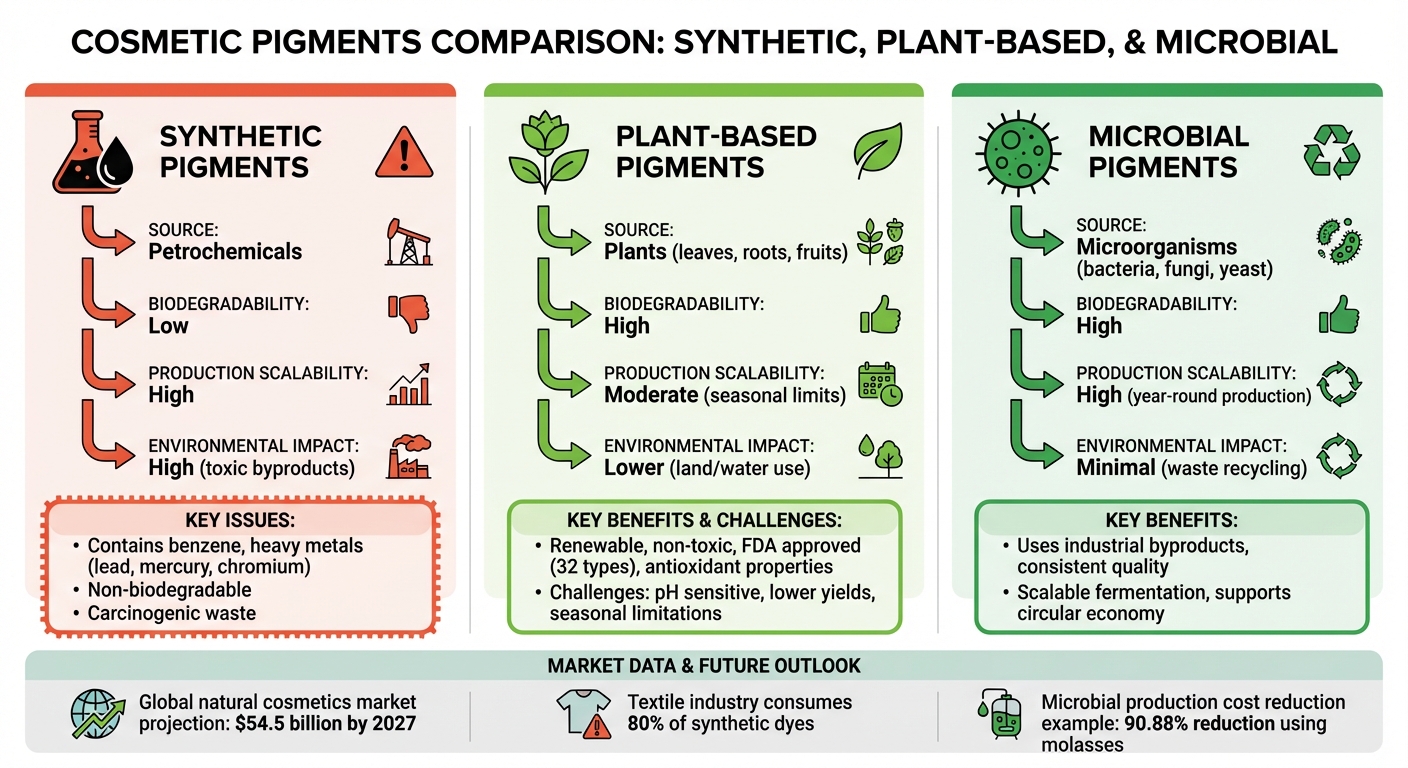
Synthetic vs Plant-Based vs Microbial Pigments Comparison for Cosmetics
Plant-Based Alternatives to Toxic Colorants
sbb-itb-aa4586a
Environmental Problems with Synthetic Pigments
The production of synthetic pigments relies heavily on petrochemicals, which are derived from non-renewable fossil fuels. This process not only depletes finite resources but also generates industrial waste laden with harmful substances like toluene, benzene, and heavy metals such as chromium, lead, mercury, copper, and cadmium [2]. These toxic byproducts pose serious threats to the environment, as extensively documented in industry research.
"Synthetic dyes are non-biodegradable, non-renewable, and carcinogenic and produce hazardous waste contamination." – MDPI, Cosmetics Journal [2]
Once synthetic pigments are released into the environment, their resistance to natural degradation becomes a major issue. They are difficult to remove through conventional wastewater treatment methods, largely because of their high water solubility. This results in contamination of both surface and groundwater sources, while also increasing chemical oxygen demand (COD) and biological oxygen demand (BOD) levels. For instance, a BOD/COD ratio of 0.25 indicates a high concentration of non-biodegradable organic matter [5].
Among synthetic pigments, azo dyes are particularly alarming. These compounds break down through enzymatic reactions into carcinogenic aromatic amines [5][6]. Studies have shown, for example, that the Red-S3B azo dye (3.19% nitrogen content) is toxic to the growth and germination of wheat saplings within just seven days [5]. Similarly, Sudan I (Solvent Yellow 14), an azo-lipophilic compound used in various industries, undergoes enzymatic transformation in humans and animals, producing carcinogenic aromatic amines [5].
The textile industry alone consumes roughly 80% of all synthetic dyes and is the second-largest contributor to global water pollution [1]. When synthetic pigments seep into aquatic environments, they block sunlight from penetrating the water. This disruption halts photosynthesis in aquatic plants and algae, while also stunting the growth and functionality of microalgae, which are critical to aquatic food chains [1]. The cascading effects on ecosystems further emphasize the environmental toll of synthetic pigments.
These challenges highlight the pressing need to transition toward eco-friendly cosmetic colorants that offer a more sustainable alternative.
This content is for informational purposes only. Consult official regulations and qualified professionals before making sourcing or formulation decisions.
Sustainability Benefits of Plant-Based Pigments
Plant-based pigments, derived from renewable sources like leaves, flowers, roots, and fruits, offer an eco-friendly alternative to petroleum-based dyes. These natural pigments are biodegradable, breaking down without leaving harmful residues behind, unlike many synthetic dyes that persist in the environment [1].
Another key advantage lies in their non-toxic nature. Free from heavy metals such as lead, arsenic, and mercury, these pigments are especially valued in industries like cosmetics [3]. In the United States, the FDA has approved 32 natural pigments, including well-known examples like chlorophyll, beet red, and β-carotene, for a range of uses [3]. Beyond their vibrant colors, many of these pigments bring added perks, such as antioxidant, anti-inflammatory, and UV-protective properties, making them increasingly attractive for commercial applications [1][3].
"Natural dyes and pigments are gaining importance as a sustainable alternative to synthetic dyes. Sourced from renewable materials, they are known for their biodegradable and non-toxic properties." – MDPI Review [1]
Several plant-based pigments have already found success in the market. For instance, beetroot powder (Beta vulgaris) produces striking red and pink shades thanks to its betalains, while spirulina powder delivers green tones along with nutritional benefits. Hibiscus flowers yield rich red and purple dyes, and annatto seeds (Bixa orellana) provide vibrant yellow to orange hues [1]. Despite their growing popularity, scaling up production to meet rising demand presents significant hurdles.
Producing plant-based pigments on a large scale comes with challenges. Cultivating the necessary crops requires substantial agricultural land and water, and yields are often lower compared to synthetic alternatives [1][7]. Seasonal changes and geographic limitations can also disrupt supply chains. Additionally, some pigments, like anthocyanins, are highly sensitive to environmental factors, such as pH, which can alter their color and complicate formulation stability. Addressing these lipid-soluble antioxidants’ stability challenges often requires techniques like encapsulation [1][3]. Overcoming these obstacles is essential to fully harness the sustainability potential of plant-based pigments in industries like cosmetics.
This content is for informational purposes only. Consult official regulations and qualified professionals before making sourcing or formulation decisions.
Microbial Pigments as an Alternative
Microbial pigments – natural colorants derived from bacteria, fungi, yeasts, and microalgae – strike a balance between synthetic and plant-based options. Produced through fermentation in bioreactors, these pigments eliminate the need for farmland, irrigation, and reliance on seasonal cycles. Unlike plant-based sources, microbial pigments can be produced consistently throughout the year, ensuring stable quality and output [11][13]. This year-round production method also opens doors to significant economic and environmental advantages.
Microorganisms grow quickly in affordable growth media and can even thrive on agro-industrial byproducts like sugarcane bagasse, wheat bran, whey, and fruit waste [11][13]. This approach not only lowers production costs but also supports waste recycling, contributing to a circular economy. For instance, using molasses as a growth medium for Rhodopseudomonas faecalis cut carotenoid production costs by an impressive 90.88%. Similarly, a techno-economic analysis of astaxanthin production from wheat bran through solid-state fermentation estimated a gross profit of $3.9 million, highlighting its industrial viability [13].
"Microbial pigments represent an eco-friendly alternative as they can be produced in large amounts through biotechnological processes and do not present environmental risks, as they are easily decomposable." – Maria Elisa Pailliè-Jiménez, Paolo Stincone, and Adriano Brandelli [9]
These pigments are biodegradable and non-toxic, making them safer compared to synthetic dyes that persist in the environment [9][11]. Examples include prodigiosin (red) from Serratia bacteria, carotenoids from Rhodotorula yeast, and phycocyanin (blue) from Spirulina microalgae. Beyond their color properties, microbial pigments offer added benefits like antioxidant activity, UV protection, and anti-aging effects, making them particularly attractive for cosmetics [2][9]. Several microbial pigments, such as riboflavin from Ashbya gossypii and lycopene from Blakeslea trispora, have even received FDA approval [12].
Advancements in genetic engineering and metabolic optimization are further expanding the potential of microbial pigments. Scientists can now modify strains like Streptomyces coelicolor to produce specific pigments by tweaking their biosynthetic pathways [2]. These innovations make microbial pigments even more scalable and adaptable to industrial needs. With the global market for natural cosmetics expected to grow to $54.5 billion by 2027, microbial pigments offer a practical and sustainable alternative for brands seeking high-performance colorants without the land-use challenges tied to plant-based options [2].
This content is for informational purposes only. Always consult official regulations and qualified professionals before making sourcing or formulation decisions.
Comparing Natural and Synthetic Pigments
When it comes to cosmetic pigments, the differences between synthetic, plant-based, and microbial sources are striking, especially in terms of their environmental impact. Synthetic pigments, made from non-renewable petrochemicals, are prized for their color stability and resistance to light and washing [14][15]. However, their environmental footprint is hefty. These pigments often contain heavy metals like lead, arsenic, and mercury, which linger in soil and water as micropollutants due to their low biodegradability [1][11]. The textile industry alone consumes about 80% of synthetic dyes produced globally, highlighting their widespread use and environmental cost [1]. These issues make the search for more sustainable alternatives increasingly urgent.
Plant-based pigments offer a renewable and biodegradable option. Extracted from roots, leaves, and fruits, these pigments are generally non-toxic, making them safer for both people and the environment [15]. However, they come with challenges: they’re sensitive to pH, light, and heat, which can lead to quicker fading [1][15]. Additionally, large-scale production requires significant land, water, and pesticide use, which can strain resources and limit scalability due to seasonal farming cycles [11].
Microbial pigments present an intriguing middle ground, balancing sustainability with practical production benefits. These pigments are created through fermentation, making them biodegradable, non-toxic, and capable of utilizing agro-industrial byproducts [4][11]. This process aligns with a circular economy model. Unlike plant-based pigments, microbial pigments can be produced year-round without relying on weather or seasonal conditions [4].
"Obtaining easily usable, nontoxic, eco-sustainable, cheap and biodegradable pigments represents the future in which researchers should invest." – Professor Nicola Cicero, University of Messina [4]
The cost of pigments varies widely depending on the source. Synthetic Tartrazine costs around $700–$800 per 100g, while microbial carotenoids are priced at about $1,000 per 100g [11]. Plant-based pigments like cochineal are more affordable, ranging from $50–$80 per 100g, though specialty options like saffron can cost as much as $1,400 per 100g [16]. Research-grade microbial pigments, such as violacein and prodigiosin, remain extremely expensive at approximately $50 million per 100g. However, advances in fermentation technology are steadily reducing production costs [16].
Comparison Table
| Metric | Synthetic Pigments | Plant-Based Pigments | Microbial Pigments |
|---|---|---|---|
| Biodegradability | Low to none; persistent micropollutants [11] | High; naturally degradable [15] | High; eco-friendly and non-toxic [11] |
| Source | Non-renewable petrochemicals [14][15] | Renewable plants (roots, leaves, fruits) [1] | Renewable microorganisms (bacteria, fungi) [4] |
| Environmental Impact | High; toxic wastewater, heavy metals [1] | Low; requires land and water for farming [11] | Very Low; uses industrial waste [4] |
| Production Scalability | High; established industrial processes [14] | Moderate; limited by seasons and land use [11] | Growing; scalable with fermentation [11] |
| Color Stability | High; resistant to light and washing [15] | Low; sensitive to pH and UV [1] | Moderate; improving with technology [14] |
This comparison highlights the sustainability challenges and opportunities across pigment types. It also sets the stage for examining how natural pigments are being stabilized and integrated into commercial applications.
This content is for informational purposes only. Always consult FDA regulations for cosmetic pigments and qualified professionals before making sourcing or formulation decisions.
Research on Stability and Commercial Use of Natural Pigments
Natural pigments face challenges like degradation when exposed to light, oxygen, heat, or pH fluctuations, which can shorten the shelf life of cosmetic products [10][19]. To address these issues, encapsulation technology has become a leading solution. Techniques such as microencapsulation and nanoencapsulation shield pigments from environmental stress while enabling controlled release in formulations. This approach helps preserve delicate compounds like anthocyanins and carotenoids, making them more suitable for use in creams, lotions, and other personal care products [8][19]. Additionally, researchers are exploring pigment-protein complexes and pigment-metal nanoparticles to enhance pigment stability during storage [3].
Fermentation methods are also making strides in stabilizing natural pigments. For instance, genetically engineered Yarrowia lipolytica strains have achieved beta-carotene yields of 4.5 g/L in 5-liter fermenters through optimized genetic modifications. Similarly, modified Escherichia coli has produced 1.18 g/L of astaxanthin within 60 hours [4]. Advances in synthetic biology, including techniques like Gibson assembly and Golden Gate cloning, allow scientists to reconstruct biosynthetic pathways, paving the way for industrial-scale production [17]. These developments not only improve efficiency but also promote sustainable production methods.
The use of waste substrates as fermentation media adds another layer of cost-effectiveness while supporting a circular economy. This dual benefit of reducing waste and lowering production costs aligns with the growing demand for sustainable practices. These innovations are helping drive the natural cosmetics market, which is projected to reach $54.5 billion by 2027 [2].
However, for natural pigments to succeed commercially, they must meet strict regulatory standards. While many microbial pigments are generally recognized as safe (GRAS), rigorous testing is still required. Currently, the FDA-approved vs. non-approved cosmetic colorants list includes 32 types of natural pigments, while China permits 54 [3]. Comprehensive evaluations, including DNA sequencing and toxicological testing, are essential since the label "natural" does not inherently guarantee safety [2][18]. Some natural pigments may also contain harmful contaminants like cadmium and chromium, making stringent quality control measures a necessity [2].
This information is intended for educational purposes. Always consult official regulatory guidelines and qualified professionals when making sourcing or formulation decisions.
Conclusion
Switching to natural pigments in cosmetics offers clear environmental advantages. These pigments are biodegradable and non-toxic, helping to prevent harmful chemical buildup in soil and water [1]. Unlike synthetic pigments, which often contain heavy metals like lead, mercury, and chromium, natural pigments avoid introducing these persistent pollutants into ecosystems [2][3].
In addition to reducing environmental pollutants, sustainable production methods amplify these benefits. Responsible sourcing and eco-friendly practices are key to long-term sustainability. For example, green extraction techniques eliminate the risk of toxic solvent residues [3]. Advanced technologies like microbial fermentation and plant cell cultures allow for consistent, year-round pigment production without harming rare wild plant species or relying on seasonal harvests [17][2]. These methods also promote a circular economy by repurposing agricultural and food waste as raw materials, reducing environmental impact while creating value from discarded resources [4].
Nicola Cicero from the University of Messina highlights the importance of these advancements:
"Obtaining easily usable, nontoxic, eco-sustainable, cheap and biodegradable pigments represents the future in which researchers should invest" [4].
With the global natural cosmetics market expected to reach $54.5 billion by 2027, adopting sustainable sourcing and production practices is essential [2]. Achieving these goals requires collaboration with suppliers who emphasize transparency, ethical practices, and ingredient integrity.
Allan Chemical Corporation supports cosmetic manufacturers by providing high-quality natural ingredients and decades of regulatory expertise. Through strong supplier relationships and technical support, Allan Chemical Corporation helps brands transition to eco-conscious alternatives without sacrificing quality or compliance.
This content is provided for informational purposes only. Always consult official regulations and qualified professionals before making sourcing or formulation decisions.
FAQs
What are the environmental advantages of using natural pigments in cosmetics?
Natural pigments bring several environmental advantages when compared to synthetic dyes. Sourced from renewable materials like plants, minerals, or microbes, they involve extraction methods that are gentler on the planet and produce minimal toxic waste. Unlike synthetic options, which often rely on harmful chemicals, natural pigments are biodegradable and non-toxic, making them far less likely to harm ecosystems or contribute to pollution.
Another notable benefit is their lower energy demand during production. Natural pigments typically require fewer non-renewable resources, which helps reduce their carbon footprint. By opting for these eco-friendly colorants, manufacturers can promote sustainable practices, minimize water and soil contamination from synthetic dye runoff, and play a role in fostering a healthier environment.
What are the sustainability advantages of microbial pigments compared to plant-based pigments in cosmetics?
Microbial pigments stand out as a more eco-conscious alternative to plant-based pigments. Thanks to biotechnological production methods, these pigments can be generated consistently throughout the year without depending on seasonal cycles or specific growing regions. This approach uses fewer natural resources and often incorporates organic residues or agricultural byproducts, which cuts down on waste and aligns with the principles of a circular bioeconomy.
Another key advantage is that microbial pigments don’t require large tracts of land for cultivation. This helps mitigate issues like deforestation and habitat destruction, which are often associated with plant-based pigment production. Additionally, these pigments are typically biodegradable and produce fewer pollutants, positioning them as a greener choice compared to synthetic dyes or traditional plant extraction processes. For the cosmetic industry, microbial pigments offer a way to achieve high-quality results while significantly lowering environmental impact.
What are the main challenges of using natural pigments in cosmetics?
Natural pigments used in cosmetics come with their own set of challenges, particularly when it comes to stability and consistency. These pigments tend to be sensitive to factors like light, heat, oxygen, and pH levels. Exposure to these elements can cause the pigments to degrade or fade, which not only impacts the color but also reduces the product’s shelf life and performance.
Another hurdle is the variability of natural pigments. Their quality often depends on the source, making it tough to produce consistent results on a large scale. While methods like encapsulation are being explored to enhance their stability, finding affordable and practical solutions for widespread use is still a work in progress. Even with these challenges, natural pigments remain appealing due to their eco-friendly nature and potential health benefits, positioning them as an area of ongoing innovation in the cosmetics industry.




Comments are closed