
Nuclear Magnetic Resonance (NMR) spectroscopy is a powerful tool for improving process control in industries like pharmaceuticals, petrochemicals, and food production. Unlike older methods that rely on delayed, off-line testing, NMR provides real-time, atomic-level data about reaction mixtures. This allows manufacturers to monitor reactants, products, and even impurities during production without disrupting the reaction. Modern benchtop NMR systems, operating at 60–82 MHz, are compact, cryogen-free, and suitable for integration into production lines.
Key advantages include:
- Real-Time Monitoring: NMR reduces analysis delays by providing results in under a minute compared to traditional methods, which take 5–10 minutes.
- Impurity Detection: NMR identifies impurities as low as 0.1% while offering structural insights that many other techniques cannot match.
- Continuous Production Support: It helps overcome challenges in moving from batch to continuous processes, such as flow dynamics and reaction delays.
- Non-Destructive Analysis: NMR preserves reaction conditions, eliminating the need for chemical modifications or separations.
Modern applications of NMR span pharmaceuticals, petrochemicals, and food industries, where it ensures product quality, detects impurities, and supports automated workflows. Its ability to deliver precise, quantitative data with minimal sample preparation makes it indispensable for maintaining efficiency, safety, and profitability in regulated manufacturing environments.
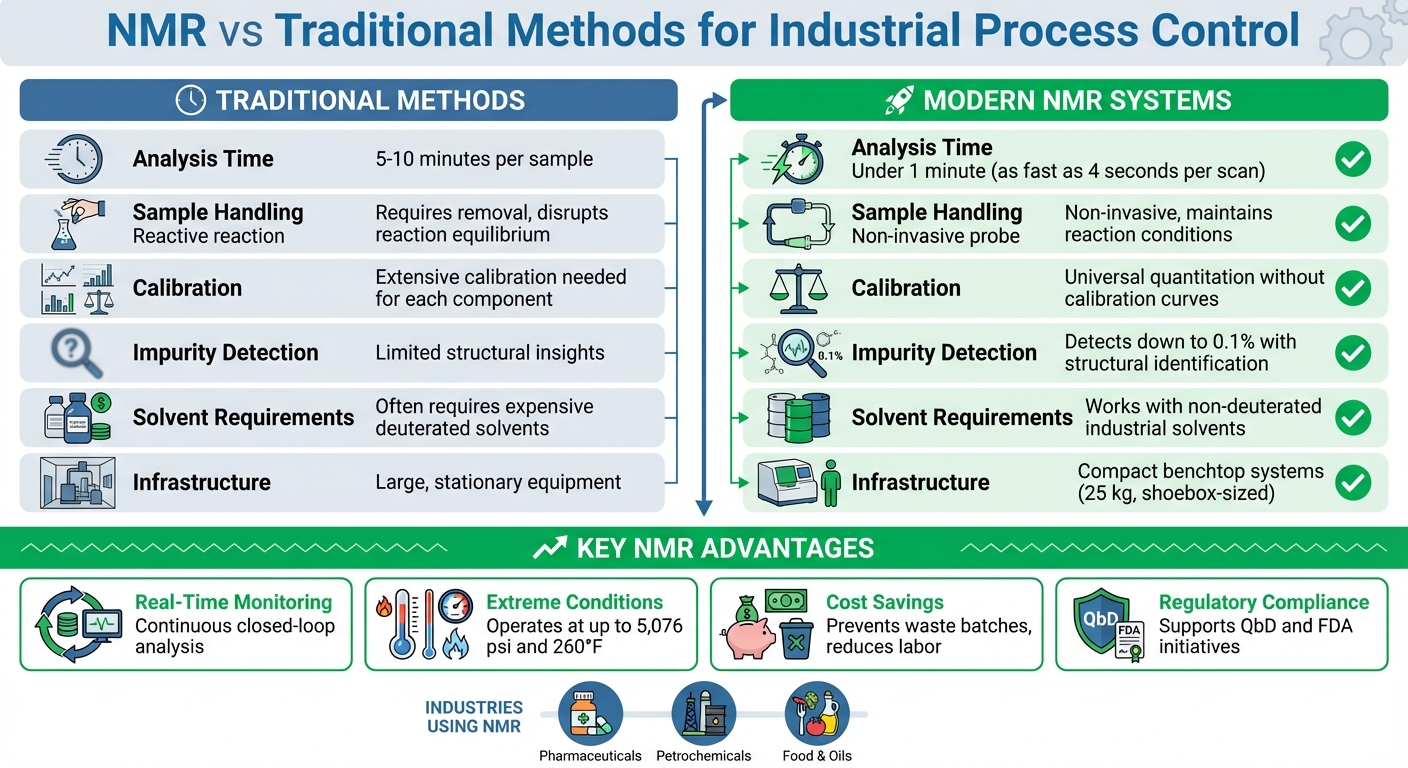
NMR vs Traditional Methods: Process Control Comparison
Benchtop NMR for Process Analytical Technology – Fourier PAT
sbb-itb-aa4586a
Process Control Challenges in Industrial Settings
Nuclear Magnetic Resonance (NMR) technology offers a unique edge in tackling some of the most persistent hurdles in industrial process control. By delivering atomic-level data in real time, NMR addresses the limitations of traditional monitoring methods, which often fall short when precise, immediate insights are required. Let’s dive into the key challenges it helps overcome.
Lack of Real-Time Reaction Data
One major drawback of conventional monitoring methods is the delay in obtaining reaction data. Off-line sampling using 5 mm NMR tubes typically takes 5–10 minutes for analysis. In contrast, on-line NMR techniques can cut this time down to under one minute [9]. However, manual sampling can disrupt the equilibrium of a reaction, potentially altering the sample’s composition [8].
"The lack of mixing in commonly used 5 mm NMR tubes may cause unrepresentative kinetic data to be acquired."
- Andrew M. R. Hall, Researcher, University of Bath [8]
Secondary sensors, such as Raman spectroscopy or Flow-IR, often require extensive calibration for each component in a mixture, adding to the complexity [4]. For instance, researchers at Takeda Pharmaceuticals in Cambridge, MA, employed a 60 MHz Nanalysis Pro-60 benchtop NMR system mounted on a mobile platform to monitor Grignard reactions during kilogram-scale distillation. This setup provided real-time qualitative data, effectively replacing the slower, more labor-intensive off-line testing methods [4].
Difficulty Detecting Impurities
Maintaining product quality, especially in industries like petroleum, biofuels, and pharmaceuticals, demands accurate detection of impurities. Traditional chromatography techniques often struggle with quantification due to significant variations in detector response across different compounds [11].
In 2016, AstraZeneca researchers in Macclesfield, UK, combined a 500-MHz 1H NMR system with a compact mass spectrometer to monitor batch reactions. While the NMR system excelled at quantifying major components, the mass spectrometer extended the detection range for low-level impurities, identifying concentrations as low as 0.02% – far below the NMR’s 0.1% detection threshold [2].
"In extreme cases, response factors can differ by several orders of magnitude for structurally dissimilar compounds, making the uncalibrated data useless for quantitative applications."
Moving from Batch to Continuous Production
Shifting from batch production to continuous processes offers efficiency gains but also introduces new challenges. While continuous flow systems improve mixing, they create time delays as samples travel from the reaction vessel to the spectrometer [8]. This delay can be especially problematic for reactions with short half-lives.
Flow dynamics can also lead to quantification errors. For example, 1H NMR peak areas may vary by up to 25% at a flow rate of 4 mL/min, and signals from nuclei like 31P and 13C can experience losses as high as 70% due to longer relaxation times [8]. Additionally, continuous processes rarely use costly deuterated solvents, making advanced suppression techniques essential to prevent solvent peaks from overwhelming the detector [8]. Engineers often address these issues by calculating correction factors, comparing stationary, fully magnetized samples with flowing ones [8].
These challenges highlight the critical role of integrating real-time NMR into industrial workflows to enhance accuracy, efficiency, and overall process control.
This content is for informational purposes only. Always consult official regulations and qualified professionals before making sourcing or formulation decisions.
How NMR Improves Process Control
Nuclear Magnetic Resonance (NMR) spectroscopy tackles process control challenges by offering detailed, atomic-level insights without interfering with production conditions. Unlike traditional methods that often involve removing samples, altering chemicals, or lengthy preparations, NMR examines reaction mixtures as they are – maintaining their pressure, temperature, and chemical balance [3][9]. This makes it a powerful tool for real-time monitoring and precise analysis.
Real-Time Reaction Monitoring
FlowNMR technology allows for continuous, real-time monitoring by circulating a small sample from the reaction vessel through the spectrometer and back. This closed-loop system, with path lengths ranging from 26 to 46 feet, significantly reduces analysis time to under a minute compared to the 5–10 minutes typical of older methods [9][10].
"FlowNMR spectroscopy is an excellent technique for non-invasive real-time reaction monitoring under relevant conditions that avoids many of the limitations that bedevil other reaction monitoring techniques."
- Ulrich Hintermair, University of Bath [8]
One standout feature is its ability to detect short-lived reactive intermediates without the need for sample separation, quenching, or chemical modification [3][7]. For example, in 2011, Pfizer Global Research and Development used NMR to optimize the synthesis of an imidazole derivative. They identified an unstable intermediate that other techniques failed to detect [7].
Accurate Impurity and Composition Analysis
Beyond monitoring reactions, NMR excels at impurity and composition analysis. Its peak areas are directly tied to the number of nuclei in a sample, allowing for straightforward quantification without needing separate calibration curves for each component [4][9]. This sets it apart from techniques like Raman or infrared spectroscopy, which require extensive calibration [4]. NMR’s fine spectral resolution also reveals structural details, distinguishing between isomers and diastereomers in complex mixtures [7][10].
"NMR peak areas can be used directly for quantification without further calibration."
- Michael Maiwald [9]
NMR’s quantification capabilities are reliable even under extreme conditions, such as pressures up to 5,076 psi and temperatures as high as 260°F. It also performs well with corrosive substances like 20% sulfuric acid or pure acetic acid [9]. Industrial NMR systems use flow cells with active volumes of 60–120 microliters, keeping sample requirements low while maintaining high precision. For trace-level analysis below 0.1%, coupling NMR with mass spectrometry can provide even greater sensitivity [2].
Benchtop NMR Systems for Industrial Use
Modern benchtop NMR systems operating at lower magnetic fields (60–80 MHz) have made the technology more practical and affordable for industrial settings [4][7]. These compact devices use permanent magnets instead of cryogenic superconducting magnets, eliminating the need for liquid helium and complex infrastructure. Their portability allows placement near fume hoods or production lines, making them ideal Process Analytical Technology (PAT) tools [4]. By enabling in-line analysis, these systems improve process control and boost operational efficiency.
"The development of low-field portable magnets has helped to overcome the logistical issues associated with fixed high field superconducting magnets."
- David A. Foley, Pfizer [7]
Advanced solvent suppression techniques, like the WET (Water suppression Enhanced through T1 effects) pulse sequence, reduce solvent peak intensity by about 500 times. This enables the use of non-deuterated industrial solvents, significantly lowering operational costs [8]. Additionally, modern NMR magnets offer excellent field stability, allowing for long acquisition times without requiring deuterium locks – an important feature for industrial processes where deuterated solvents are cost-prohibitive [9]. This combination of portability, cost savings, and reliable performance makes benchtop NMR systems an attractive option for routine process monitoring across diverse manufacturing environments.
This content is for informational purposes only. Always consult official regulations and qualified professionals before making sourcing or formulation decisions.
NMR Applications Across Industries
Nuclear Magnetic Resonance (NMR) spectroscopy finds use in a variety of industries, thanks to its ability to identify structures, monitor reactions in real time, and provide precise quantitative data. These capabilities make it a valuable tool for quality control and process optimization.
Pharmaceuticals: Monitoring Reactions with Precision
In pharmaceutical manufacturing, NMR has emerged as a key Process Analytical Technology (PAT). It provides both structural and quantitative insights, making it especially effective at distinguishing between structural isomers and diastereomers in complex reaction mixtures [7].
In January 2023, the FDA partnered with the University of Maryland on a project led by Bruce Yu, PhD, and Marc Taraban, PhD, to explore water proton NMR (wNMR) for noninvasive drug product assessment. Using compact wNMR instruments, this initiative evaluates product consistency in vials and syringes within seconds, all without compromising the integrity of the containers [12]. This illustrates how NMR contributes to maintaining strict process controls in pharmaceutical production.
Beyond pharmaceuticals, NMR’s ability to handle complex mixtures makes it equally valuable in other industries.
Petrochemicals: Ensuring Product Quality
In the petrochemical sector, NMR is indispensable for analyzing complex hydrocarbon mixtures and ensuring fuel quality during production and transfer. Its non-invasive nature allows for real-time monitoring of reaction dynamics, concentration changes, and mixing conditions – without the need for chemical separation or derivatization [13][3]. This is particularly useful for products like liquefied natural gas (LNG) and biofuels, including fatty acid methyl esters (FAME).
NMR is also used to precisely quantify ethanol in fuel blends like E10 or E85 by identifying specific CH₂ and OH signals [13][3]. This ensures that fuel meets quality standards during distribution.
"NMR is ideally suited for analyzing changes in reaction mixtures, identifying changes in chemical structure, monitoring concentrations, mixing conditions and detecting impurities."
Additionally, NMR detects impurities and structural changes caused by oxidation, thermal breakdown, or polymerization [13]. Low-field NMR systems, operating at magnetic field strengths up to 2 T (around 85 MHz for ¹H), are commonly employed for industrial quality control [1]. These systems demonstrate how NMR supports consistent product quality.
Food and Oils: Verifying Purity and Composition
In the food industry, NMR is a powerful tool for analyzing composition and authenticity. It can differentiate between similar products, such as essential oils, and quantify components like ethanol in beverages or fatty acids in edible oils to ensure compliance with labeling and regulatory standards.
For edible oils, NMR distinguishes between fatty acid methyl esters like methyl oleate, methyl linoleate, and methyl linolenate by analyzing olefinic, allylic, and divinyl proton signals. This helps verify nutritional claims for products like omega-3-rich fish oils [13][3].
When it comes to alcoholic beverages, NMR can measure the "walk" of the hydroxyl (–OH) signal, which reflects the alcohol-to-water ratio. This aids in verifying claims like 100 proof (50% alcohol by volume) or 200 proof (pure ethanol) [13]. NMR can also detect adulteration by identifying unauthorized sweeteners or additives through changes in signal patterns, such as broadening or unexpected resonances in specific regions [13].
The portability of benchtop NMR systems, like the 60 MHz Nanalysis Pro‑60, has made real-time quality control more accessible. These systems can be used directly at fume hoods or on mobile platforms, allowing for efficient monitoring of large-scale distillation processes [4]. This mobility underscores NMR’s practicality for on-site quality assurance.
This content is for informational purposes only. Always consult official regulations and qualified professionals before making sourcing or formulation decisions.
Adding NMR to Automated Industrial Systems
Incorporating NMR spectroscopy into automated workflows is reshaping how industries manage and optimize their processes. Unlike traditional standalone analytical methods, automated NMR systems provide real-time feedback, enabling operators to fine-tune parameters without halting production. This is especially crucial in environments where precise control over reaction conditions directly influences product quality and yield. By leveraging NMR’s ability to deliver immediate analytical insights, automated systems now use this data to drive continuous improvements in process performance.
Online NMR for Continuous Process Optimization
Online NMR systems function by circulating a small sample from the reaction vessel through the NMR spectrometer in a closed-loop setup. This design ensures real-time monitoring of concentration data while maintaining the equilibrium of the process. For example, online ¹H NMR monitoring can reduce analysis delays from 5–10 minutes to under a minute [9]. The system diverts only a minimal amount of material, preserving the integrity of the production process.
These systems are built to handle rigorous industrial conditions. Modern NMR flow probes can operate at pressures up to 35 MPa (around 5,075 psi) and temperatures as high as 400 K (approximately 260°F), making them well-suited for high-pressure reactions often seen in pharmaceutical and petrochemical industries [9].
A major advancement in this field is lock-free operation, which eliminates the need for costly deuterated solvents. Thanks to stable magnets and automated shimming through proton field mapping, field homogeneity is achieved in less than a minute [9]. This innovation is particularly valuable in industrial settings where deuterated solvents might be prohibitively expensive or could interfere with the process.
"On-line NMR spectroscopy is the method of choice for investigations of chemical equilibria and reaction kinetics of complex reacting multicomponent mixtures."
- Michael Maiwald, Author and Researcher [9]
Using NMR to Calibrate Secondary Sensors
NMR spectroscopy also plays a key role in enhancing the accuracy of secondary sensors, such as Near-Infrared (NIR) or UV/visible spectroscopy. Because NMR provides inherently quantitative data without requiring calibration curves for each new chemical species, it serves as a reliable reference for training chemometric models used by these sensors [6][9]. This approach combines NMR’s precision with the ease and speed of secondary sensors, making it easier to integrate into manufacturing workflows.
In May 2022, researchers at the Center for Continuous Flow Synthesis and Processing (CCFLOW) in Graz, Austria, showcased this application during the synthesis of the pharmaceutical ingredient Mesalazine (5-ASA). Led by Peter Sagmeister and C. Oliver Kappe, the team combined a Magritek Spinsolve Ultra 43 MHz NMR with an Avantes Starline UV/visible spectrometer. Using Artificial Neural Networks (ANNs) to merge data from both systems, they achieved real-time concentration predictions for seven chemical species, with a Root Mean Square Error of Validation (RMSEV) below 1.0 millimolar for most intermediates. This hybrid system processed data quickly and identified process deviations – such as reduced separation efficiency – much faster than conventional chromatographic techniques [6].
Case Studies: Quality Assurance in Modular Plants
Automated NMR systems have also proven invaluable in modular manufacturing setups, where portable equipment is reconfigured for different products. These systems ensure consistent quality assurance while allowing for flexible production adjustments.
In May 2020, Mark J. Milton and his team at Takeda Pharmaceuticals in Cambridge, Massachusetts, used a benchtop NMR to monitor Grignard formation and coupling reactions during kilogram-scale distillation. The NMR provided a simple "yes/no" result for component enrichment, eliminating the need for time-consuming off-line testing that could have delayed production decisions [4].
Similarly, in July 2016, a group at AstraZeneca in Macclesfield, UK, led by Tony W. T. Bristow, paired a 500-MHz ¹H NMR with a compact mass spectrometer to monitor batch reactions. This setup enabled simultaneous quantification of high-level components (above 0.1% concentration) via NMR and detection of low-level impurities (ranging from 0.02% to 2% relative concentration) using mass spectrometry [2]. By combining the strengths of both techniques, the team gained a more comprehensive understanding of the reaction mixture than either instrument could provide on its own.
This content is for informational purposes only. Always consult official regulations and qualified professionals before making sourcing or formulation decisions.
Advantages of Using NMR for Process Control
NMR spectroscopy has revolutionized process control by offering faster results, improving safety standards, and increasing profitability. By delivering real-time, quantitative data with minimal sample preparation, solvent suppression, or calibration, NMR has become an essential tool for industries looking to streamline production processes.
Improved Efficiency and Reduced Downtime
NMR significantly shortens the time between sampling and results, bypassing the delays common with traditional methods. Unlike chromatography, which often involves shipping samples to off-site labs and waiting hours or even days for results, NMR provides data almost instantly – sometimes in as little as 4 seconds per scan [5]. This speed enables operators to make immediate adjustments, reducing the risk of compromised batches.
The process is noninvasive and doesn’t require chemical modifications, separations, or derivatization before analysis [3]. A notable example is a BASF SE project from 2015, where a 60 MHz benchtop NMR was used to monitor the chlorination of 1-octanol to 1-chlorooctane at 212°F (100°C). The system performed 4-second scans every 2.5 minutes over a 6-hour period, tracking the reactant, intermediates, and final product – all without the need for expensive deuterated solvents [5].
Additionally, NMR offers calibration-free quantitation for all components in a solution simultaneously, unlike methods that require separate calibration for each substance [4][5]. This combination of speed and simplicity also contributes to safer handling during processes.
Enhanced Safety and Regulatory Compliance
The efficiency and precision of NMR also translate to better safety and regulatory compliance. The technology allows for noninvasive quality checks directly in original containers. For example, water proton NMR (wNMR) can inspect drug products in vials, syringes, or injection pens without compromising their integrity, making it ideal for routine safety checks throughout the supply chain [12]. With data acquisition times ranging from seconds to minutes, this approach is practical for frequent quality assurance.
NMR’s high selectivity ensures that products meet stringent purity standards. It can distinguish between structural isomers and diastereomers in complex mixtures, providing the atomic-level detail needed to confirm chemical identity and composition [7].
"NMR is potentially a very powerful process analytical technology (PAT) tool as it gives an atomic resolution picture of the reaction mixture without the need for chromatography." – Mark J. Milton, Takeda Pharmaceuticals [4]
Real-time monitoring also supports Quality by Design (QbD) initiatives. By tracking reaction dynamics and identifying transient intermediates, NMR helps manufacturers maintain product specifications throughout the production cycle [7][4].
Increased Profitability and Cost Savings
The financial advantages of NMR are substantial. One major benefit is the prevention of waste batches. Real-time monitoring allows operators to catch deviations early, enabling corrective actions before an entire batch is lost.
"The cost reductions associated with preventing manufacturing errors (i.e., waste batches) increase the efficiency of a process, and subsequently reduce the environmental impact while also improving the safety of productions." – Tobias Boehringer, Nanalysis [5]
Modern benchtop NMR systems also reduce infrastructure and operational costs. These compact instruments – some weighing just 55 pounds (25 kg) and no larger than a shoebox – use permanent, cryogen-free magnets, eliminating the need for liquid helium and costly specialized facilities [5][7].
Labor costs are another area where NMR shines. Once integrated into automated platforms, the systems require minimal operator involvement. They can be controlled remotely via API or Ethernet, allowing for scripted, hands-off measurements without the need for expert spectroscopists. Applications like pharmaceutical distillation monitoring and continuous flow synthesis demonstrate how NMR delivers significant returns on investment by reducing labor, minimizing waste, and improving operational efficiency.
This content is for informational purposes only. Always consult official regulations and qualified professionals before making sourcing or formulation decisions.
Conclusion
NMR spectroscopy has become a game-changer for industrial process control, offering solutions where traditional methods fall short. By providing real-time, quantitative data with atomic-level precision, NMR allows manufacturers to monitor chemical reactions as they occur, spot impurities that might escape other techniques, and uphold product quality – all without interrupting production. Its ability to perform non-invasive analysis directly in original containers supports in-line monitoring and reduces waste, making it a practical choice for modern manufacturing. This demand has spurred the development of smaller, more durable NMR systems.
The shift from bulky, stationary high-field systems to compact benchtop instruments has made NMR more accessible and user-friendly. These smaller units eliminate the need for liquid cryogens, fit easily on standard workbenches, and integrate with automated systems. Unlike optical methods, which require extensive calibration for each component, NMR delivers universally quantitative data, simplifying workflows and reducing complexity.
This technological advancement has brought substantial benefits to regulated industries. In pharmaceuticals, for example, NMR’s precision and ability to differentiate structural isomers align with Quality by Design (QbD) principles and help meet regulatory requirements. The FDA is actively exploring applications like water proton NMR (wNMR) to improve manufacturing oversight and enhance patient safety by fostering more controlled production environments [12].
The advantages of NMR – reduced waste, minimized downtime, lower labor costs, and improved safety – directly contribute to profitability and compliance. As industries continue shifting from batch processing to continuous production, NMR’s role in streamlining operations becomes even more critical. Its unmatched speed, precision, and adaptability make it an essential tool for manufacturers aiming to achieve efficiency, regulatory compliance, and superior product quality.
This content is for informational purposes only. Always consult official regulations and qualified professionals before making sourcing or formulation decisions.
FAQs
What are the advantages of NMR for real-time monitoring and impurity detection compared to traditional methods?
NMR spectroscopy stands out as a powerful tool for real-time monitoring and impurity detection in industrial processes. Unlike traditional methods that often rely on offline sampling and analysis, NMR offers continuous, non-invasive monitoring of chemical reactions as they occur. This real-time capability enables immediate identification of impurities and process deviations, leading to improved precision and operational efficiency.
Recent innovations, such as flow-cell technology and solvent suppression techniques, have further enhanced the practicality and affordability of NMR in industrial settings. With its ability to provide high-resolution, quantitative data on the spot without interrupting workflows, NMR has become an essential instrument for optimizing process control and ensuring consistent product quality.
What are the advantages of using benchtop NMR systems in industrial process control?
Benchtop NMR systems bring a range of benefits to industrial process control, particularly when it comes to enhancing efficiency, precision, and quality management. These compact devices provide analytical performance comparable to traditional NMR instruments but are designed to be more accessible and fit seamlessly into production settings. They allow for rapid and accurate analysis of raw materials, intermediates, and finished products, enabling real-time monitoring and faster decision-making.
One standout advantage is their ability to perform inline and online process monitoring, which allows industries to identify potential issues early, streamline operations, and reduce waste. This not only ensures consistent product quality but also supports adherence to regulatory requirements. On top of that, benchtop NMR systems are cost-effective to operate, simple to maintain, and versatile enough for tasks like tracking chemical reactions and confirming material purity. These features make them highly suitable for routine manufacturing and quality control processes.
How does NMR help industries switch from batch to continuous production?
NMR spectroscopy plays a crucial role in shifting from batch to continuous production by providing real-time data on chemical compositions and reaction behaviors. This enables constant monitoring of reaction progress, impurity levels, and concentration shifts, maintaining consistent product quality without relying on manual sampling or adjustments.
Compact benchtop NMR systems are especially valuable for inline monitoring, delivering instant feedback to fine-tune reaction conditions as they happen. This not only boosts efficiency but also supports process automation and ensures stable operations. Industries such as pharmaceuticals, chemicals, and petrochemicals are increasingly using NMR to modernize and streamline their production processes.




Comments are closed