
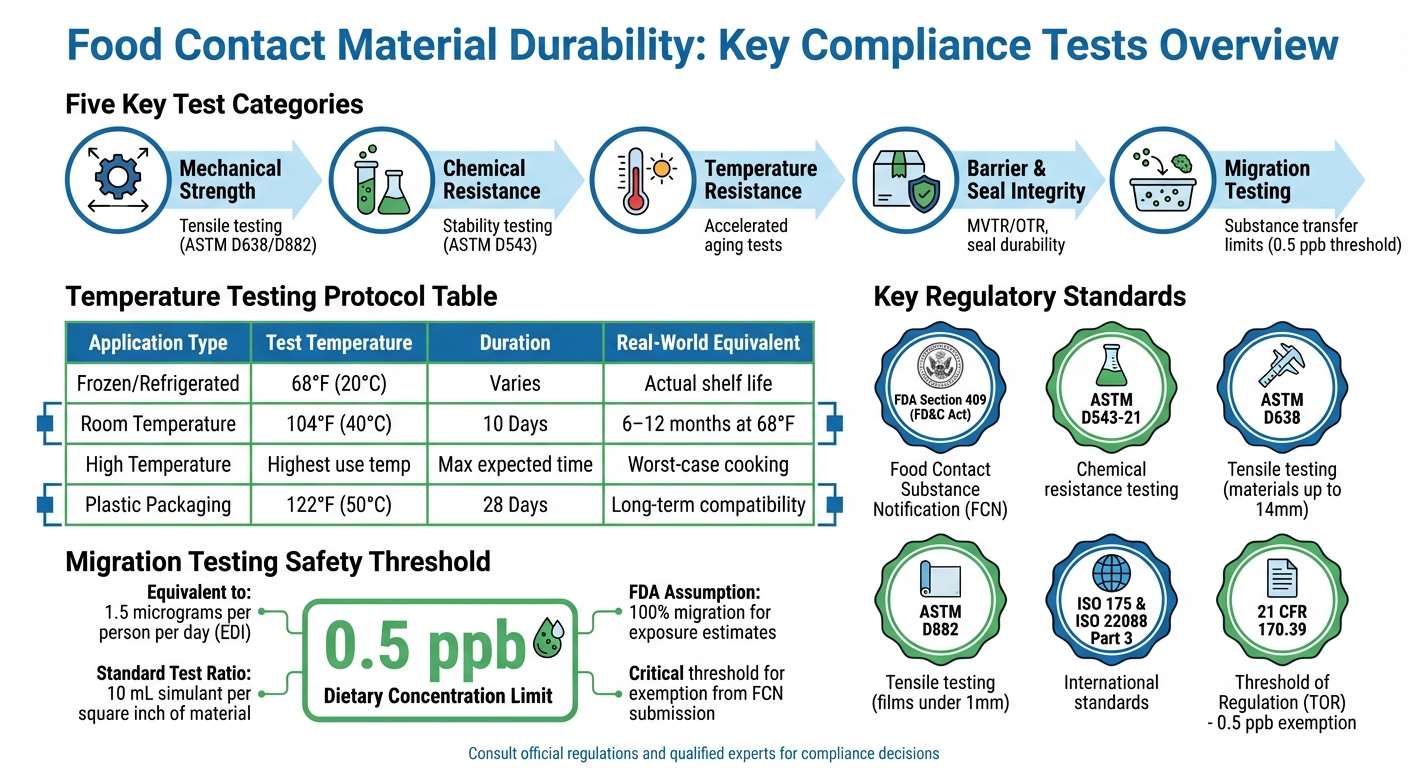
Durability testing for Food Contact Materials (FCMs) ensures they stay safe and functional under physical, chemical, and temperature stresses. These tests are vital to meet FDA and international safety standards, preventing harmful substances from migrating into food. Key tests include:
- Mechanical Strength: Measures resistance to physical stress (e.g., tensile testing under ASTM D638/D882).
- Chemical Resistance: Assesses stability after exposure to food simulants or cleaning agents (ASTM D543).
- Temperature Resistance: Simulates long-term use or extreme conditions (e.g., 10 days at 104°F mimics 6–12 months at 68°F).
- Barrier and Seal Integrity: Evaluates moisture, oxygen protection, and seal durability.
- Migration Testing: Detects substance transfer into food, ensuring safety thresholds like 0.5 ppb dietary concentration.
These tests help manufacturers select materials, refine designs, and improve production processes, ensuring compliance and protecting consumers. Always consult official regulations and experts for decisions.
Food Contact Material Durability Testing Requirements and Standards
Regulatory Requirements for Durability Testing
FDA and International Regulations
The FDA’s guidelines for durability testing are rooted in Section 409 of the Federal Food, Drug, and Cosmetic Act (FD&C Act), which outlines the Food Contact Substance Notification (FCN) process. This process serves as the main authorization pathway for food contact materials, requiring manufacturers to demonstrate safety under intended use conditions and undergo a defined review period [7][2][6].
To assess durability, the FDA relies heavily on migration testing, which evaluates how substances transfer from materials into food over time. Submitted data must represent "the most severe temperature/time conditions" that the material will encounter during its use [1]. Testing protocols differ between single-use and repeated-use materials, focusing on cumulative migration levels [1].
When estimating dietary exposure, the FDA assumes 100% migration of a substance into food. Substances below 0.5 ppb may qualify for a Threshold of Regulation (TOR) exemption under 21 CFR 170.39 [1][2]. It’s worth noting that FCNs are manufacturer-specific, meaning an approved notification applies only to the specific manufacturer, substance, and usage conditions detailed in the submission. Similar materials from other producers must undergo separate evaluations [4][7]. These principles guide the standardized testing methods discussed in the next section.
ASTM and ISO Testing Standards
In addition to FDA regulations, standardized testing methods from ASTM and ISO provide critical frameworks for evaluating the durability of food contact materials (FCMs). ASTM D543-21 outlines procedures for assessing how plastics withstand chemical exposure, a key factor in determining FCM durability [5]. This standard measures changes in properties such as weight, dimensions, appearance, color, and mechanical strength after exposure to specific chemicals [5].
- Practice A focuses on immersion testing for materials in continuous contact with substances, such as food containers.
- Practice B incorporates mechanical stress to test for environmental stress cracking resistance [5].
- For short-term exposure scenarios, a wet patch or wipe method is used instead [5].
ISO standards, including ISO 175 and ISO 22088 Part 3, cover similar testing areas but differ in technical specifics. As a result, their findings may not always align with ASTM D543 results [5]. These international standards enable researchers to evaluate the resistance of plastics under controlled conditions, such as reagent concentration, duration, and temperature [5]. By simulating real-world use, these tests help quantify the performance characteristics that ensure food safety under various stress conditions [5].
This content is for informational purposes only. Always consult official regulations and qualified experts before making decisions related to sourcing or formulation.
Chemical Migration From Food Contact Materials Into Food
Main Compliance Tests for Food Contact Material Durability
Testing ensures that food contact materials maintain safety and durability throughout their lifecycle, meeting strict regulatory standards.
Mechanical Strength Tests
Mechanical strength tests evaluate how well food contact materials withstand physical stress. For example, tensile property testing measures the force needed to pull a plastic specimen apart and how much it stretches before breaking. ASTM D638 is the standard for materials up to 14 mm (0.55 in.) thick, while ASTM D882 is used for thinner films under 1 mm [8].
Chemical resistance testing, following ASTM D543, examines whether materials retain their mechanical properties after exposure to food simulants or cleaning agents. Practice B of ASTM D543 combines chemical exposure with mechanical stress to test resistance to environmental stress-cracking [5]. The FDA requires that materials achieve their "intended technical effect" at the minimum necessary level, ensuring they remain safe and durable during use [1]. For hazardous packaging, failure occurs if permeation exceeds 0.5% for poisonous substances or 2.0% for others [3].
Mechanical integrity is just one piece of the puzzle – environmental factors also play a crucial role in material performance.
Environmental and Temperature Resistance Tests
Temperature resistance tests simulate the extreme conditions food contact materials may face during storage and use. For room-temperature applications, accelerated testing at 104°F (40°C) for 10 days represents 6–12 months of ambient storage at 68°F (20°C) [1]. Polymers like PET or polystyrene, which are in a "glassy" state, may require longer testing periods (up to 30 days) to assess long-term performance due to their slower diffusion rates compared to "rubbery" polymers like polyolefins [1]. These tests monitor for issues such as permanent deformation, cracking, or embrittlement [3].
| Application Type | Test Temperature | Duration | Real-World Equivalent |
|---|---|---|---|
| Frozen/Refrigerated | 68°F (20°C) | Varies | Actual shelf life |
| Room Temperature | 104°F (40°C) | 10 Days | 6–12 months at 68°F (20°C) [1] |
| High Temperature | Highest use temp | Max expected time | Worst-case cooking/processing |
| Plastic Packaging (Method 2) | 122°F (50°C) | 28 Days | Long-term chemical compatibility [3] |
Higher temperatures can increase chemical migration from packaging into food, making these tests critical for safety validation [1]. Materials intended for microwave or dual-ovenable use must be tested at their highest use temperature [1].
Barrier and Seal Performance Tests
Barrier and seal performance tests ensure that packaging maintains its integrity during storage and distribution. Barrier property tests, such as Moisture Vapor Transmission Rate (MVTR) and Oxygen Transmission Rate (OTR), measure how well materials protect food from moisture and oxygen, which can affect shelf life.
Seal integrity tests, including vacuum decay and peel tests, verify that packaging remains sealed under normal conditions. Migration testing often uses a standard ratio of 10 mL of food simulant per square inch of material surface area to replicate real-world conditions [1]. Failures may include visible vapor pressure build-up, material deterioration, or defects that compromise the packaging’s performance [3].
Chemical Stability and Migration Tests
Migration testing measures how substances from food contact materials transfer into food or simulants over time [1]. The FDA evaluates these results to calculate the Estimated Daily Intake (EDI) and Cumulative Estimated Daily Intake (CEDI), comparing them to toxicological safety data [2][10]. Testing must simulate the most severe temperature and time conditions the material will face during use [1].
"The information must demonstrate that there is a reasonable certainty of no harm to consumers when the food contact substance is proposed or intended for use in contact with food." – FDA [2]
Recycled plastics undergo surrogate contaminant testing, where virgin polymers are exposed to volatile, non-volatile, polar, non-polar, and heavy metal contaminants to confirm that impurities are effectively removed [9]. The FDA considers a dietary concentration of 0.5 parts per billion (ppb) or less – equivalent to an EDI of 1.5 micrograms per person per day – to pose negligible risk [9].
Appropriate simulants are crucial for accurate testing: 10% ethanol is used for aqueous and acidic foods, while oils like corn oil or synthetic triglycerides (e.g., Miglyol 812) mimic fatty foods [1]. Testing focuses on worst-case scenarios, such as the thinnest material with the highest substance concentration, as these conditions typically result in greater migration [1]. Safety assessments also account for impurities, oligomers, and degradation products that might migrate [10].
This content is for informational purposes only. Always consult official regulations and qualified experts before making decisions related to sourcing or formulation.
sbb-itb-aa4586a
How Durability Testing Applies in Practice
Durability testing plays a critical role in guiding decisions about material selection, packaging design, and manufacturing processes.
Using Test Results for Material Selection and Design
Test results help manufacturers avoid unsuitable materials early in development by comparing how various polymers, coatings, and additives react to chemical exposure and environmental stressors [5]. For instance, if testing shows that a polymer with low molecular weight and high plasticizer content exceeds safety thresholds, manufacturers can tweak formulations or increase material thickness to lower the surface-area-to-volume ratio, ensuring compliance with FDA safety standards [1]. Materials like PET and polystyrene require particular attention since their glass transition temperature (Tg) impacts diffusion rates. When these polymers are used below their Tg, data from a 10-day test is often extrapolated to 30 days to better predict long-term migration [1].
Structural design is also shaped by test outcomes. If testing uncovers risks like cracking, crazing, or wall collapse, manufacturers may choose more durable resins or add stabilizers, such as antioxidants, to counteract oxidative degradation. This ensures that additives achieve the desired technical effect while being used at the lowest effective levels [1][3].
These insights not only refine material and design choices but also pave the way for improvements in production methods.
Improving Manufacturing Processes
Durability testing doesn’t stop at material selection – it also informs manufacturing refinements to enhance product safety. Seal integrity and transit tests, for example, reveal weaknesses in closures or packaging systems, leading to adjustments in temperatures, pressures, or material composition during production [11]. Compression tests are used to establish safe stacking limits, reducing the risk of structural failure during shipping [11]. Additionally, transit testing evaluates the performance of the entire packaging system – from primary containers to master cartons – under real-world shipping conditions, ensuring reliability [11]. Process data showing that high temperatures effectively remove volatile impurities further supports safety conclusions [1].
This content is for informational purposes only. Consult official regulations and qualified professionals before making sourcing or formulation decisions.
Conclusion
Durability testing is the backbone of ensuring food contact materials meet safety and compliance standards. Without rigorous evaluations under extreme conditions, manufacturers cannot meet the FDA’s standard of "reasonable certainty of no harm" for food contact substances [2]. These tests are crucial for verifying that materials remain protective throughout their shelf life, even under harsh conditions. Beyond validating performance, they play a key role in shaping regulatory decisions.
In February 2025, FDA research highlighted the importance of such testing when it found that dinnerware made from Areca catechu released harmful toxins, leading to a U.S. warning [2]. Similarly, the FDA phased out certain PFAS in food contact applications after reassessing their safety [2]. These examples underscore how thorough testing identifies risks before products reach consumers.
"The information must demonstrate that there is a reasonable certainty of no harm to consumers when the food contact substance is proposed or intended for use in contact with food." – U.S. Food and Drug Administration [2]
Durability testing also drives advancements in packaging by flagging unsuitable materials early and guiding the development of safer, more reliable designs [5]. This ensures materials maintain their integrity, prevent contamination, and meet the technical demands of modern food packaging.
As outlined earlier, compliance testing protects public health and strengthens brand reputation. It ensures adherence to regulations, minimizes recall risks, and fosters consumer trust.
This content is for informational purposes only. Consult official regulations and qualified professionals before making sourcing or formulation decisions.
FAQs
What are the key regulatory guidelines for testing the durability of food-contact materials?
The safety and reliability of food-contact materials fall under the oversight of the U.S. Food and Drug Administration (FDA), specifically regulated by 21 CFR Part 177. This regulation is designed to ensure that materials used in contact with food remain safe and stable under real-world conditions. These conditions may involve exposure to different temperatures, mechanical stress, and cleaning agents.
To meet these requirements, materials undergo several critical tests:
- Migration testing: This evaluates the potential transfer of substances from the material into food under simulated use conditions.
- Durability testing: This ensures the material can endure repeated use, such as cycles of heating, cooling, and cleaning, without breaking down or releasing harmful substances.
- Chemical-resistance testing: This assesses the material’s ability to remain stable when exposed to harsh agents like detergents or extreme temperatures.
Allan Chemical Corporation plays an active role in helping manufacturers meet these stringent standards. By providing FDA-compliant chemicals and assisting in the development of migration and durability data for Food Contact Notification (FCN) submissions, the company helps ensure food-contact materials remain safe and compliant throughout their use.
How do temperature resistance tests ensure food packaging can handle real-life conditions?
Temperature resistance tests play a crucial role in assessing how food packaging handles the heat-related stress it may encounter during regular use. These tests mimic scenarios such as hot-filling, microwave heating, or extended storage in warmer conditions to verify that the packaging stays both safe and effective. In the U.S., regulatory bodies like the FDA outline specific guidelines, such as the Conditions of Use, which detail temperature and time combinations that closely match everyday situations. For instance, hot-filling might involve temperatures of 158°F, while refrigerated storage typically occurs around 77°F.
To ensure precise results, standardized methods like ASTM D543-21 and federal regulations set realistic temperature and exposure benchmarks. Accelerated aging tests, for example, might replicate long-term heat exposure by maintaining packaging at 122°F for 28 days. These carefully designed tests mirror real-world conditions, providing dependable data to confirm that the packaging material remains safe and durable throughout its intended use.
What is migration testing, and why is it important for food safety in contact materials?
Migration testing plays a crucial role in assessing whether any chemical substances from food-contact materials transfer into the food. This process ensures these materials meet safety standards and stay within regulatory limits designed to safeguard consumer health.
By checking compliance with both specific and overall migration limits, this testing helps manufacturers confirm their products are safe for food use while meeting strict industry regulations. It’s an essential step in protecting food safety and maintaining consumer confidence.




Comments are closed