
21 CFR Part 120 outlines mandatory food safety requirements for juice processors in the U.S. It focuses on implementing a Hazard Analysis and Critical Control Point (HACCP) system to prevent contamination and ensure safe processing of fruit and vegetable juices. Processors must meet a 5-log pathogen reduction standard (100,000-fold decrease in harmful microorganisms) and maintain strict sanitation practices. Failure to comply results in products being classified as adulterated under federal law.
Key points include:
- Scope: Applies to 100% juice products, concentrates, and purees. Retailers selling directly to consumers are exempt but must meet labeling requirements if untreated juice is sold.
- HACCP Plan: Includes written hazard analysis, pathogen reduction, and Sanitation Standard Operating Procedures (SSOPs).
- Training: Staff must complete HACCP training or demonstrate equivalent experience.
- Recordkeeping: Retain records for at least one year for perishable products or two years for frozen/shelf-stable items.
- Import Compliance: Importers must verify foreign suppliers meet Part 120 standards.
For mixed beverages with less than 100% juice, the juice ingredient must comply with Part 120, while the final product is regulated under 21 CFR Part 117. Juice processors benefit from exemptions under Part 120 but must still adhere to general food safety practices outlined in Part 117.
Processors must carefully manage ingredients, verify supplier compliance, and document all safety measures to meet regulatory demands.
How to Implement HACCP plan in Beverage Industry, HACCP in Soft Drinks Industry, HACCP in Beverages
sbb-itb-aa4586a
Scope and Applicability
Part 120 applies to juice products, which include aqueous extracts, purees, or concentrates derived from fruits and vegetables. This category covers items marketed as 100% juice or as concentrates used in beverage production. However, beverages containing less than 100% juice – like fruit-flavored drinks with only 5% juice – are treated differently. While the final blended product isn’t required to follow a Part 120 HACCP plan, the juice ingredient itself must be produced under a Part 120-compliant HACCP system. The finished beverage, on the other hand, falls under the regulations of Part 117. These definitions establish the foundation for the regulatory requirements that follow.
Retail outlets selling juice directly to consumers (as defined in 21 CFR 120.3(l)) are exempt from HACCP requirements. However, if these retailers sell juice to other businesses, the exemption no longer applies, and a full HACCP system becomes mandatory. Even for exempt retailers, compliance with 21 CFR 101.17(g) is still required, which mandates a warning label on packaged juice products that haven’t undergone the necessary 5-log pathogen reduction process.
This distinction plays out in real-world scenarios. For instance, a roadside cider vendor selling directly to customers is exempt from HACCP. But if the cider is processed by a third party, that processor must implement a HACCP plan.
Importers also have responsibilities under Part 120. They must ensure that all juice ingredients meet regulatory standards by maintaining records that verify HACCP compliance. This may include obtaining HACCP plans or written guarantees from foreign processors. Importers can only bypass these measures if the juice comes from a country with an active Memorandum of Understanding (MOU) with the FDA. Currently, no such MOUs exist for juice imports.
HACCP Requirements
Under Part 120 regulations, juice processors are required to implement a structured HACCP (Hazard Analysis and Critical Control Points) plan. This begins with a written hazard analysis for each type of juice, identifying potential biological, chemical, and physical hazards. These hazards may include microbiological contamination, parasites, residues from illegal pesticides, natural toxins like patulin, undeclared allergens, and physical risks such as glass fragments. The analysis must consider risks from all stages – before, during, and after harvest – and account for both internal plant operations and external sources.
"A food hazard that is reasonably likely to occur is one for which a prudent processor would establish controls because experience, illness data, scientific reports, or other information provide a basis to conclude that there is a reasonable possibility that, in the absence of those controls, the food hazard will occur." – 21 CFR § 120.7 [2]
Beyond hazard identification, Part 120 enforces stringent pathogen reduction standards. The 5-log pathogen reduction rule mandates a 100,000-fold decrease in the most resistant pathogen present in the juice. For apple cider, this target is typically Cryptosporidium parvum, while other juices focus on pathogens like E. coli O157:H7 or Salmonella. This reduction must occur entirely within a single facility. Citrus processors may use surface treatments on fruit after culling and cleaning, but for all other juices, the treatment must be applied directly to the extracted liquid. These measures are designed to work in tandem with sanitation protocols, forming a robust HACCP system.
Sanitation Standard Operating Procedures (SSOPs) are a critical component of this system. Processors must create detailed SSOPs addressing key areas such as water safety, equipment and surface cleanliness, prevention of cross-contamination, employee hand hygiene, storage of toxic substances, protection against adulterants, pest control, and monitoring employee health. These procedures must be consistently monitored, with records documenting routine checks and any corrective actions taken.
Training requirements are another essential element. Key personnel must either complete FDA-equivalent HACCP training or demonstrate sufficient experience. Additionally, a trained individual must review all records related to critical control point monitoring and corrective actions within seven days of their creation, ensuring proper oversight. Records for perishable or refrigerated juices must be kept for at least one year, while records for frozen or shelf-stable products must be maintained for two years or for the product’s shelf life – whichever is longer.
This content is intended for informational purposes only. Always consult official regulations and qualified professionals before making any sourcing or formulation decisions.
Ingredient and Supplier Management
Under Part 120, processors must carefully assess all incoming ingredients. The written hazard analysis mandated by § 120.7 must identify potential food hazards originating outside the processing facility. These hazards include microbiological and chemical contamination, unlawful pesticide residues, natural toxins, unapproved food or color additives, and undeclared allergens [2]. If any of these risks are deemed probable, processors are required to establish critical control points specifically designed to mitigate sourcing-related dangers [1][5]. Supplier verification is a key part of this process, emphasizing the importance of thorough documentation to maintain compliance.
To ensure ingredient safety, processors must maintain detailed records for every raw material and document any changes in suppliers. Any modification in raw materials or suppliers necessitates an immediate re-validation of the HACCP plan [2]. Importers are legally responsible for ensuring that all juice and beverage ingredients entering the U.S. meet Part 120 standards. This creates a clear demand for suppliers capable of providing Certificates of Analysis (COAs), technical data sheets, and traceability records that meet FDA audit requirements [2]. Such comprehensive documentation is critical for verifying that suppliers adhere to the strict standards outlined in Part 120.
Allan Chemical Corporation supports compliance by offering compendial-grade (FCC and USP) ingredients accompanied by complete verification documentation. With over 40 years of experience, Allan Chemical Corporation delivers audit-ready materials and just-in-time delivery services, ensuring processors meet regulatory demands.
"Transparency in the supply chain isn’t just a regulatory requirement; it’s the cornerstone of integrity for any business prioritizing safety and trust." – Miceál O’Kane, Helix EHS [6]
Processors must ensure that all ingredient suppliers provide detailed COAs confirming the absence of chemical or physical hazards identified in their hazard analysis. When transitioning to a new supplier, it’s essential to reassess the HACCP plan to evaluate whether new hazards have been introduced. For ingredients sourced internationally, processors should maintain records verifying that foreign suppliers comply with HACCP standards as outlined in § 120.14 [2]. These steps are vital to keeping the supply chain a well-controlled aspect of the broader food safety system.
This content is provided for informational purposes only. Always consult official regulations and qualified professionals before making sourcing or formulation decisions.
Pros and Cons
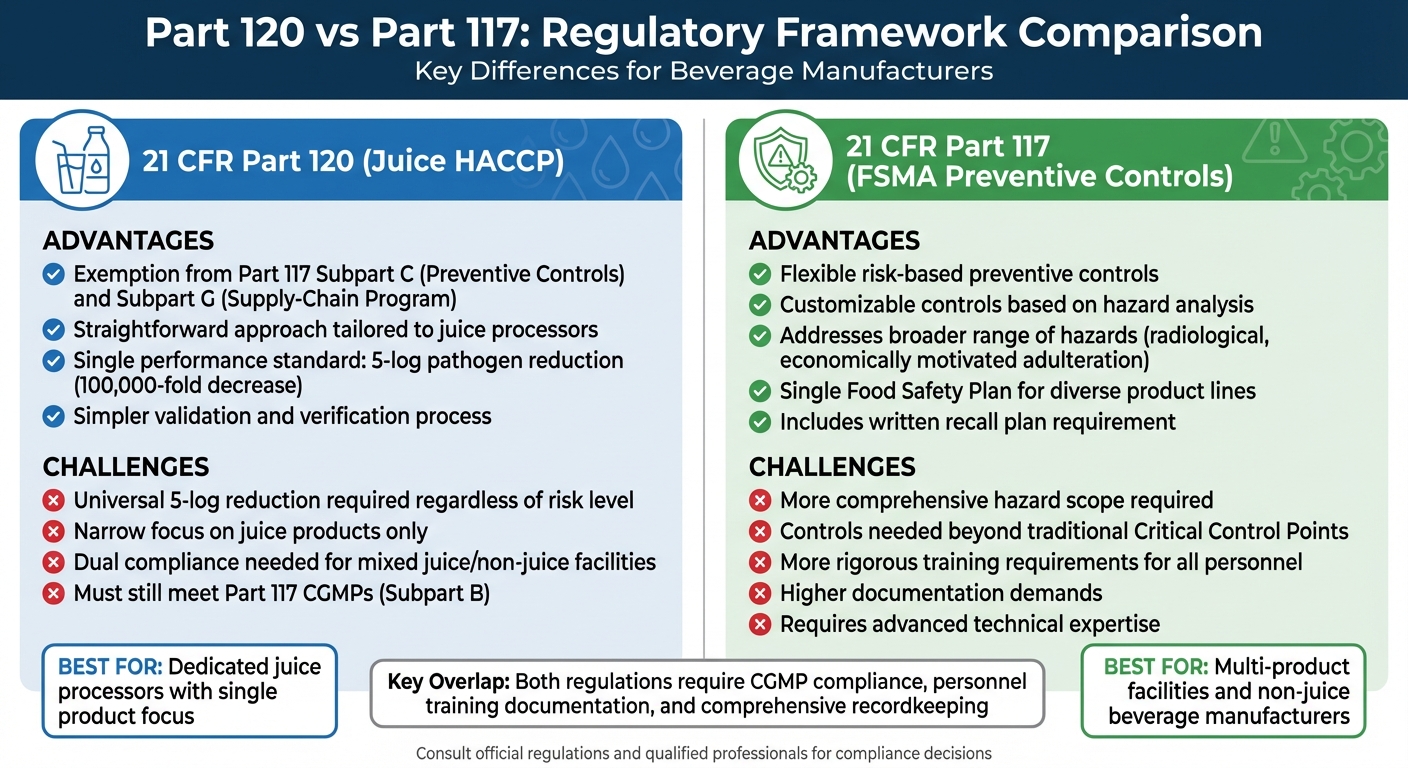
21 CFR Part 120 vs Part 117 Compliance Requirements Comparison
When it comes to regulatory frameworks for beverage producers, the choice often boils down to 21 CFR Part 120 (Juice HACCP) or 21 CFR Part 117 (FSMA Preventive Controls). Each offers distinct benefits and challenges, and understanding these differences is key to managing resources efficiently while staying compliant.
Part 120 stands out for its straightforward approach tailored specifically to juice processors. One of its main advantages is the exemption from the broader requirements of Part 117[7]. This exemption lightens the documentation load for facilities exclusively focused on juice production. The regulation’s emphasis on a single performance standard – the 5-log pathogen reduction, which equates to reducing the target microorganism by 100,000 times – makes validation and verification more direct compared to the more expansive, risk-based framework of Part 117[4]. This clarity can simplify compliance for juice processors.
However, Part 120’s narrow focus has its drawbacks. The 5-log reduction standard applies universally, even in cases where historical data suggests a lower risk[4]. This means processors must implement and validate the reduction regardless of the specific hazard analysis. Additionally, facilities that produce both juice and non-juice beverages face the added complexity of dual compliance, requiring separate documentation for each product type[7].
On the other hand, Part 117 offers flexibility through its risk-based preventive controls. Instead of prescribing specific log reductions, it allows manufacturers to customize controls based on identified hazards, including radiological threats and economically motivated adulteration[8]. This adaptability helps address a broader range of potential risks, including emerging ones. Part 117 also requires a written recall plan, which, while adding to documentation, enhances a facility’s readiness to handle safety incidents[7]. For manufacturers handling diverse products, a single Part 117 Food Safety Plan can streamline operations.
That said, Part 117’s comprehensive scope can be demanding. It requires addressing more types of hazards and implementing preventive controls at points beyond traditional Critical Control Points. Monitoring is flexible but needs to be tailored appropriately, often requiring advanced technical expertise[8]. Training requirements are also more rigorous, as all manufacturing personnel must qualify as "qualified individuals" with documented training in food safety and hygiene[7]. For smaller juice processors with limited staff, the prescriptive and simpler framework of Part 120 may be easier to manage compared to the more extensive demands of Part 117.
These differences underscore the importance of aligning regulatory choices with operational needs to ensure compliance without unnecessary complications.
This content is for informational purposes only. Consult official regulations and qualified professionals before making decisions related to sourcing or formulation.
Conclusion
Juice processors face a critical choice: comply with a Part 120 HACCP plan, which mandates a 5-log (100,000-fold) pathogen reduction and detailed Sanitation Standard Operating Procedures (SSOPs), or opt for the broader Part 117 Food Safety Plan, which focuses on risk-based controls without a specific log-reduction requirement [2][3][9]. One key benefit of Part 120 compliance is exemption from certain Part 117 requirements, such as Subpart C (Preventive Controls) and Subpart G (Supply-Chain Program) [7]. This distinction provides juice processors with a clearer regulatory pathway compared to other beverage manufacturers.
However, even with Part 120 exemptions, juice processors must still meet the Current Good Manufacturing Practices (CGMPs) outlined in Part 117 Subpart B, along with general provisions in Subpart A and recordkeeping requirements in Subpart F [7]. This includes maintaining training records that meet both the HACCP-specific training under Part 120.13 and the broader food safety training under Part 117.4 [7]. Adherence to these standards ensures compliance across both regulatory frameworks.
For beverages that qualify as juice, processors must verify product definitions carefully, process under Part 120, and document both the 5-log pathogen reduction and SSOP monitoring. Accurate and thorough records of 5-log reduction validation and SSOP monitoring are crucial, as these are often the first items reviewed during inspections [2][3]. Importers can also use the Affirmation of Compliance code "FSX" when filing entries to indicate exemption from Foreign Supplier Verification Program (FSVP) requirements [7].
By understanding these distinctions and requirements, juice and beverage producers can allocate resources wisely while staying compliant with regulatory standards.
This content is for informational purposes only. Always refer to official regulations and consult qualified professionals when making sourcing or formulation decisions.
FAQs
What is the difference between 21 CFR Part 120 and Part 117 for juice processors?
21 CFR Part 120 is a regulation tailored specifically for juice processors, requiring them to create a written Hazard Analysis and Critical Control Points (HACCP) plan. It also mandates maintaining sanitation standard operating procedures (SOPs) and keeping associated records. On the other hand, Part 117 applies broadly to all human foods, with a focus on current good manufacturing practices (CGMP) and risk-based preventive controls.
Juice processors who comply with the requirements of Part 120 are exempt from certain sections of Part 117, specifically the preventive controls outlined in Subpart C and the supply-chain requirements in Subpart G. However, they are still required to adhere to Subparts A, B, and F of Part 117, which address general provisions, CGMPs, and recordkeeping. This exemption ensures that juice processors meeting the stricter standards of Part 120 are not burdened by redundant regulations.
What is the 5-log pathogen reduction standard, and how does it apply to juice products?
The 5-log pathogen reduction standard ensures the safety of juice products by reducing harmful microorganisms by 100,000 times. This requirement, outlined under 21 CFR Part 120, applies to all juice products, including fruit and vegetable juices, purees, and concentrates. A key focus is on Clostridium botulinum, a highly resistant pathogen often linked to juice production.
To meet this standard, juice manufacturers must implement effective Hazard Analysis and Critical Control Point (HACCP) plans. These plans are designed to minimize contamination risks and comply with safety regulations, ensuring consumers receive safe and reliable beverages.
What are the import compliance rules for juice processors under 21 CFR Part 120?
The import compliance requirements for juice processors under 21 CFR Part 120 are not explicitly outlined in the provided sources. However, this regulation emphasizes the need for juice processors to establish a Hazard Analysis and Critical Control Point (HACCP) system to manage food safety risks effectively.
Importers must ensure that their foreign suppliers follow these HACCP standards to align with U.S. regulatory requirements. Juice products brought into the United States are held to the same safety standards as those produced domestically. This includes conducting thorough hazard analysis and implementing control measures during production. For more detailed information, it’s recommended to consult FDA resources or seek advice from regulatory professionals.




Comments are closed