
Electrochemical stability and chemical reactivity are two critical properties for selecting electrode materials, especially in industrial applications. While they may seem similar, they address entirely different challenges:
- Electrochemical stability measures how well a material resists degradation under applied voltage. It determines how long an electrode maintains functionality in systems like water electrolyzers.
- Chemical reactivity evaluates how readily a material reacts with its environment (e.g., acids, salts) without voltage, influencing corrosion and material compatibility.
The trade-off? Highly reactive materials often degrade faster, while stable ones may lack efficiency. Striking the right balance is vital to ensure durability and performance in harsh conditions like extreme pH, high temperatures, or fluctuating power loads.
Key Takeaways:
- Electrochemical Stability Window (ESW): Defines a material’s voltage range before it degrades.
- Testing Methods: Cyclic voltammetry (CV), chronoamperometry, and impedance spectroscopy assess stability over time.
- Reactivity Testing: Immersion studies and ICP-MS help identify corrosion risks and material compatibility.
- Industrial Challenges: Materials must endure harsh conditions without compromising efficiency or lifespan.
Balancing these properties requires rigorous testing and reliable sourcing to ensure consistent performance in demanding environments.
Core Concepts and Material Properties
The Electrochemical Stability Window
The Electrochemical Stability Window (ESW) defines the voltage range within which a material maintains its structural integrity. If this range is exceeded, the material begins to degrade, leading to issues like cation leaching, phase transformations, or amorphization.
To measure ESW, engineers typically use cyclic voltammetry (CV), where voltage is gradually applied, and the resulting current is recorded. A key indicator is the Coulombic Efficiency – the ratio of recovered charge to applied charge. When this efficiency drops below a set threshold, often between 97% and 99%, the material’s stability is considered compromised. To validate these findings, voltage hold tests lasting 500 hours or more are performed, as short CV sweeps can sometimes overestimate stability.
This process is essential for selecting electrode materials that can withstand challenging industrial environments. By understanding how materials behave within their ESW, engineers can better predict their performance under electrochemical stress.
Chemical Reactivity Outside Electrochemical Conditions
Chemical reactivity refers to how a material interacts with its surroundings in the absence of an applied voltage. Factors like pH, ion concentration, and temperature can drive reactions such as corrosion, oxidation, or hydrolysis, potentially degrading materials even before they are used in electrodes.
Surface characteristics – such as crystal facets, terminations, and solubility – play a major role in determining how aggressively these reactions occur. For instance, titanium forms a protective oxide layer (titania), which shields it from further damage. In contrast, copper corrodes quickly in salt-rich environments. Techniques like X-ray Photoelectron Spectroscopy (XPS) and Scanning Electron Microscopy (SEM) are used to detect surface changes, such as oxidation, pitting, or erosion.
These surface interactions are critical when evaluating materials for industrial applications, as they can significantly impact long-term performance and reliability.
Thermodynamic vs. Kinetic Control
Material performance is influenced not just by voltage but also by thermodynamic and kinetic factors. A material might be thermodynamically unstable – meaning its chemistry favors degradation – but still function effectively if the rate of degradation is slow enough. This concept, known as kinetic stability, hinges on the presence of a high activation energy barrier that slows down undesirable reactions.
The distinction between thermodynamic and kinetic stability is vital for material selection. Research from Frontiers in Chemistry by Marcus Wohlgemuth and colleagues at Forschungszentrum Jülich highlights this. In their study, La₀.₆Sr₀.₄CoO₃-δ (LSCO) exhibited a 490 mV overpotential at 3 mA/cm² and failed after approximately 6,020 seconds. Meanwhile, LaNiO₃-δ (LNO), with a lower overpotential of 433 mV, lasted about 17,400 seconds. LNO’s specific crystal facets contributed to both its thermodynamic favorability and kinetic resistance to side reactions. As the researchers explained:
"Enhanced reaction rates (in the most active materials) at the same time lead to enhanced dynamics of undesired side or decomposition reactions, which take place in parallel to the OER and lead to a transient change of composition, structure, and catalytic behavior." – Marcus Wohlgemuth et al., Peter Gruenberg Institute [1]
Understanding whether a material’s stability is governed by thermodynamic or kinetic factors helps engineers design systems that optimize performance while minimizing maintenance needs in industrial settings.
sbb-itb-aa4586a
Electrochemical Stability in Industrial Applications
Factors That Affect Stability
Electrochemical stability in mixed environments and industrial settings hinges on several operational factors. One of the most critical is electrolyte composition. For example, Alkaline Water Electrolyzers (AWE) often operate in 6 M KOH solutions at temperatures of 140°F (60°C) or higher, with current densities exceeding 1 A·cm⁻². In such conditions, chloride ions (Cl⁻), commonly found in seawater, can degrade protective passivation layers and trigger unwanted reactions like the chlorine evolution reaction.
Temperature and current density also play major roles in stability. Higher temperatures accelerate both catalytic activity and corrosion rates. Simultaneously, elevated current densities can lead to gas bubble formation and local pH changes, which intensify material degradation. Surface nanostructures, which are often engineered for high catalytic activity, are especially prone to damage under these conditions [6].
"The electrodes are the heart of an alkaline water electrolyzer, directly determining its performance and durability." – Prof. Hui Chen, State Key Laboratory of Inorganic Synthesis and Preparative Chemistry [4]
A durable support structure is equally important. Even the most active catalyst will fail if its support corrodes under harsh conditions. Selecting a substrate that resists corrosion while providing a stable foundation for the active layer is a vital design consideration that directly impacts the system’s lifespan [5].
Testing and Evaluation Methods
Industrial evaluation of electrochemical stability goes beyond standard cyclic voltammetry (CV). A broader range of tools is used to thoroughly assess materials:
- Linear Sweep Voltammetry (LSV): Ideal for initial screening, this method quickly identifies the potential range where a material remains stable before degradation begins.
- Chronoamperometry: By holding a fixed potential over time, this method simulates long-term stress and monitors current changes to evaluate aging and corrosion resistance [3].
- Electrochemical Impedance Spectroscopy (EIS): Offers insights into charge transfer resistance and surface film changes, providing a deeper understanding of degradation mechanisms [8].
- On-line ICP-MS (Inductively Coupled Plasma Mass Spectrometry): Tracks metal dissolution in real time at sub-parts-per-billion levels. For instance, researchers at Stanford University and SLAC National Accelerator Laboratory used this method in March 2025 to demonstrate that metallic cobalt exhibits a hydrogen evolution reaction stability window about 300 mV different from classical predictions [9].
The table below highlights the strengths of these methods:
| Method | Best For | Key Advantage |
|---|---|---|
| LSV/CV | Initial screening | Rapidly defines the stability window [3] |
| Chronoamperometry | Service life prediction | Simulates long-term stress and aging [3] |
| EIS | Mechanistic study | Tracks surface film and resistance changes [8] |
| On-line ICP-MS | Degradation tracking | Quantifies real-time metal dissolution [9] |
These techniques provide a comprehensive understanding of material performance under industrial conditions.
Industrial Use Cases
Validated testing methods are crucial for ensuring reliable industrial performance. One of the most demanding applications is water electrolysis. In June 2025, researchers at Hainan University and Jilin University, led by Prof. Hui Chen and Prof. Yipu Liu, demonstrated that NiFe-O nanowire arrays on iron foam could operate continuously for 200 hours in 6 M KOH at 140°F (60°C) and current densities above 1,000 mA·cm⁻² without significant degradation. Trace iron doping played a key role in enhancing the corrosion resistance of the active surface layer [4].
Large-scale systems also show impressive durability. For example, in April 2026, researchers from Tianjin University evaluated a 2,000 kW industrial alkaline water electrolyzer after seven years of continuous operation. Remarkably, the nickel foam electrodes improved over time as iron species deposited from the electrolyte reduced the oxygen evolution reaction overpotential by 315 mV at 100 mA·cm⁻² compared to fresh materials [7]. These examples highlight that, under certain conditions, electrode materials can even self-optimize.
"Maintaining the high catalytic performance under working conditions with high polarization and vigorous microkinetics that induce intensive degradation of surface nanostructures presents a significant challenge for commercial applications." – Viet-Hung Do and Jong-Min Lee, Nanyang Technological University [6]
For engineers and material scientists, ensuring consistent material quality is critical. Variations in purity or particle morphology between production batches can cause unpredictable changes in stability, requiring extensive retesting. Allan Chemical Corporation (https://allanchem.com) supports industrial applications with technical-grade and compendial-grade chemical solutions. By providing reliable materials and just-in-time delivery, they help teams maintain the consistency needed for stable electrode performance.
Disclaimer: This content is for informational purposes only. Consult official regulations and qualified professionals before making sourcing or formulation decisions.
Chemical Reactivity and Compatibility
What Chemical Reactivity Involves
Chemical reactivity refers to how a material interacts with solvents, acids, gases, or other chemicals without requiring an external stimulus, like voltage. This behavior stems from the material’s inherent properties, such as electronegativity (how strongly it attracts electrons) and electron affinity (its tendency to gain electrons), along with structural factors like steric hindrance [11].
Interestingly, a material might handle a solvent and an acid separately without issue but react violently when both are present. Eric Margelefsky, a researcher at Merck & Co., explains:
"We’ve seen really interesting cases where a solvent is completely inert to a metal, and a certain acid is also pretty inert to that metal, but then you mix them together, and all of a sudden the metal just gets eaten away." [10]
Environmental factors like temperature, UV light, and static electricity can also worsen degradation. For instance, in glass-lined vessels, static buildup on non-conductive surfaces can create pinholes in the glass lining – a failure that is both expensive and time-consuming to fix [10]. These complexities make precise testing methods essential.
Testing Chemical Reactivity
Reliable reactivity testing often begins with coupon immersion studies, where a material sample is suspended in a chemical stream to track weight loss and surface changes over time. These tests, which can last up to 14 days, are widely used for metals, polymers, and glass [10]. For quicker results, electrochemical corrosion studies can provide insights within hours, though they are mainly suited for aqueous environments. Together, these methods offer complementary insights.
Here’s a quick comparison of common testing methods:
| Testing Method | Duration | Best For | Limitation |
|---|---|---|---|
| Immersion (Coupon) | Up to 14 days | All material classes | Slow; manual analysis required |
| Electrochemical Study | Hours | Rapid metal corrosion screening | Limited to aqueous systems |
| Durometer Testing | Immediate | Polymer/plastic degradation | Measures only physical hardness |
Small details during testing can reveal potential issues. Margelefsky advises:
"If you run an experiment and you notice that the vial is etched and hazy afterwards, don’t just ignore that information, especially if you’re planning on scaling up to a much larger, much more expensive glass reactor." [10]
Reactivity in Regulated Industries
In regulated industries like pharmaceuticals and food processing, managing chemical reactivity is about more than engineering – it’s critical to product safety and quality. Even trace contamination from corroded equipment can ruin entire batches [10].
For example, in April 2026, Merck & Co. researchers in Rahway, NJ, reported two incidents: in one, iron contamination turned a white pharmaceutical product purple; in another, metal ions disrupted a chiral hydrogenation process, producing a racemic mixture instead of the desired single enantiomer [10].
These cases highlight the importance of balancing reactivity with material stability. Ensuring consistent, high-quality raw materials is a key step in preventing such failures. Allan Chemical Corporation (allanchem.com) provides technical-grade and compendial-grade chemicals (USP, FCC, ACS, NF) tailored for industries where contamination risks are critical. With just-in-time delivery and strong supplier relationships, they help maintain process reliability.
Disclaimer: This content is for informational purposes only. Consult official regulations and qualified professionals before making sourcing or formulation decisions.
Electrochemical Stability Window of Solid Electrolyte for Stable Interfaces in Solid-State Battery
Electrochemical Stability vs. Chemical Reactivity: A Direct Comparison
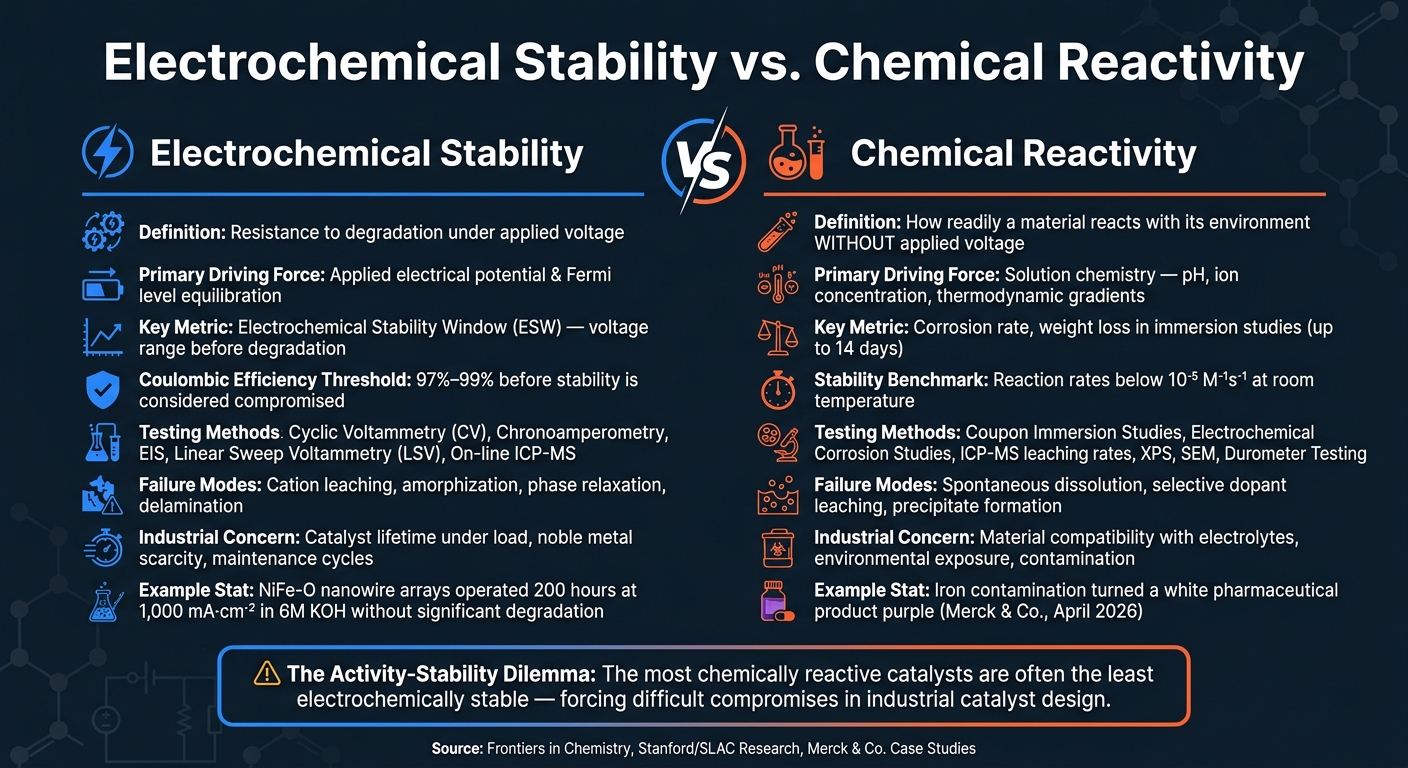
Electrochemical Stability vs. Chemical Reactivity: Key Differences at a Glance
Comparison Table
Understanding the differences between electrochemical stability and chemical reactivity is essential for addressing the trade-offs involved in material selection. While these properties are often confused, they operate through entirely different mechanisms. Electrochemical stability depends on applied voltage and the material’s Fermi level, describing how well a material performs when current flows through it [2]. On the other hand, chemical reactivity is dictated by environmental factors like pH, ion concentration, and thermodynamic gradients, without requiring an external voltage [12].
Here’s a side-by-side breakdown of the key differences:
| Feature | Electrochemical Stability | Chemical Reactivity |
|---|---|---|
| Primary Driving Force | Applied electrical potential and Fermi level equilibration [2] | Solution chemistry – pH, ion concentration, thermodynamic gradients [12] |
| Testing Methods | Chronopotentiometry, EIS, S-number analysis [1][2] | ICP-MS leaching rates, chemical stability diagrams [12][2] |
| Failure Modes | Cation leaching, amorphization, phase relaxation, delamination [1][2] | Spontaneous dissolution, selective dopant leaching, precipitate formation [12][2] |
| Industrial Concerns | Catalyst lifetime under load, noble metal scarcity, maintenance cycles [1] | Material compatibility with electrolytes, environmental exposure [12] |
This table highlights a critical point: a material might excel in electrochemical stability tests yet fail in chemically reactive environments. These distinct failure pathways often lead to unexpected hurdles during industrial scale-up, emphasizing the need for careful evaluation in material selection.
Material Selection Challenges
The differences between these properties create several practical challenges when choosing electrode materials for industrial applications. One example is the ECSA paradox: as a material degrades through surface roughening or selective leaching, its electrochemically active surface area (ECSA) may increase. While this might seem like improved performance, it actually masks the loss of intrinsic catalytic quality [2]. Another issue is the activity-stability dilemma, where the most chemically reactive catalysts are often the least stable electrochemically. This forces difficult compromises in industrial catalyst design, where both high performance and long-term durability are essential.
These challenges are further complicated by supply chain limitations. Many stable and active catalysts rely on scarce noble metals like iridium. For instance, projections indicate that deploying iridium-based electrolyzers in Germany by 2050 could consume 37% of the global annual iridium supply [1]. This underscores the importance of balancing material performance with resource availability.
Disclaimer: This content is for informational purposes only. Consult official regulations and qualified professionals before making sourcing or formulation decisions.
Design and Sourcing Considerations
Balancing Stability and Reactivity in Material Selection
Dr. David M. Heard and Dr. Alastair J. J. Lennox emphasize an essential point:
"It is impossible to select the optimum electrode for a given process on a theoretical basis. Instead, an empirical approach must be used." [13]
This means engineers must test materials under actual operating conditions – like specific electrolyte pH, temperature, target potential range, and mechanical stress from fluid convection – before finalizing a design. A critical aspect of this process is managing overpotential, which involves selecting materials with high overpotentials for undesirable side reactions to suppress them effectively. For instance, cathodes like lead or mercury have historically been used to suppress the Hydrogen Evolution Reaction (HER) during substrate reduction. However, the industry is increasingly moving toward alternatives such as Boron Doped Diamond (BDD) and glassy carbon, which provide wide potential windows without the environmental and regulatory concerns tied to traditional materials.
Another significant issue is passivation, where an insulating layer forms on the electrode due to insoluble byproducts or polymer deposits. This layer can halt the reaction entirely. Avoiding passivation requires selecting materials suited to both the chemical environment and the electrical demands of the process. The Sabatier Principle adds yet another layer of complexity: the interaction between the electrode and substrate must be strong enough to initiate the reaction but weak enough to release the product. Interactions that are too strong can lead to decomposition and poor yields, a problem that often arises during production rather than in laboratory testing.
These challenges highlight the need for stringent sourcing and material evaluation protocols.
The Role of Specialty Chemical Providers
Addressing these material performance challenges requires not only careful selection but also reliable sourcing and quality control. Batch-to-batch inconsistency is a significant issue in electrochemical processes. Variations in electrode material grade or source can lead to shifts in reaction selectivity, unexpected passivation, or the introduction of trace metal contaminants. Such risks are particularly concerning in industries like pharmaceuticals and electronics, where contamination can directly affect product quality and compliance with regulatory standards [13].
This is why sourcing cannot be treated as an afterthought. Allan Chemical Corporation (allanchem.com) supports industries with strict quality requirements, such as pharmaceuticals, electronics, and ceramics, by providing consistent, grade-verified specialty chemicals. With over 40 years of experience and direct relationships with vetted manufacturers, Allan Chemical supplies technical-grade and compendial-grade materials (ACS, USP, NF, FCC) that meet the documentation and quality standards these industries demand. Additionally, their just-in-time delivery model minimizes risks associated with long-term storage, such as material degradation, which can alter surface states and electrochemical properties in sensitive applications.
For engineering teams balancing the trade-off between electrochemical stability and chemical reactivity, sourcing decisions are integral to the design process – not an afterthought.
Disclaimer: This content is for informational purposes only. Consult official regulations and qualified professionals before making sourcing or formulation decisions.
Conclusion
The longevity of devices, product quality, and operational safety hinge on two critical factors: electrochemical stability and chemical reactivity. This differs from electrochemical vs. thermal stability, which focuses on temperature-induced degradation. A material that may excel in isolated tests can fail unexpectedly when exposed to specific electrolytes or co-components. This underscores the importance of assessing system-wide compatibility rather than focusing solely on individual properties. Factors like steric hindrance and kinetic rate constants play a crucial role in determining how materials behave under actual operating conditions [11]. For instance, reaction rates below 10⁻⁵ M⁻¹ s⁻¹ at room temperature serve as a practical benchmark for stability when evaluating materials for long-term use [11].
Balancing these considerations requires looking beyond standard metrics. As highlighted in earlier industrial examples, even slight changes in material composition can lead to noticeable shifts in performance. Ensuring consistent material behavior under operational conditions involves not only stability testing but also dependable sourcing practices.
This is where reliable sourcing becomes indispensable. Even the most promising lab results can be undermined by inconsistencies in material grades or unrecorded substitutions during procurement. Variations in sourcing can alter a material’s reactivity profile, potentially causing issues that are difficult to trace later. Allan Chemical Corporation emphasizes this point:
"Our growth and success are a result of our ability to respond to customer requirements with products that meet their specifications." [14]
Allan Chemical Corporation has been a trusted partner to regulated industries for over 40 years, providing grade-certified specialty chemicals – ACS, USP, NF, FCC – with complete documentation, including Certificates of Analysis and Safety Data Sheets. For sectors like pharmaceuticals, electronics, and ceramics, traceability is not just a preference but a necessity for maintaining quality standards.
Ultimately, understanding and managing both electrochemical stability and chemical reactivity, coupled with sourcing materials that consistently meet these demands, is what transforms a successful lab process into a scalable, reliable production system.
Disclaimer: This content is for informational purposes only. Consult official regulations and qualified professionals before making sourcing or formulation decisions.
FAQs
How do I choose between electrochemical stability and chemical compatibility?
When selecting materials, prioritize electrochemical stability if the application requires resistance to redox decomposition within a secure electrochemical stability window (ESW). This property is commonly evaluated using techniques like linear sweep or cyclic voltammetry. On the other hand, focus on chemical compatibility when the concern lies with corrosion or material degradation in certain chemical environments. Immersion tests or corrosion studies can help assess material performance, identifying potential attack, corrosion products, and rates before moving to larger-scale applications.
What tests best predict real-world electrode lifetime?
Predicting how long an electrode will last involves using a mix of diagnostic techniques, as relying solely on electrochemical data won’t reveal every possible failure mode. Common approaches include calendar aging tests, which involve conditions like constant voltage or open-circuit voltage, and float current analysis, which focuses on mechanisms such as SEI (Solid Electrolyte Interphase) growth. For a more detailed understanding, advanced techniques like high-precision coulometry and hybrid pulse power characterization (HPPC) are often employed. Allan Chemical Corporation plays a role in these efforts by supplying high-grade chemicals tailored for energy storage applications.
Why can a material look stable in CV but fail in long runs?
When a material seems stable during Cyclic Voltammetry (CV) testing, it’s because its electrochemical stability window (ESW) and cyclic current response remain consistent within the tested range and timeframe. However, this doesn’t always tell the full story. Over extended periods, slower processes – like side reactions, parasitic reactions, or corrosion – can take place. These hidden issues can result in problems such as capacity loss, lower coulombic efficiency, or higher impedance, which CV testing might fail to reveal.




Comments are closed