
Kosher-certified chemicals ensure dietary supplements meet Jewish dietary laws while enhancing ingredient transparency. This certification applies to all components, including active ingredients, solvents, and excipients. Key challenges include tracing ingredient origins, preventing cross-contamination, and certifying inactive components like lubricants and carriers.
Key Points:
- Ingredient Sourcing: Glycerin must come from plants (e.g., palm oil) instead of animal tallow. Ethanol derived from corn is kosher, but whey-based ethanol is not.
- Cross-Contamination Risks: Shared equipment must undergo rigorous cleaning (kosherization) to prevent non-kosher residue transfer.
- Inactive Ingredients: Items like magnesium stearate and gelatin often fail certification unless sourced from plant-based materials.
- Consumer Demand: Over 12 million U.S. consumers seek kosher products, driven by dietary restrictions and quality assurance.
Reliable sourcing partnerships and detailed documentation streamline compliance while maintaining production efficiency. Manufacturers should verify kosher status for every ingredient and follow a chemical supplier verification checklist to ensure compliance to meet growing market demand.
Common Problems in Sourcing Kosher-Certified Chemicals
Supply Chain Difficulties
Sourcing kosher-certified chemicals can be a maze of challenges, especially when it comes to tracing every ingredient back to its origin. Take common materials like glycerin, stearic acid, and oleic acid, for example. These are often derived from animal fats, which makes them non-kosher unless they come from plant-based sources like palm, coconut, or soy oils [1][4]. Things get even trickier with fermentation-derived ingredients. The growth media used in fermentation processes often include animal-based components, such as beef extract or peptones, which can disqualify the final product from being kosher [4].
Marine-based ingredients add another layer of complexity. In 2023, a European manufacturer tried to certify Vitamin D3 made from Peruvian anchovy oil. While anchovies are kosher, the process hit a roadblock. On-site inspections revealed that non-kosher bycatch – like shrimp and krill – frequently exceeded the allowable threshold under kosher law. As a result, the project was abandoned [1]. This example shows how even seemingly straightforward ingredients can fail certification due to contamination during harvesting.
These supply chain issues often lead to another significant challenge: cross-contamination risks during production.
Cross-Contamination Risks
Shared equipment in manufacturing facilities poses a major risk to maintaining kosher standards. According to Jewish dietary law (Kashrut), equipment that processes non-kosher materials can absorb their non-kosher properties. This "absorbed" character can then transfer to subsequent batches, compromising their kosher status [9]. With the global kosher food market valued at over $24 billion annually, maintaining strict separation protocols is non-negotiable [9].
Even boiler systems and thermal fluids can inadvertently transfer non-kosher elements. For example, shared steam or processing fluids can carry traces of non-kosher materials, making physical barriers and thorough cleaning essential [9]. These risks are magnified when excipients, the inactive substances in formulations, lack proper certification.
Limited Certification for Excipients
The scarcity of certified kosher excipients creates hurdles in product formulation. Ingredients like magnesium stearate or kosher-certified calcium stearate (commonly used as lubricants), solvents such as ethanol, and carriers like lactose often lack the necessary rabbinical oversight [1][8]. Additionally, fat-soluble vitamins frequently undergo micro-encapsulation using non-kosher gelatin, which isn’t always disclosed on final product labels [8].
One success story comes from an ashwagandha producer who faced certification challenges due to the use of milk-based solvents. By switching to an ethanol-water mix, the company was able to achieve Pareve status, meaning the product could be classified as neither meat nor dairy under kosher law [1].
Rabbi Moshe Elefant, COO of OU Kosher, highlights the economic pressures at play:
"The rising prices [of vegetable glycerin] will likely drive companies to look toward cheaper animal fat-based alternatives… But many of these do not meet vegetarian, vegan, and other consumer needs" [7].
Disclaimer: This content is for informational purposes only. Consult official regulations and qualified professionals before making sourcing or formulation decisions.
sbb-itb-aa4586a
Kosher Certification Requirements for Nutraceutical Ingredients
Jewish Dietary Law Compliance
Securing kosher certification for nutraceutical ingredients requires strict adherence to Kashrut, the Jewish dietary laws. Every component, from active ingredients to excipients, must meet these standards [1]. This underscores the importance of thorough ingredient traceability and quality assurance in kosher dietary supplements.
The origin of each ingredient is critical. For example, materials derived from animals must come from kosher species, such as fish with fins and scales or land animals that are properly slaughtered. Even botanical extracts can fail certification if they contain microscopic insects like aphids, unless processing completely disintegrates them [1].
Kosher law also prohibits combining meat (fleishig) and dairy (milchig) products. Ingredients classified as pareve (neutral) are the most versatile since they can be consumed with either meat or dairy, making them essential for formulating supplements that cater to diverse dietary needs [4].
Rabbinical Oversight
Given the complexities of modern supply chains, rabbinical oversight plays a crucial role in maintaining kosher integrity. Continuous supervision ensures compliance throughout the production process [10]. Certification agencies conduct initial inspections to classify ingredients and follow up with periodic, often unannounced, on-site audits. During these inspections, batch records, receiving logs, and electronic data are reviewed to confirm that no unauthorized ingredients have entered the production line.
This oversight extends beyond production facilities. For example, when bulk chemicals are transported in tanker trucks, inspectors verify that the tankers are either kosher-certified or exclusively used for kosher materials [4]. This step prevents contamination during transit. Equipment that handles both kosher and non-kosher products must undergo kosherization, a rigorous cleaning process involving heat treatments between 190°F and 212°F (88°C to 100°C) to eliminate absorbed traces of non-kosher substances [4].
Dr. Luke Grocholl and Rabbi Gershon Segal of Sigma-Aldrich highlight that "the additional scrutiny involved in the kosher certification process can lead to an improvement in the overall quality of the products and the sharpening of the monitoring process throughout the quality system" [4].
This added layer of oversight not only ensures compliance with religious standards but also enhances product quality, benefiting manufacturers beyond the kosher market.
Common Kosher-Certified Chemicals
With robust oversight in place, manufacturers can confidently source kosher-certified chemicals for their formulations. Popular kosher-certified ingredients include vegetable glycerin, which is derived exclusively from palm, coconut, or soy oils [1]. Other widely available options include ascorbic acid (vitamin C) and citric acid. Suppliers like Spectrum Chemical offer nearly 200 kosher-grade ingredients, such as magnesium sulfate and maltodextrin [6]. Sigma-Aldrich, with over 25 years of experience, provides more than 1,200 kosher-certified chemicals [4].
Stearic acid and its derivatives, like magnesium stearate, must come from tropical vegetable oils rather than animal tallow to qualify as kosher [1][3]. Ethanol, often used as an extraction solvent, is generally kosher when sourced from sugar or starch feedstocks. However, ethanol derived from wine or whey typically does not meet kosher standards [1]. Maltodextrin, a common carrier or diluent, is generally kosher as it is derived from starch [1].
Here are some examples of kosher-certified chemicals and their specific requirements:
| Chemical | Typical Use | Kosher Requirement |
|---|---|---|
| Vegetable Glycerin | Liquid delivery system | Must be from botanical sources (palm, coconut, soy) [1] |
| Magnesium Stearate | Anti-caking agent | Must be derived from vegetable oils, not tallow [1][3] |
| Ascorbic Acid | Active ingredient (Vitamin C) | Produced on verified kosher equipment [6] |
| Ethanol | Extraction solvent | Feedstock must be sugar/starch, not wine or whey [1] |
| Maltodextrin | Carrier/Diluent | Generally kosher as starch derivative [1] |
Disclaimer: This content is for informational purposes only. Consult official regulations and qualified professionals before making sourcing or formulation decisions.
Solutions for Reliable Sourcing and Compliance
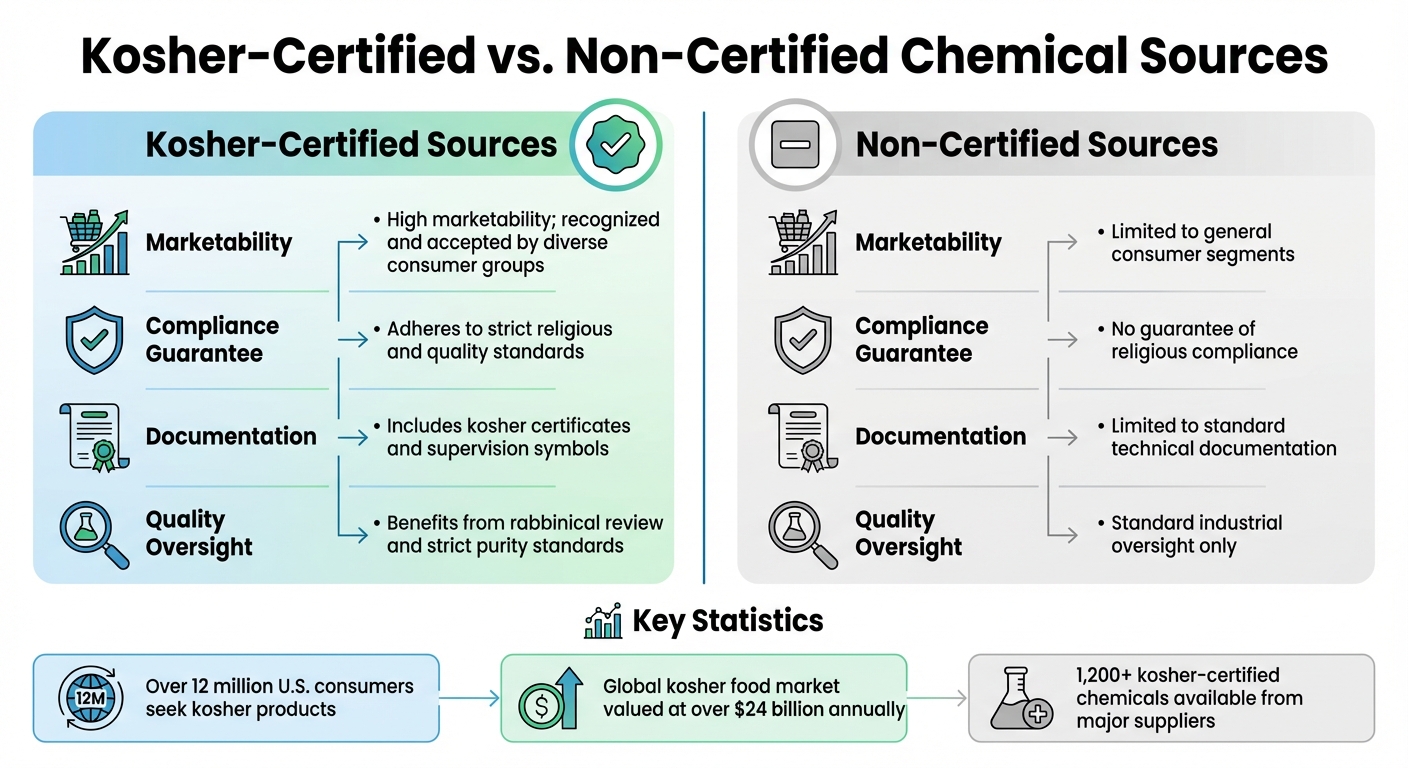
Kosher vs Non-Kosher Chemical Sources Comparison for Dietary Supplements
Working with Certified Suppliers
Partnering with certified suppliers is a key step in ensuring kosher compliance for dietary supplements. Look for suppliers who adhere to rigorous standards, such as those with ISO certifications. For example, ISO 9001:2015, a globally recognized quality management system, has over 1,000,000 certificates issued across 189 countries. Meanwhile, ISO 14001 reflects a commitment to reducing environmental impact [11][12].
Allan Chemical Corporation, with over four decades of experience, is a prime example of a trusted supplier. They provide specialty chemicals that meet kosher certification requirements and are compendial-grade (USP, FCC, NF). Their established relationships with vetted manufacturers ensure a reliable supply chain, while their technical support helps customers navigate the complexities of kosher compliance without disrupting production timelines.
"Our growth is measured by our customers’ success which is why building genuine relationships will always be our top priority." – Allan Chemical Corporation [5]
In addition to working with certified suppliers, effective inventory management and thorough documentation play a critical role in maintaining supply chain integrity.
Just-in-Time Delivery and Documentation
Just-in-time delivery is an effective strategy to minimize storage risks and prevent cross-contamination. Suppliers with on-site warehousing capabilities can deliver specialty chemicals exactly when they are needed, reducing inventory costs and the potential for contamination during storage.
Proper documentation is equally crucial. Manufacturers should request lot-specific Certificates of Analysis (CofA) that match catalog and lot numbers on product labels [2]. Additionally, transport documents should confirm that tankers meet kosher certification standards. Maintaining a centralized database of kosher certificates, product symbols, and expiration dates integrates compliance into the overall quality control process.
"The kosher certification process enhances the overall quality control of a production line as it requires an additional certification at every control point from raw materials purchasing, receiving, label and document verification, to the manufacturing process itself…" – Dr. Luke Grocholl and Rabbi Gershon Segal, Sigma-Aldrich [4]
These practices underline the unique advantages of sourcing from kosher-certified suppliers compared to non-certified ones.
Kosher vs. Non-Kosher Chemical Sources
| Feature | Kosher-Certified Sources | Non-Certified Sources |
|---|---|---|
| Marketability | High; recognized and accepted by diverse consumer groups [2]. | Limited to general consumer segments. |
| Compliance Guarantee | Adheres to strict religious and quality standards [2]. | No guarantee of religious compliance. |
| Documentation | Includes kosher certificates and supervision symbols [2]. | Limited to standard technical documentation. |
| Quality Oversight | Benefits from rabbinical review and strict purity standards [2][12]. | Standard industrial oversight only. |
Kosher-certified sources bring a level of quality assurance that goes beyond basic regulatory requirements. Their certification not only meets religious standards but also enhances marketability, as it appeals to a broader audience, including those outside strictly religious communities. The additional oversight involved in kosher certification ensures a higher standard of purity and quality, creating value for all end users.
Disclaimer: This content is for informational purposes only. Consult official regulations and qualified professionals before making sourcing or formulation decisions.
Quality Assurance and Implementation Steps
Verification of Kosher Status
Every ingredient – whether active or inactive, including solvents, excipients, diluents, and carriers like maltodextrin or dextrose – needs to be thoroughly verified for kosher status [1]. Ingredients should be classified as Kosher or non-Kosher and as Pareve (neutral) or Dairy [10]. While some components, like cane sugar or corn meal, are inherently kosher and may not require formal certification, others demand an up-to-date Letter of Certification (LOC) from a recognized rabbinic authority [10]. Particular attention should be given to ingredients like glycerin, which can come from either animal fat or vegetable oil, and stearates, which are non-kosher if derived from tallow instead of tropical oils [1].
"The quality and depth of a certification agency, however, lies in its ability to verify."
– Rabbi Gavriel Price, Rabbinic Coordinator, OU Kosher [1]
Proper kosherization of production equipment is essential when switching from non-kosher to kosher ingredients [1]. Additionally, detailed supplier process maps should be reviewed to identify any potential contamination risks [1]. This meticulous verification process forms the backbone of reliable supplier documentation.
Supplier Support and Documentation
Maintaining comprehensive documentation is critical for ensuring ongoing compliance. A Certificate of Analysis (COA) should be obtained for every batch of ingredients, even for minor components like carriers, as this verifies their specific attributes [1][14]. Standard operating procedures (SOPs) must be developed and rigorously followed to guide quality control processes, including decisions on ingredient approval or rejection [13][14]. If working with contract packagers, ensure they adhere to 21 CFR 111.255 by keeping detailed batch production records [14].
Suppliers can provide valuable technical support to clarify certification details. For instance, at Allan Chemical Corporation, the team offers prompt, batch-specific documentation to streamline your kosher certification process. This kind of proactive support not only simplifies compliance but also underscores ethical and responsible sourcing practices. Unannounced rabbinic inspections further ensure compliance by reviewing production records, ingredient labels, and equipment logs [10][1]. All new ingredients must be approved through the certifying agency before use [10].
In addition to documentation, prioritizing ethical sourcing strengthens the overall integrity of your product.
Sustainability and Ethical Certifications
Kosher certification aligns well with broader quality and ethical standards. When verifying kosher status, consider collaborating with suppliers who also uphold sustainable and ethical practices [1]. For ingredients like glycerin or stearates derived from palm oil, prioritize suppliers with strong sustainability credentials to promote responsible sourcing. These additional certifications not only enhance supply chain transparency but also signify a commitment to high-quality standards.
Suppliers such as Allan Chemical Corporation emphasize integrating ethical and quality certifications, which can include systems like ISO 9001 and ISO 14000, RSPO Supply Chain Certification, and others. This approach ensures a transparent, sustainable supply chain while reinforcing trust and accountability.
Disclaimer: This content is for informational purposes only. Consult official regulations and qualified professionals before making sourcing or formulation decisions.
Conclusion
Sourcing kosher-certified chemicals involves meticulous ingredient verification and thorough documentation to align with rabbinical standards [1]. Challenges such as preventing cross-contamination, securing certification for inactive ingredients, and navigating complex supply chains call for collaboration with reliable and experienced suppliers. Working with a provider like Allan Chemical Corporation offers the advantage of decades of expertise, just-in-time delivery, and comprehensive batch documentation, helping manufacturers meet certification requirements while keeping production on track [15]. This rigorous approach ensures compliance and boosts a product’s appeal in the marketplace.
Kosher certification goes beyond meeting regulatory requirements – it underscores product quality and transparent sourcing. Labels such as "Pareve" or "D" provide critical information for consumers with dietary restrictions, while the certification process verifies the integrity of raw materials [1]. This level of scrutiny not only enhances product reliability but also fosters consumer trust.
For manufacturers, maintaining strict verification protocols and cultivating strong supplier relationships is key to thriving in the expanding nutraceutical market [16]. By prioritizing quality assurance and forging dependable partnerships, companies can achieve consistent compliance and gain a competitive edge.
Disclaimer: This content is for informational purposes only. Consult official regulations and qualified professionals before making sourcing or formulation decisions.
FAQs
What challenges come with sourcing kosher-certified chemicals for dietary supplements?
Sourcing kosher-certified chemicals for dietary supplements involves navigating a strict set of requirements to ensure compliance with kosher laws. Every ingredient and production step must align with these standards, no matter where the manufacturing occurs.
An additional hurdle lies in maintaining rigorous supervision and certification throughout the process. This helps prevent cross-contamination and ensures adherence to kosher guidelines. Careful monitoring and detailed record-keeping are critical to preserving the certification’s integrity and meeting regulatory demands.
What impact does cross-contamination have on the kosher certification of dietary supplements?
Cross-contamination poses a serious risk to the kosher status of dietary supplements. It can occur when non-kosher ingredients or residues come into contact with kosher products during manufacturing. Even the smallest trace of a non-kosher substance can breach strict kosher standards, potentially disqualifying the entire product.
To prevent this, manufacturers need to adopt strict quality control measures. This includes using dedicated equipment, implementing thorough cleaning procedures, and ensuring all ingredients come from verified kosher-certified sources. These steps are crucial for preserving the kosher certification and maintaining consumer confidence in the product.
Why is rabbinical supervision important for kosher certification?
Kosher certification relies heavily on rabbinical supervision to ensure that both the ingredients and production methods adhere to strict kosher laws. This oversight plays a critical role in maintaining compliance with religious standards while preventing any risk of cross-contamination with non-kosher substances.
From sourcing raw materials to the final stages of production, every step demands careful monitoring. Rabbinical authorities bring the expertise and oversight needed to confirm that all processes align with kosher requirements. Their involvement provides consumers with assurance about the product’s quality and adherence to these religious guidelines.




Comments are closed