
Viscosity-reducing excipients are inactive substances added to protein formulations to decrease viscosity while maintaining stability. This often involves the role of osmolytes in stabilizing therapeutic proteins. These are critical for high-concentration biologic drugs, particularly for subcutaneous injections, where solutions must remain injectable within a viscosity range of 20–25 mPa·s. Without these excipients, concentrated formulations exceeding 100 mg/mL often become too thick due to protein-protein interactions, making them difficult to manufacture and administer.
Key points about viscosity-reducing excipients:
- Why they’re needed: High protein concentrations (100–200 mg/mL) cause molecular crowding, leading to increased viscosity. This impacts production processes like filtration and filling, and also affects patient comfort during injection.
- How they work: Excipients disrupt short-range molecular forces such as van der Waals interactions and hydrogen bonds, reducing clustering and thickening.
- Types: Common categories include top excipients for protein stabilization such as amino acids (e.g., Arginine Hydrochloride), salts (e.g., Sodium Chloride), and anionic compounds.
- Challenges: Selecting the right excipient depends on the specific protein, as improper choices can destabilize the formulation.
These excipients are essential for ensuring biologic drugs remain injectable, safe, and effective, especially as the industry shifts toward patient-friendly delivery methods.
Comera Life Sciences on Developing a New Generation of Biologic Medicines
Viscosity in High-Concentration Biologics
High viscosity is a major hurdle in the lifecycle of biologic drugs, affecting everything from production to patient use. When protein concentrations exceed 100 mg/mL, the molecules pack so tightly that the solution becomes thick and resists flowing. This isn’t just an operational inconvenience – it reshapes how these drugs are manufactured, stored, and administered.
What Causes High Viscosity in Biologics
To understand why viscosity becomes an issue, we need to examine molecular interactions. Protein–protein interactions (PPI) are the primary driver of high viscosity. At high concentrations, short-range attractive forces overpower the repulsive forces that typically keep proteins apart. Danika Rodrigues, PhD, formerly with Janssen R&D, explains:
"In these crowded environments, short‐range attractive interactions, including van der Waals interactions, hydrogen bonds, and dipole–dipole interactions, dominate over long‐range repulsive interactions and lead to increased viscosity" [3].
The problem is compounded by the uneven charge distribution on protein surfaces. Some proteins expose hydrophobic (water-repelling) regions, which naturally attract other proteins. As Laura Tanenbaum, a Drug Product Development Scientist at Janssen R&D, notes:
"Some molecules may have more solvent‐exposed hydrophobic patches that permit more of these short‐range attractions, resulting in solutions with higher viscosities" [3].
These interactions can lead to the formation of transient clusters or even larger networks that slow down flow.
pH also plays a critical role. When the pH of a solution approaches a protein’s isoelectric point (pI) – the pH at which it carries no net charge – electrostatic repulsion between proteins decreases, leading to a spike in viscosity. Additionally, at high concentrations, proteins may partially unfold or change shape, increasing their hydrodynamic radius and further thickening the solution.
Viscosity issues become more pronounced at specific concentration thresholds. For example:
- Below 75 mg/mL, viscosity problems are rare [3].
- Between 100 and 200 mg/mL, some proteins begin forming clusters that raise viscosity beyond the injectable limit of 20 to 25 mPa·s [1].
- Above 200 mg/mL, nearly all protein solutions become highly viscous due to unavoidable molecular interactions [3].
These challenges directly impact both the manufacturing process and patient experience, as explored in the next section.
How High Viscosity Affects Pharmaceutical Processes
The molecular causes of high viscosity ripple through critical stages of drug production. Manufacturing biologics becomes more challenging as viscosity increases. During ultrafiltration and diafiltration (UF/DF) – essential steps for concentrating and purifying proteins – high viscosity leads to pump back pressure, filter clogging, and reduced transmembrane flux [5].
Pumping and filling viscous solutions also expose proteins to shear stress, which can denature them and cause aggregation. These aggregates not only reduce protein activity but may also trigger unwanted immune responses in patients. This risk underscores the importance of rigorous protein stabilizer testing during development. As Danika Rodrigues warns:
"Aggregates in the delivered product can potentially lead to decreased protein activity or unwanted immune responses in patients" [3].
Patient administration is another significant challenge. Highly viscous formulations require a lot of force to push through a syringe needle. A white paper highlights:
"Highly viscous protein solutions would require a significant force to be applied to the syringe for injection. As a result, the patient could experience a considerable amount of pain. In many cases, injectability would not be possible" [1].
Manual injections become impractical when viscosity exceeds 20 to 25 mPa·s, and even autoinjectors may struggle to handle such formulations [1]. This is particularly problematic for subcutaneous injections, which are limited to volumes of 1 to 3 mL [3]. To deliver therapeutic doses within these small volumes, formulations often exceed 100 mg/mL – precisely the concentration range where viscosity issues arise. Robert Mahoney, Chief Scientific Officer at Comera Life Sciences, sums up the impact:
"Higher viscosity can make the production of biologics difficult, lead to potential quality and safety issues, and cause problems for patients" [2].
This content is for informational purposes only. Consult official regulations and qualified professionals before making sourcing or formulation decisions.
Types of Viscosity-Reducing Excipients
Types of Viscosity-Reducing Excipients for High-Concentration Biologics
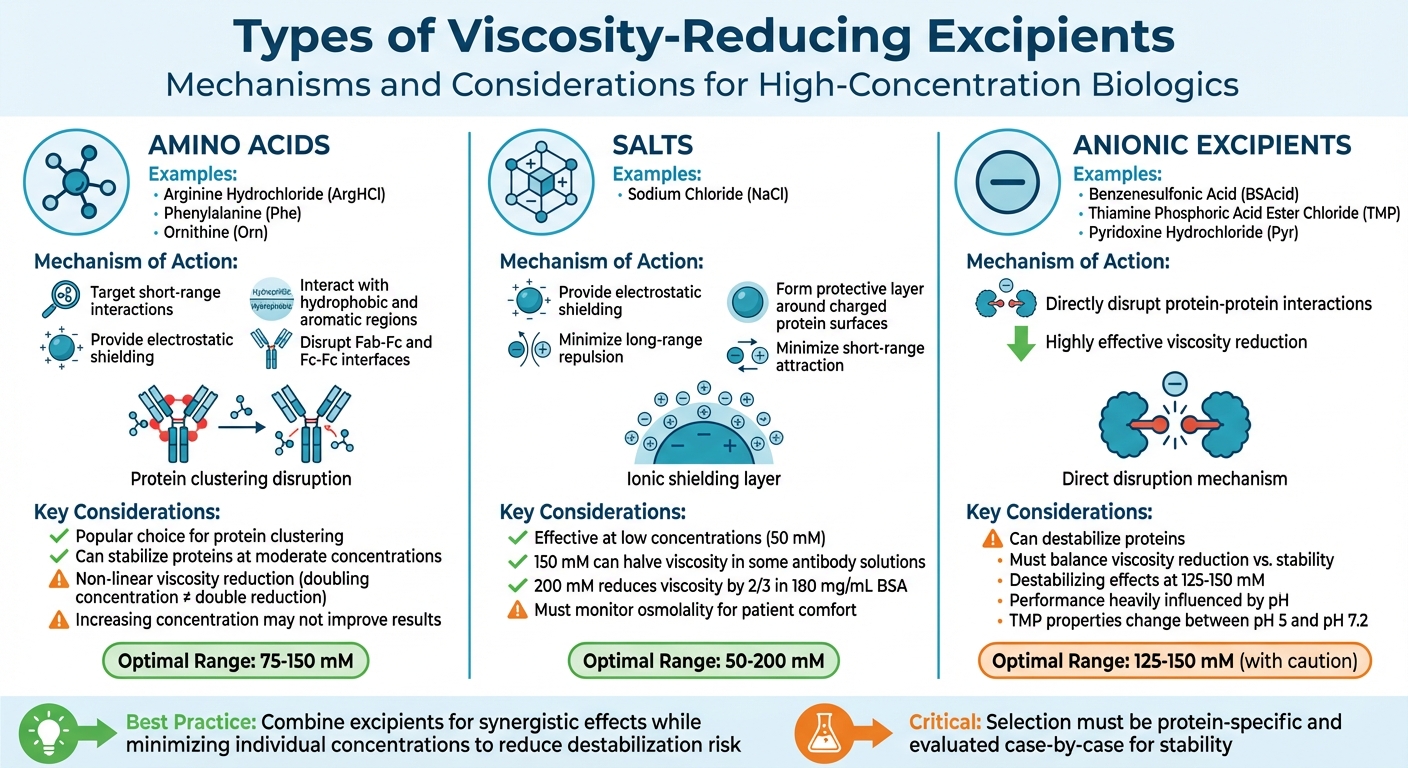
When dealing with high-concentration biologics, formulators have several types of excipients at their disposal to address viscosity challenges. Each category operates through unique molecular mechanisms, making it essential to understand these differences to select the most effective option for a specific protein formulation. These approaches build upon earlier molecular insights, offering tailored solutions for various protein formulations.
Amino Acids
Amino acids are a popular choice due to their ability to target short-range interactions that lead to protein clustering. Commonly used amino acids include arginine hydrochloride (ArgHCl), phenylalanine (Phe), and ornithine (Orn). These compounds interact with exposed hydrophobic and aromatic regions on proteins, reducing the attractive forces between molecules [7][8].
Arginine stands out for its dual action: it provides electrostatic shielding while disrupting hydrophobic interactions between antibody regions, such as Fab-Fc or Fc-Fc interfaces. Researchers like Taehun Hong from the University of Tsukuba have observed that amino acids can stabilize proteins or even enhance their stability at moderate concentrations [7].
However, increasing amino acid concentrations doesn’t always lead to proportional viscosity reduction. For instance, doubling phenylalanine from 75 mM to 150 mM may not improve viscosity reduction and can even increase viscosity at higher levels [8]. This non-linear behavior underscores the importance of testing various concentrations rather than assuming that more is always better.
Salts and Anionic Excipients
Salts, such as sodium chloride (NaCl), reduce viscosity by providing electrostatic shielding. They form a protective layer around charged protein surfaces, minimizing both long-range repulsion and short-range attraction [7]. For example, a 150 mM salt solution can halve the viscosity of certain antibody solutions, while 200 mM NaCl reduces viscosity by two-thirds in 180 mg/mL bovine serum albumin [7].
Anionic excipients take a more direct approach by disrupting protein-protein interactions. Examples include benzenesulfonic acid (BSAcid), thiamine phosphoric acid ester chloride (TMP), and pyridoxine hydrochloride (Pyr). These compounds are highly effective at reducing viscosity but can destabilize proteins, as highlighted in a Merck/MilliporeSigma white paper:
"It is essential to balance an excipient’s viscosity-reducing ability against its potential to destabilize a protein" [1].
At concentrations between 125 mM and 150 mM, anionic excipients can show destabilizing effects, particularly during forced degradation studies conducted over 28 days at 104°F (40°C) [8]. Additionally, their performance can be heavily influenced by pH. For instance, TMP’s protonation state and hydrophobicity shift between pH 5 and pH 7.2, altering its interaction with proteins [8]. This sensitivity to pH means that formulators must carefully align the excipient with the formulation’s pH range to ensure consistent results.
This content is for informational purposes only. Consult official regulations and qualified professionals before making sourcing or formulation decisions.
sbb-itb-aa4586a
How to Optimize Viscosity Reduction
Combining Excipients for Better Results
Pairing excipients can achieve greater viscosity reduction than using them individually. By combining excipients, formulators can lower the concentration of each component, which helps minimize the risk of destabilizing the protein while still meeting viscosity targets. For instance, blending an amino acid like L-Ornithine with an anionic excipient such as Thiamine phosphoric acid ester chloride (TMP) has been shown to outperform simply increasing the concentration of a single excipient [1][3]. This method aligns with broader strategies for managing protein viscosity discussed earlier.
The industry is increasingly moving toward using carefully chosen combinations of excipients instead of relying on high doses of a single component. This reflects a preference for strategies that leverage multiple mechanisms of action.
Addressing multiple molecular mechanisms at once is crucial. For example, salts like sodium chloride provide electrostatic shielding at concentrations as low as 50 mM, while amino acids like Arginine hydrochloride help by disrupting hydrophobic and aromatic interactions between protein molecules [7]. When combined, these mechanisms often produce results that exceed the sum of their individual effects. However, formulators must carefully monitor osmolality to ensure isotonicity, as high osmolality can negatively affect patient comfort during injection [2][3].
Selecting Excipients Based on Protein Type
Building on the concept of synergy, excipient selection should be tailored to the specific properties of the protein to ensure stability and reduce viscosity, often by utilizing top stabilizing excipients for protein formulations. Proteins with exposed hydrophobic regions benefit from excipients that can disrupt short-range interactions, such as arginine or phenylalanine, which tend to be particularly effective [2]. Laura Tanenbaum, a Drug Product Development Scientist at Janssen R&D, highlights this point:
"The optimized excipient or combination is highly protein-specific and must be evaluated on a case-by-case basis to ensure stability in the final formulation" , a process that also requires careful excipient selection for vaccine stability in related biologic categories [2][3]. This is particularly important when transitioning to solid dosage forms, where lyophilization excipients for protein stability are required to protect the biologic during freeze-drying.
Protein concentration also plays a key role in determining the best strategy. At concentrations below 200 mg/mL, viscosity is primarily influenced by transient clusters and self-interactions, making excipients more effective at breaking these weak associations. However, at concentrations above 200 mg/mL, the close proximity of molecules becomes the dominant factor, making viscosity reduction much more challenging [1][2]. Formulators working in the 100 to 200 mg/mL range – where about 33% of FDA-approved monoclonal antibody products operate – have more flexibility in selecting excipients [2][3].
Forced degradation studies are essential to confirm that viscosity reduction does not compromise protein stability. Danika Rodrigues, formerly of Janssen R&D, warns:
"While increasing excipient concentration could further lower the formulation viscosity through interference of protein-protein interactions, it could potentially act as a protein destabilizer simultaneously" [2][3].
High-throughput screening and computational modeling are valuable tools for identifying the optimal excipient concentration for each protein. The extent of viscosity reduction can vary significantly between different molecules, making a tailored approach necessary [2][3].
This content is for informational purposes only. Consult official regulations and qualified professionals before making sourcing or formulation decisions.
Applications and Case Studies
Uses in Biologic Formulations
Viscosity-reducing excipients play a critical role in enabling the subcutaneous delivery of high-concentration biologics. This approach often requires compressing proteins into 1–3 mL volumes, a necessity that has become even more prominent during the COVID-19 pandemic [2][3].
However, high viscosity can create significant hurdles in manufacturing and filling processes. Issues like filter clogging, poor mixing, increased pump back pressure, protein denaturation, and lower product recovery are common challenges [2][3][5]. To ensure compatibility with autoinjectors and pre-filled syringes, formulators aim to keep viscosity within a range of 20 to 25 mPa·s [1][6]. While protein solutions below 75 mg/mL rarely face viscosity problems, concentrations exceeding 200 mg/mL almost always lead to elevated viscosity due to molecular crowding [2][6].
These challenges have driven innovative solutions, with real-world case studies offering practical insights into effective viscosity management.
Case Studies
Industry case studies showcase how companies are addressing viscosity challenges with creative approaches. For example, Janssen R&D is actively involved in the FDA’s Novel Excipient Review Pilot Program, which promotes the use of non-traditional chemicals to manage viscosity [2][3].
Recent patents have identified caffeine as a promising small-molecule excipient for reducing viscosity in antibody formulations [2][3]. Studies using the NISTmAb reference material reveal that ionic excipients can sometimes increase short-range attraction, while nonionic excipients often enhance repulsive interactions at higher protein concentrations. These findings underscore the need for protein-specific testing to select the most effective excipients [4]. Such insights are invaluable for optimizing biologic formulations and ensuring their efficiency.
This information is provided for educational purposes only. Always consult official regulations and qualified experts before making formulation or sourcing decisions.
For formulators in search of reliable viscosity-reducing excipients, Allan Chemical Corporation offers a wide range of technical-grade and compendial-grade solutions. With over 40 years of experience in regulated industries, Allan Chemical Corporation delivers just-in-time inventory, competitive pricing, and trusted supplier relationships to help meet the demanding needs of high-concentration biologic formulations.
Conclusion
Effectively managing viscosity is key to both efficient production and patient-friendly administration of biologics. High-concentration formulations, especially for subcutaneous delivery, are becoming more common, with about one-third of FDA-approved monoclonal antibody products now exceeding 100 mg/mL [2]. To address the challenges of high viscosity, excipients like amino acids, salts, and anionic compounds play a vital role in keeping formulations within the 20 to 25 mPa·s range required for injectability [1]. This highlights the importance of selecting excipients for monoclonal antibodies and employing tailored formulation strategies.
Each protein presents unique challenges, requiring formulators to customize excipient choices. A case-by-case approach is essential to achieve the right balance between reducing viscosity and maintaining protein stability with effective stabilizers. As Laura Tanenbaum, a Drug Product Development Scientist at Janssen R&D, puts it:
"The optimized excipient or combination is highly protein-specific and must be evaluated on a case-by-case basis to ensure stability in the final formulation" [2].
Beyond formulation, sourcing high-quality excipients is equally critical. Working with trusted suppliers ensures consistent manufacturing processes and regulatory compliance. For example, Allan Chemical Corporation offers decades of expertise, reliable just-in-time delivery, and comprehensive documentation to support pharmaceutical development.
With 75% of high-concentration monoclonal antibody products approved since 2015 [3], the demand for effective viscosity management solutions is only expected to grow. Success in this area depends on understanding viscosity mechanisms, choosing the right excipients, and collaborating with dependable suppliers.
This content is provided for informational purposes only. Always consult official regulations and qualified professionals for sourcing and formulation decisions.
FAQs
What are viscosity-reducing excipients, and how do they work?
Viscosity-reducing excipients are substances designed to lower the thickness of concentrated protein formulations, making them easier to produce, handle, and administer. They achieve this by minimizing protein-protein interactions and stopping the formation of transient clusters – key factors that lead to high viscosity in protein solutions at concentrations of 100–200 mg/mL.
Some commonly used viscosity-reducing excipients include amino acids, sugars, surfactants, and co-solutes. These excipients adjust the solution’s environment – such as its pH, ionic strength, or hydrophobic properties – to limit protein self-association without compromising the formulation’s stability. Interestingly, using a combination of excipients in smaller amounts can sometimes boost their effectiveness, ensuring both lower viscosity and maintained protein integrity.
By controlling intermolecular forces and preventing clustering, these excipients are essential for the development of high-concentration biologics. They simplify manufacturing processes and make drug administration more practical and efficient.
How does protein concentration impact the selection of viscosity-reducing excipients?
Protein concentration significantly impacts the choice of excipients used to reduce viscosity in biologic formulations. When protein concentrations reach higher levels – often around 100–200 mg/mL or more – proteins are more likely to interact with one another, leading to increased viscosity. This rise in viscosity can make the formulation harder to inject, particularly for subcutaneous delivery methods.
To address this challenge, formulators select excipients that minimize protein-protein interactions while maintaining the biologic’s stability. Sometimes, using a combination of excipients at lower concentrations can work together to achieve better results, reducing viscosity without compromising the protein’s integrity. The ultimate aim is to ensure that high-concentration formulations are stable, easy to inject, and suitable for patient-friendly use.
Why is it necessary to choose excipients based on the specific protein being used?
Choosing the right excipients for a specific protein is essential because proteins react differently based on their unique structure and surrounding conditions. These variations can influence key aspects such as viscosity, stability, and how easily the protein can be injected. Selecting an appropriate excipient helps lower viscosity effectively while preserving the protein’s integrity.
A well-suited excipient not only protects the protein’s function but also enhances the overall performance of the formulation. This selection plays a key role in creating biologic products that are both safe and effective.




Comments are closed