
Artificial Intelligence (AI) is transforming how antioxidant efficacy is assessed, making it faster and more precise. Antioxidant efficacy refers to a compound’s ability to neutralize free radicals, which harm skin cells and accelerate aging. Traditionally, this is measured through lab assays like DPPH (CAS No. 1898-66-4) and ABTS, expressed as IC50 values – lower values indicate stronger antioxidants. AI now enables rapid screening of thousands of molecules, predicting their performance before physical testing.
AI models analyze chemical structures using tools like SMILES strings and ECFP-4 fingerprints. Techniques such as Random Forest and Support Vector Machines achieve high accuracy (often over 90%) in identifying active compounds. These models can also predict IC50 values, helping researchers rank antioxidants by potency. Beyond discovery, AI aids in optimizing formulations, ensuring stability, and improving delivery systems like liposomes.
Key applications include:
- Ingredient Screening: Identifying promising antioxidants from large chemical libraries.
- Formulation Optimization: Improving stability and skin penetration of antioxidants like Vitamin C and Vitamin E.
- Quality Control: Monitoring antioxidant stability over time using AI-powered spectroscopy.
While challenges like data quality and model generalizability remain, AI is reshaping anti-aging product development by reducing costs and accelerating research timelines. Researchers are now exploring multi-modal data integration and personalized skincare solutions, paving the way for more targeted and effective formulations.
Antioxidants and Skin Aging: Scientific Background
How Oxidative Stress Ages the Skin
Skin aging is largely influenced by chemical reactions caused by environmental factors like UV radiation, pollution, and infrared exposure. These stressors lead to the production of reactive oxygen species (ROS) – unstable molecules such as superoxide and hydroxyl radicals that can damage healthy cells. When the skin’s natural antioxidant defenses are overwhelmed, ROS initiate harmful processes like lipid peroxidation and trigger enzymes that degrade collagen [7][8].
Lipid peroxidation happens when ROS target the fatty acids in cell membranes, setting off a chain reaction that produces damaging byproducts like 4-HNE. These byproducts disrupt cell function and weaken membrane integrity [7][8]. Additionally, oxidative stress activates matrix metalloproteinases (MMPs) – enzymes responsible for breaking down collagen in the skin – while simultaneously inhibiting TGF-β, a protein vital for collagen production [8].
"The cumulative exposure to UVR leads to the progressive depletion of cutaneous antioxidants, and an imbalance of cellular redox in favor of a state of oxidative stress." – Patricia K. Farris, School of Medicine, Tulane University [8]
Environmental factors exacerbate the issue. For instance, exposure to both UV radiation and ozone depletes skin antioxidants more severely than UV radiation alone [8]. Infrared A (IRA) radiation introduces its own damage pathway by targeting mitochondrial chromophores, which increases MMP-1 production and speeds up collagen degradation [8].
These oxidative pathways highlight the challenges in creating effective antioxidant-based formulations.
Challenges in Antioxidant Formulation
Developing skincare products to combat oxidative stress comes with unique obstacles. Many potent antioxidants are chemically unstable. For example, alpha-tocopherol (Vitamin E) is nearly depleted after just 15 minutes of exposure to simulated UV radiation [10]. Similarly, Vitamin C (L-ascorbic acid; CAS No. 50-81-7) requires a pH below 3.5 to penetrate the stratum corneum – the skin’s outermost layer – and is highly prone to oxidation in water-based formulations [8].
Skin penetration presents another difficulty. The lipid-rich stratum corneum hinders the absorption of hydrophilic molecules like Vitamin C, while hydrophobic antioxidants, such as curcumin, struggle with low water solubility [12][13]. To address this, formulators are increasingly using nanocarriers to enhance antioxidant efficacy—delivery systems like liposomes and nanoemulsions—that help transport sensitive ingredients through the skin barrier without degradation [12][6]. AI-based predictive modeling is emerging as a valuable tool to refine these approaches in anti-aging product development.
Combining antioxidants is another effective strategy to address stability issues. A well-known example is the combination of Vitamin C, Vitamin E, and ferulic acid, which provides eight times the protection against sunburn cells and erythema compared to unprotected skin [8]. This synergy works because each antioxidant neutralizes free radicals through distinct mechanisms, with some even regenerating others after use. This multi-pathway approach aligns with the growing use of AI tools to optimize formulations [6].
| Antioxidant | Primary Challenge | Solution |
|---|---|---|
| Vitamin C | Hydrophilic; poor penetration; unstable | Derivatives like ascorbyl glucoside [13] |
| Vitamin E | Photo-unstable; rapid UV degradation | Prodrugs like pre-tocopheryl [10] |
| Curcumin | Poor water solubility; low bioavailability | Nanoencapsulation in lipid carriers [12][6] |
| Plant Extracts | Pigment interference in analysis | Advanced spectroscopy or EPR [11] |
These challenges highlight the need for innovative approaches, including AI-driven solutions, to improve the stability and effectiveness of antioxidants in skincare products.
sbb-itb-aa4586a
AI Techniques for Predicting Antioxidant Efficacy
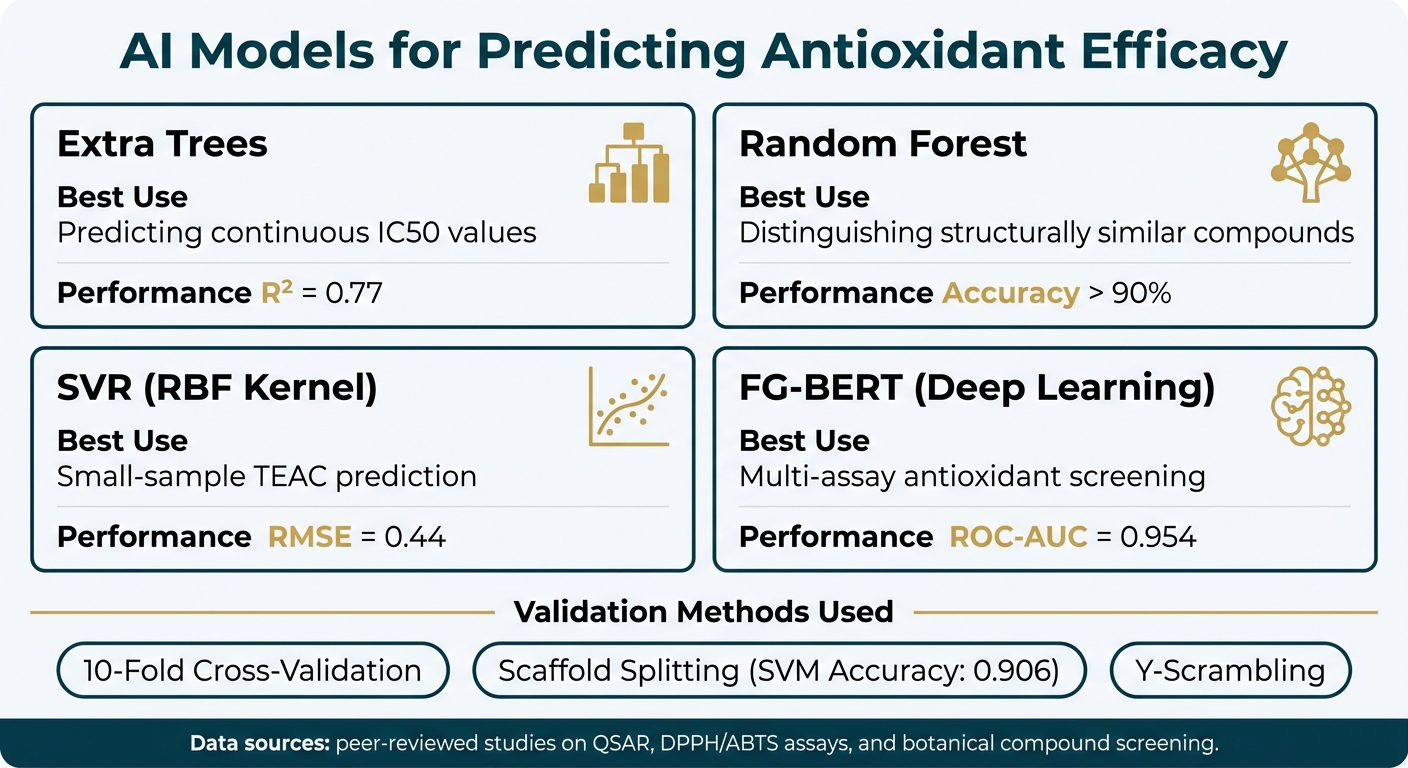
AI Models for Predicting Antioxidant Efficacy: Performance Comparison
AI techniques are transforming how researchers predict antioxidant efficacy, addressing formulation challenges by using detailed molecular data for predictive modeling. These methods provide a faster and more precise way to screen antioxidants, building on the need for efficient tools in this area.
Data Sources and Input Features
A reliable AI model starts with high-quality data. For antioxidant research, this includes molecular descriptors (such as those generated by tools like Mordred or RDKit, often exceeding 1,800 descriptors per molecule) and chemical fingerprints like ECFP-4, which capture essential molecular substructures. Researchers also factor in formulation variables like surfactant-to-cosurfactant ratios and rheological properties. Experimental results from in vitro assays, such as DPPH and ABTS radical scavenging tests, are used as target values for the model to predict [4][2][16].
Certain molecular features consistently stand out in predictive models. For example, the count of aromatic hydroxyl groups (Fr_Ar_OH) has been identified as a key descriptor in a QSAR model analyzing 3,133 antioxidant compounds [15]. Other influential factors include molecular surface area and electronic charge distribution, which contribute significantly to predicting radical scavenging activity [14][15].
AI Models in Use
Several AI models excel at predicting antioxidant efficacy. Ensemble tree-based models, such as Extra Trees, Gradient Boosting, and XGBoost, are widely used for regression tasks like predicting IC50 values – the concentration needed to inhibit a reaction by 50%. These models effectively handle the complex, non-linear relationships between molecular structure and biological activity, outperforming simpler linear methods, which often max out at an R² of 0.31 [4].
For smaller datasets, Support Vector Regression (SVR) with an RBF kernel is a strong choice. In one study of 75 phenolic compounds, an SVR model achieved a cross-validation RMSE of 0.44 when predicting Trolox-equivalent antioxidant capacity (TEAC), a standardized measure of antioxidant strength [14]. For more complex tasks, like screening across multiple assays, deep learning frameworks such as FG-BERT (a BERT-based model tailored for functional group recognition) have shown impressive results, with an average ROC-AUC of 0.954 across eight different in vitro antioxidant assays [3].
Here’s how some of these models perform in specific applications:
| Model Type | Best Use Case | Key Performance |
|---|---|---|
| Extra Trees | Predicting continuous IC50 values | R² = 0.77 [4] |
| Random Forest | Distinguishing structurally similar compounds | Accuracy > 0.90 [1] |
| SVR (RBF Kernel) | Small-sample TEAC prediction | RMSE = 0.44 [14] |
| FG-BERT (Deep Learning) | Multi-assay antioxidant screening | ROC-AUC = 0.954 [3] |
Model Accuracy and Validation
Accurate predictions require thorough validation to ensure models perform well with novel compounds. Researchers typically use internal cross-validation, such as 10-fold cross-validation, where the dataset is split into 10 subsets and tested iteratively, and external validation using independent compound databases [1][4].
A particularly rigorous test is scaffold splitting, which checks whether a model can predict the activity of compounds with entirely new chemical backbones – structures it hasn’t encountered during training. This is crucial for anti-aging formulations, where the focus is often on discovering new active ingredients rather than confirming known ones. In one study, SVM models achieved an accuracy of 0.906 on scaffold-split datasets, demonstrating their ability to generalize beyond the training set [1].
Other validation techniques include Y-scrambling, where target values are shuffled to confirm the model’s predictive validity [3]. Additionally, the Applicability Domain (AD) defines the structural boundaries where predictions are reliable. This is often visualized using a Williams plot, helping flag uncertain predictions for compounds outside the domain [4][14].
Disclaimer: This content is for informational purposes only. Consult official regulations and qualified professionals before making sourcing or formulation decisions.
Case Studies: AI in Antioxidant Research
AI-driven predictive models are solving real-world challenges in antioxidant formulation. Let’s look at three specific ways AI is reshaping this field.
Predicting Multi-Antioxidant Stability in Liposomes
One of the toughest hurdles in cosmetic formulation is ensuring antioxidant stability within liposomes – tiny lipid-based carriers designed to deliver active ingredients into the skin. If antioxidants and encapsulants are not well-matched, the result can be leakage, degradation, or reduced effectiveness.
In September 2024, researchers at the Universidad de los Andes addressed this issue using a K-Nearest Neighbor (KNN) algorithm. Their goal was to evaluate the compatibility of peach polyphenols with sodium alginate matrices. The model achieved an impressive accuracy of 0.92, with perfect specificity (1.0) [18]. Juliana Quintana-Rojas, one of the researchers, explained:
"Compatibility between the active and encapsulant compounds (WM) is crucial in encapsulation… suitable matches are complex, requiring costly and time-consuming trial-and-error experiments." [18]
Building on this work, a January 2026 study in the Journal of Drug Delivery Science and Technology used computational tools – pkCSM and SwissDock – to enhance a resveratrol-loaded liposomal system. The optimized liposomes, measuring 120 nm, stayed stable for six months at 39°F (4°C). They also delivered a 60% boost in antioxidant activity and a 45% improvement in antimicrobial action against Staphylococcus aureus [19]. Eon-Bee Lee from Konyang University highlighted the significance:
"The integration of computational predictions and experimental validation established a robust liposomal platform with improved therapeutic potential for resveratrol." [19]
AI is also making strides in the search for plant-based antioxidants.
Machine Learning for Botanical Antioxidants
Machine learning is speeding up the discovery of plant-derived antioxidants, making it more precise and efficient.
In November 2024, researchers led by Jinwoo Jung at Pusan National University applied Random Forest (RF) and Support Vector Machine (SVM) models to screen the BATMAN database, which contains 1,708 compounds from 8,404 medicinal plants. The RF model achieved an accuracy of 0.908 and an AUROC of 0.968. It identified well-known antioxidants like Quercetin hydrate and Cyanidin chloride, while also uncovering lesser-known candidates such as ellagic acid dihydrate and strictinin for further study [1].
In June 2025, Professor Jun Wu’s team at The Hong Kong University of Science and Technology took this further with a two-stage BERT-based deep learning framework. Screening 2,882 natural herbal compounds, their method improved accuracy by 20% compared to traditional models. Among the compounds identified, three were incorporated into liposomes and successfully reduced oxidative stress in in vivo trials [5]. Professor Wu emphasized:
"Our findings highlight the potential of integrating deep learning-based compound screening with an engineered liposomal delivery platform in the research of oxidative stress and aging." [5]
These breakthroughs are fast-tracking the development of advanced anti-aging antioxidants.
Spectroscopy and Stability Monitoring
AI isn’t just transforming formulation design – it’s also revolutionizing quality control by monitoring the stability of antioxidants over time. Knowing an antioxidant works at the start of a product’s shelf life is one thing, but ensuring its longevity is an entirely different challenge.
In February 2026, Charaf Ed-dine Kassimi and Lahcen Hssaini from the National Institute of Agricultural Research (INRA) developed a high-throughput screening approach for fig seed oil. They paired mid-FTIR spectroscopy (a technique that uses infrared light absorption to identify chemical compounds) with a Multilayer Perceptron (MLP) neural network. Testing 222 samples, the model achieved blind test R² values above 0.85 in predicting DPPH and ABTS antioxidant activities [20]. This method offers a non-destructive way to track antioxidant levels and detect early degradation, reducing reliance on traditional wet chemistry assays.
| AI Approach | Antioxidant Application | Key Result |
|---|---|---|
| KNN Compatibility Model | Polyphenol/alginate encapsulation | 0.92 accuracy [18] |
| BERT-based Framework | Herbal compound library screening | 20% accuracy improvement [5] |
| MLP + mid-FTIR Spectroscopy | Fig seed oil antioxidant activity | R² > 0.85 [20] |
| pkCSM + SwissDock | Resveratrol liposome optimization | 60% increase in antioxidant activity [19] |
Disclaimer: This content is for informational purposes only. Consult official regulations and qualified professionals before making sourcing or formulation decisions.
Practical Impact and Future Directions
AI Applications in Anti-Aging Formulations
AI is no longer confined to academic research – it’s actively shaping product development in the anti-aging sector. From ingredient discovery to formulation optimization and safety screening, AI is transforming how formulations are created.
Take ingredient discovery, for example. Virtual screening tools now allow formulators to analyze thousands of antioxidant candidates in silico. By predicting molecular activity based on chemical structures, these tools eliminate the need for early-stage lab assays, cutting both time and costs. Once promising ingredients are identified, AI fine-tunes their ratios, ensuring maximum effectiveness while maintaining sensory qualities like texture and spreadability [16].
Safety screening is another area where AI shines. Tools like DeepTox 2.0 and ProTox-II can predict risks such as skin sensitization and neurotoxicity before any physical testing begins. For instance, AI-based QSAR (Quantitative Structure-Activity Relationship) models have achieved an accuracy of 87.7% in predicting neurotoxicity in cosmetic preservatives [16]. In a notable example of industry innovation, IBM and L’Oréal announced in January 2025 a collaboration to create an AI model focused on sustainable cosmetic formulations. This partnership highlights how AI is moving beyond theoretical applications into real-world advancements [22].
"The integration of AI into cosmetic formulation has also opened new avenues in ingredient discovery, formulation optimization, and consumer personalization." – Antonio Di Guardo, IDI-IRCCS [16]
Allan Chemical Corporation, with over 40 years of expertise in specialty chemicals, is actively supporting these AI-driven advancements in anti-aging formulations. These efforts are paving the way for addressing current hurdles and exploring uncharted territories in cosmetic science.
Limitations and Challenges
Despite its potential, AI in antioxidant research faces significant challenges.
One of the biggest hurdles is data quality. AI models, particularly those based on supervised learning, depend on large, well-labeled datasets. Producing these datasets can be both costly and complex. Moreover, inconsistencies in laboratory methods – such as variations in incubation times, temperatures, and solvent conditions during anti-collagenase and anti-elastase assays – can lead to unreliable training data [9].
Another issue is model generalizability. For instance, a Graph Convolutional Neural Network (GCNN) trained on 41,379 small molecules achieved an impressive R² of 0.99 for simpler compounds. However, its accuracy dropped to an R² of 0.81 when applied to more complex antioxidants like flavonoids. Expanding training datasets to include larger, more diverse molecules (up to 30 heavy atoms) has been shown to improve performance, boosting the R² back to 0.94 [21]. Additionally, regulatory agencies are increasingly demanding AI tools to be both explainable and auditable, adding another layer of complexity to their adoption.
Addressing these challenges is essential to unlocking the full potential of AI in formulation science.
Future Research Directions
AI’s next chapter in antioxidant science will likely focus on multi-modal data integration. This approach combines chemical structure data with other inputs like spectroscopic readings, proteomic profiles, and microbiome signatures to create more comprehensive predictive models [16][22]. Such advancements could help researchers move beyond analyzing individual molecules to predicting how entire formulations behave over time.
Personalized skincare is another exciting area. For instance, Support Vector Regression (SVR) models are being developed to estimate biological skin age using proteomic data. These tools could allow brands to create antioxidant formulations tailored to individual aging profiles [25]. But perhaps the boldest shift lies in "discovery by design." Instead of relying on chance to find effective molecules, AI could reverse-engineer new compounds by starting with a desired biological outcome. As Joshua Britton, Ph.D., CEO of Debut, put it:
"Beauty is entering the same transformation pharmaceuticals did in 1976… from discovery by chance to discovery by design." [24]
Currently, traditional R&D taps into just 0.001% of the possible chemical universe. AI-driven design aims to unlock the remaining 99.999%, opening up a world of possibilities for innovation [24].
Disclaimer: This content is for informational purposes only. Consult official regulations and qualified professionals before making sourcing or formulation decisions.
Conclusion
AI has reshaped how antioxidant efficacy is assessed. Processes that once demanded extensive laboratory work – like conducting DPPH and ABTS assays on hundreds of compounds – can now be executed digitally with impressive predictive accuracy. This evolution from simple binary screening to regression-based predictions equips formulators with deeper insights, revealing not just whether a compound is effective, but how effective it is and at what concentration.
Recent developments underscore AI’s growing influence. For example, in May 2026, researchers used the ESM-2 protein language model to uncover nine new antioxidant peptides from yak bone collagen hydrolysates, later confirmed through in vitro testing [17]. Similarly, a February 2026 patent by ELC Management LLC introduced a system that employs generative AI to design complete cosmetic formulations and simulate their effects on a 3D virtual face [23]. These advancements not only validate AI’s capabilities but also set higher benchmarks for the industry.
Such innovations are streamlining the path from discovery to formulation. Multitask BERT models, for instance, can predict antioxidant activity across eight assay types with an average ROC-AUC of 0.954 [3]. This provides product developers with a comprehensive view of ingredient performance long before physical testing begins.
However, turning AI predictions into tangible products requires reliable ingredient sourcing. Allan Chemical Corporation (https://allanchem.com), with over 40 years of expertise, offers high-quality antioxidant-grade raw materials, bridging the gap between AI-driven insights and real-world formulations.
Disclaimer: This content is for informational purposes only. Consult official regulations and qualified professionals before making sourcing or formulation decisions.
FAQs
How reliable are AI-predicted IC50 values compared to lab tests?
AI-predicted pIC50 values demonstrate impressive reliability, often matching experimental outcomes closely. For example, studies employing Quantitative Structure-Activity Relationship (QSAR) models report R-squared values as high as 0.78 on external test sets, with some achieving 0.99 for certain compound classes. These models serve as a valuable addition to traditional assays, which can sometimes be both time-consuming and subject to variability. Allan Chemical Corporation supplies premium-grade chemicals that aid in the development and validation of these predictive tools across the cosmetics and pharmaceutical industries.
What data do AI models need to predict antioxidant efficacy?
AI models rely on structural and physicochemical data to predict how effective compounds are as antioxidants. For small molecules, this involves examining molecular descriptors or specific structural fragments derived from their chemical structures. When it comes to peptides, the process involves converting amino acid sequences into feature matrices that capture properties such as hydrophobicity, charge, and steric effects. These datasets are then paired with experimental data on antioxidant activity for accurate predictions. Allan Chemical Corporation offers premium chemical solutions to aid research in this area.
How does AI help stabilize antioxidants in skincare formulas?
AI improves antioxidant stability by fine-tuning formulations and enabling real-time performance monitoring. Through machine learning, it identifies the best lipid combinations, concentrations, and co-encapsulation conditions to protect antioxidants from breaking down. Additionally, AI-powered packaging sensors deliver ongoing stability updates, allowing early detection of potential problems. Allan Chemical Corporation contributes to these innovations by offering high-grade chemical ingredients, helping companies lower development costs and accelerate the launch of effective anti-aging products.




Comments are closed