
Surfactants are amphiphilic molecules with both hydrophilic and hydrophobic regions, widely used in ceramic manufacturing to control porosity. For example, Sodium Dodecyl Sulfate (SDS) (CAS No. 151-21-3) stabilizes foams for alumina ceramics, while Triton X-100 minimizes additive interference in slurries. Surfactants reduce interfacial energy, preventing bubble collapse, though some applications require anti-foaming agents to manage excess air during ceramic processing, which directly impacts pore size, distribution, and connectivity.
The microstructure of ceramics determines their performance:
- Structural ceramics need minimal pores for strength.
- Functional ceramics rely on engineered porosity for insulation, filtration, or catalyst support.
Surfactants can achieve porosities ranging from 40% to 97%, with pore sizes between 35 μm and 1.2 mm. Their concentration, chain length, and type (anionic, cationic, non-ionic, or protein-based) are adjusted to meet specific ceramic applications.
For open-cell ceramics (e.g., filters), higher surfactant levels promote interconnected pores. For closed-cell ceramics (e.g., insulators), lower concentrations maintain bubble separation. Manufacturers optimize formulations by testing foam stability, slurry viscosity, and surfactant ratios to produce consistent results.
Ceramic Processing L4-04 Surfactant as dispersant
sbb-itb-aa4586a
Selecting the Right Surfactant for Your Ceramic Application
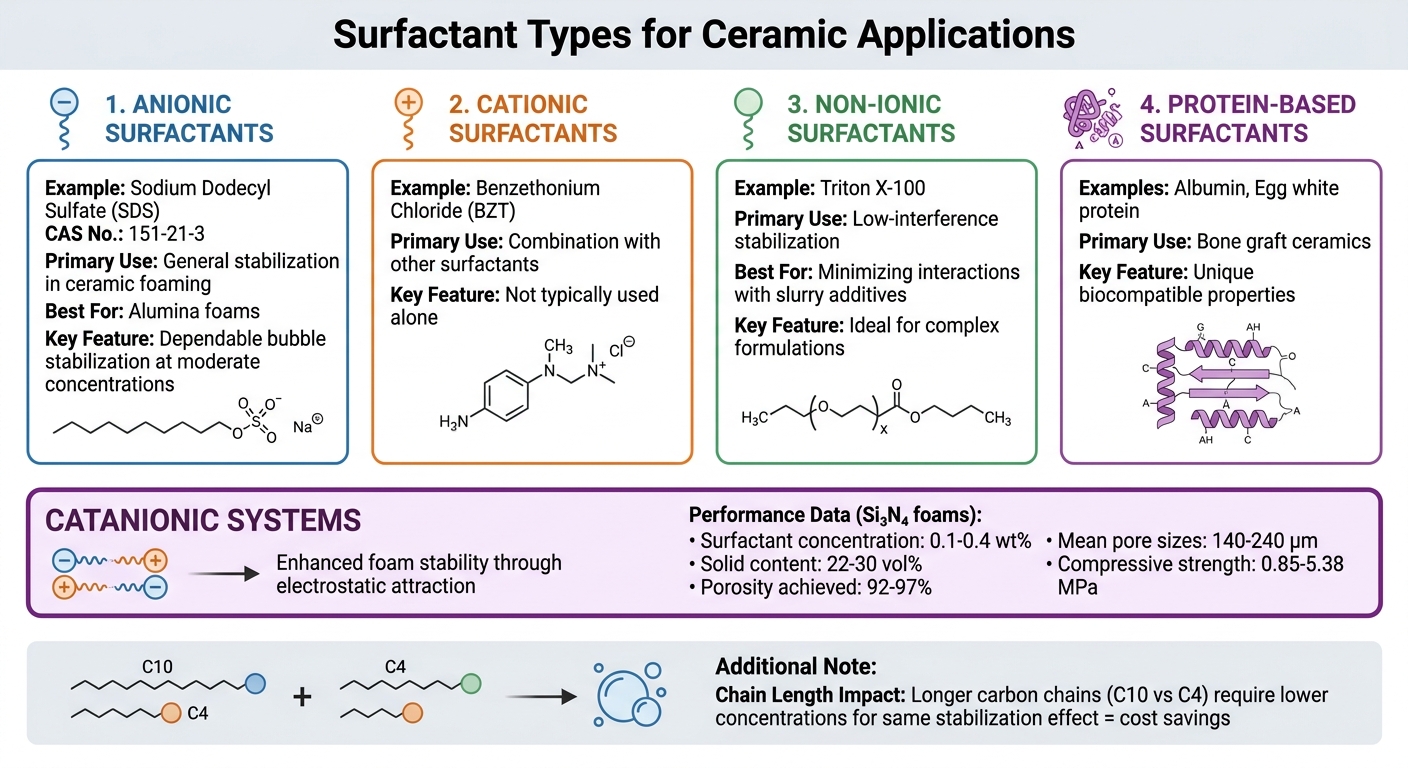
Surfactant Types and Properties for Ceramic Manufacturing
Choosing the correct surfactant is essential for achieving desired ceramic properties, as it directly influences pore size, distribution, and mechanical strength. Proper selection can also help streamline production and reduce costs.
Types of Surfactants and Their Properties
Understanding the different types of surfactants is key to aligning your formulation with specific microstructural goals.
- Anionic surfactants: Sodium dodecyl sulfate (SDS) is widely used for general stabilization in ceramic foaming. It performs well with alumina foams, offering dependable bubble stabilization at moderate concentrations.
- Cationic surfactants: Benzethonium chloride (BZT) is often used in combination with other surfactants rather than on its own.
- Non-ionic surfactants: Triton X-100 provides low-interference stabilization, making it ideal for minimizing interactions with other slurry additives.
- Protein-based surfactants: Albumin and egg white protein are commonly used in bone graft ceramics due to their unique properties.
Mixing surfactants with opposite charges can create catanionic systems, which offer enhanced foam stability. For example, researchers at the Shanghai Institute of Ceramics demonstrated this technique with Si₃N₄ ceramic foams. By adjusting surfactant concentrations between 0.1 and 0.4 wt% and solid content between 22 and 30 vol%, they achieved porosities of 92%-97% with mean pore sizes of 140-240 µm and compressive strengths ranging from 0.85 to 5.38 MPa [1].
As Zhongpei Du explained, "The oppositely charged surfactants mixed in slurries could combined into catanionic surfactant by the electrostatic attraction and facilitate the formation of ultra-stable foams" [1].
The hydrophobic chain length of a surfactant also plays a significant role. Surfactants with longer carbon chains (e.g., C10 versus C4) require lower concentrations to achieve the same stabilization effects, allowing for cost savings while maintaining control over the microstructure [3].
Testing Surfactant Performance
To evaluate surfactant performance, focus on two critical factors: foam volume and foam stability. These indicators reveal how well a surfactant performs under specific conditions [2].
Another important test is contact angle measurement, which assesses how the surfactant modifies particle wettability at the solid/liquid/gas interface [2][3]. This test helps determine whether particles will adsorb at bubble surfaces to create particle-stabilized foams. Such foams can remain stable for days, unlike ordinary surfactant-stabilized foams that often collapse within an hour [2].
Additionally, test the surfactant’s compatibility with your specific ceramic processing conditions. This includes factors like pH levels, mixing and setting temperatures, and interactions with gelling agents or binders. Small-scale trials with varying surfactant concentrations can help identify the point at which pore structures transition from closed to open cells [3].
Matching Surfactants to Target Microstructures
Once foam stability and wettability tests are complete, fine-tune the surfactant-to-solid ratio to achieve your desired pore characteristics. For high porosity (above 90%), catanionic mixtures are ideal due to their superior foam stability [1]. For moderate porosity (40%-70%), single anionic or non-ionic surfactants are often sufficient.
Control over pore size and total porosity depends heavily on the ratio of surfactant to solid content in the slurry [1]. For larger pores (above 500 µm), decrease the solid loading while maintaining constant surfactant levels. To create smaller, more uniform pores (35-200 µm), increase the solid content and carefully adjust the surfactant concentration just below the threshold for open-cell formation.
For closed-cell structures used in insulation, keep surfactant concentrations on the lower end of the effective range. On the other hand, open-cell structures for filtration or catalyst supports require higher surfactant concentrations to encourage particle aggregation and interconnected pore windows [3].
As Chayuda Chuanuwatanakul noted, "The morphology of gelled ceramic foams changes from closed cell (bubble like morphology) to open cell (granular morphology) as the surfactant concentration is increased beyond a critical level" [3].
When sourcing surfactants, it’s important to work with suppliers experienced in technical-grade materials. This ensures consistent quality and proper documentation. Allan Chemical Corporation offers a range of surfactants for ceramic processing and provides certificates of analysis, along with technical support for formulation inquiries.
This content is for informational purposes only. Consult official regulations and qualified professionals before making sourcing or formulation decisions.
How to Control Ceramic Porosity with Surfactants
To achieve the desired ceramic microstructure, carefully apply surfactants and adjust key variables like foam stability, slurry properties, and processing parameters. Even small changes can significantly alter porosity, ranging from 40% to as high as 97%.
Adjusting Foam Stability for Uniform Pores
Foam stability plays a crucial role in maintaining the pore structure until the slurry sets. Surfactants stabilize foams by adsorbing at the gas/liquid interface, reducing interfacial energy and slowing down bubble merging [2]. Striking the right balance is essential – insufficient stability causes the foam to collapse prematurely, while excessive stability makes it difficult to control pore size.
Mechanical agitation is a primary tool for managing foam stability. Higher stirring speeds generally result in smaller, more uniform pores, while lower speeds produce larger, less consistent ones [2]. Monitoring foam volume and stability during mixing ensures consistent results across batches.
For extended foam stability, catanionic systems are highly effective, creating foams that resist drainage and coalescence over time [1]. In contrast, foams stabilized by single long-chain surfactants may collapse within minutes, while particle-stabilized foams can last for days or even weeks [2].
Since surfactant-stabilized foams are thermodynamically unstable, it’s important to consolidate the structure quickly. Techniques like gelcasting or using a setting agent help lock the pore structure in place before coalescence occurs [2][3].
Once foam stability is under control, the next focus is optimizing the slurry’s properties to enhance the ceramic’s mechanical performance.
Optimizing Slurry Properties
The solid content and viscosity of the slurry directly influence both porosity and mechanical strength. For ceramics with porosities above 90%, maintain a solid content between 22 and 30 vol% [1]. Increasing the solid content within this range can improve compressive strength without significantly reducing porosity. For example, Si₃N₄ foams made with 22–30 vol% solids achieved compressive strengths ranging from 0.85 to 5.38 MPa while maintaining porosities of 92–97% [1].
Viscosity must also be carefully managed. A slurry that’s too thick won’t support foam formation, while one that’s too thin will lead to rapid foam drainage. Rheometry can guide adjustments in solid loading or dispersant levels, ensuring the slurry flows well during mixing but retains its structure after foaming.
Higher surfactant levels encourage particle aggregation, which shifts the structure toward open-cell configurations [3]. Monitoring aggregate size is a better predictor of morphological changes than contact angle measurements. For closed-cell structures, minimize aggregation; for open-cell applications, increase surfactant concentration to encourage larger aggregates.
Key Parameters for Microstructure Control
After addressing foam stability and slurry composition, three key factors determine the final microstructure: surfactant concentration, mixing ratio (especially in catanionic systems), and processing temperature. Start by defining your target porosity, then adjust these parameters accordingly.
- Surfactant Concentration: For Si₃N₄ foams, concentrations between 0.1 and 0.4 wt% yield porosities of 92–97%, with mean pore sizes between 140 and 240 µm [1]. Below 0.1 wt%, foam stability drops significantly, while concentrations above 0.4 wt% can cause unwanted structural changes. Small-scale trials in 0.05 wt% increments can help identify the optimal concentration.
- Hydrophobic Chain Length: Surfactants with a 10-carbon hydrophobic chain stabilize foams at lower concentrations compared to those with shorter chains, potentially reducing material costs. Adjust concentration targets when switching surfactant types [3].
- Temperature: Temperature affects both foam stability and slurry behavior. Higher temperatures speed up the setting process but may reduce foam stability. Most ceramic foaming processes perform best between 68°F and 86°F (20°C to 30°C).
For open-cell structures used in filtration or catalyst supports, increase surfactant concentration to encourage particle segregation at the foam’s plateau borders [2]. For closed-cell structures, ideal for insulation, maintain surfactant levels just below the threshold that triggers structural transitions, ensuring uniform particle distribution around gas bubbles.
When sourcing surfactants, select suppliers offering consistent technical-grade materials and thorough documentation. Allan Chemical Corporation provides surfactants tailored for ceramic applications, along with certificates of analysis and technical support for formulation guidance.
This content is for informational purposes only. Always consult official regulations and qualified professionals before making sourcing or formulation decisions.
Fixing Common Ceramic Microstructure Defects
Problems in ceramic foam production often stem from surfactant imbalances, which can disrupt the pore structure. Quickly identifying these issues and making adjustments can prevent production losses.
Identifying Defects and Their Causes
Unintended morphology transitions are a common issue. When surfactant levels surpass a critical point, the foam’s structure can shift from a closed-cell, "bubble-like" form to an open-cell, "granular" one due to particle aggregation [3].
Irregular pore distribution is another red flag. This occurs when surfactant mixing ratios or concentrations are off, leading to uneven pore sizes. Such inconsistencies weaken the ceramic’s mechanical strength and create unpredictable weak spots. This often happens when foam stability fluctuates during mixing, causing some bubbles to merge while others remain intact.
Foam instability can result in weak, oversized pores or even complete foam collapse before the structure sets. This typically occurs when the surfactant is either insufficient or poorly matched electrostatically, preventing proper stabilization of the gas–liquid interface.
During production, monitoring suspension viscosity is crucial. A sudden increase often indicates particle aggregation and the risk of a granular morphology shift. Aggregate size analysis is more reliable than contact angle measurements for predicting these changes [3].
| Defect | Root Cause | Identification Method |
|---|---|---|
| Granular Morphology | Excess surfactant concentration; particle aggregation | Suspension viscosity measurement; aggregate size analysis |
| Low Compressive Strength | Incorrect surfactant ratio or solid content below 22 vol% | Mechanical testing; porosity analysis |
| Large/Uneven Pores | Foam instability; poor surfactant adsorption | Foam stability testing; contact angle measurement |
| Closed-to-Open Cell Shift | Excess surfactant chain length or concentration | Microscopic imaging of green bodies; density checks |
Once the issue is identified, you can adjust the formulation using the corrective measures below.
Corrective Steps for Better Porosity Control
If pore distribution is uneven, switch to a catanionic surfactant system. This involves using oppositely charged surfactants, which create more stable foams by preventing bubbles from merging or disproportionating [1].
For structural weaknesses like thin or cracked cell walls, raise the solid content in your slurry to 22–30 vol%. This increase strengthens the structural struts without significantly affecting porosity. Additionally, applying a ceramic coating post-production with fine powders like AKP-30 or ALM-44 can repair microscopic cracks and improve compressive strength [2].
If viscosity issues arise, consider these adjustments:
- To reduce high viscosity, add linear-chain alcohols (C₂–C₅), which promote lamellar-to-micellar transitions [4].
- For slurries that are too thin, add short-chain polyols. These increase viscosity through hydrogen bonding, stabilizing the structure at room temperature.
- To prevent crystallization and improve flow, use propylene glycol. It also creates lubrication layers near equipment walls, reducing uneven flow [4].
When changing surfactant types, keep in mind that longer chain lengths alter the critical concentration needed to maintain the desired microstructure. Adjust formulations accordingly.
After making these corrections, ongoing quality control is essential to ensure the microstructure remains consistent.
Monitoring and Quality Control During Production
Effective quality control involves understanding the four main foam destabilization mechanisms: drainage (creaming), coalescence (film rupture), Ostwald ripening (disproportionation), and sedimentation [2].
Key monitoring steps include:
- Tracking suspension viscosity, aggregate size, and drainage time to catch early signs of foam destabilization.
- Establishing baseline values for your target microstructure and flagging deviations for immediate adjustments.
- Maintaining a critical surfactant checkpoint to avoid morphology shifts. Exceeding this threshold can cause a transition from closed-cell to granular open-cell structures [3].
For particle-stabilized foams, ensure the contact angle stays below 90° by adjusting short-chain amphiphile concentrations, such as valeric acid. This helps particles remain partially hydrophobic, allowing proper adsorption at the air–water interface [2].
Post-sintering quality control should include microscopic imaging to check for cracks in cell struts. If defects are detected, recoat the green body with a thinner slurry of the same composition before the final sintering step. This process increases strut thickness and helps repair cracks, which is especially critical for replica methods where pyrolysis can damage struts [2].
Allan Chemical Corporation offers technical-grade surfactants with detailed documentation and certificates of analysis to support consistent quality control in ceramic production. Their technical support team is available to guide formulation adjustments when defects occur.
This content is for informational purposes only. Always consult official regulations and qualified professionals before making any sourcing or formulation decisions.
Conclusion
Key Takeaways
This article has highlighted how careful surfactant management can directly influence the microstructure of ceramic materials. Critical factors include the surfactant mixing ratio, concentration levels, and the solid content within the slurry. Research on silicon nitride (Si₃N₄) ceramic foams demonstrates that using 0.1–0.4 wt% mixed surfactants results in porosities between 92% and 97%, with average pore sizes ranging from 140 to 240 µm. Compressive strengths vary from 0.85 to 5.38 MPa, improving as the slurry solid content increases from 22 to 30 vol% [1].
One standout approach involves catanionic surfactant systems, created by blending oppositely charged surfactants.
Researchers from the State Key Laboratory of High Performance Ceramics observed, "The oppositely charged surfactants mixed in slurries could combined into catanionic surfactant by the electrostatic attraction and facilitate the formation of ultra-stable foams" [1].
This electrostatic interaction enhances foam stability, allowing it to endure both drying and sintering processes.
Understanding transitions in foam morphology is equally important for maintaining product quality.
As George V. Franks from the University of Melbourne points out, "The morphology of gelled ceramic foams changes from closed cell (bubble like morphology) to open cell (granular morphology) as the surfactant concentration is increased beyond a critical level" [3].
By monitoring suspension viscosity and particle aggregation, manufacturers can anticipate these shifts and adjust processes accordingly to preserve the desired microstructure.
Next Steps for Ceramic Manufacturers
To take advantage of surfactant control in ceramic production, consider these practical steps. Transition from single-surfactant systems to catanionic mixtures, starting with low concentrations (around 0.1 wt%) and gradually increasing to determine the optimal balance for stabilizing pore size without affecting slurry flow. Adjust slurry solid content based on whether the focus is on achieving higher porosity or greater compressive strength.
When experimenting with surfactant types, keep in mind that longer hydrophobic chains (e.g., 10 carbon atoms versus 4) require lower concentrations to maintain foam stability [3]. Regularly track indicators like suspension viscosity and aggregate size to ensure consistent results. Allan Chemical Corporation offers technical-grade surfactants along with detailed documentation and expert support to help manufacturers troubleshoot issues and refine their formulations.
This content is intended for informational use only. Always consult official guidelines and qualified experts before making sourcing or formulation changes.
FAQs
How do I choose a surfactant for open-cell vs closed-cell ceramics?
Selecting the right surfactant plays a key role in achieving the desired ceramic microstructure. For open-cell ceramics, opt for surfactants that can stabilize wet foam while minimizing changes during drying and sintering. This helps maintain the open, interconnected pore structure. On the other hand, for closed-cell ceramics, use surfactants that promote stable, isolated bubbles with precise control over pore size and connectivity. Pay attention to factors like adsorption energy and the ability to stabilize the bubble interface to fine-tune porosity and structure effectively.
What tests should I run to confirm foam stability before scaling up?
To ensure foam stability before scaling up production, it’s important to test how well it maintains its structure over time. This involves a few key evaluations: visually observing the foam, measuring its drainage rate, and determining its lifespan. Additionally, controlled experiments to examine pore size distribution and porosity are crucial. These steps help confirm that the foam’s microstructure stays intact, which is essential for achieving consistent results during production.
How can I prevent a sudden shift from closed-cell to granular morphology?
To keep the foam structure stable and avoid an abrupt change from closed-cell to granular morphology, it’s crucial to stabilize the foam during processing. Surfactants play a key role here by maintaining uniform bubble size and preventing them from merging. Those that promote in situ hydrophobization are particularly effective, as they resist coarsening and Ostwald ripening, helping to preserve the microstructure. Additionally, choosing surfactants that fine-tune the contact angle and particle interactions can further enhance foam stability and reduce the risk of unwanted changes.




Comments are closed