
Silane-siloxane coatings are advanced waterproofing solutions designed to protect concrete from water damage. They work by penetrating the concrete’s pores and chemically bonding to its structure, forming a water-repellent barrier while allowing the material to release moisture. This makes them highly effective for below-grade structures like basements and foundations, which are constantly exposed to groundwater and soil moisture.
Key Benefits:
- Deep Penetration: Silanes reach deep into dense concrete, providing internal protection.
- Surface Protection: Siloxanes create a water-repellent layer on porous surfaces.
- Dual Action: Blends of silane and siloxane combine these strengths for versatile application.
- Durability: Long-lasting protection against water ingress, freeze-thaw cycles, and chloride-induced corrosion.
- Breathability: Prevents moisture entrapment, reducing risks like spalling.
Research Insights:
- Corrosion Resistance: Treated concrete doubles the lifespan of reinforcement steel.
- Water Absorption: Capillary water absorption can be reduced by over 70%.
- Damp Surface Application: Newer formulations improve adhesion and reduce volatility on moist substrates.
- VOC Compliance: Water-borne emulsions meet regulations while maintaining performance.
Silane-siloxane coatings are tailored for specific substrates. Dense concrete benefits from 100% silane, while porous materials perform better with silane-siloxane blends. For below-grade waterproofing, these coatings provide reliable, long-term protection when applied under the right conditions.
Research on Hydrophobic Performance
Water Intrusion Prevention and Durability
Recent studies have reinforced the ability of hydrophobic treatments to protect against water intrusion, particularly in below-grade environments. Research on double silane gels – combinations of isobutyl triethoxy silane and tetraethyl orthosilicate – has provided valuable long-term data. Findings revealed that reinforcement bars in treated concrete experienced over twice the corrosion resistance compared to untreated samples[2]. Field studies have also demonstrated that surface coating repairs can maintain their effectiveness for up to 20 years under specific conditions[2]. As highlighted in the Journal of Materials Science, "The application of surface treatment methodologies presents a practical, efficient, and user-friendly strategy to significantly augment the durability of [cementitious] materials"[1]. For most below-grade applications, these treatments are expected to last up to 10 years, although actual results depend on environmental factors. Building on these findings, recent research has shifted focus to performance on damp substrates.
Application on Damp Surfaces
The moisture content of a substrate plays a critical role in the effectiveness of hydrophobic treatments. Traditional silane-based materials often face challenges such as high volatility and poor adhesion when applied to damp surfaces[2]. However, newer gel formulations developed through sol–gel synthesis have addressed these issues, offering better adhesion and reduced volatility on substrates that are not completely dry[2]. According to the Journal of Coatings Technology and Research, "Inhibiting moisture transfer at the surface of concrete plays a vital role on the durability of concrete, and permeable protective coating can effectively resist the intrusion of external moisture"[2]. These advanced treatments work by modifying the internal pore structure of the cementitious material to repel water, rather than forming a continuous surface film. However, the moisture level during application still affects the depth of penetration and the resulting water-repellent properties.
Solvent-Borne vs. Water-Borne Formulations
Stricter VOC regulations have driven a shift from solvent-borne to water-borne silane-siloxane formulations. While solvent-borne options traditionally offered deeper penetration, they now face regulatory challenges. Water-borne emulsions, on the other hand, provide similar chloride resistance and waterproofing capabilities while adhering to modern environmental standards[1]. Research shows that water-borne systems perform particularly well on mortar and concrete, especially when applied to damp surfaces where solvent-based formulations might falter[1]. The trade-off lies in balancing penetration depth with compliance, but advancements in water-borne technology continue to narrow the performance gap.
This content is for informational purposes only. Consult official regulations and qualified professionals before making sourcing or formulation decisions.
sbb-itb-aa4586a
How does a silane siloxane sealer work?
Silane, Siloxane, and Silane-Siloxane Blends Compared
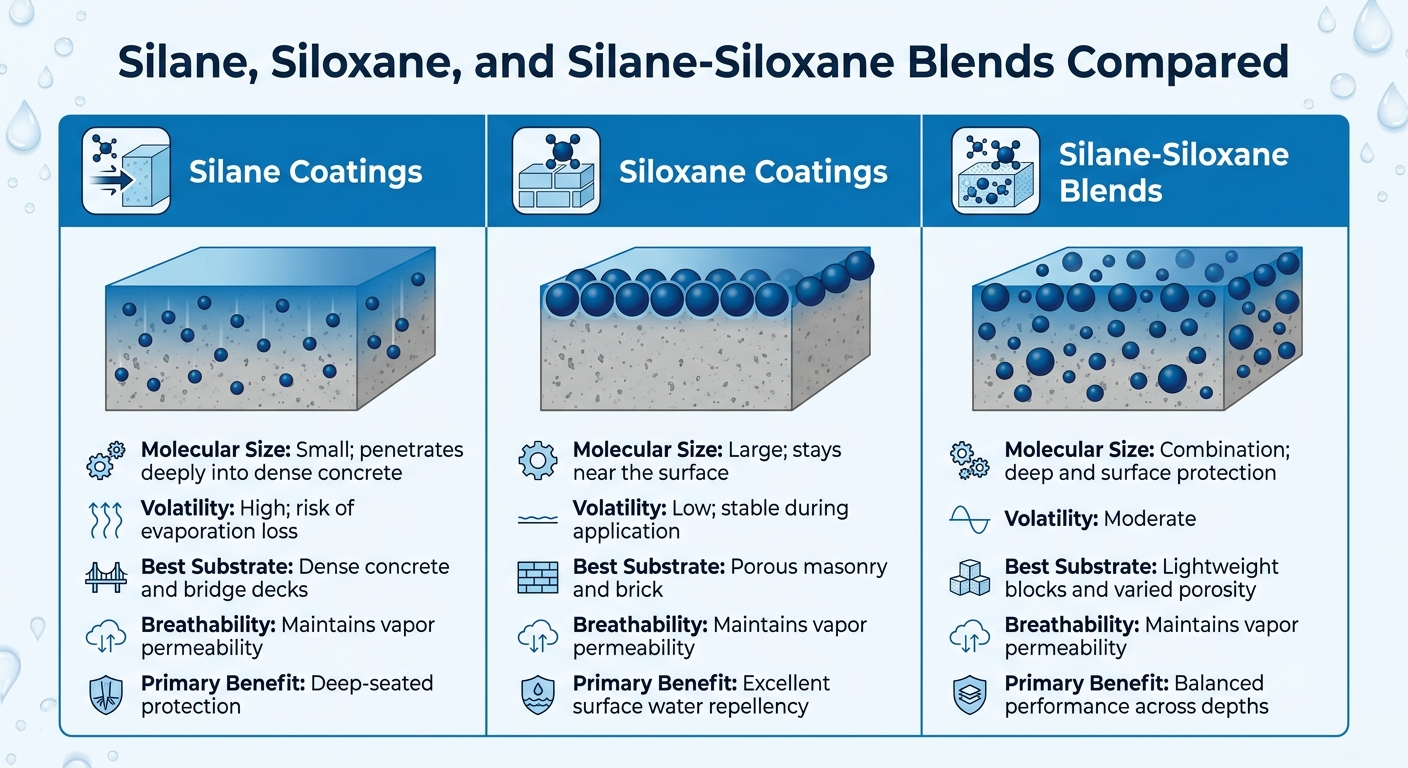
Silane vs Siloxane vs Silane-Siloxane Blend Coating Comparison
This section highlights the distinct characteristics and performance of silane, siloxane, and their blended formulations, based on their molecular properties and application suitability.
Performance Metrics
The effectiveness of silane, siloxane, and silane-siloxane blends largely hinges on molecular size, which influences how deeply they penetrate into substrates. Silanes, with their smaller molecular size, penetrate deeply into dense materials like high-strength concrete. This makes them ideal for applications requiring subsurface protection, such as bridge decks. However, their high volatility can lead to evaporation losses during application.
Siloxanes, on the other hand, have larger molecules that stay closer to the surface. This makes them excellent for providing water repellency on porous materials like masonry and brick, where surface sealing is the main goal. Their lower volatility ensures better stability during application.
Silane-siloxane blends combine the strengths of both. These blends deliver deep penetration from silanes and surface-level water repellency from siloxanes, making them suitable for substrates with varied porosity, such as lightweight blocks or weathered surfaces. Importantly, all three types maintain vapor permeability, allowing moisture to escape while preventing water intrusion.
Comparison Table
| Metric | Silane Coatings | Siloxane Coatings | Silane-Siloxane Blends |
|---|---|---|---|
| Molecular Size | Small; penetrates deeply into dense concrete | Large; stays near the surface | Combination; deep and surface protection |
| Volatility | High; risk of evaporation loss | Low; stable during application | Moderate |
| Best Substrate | Dense concrete and bridge decks | Porous masonry and brick | Lightweight blocks and varied porosity |
| Breathability | Maintains vapor permeability | Maintains vapor permeability | Maintains vapor permeability |
| Primary Benefit | Deep-seated protection | Excellent surface water repellency | Balanced performance across depths |
This content is for informational purposes only. Always consult relevant regulations and qualified professionals before making decisions regarding sourcing or formulations.
Testing Standards and Field Results
Industry Testing Protocols
To assess the effectiveness of silane-siloxane treatments against water intrusion, standardized testing methods are employed. EN 1504-2 sets the guidelines for surface protection systems by measuring the penetration depth of silanization solutions. This involves fracturing a treated concrete cube and spraying water to reveal the non-wetted (bright) area, which shows how far the barrier has penetrated. Meanwhile, EN 1062-3 focuses on liquid water permeability, using capillary suction to determine the rate at which water passes through the coating.
The capillary water absorption test compares the weight of concrete samples before and after 24 hours of submersion, highlighting the material’s resistance to water uptake. Hydrophobicity is confirmed through Water Contact Angle (WCA) measurements, with effective treatments achieving angles exceeding 100°. Additionally, GB/T 50082, a standard for evaluating the long-term performance and durability of concrete, measures resistance to environmental stressors over time. These lab-based assessments are further validated by field studies.
Field Test Results
Field tests consistently support laboratory findings. A 2013 study published in the Journal of Construction and Building Materials examined the 20-year performance of reinforced concrete bridges treated with a 20% aqueous solution of alkyltrialkoxysilane. The study, conducted by Christodoulou, Goodier, Austin, Webb, and Glass, showed a 90% reduction in water absorption just one month after application. Even after 12 years, protection remained at 78%, and it was still at 70% after 18 years [3].
"The application of silanes significantly reduces the amount of water that permeates the concrete structure, which also limits the permeation of chlorides and reduces the risk of corrosion of concrete reinforcement elements." – Christodoulou et al. [3]
Field conditions, such as substrate moisture and environmental aging, can impact penetration depth and gradually wear down the hydrophobic layer. Despite this, treated surfaces have maintained high water contact angles (above 101°) even after prolonged exposure. For effective long-term protection, typical material consumption ranges between 600 g/m² and 1,000 g/m². These findings underscore the importance of silane-siloxane coatings in prolonging the durability of below-grade structures.
This content is for informational purposes only. Consult official regulations and qualified professionals before making sourcing or formulation decisions.
Applications, Limitations, and Sourcing
Best Practices for Below-Grade Waterproofing
When it comes to below-grade waterproofing, ensuring both effective protection and compatibility with the underlying material is key. Silane-siloxane coatings are particularly effective for standard concrete, mortar, lightweight blocks, and even recycled aggregates. These coatings penetrate deeply into the substrate, providing a layer of surface protection while still allowing vapor to escape. This feature minimizes the risk of moisture being trapped within the material.
To get the best results, opt for reactive sealers rather than simple surface coatings. For example, 100% silane formulations are ideal for dense concrete because they can penetrate deeply. On the other hand, silane-siloxane blends work better for porous substrates like brick or lightweight blocks. In environments exposed to salt or marine conditions, these coatings offer strong resistance to chloride penetration and freeze-thaw cycles, making them a reliable choice for demanding conditions.
Limitations and Challenges
Despite their effectiveness, silane-siloxane coatings come with some challenges. One of the most critical factors is the moisture content of the substrate during application. If the moisture levels are outside the manufacturer’s recommended range, the treatment’s effectiveness can be compromised.
"Among the diverse surface protection agents utilized, silane and siloxane materials are extensively utilized for hydrophobically modifying and sealing cementitious pore structures." – Journal of Materials Science [1]
Another consideration is carbonation resistance, which remains a topic of debate. Additionally, solvent-based formulations may face stricter VOC regulations, while water-based emulsions, though more environmentally friendly, can behave differently in terms of penetration and performance. Determining the service life of these coatings under real-world conditions often requires ongoing monitoring. These factors highlight the importance of choosing reliable, high-quality products to ensure optimal results.
Sourcing Technical-Grade Coatings
To ensure quality and performance, source silane-siloxane coatings through trusted distributors or specialty chemical suppliers. Always review Product Data Sheets (PDS) and Safety Data Sheets (SDS) to confirm the materials meet the specific needs of your project and comply with VOC regulations and industry standards.
Allan Chemical Corporation offers technical-grade and compendial-grade chemical solutions backed by four decades of experience. Their approach emphasizes strong supplier partnerships and just-in-time delivery, ensuring consistent access to high-quality materials for challenging waterproofing applications. Their technical support team is available to help professionals select the right formulations – whether it’s 100% silane penetrating sealers, silane-siloxane blends, or water-based emulsions – tailored to the substrate and environmental conditions.
This content is for informational purposes only. Consult official regulations and qualified professionals before making sourcing or formulation decisions.
Conclusion
Key Takeaways
Silane-siloxane coatings offer robust protection for below-grade structures by penetrating cement-based materials and forming a chemical bond. Unlike traditional surface barriers, these coatings alter the internal pore structure to repel water while still allowing the material to breathe. This breathability is crucial, as it helps prevent moisture buildup and structural issues. Studies have shown that these treatments significantly reduce water absorption over extended periods [3].
The effectiveness of these coatings depends on matching the formulation to the substrate and environmental conditions. For instance, dense concrete often benefits from 100% silane sealers, while porous materials like lightweight blocks perform better with silane-siloxane blends. These treatments are highly resistant to freeze-thaw damage, chloride penetration, and salt-related deterioration. They also help mitigate minor cracks, contributing to the overall durability of the structure.
These advantages highlight the practical role of silane-siloxane coatings in protecting below-grade environments from water and environmental stress.
Final Thoughts
Leveraging these research findings, sourcing high-quality materials from reputable suppliers ensures long-term performance. Allan Chemical Corporation provides technical-grade formulations tailored for various waterproofing needs. Their expert team can guide you in selecting the right product, whether it’s a solvent-based reactive sealer or a water-borne emulsion designed to meet stringent VOC standards.
For applications where both durability and breathability are critical, silane-siloxane coatings stand out as a proven solution. With proper surface preparation, the right formulation, and reliable sourcing, these treatments can deliver decades of protection against water intrusion and environmental challenges. This approach is essential for extending the lifespan of below-grade structures and supports the article’s emphasis on science-driven waterproofing solutions.
This content is for informational purposes only. Always consult relevant regulations and qualified professionals before making decisions about sourcing or formulations.
FAQs
Do silane-siloxane coatings stop hydrostatic pressure leaks?
Silane-siloxane coatings are hydrophobic, meaning they repel water effectively. They help reduce water absorption and limit chloride ion penetration, making them useful for protecting surfaces from moisture. However, these coatings are not intended to handle hydrostatic pressure leaks, as they are designed to repel moisture rather than resist the force exerted by pressurized water.
How wet can concrete be before applying silane-siloxane?
Concrete must be thoroughly dry before applying silane-siloxane coatings. This allows the coating to penetrate the surface effectively, enhancing its ability to provide waterproofing and hydrophobic protection.
How long does below-grade protection typically last?
Silane-siloxane coatings used for below-grade protection can last anywhere from 5 to 28 years. The durability largely hinges on factors like the surrounding conditions and how well the coating was applied.


Comments are closed