
Crystalline admixtures are chemical compounds added to concrete to make it waterproof from the inside out. These admixtures react with water and free lime in the concrete to form insoluble crystals, which block pores, capillaries, and micro-cracks. This protection is permanent and self-healing, sealing cracks up to 0.8 mm wide when exposed to moisture. Unlike external membranes, which can puncture or fail, crystalline admixtures integrate directly into the concrete structure, offering long-term durability and resistance to moisture, freeze-thaw cycles, and chemical exposure.
Key Points:
- How It Works: Reacts with water and free lime to form crystals that seal concrete internally.
- Self-Healing: Dormant chemicals reactivate to seal cracks up to 0.8 mm wide.
- Applications: Ideal for underground foundations, tunnels, and water tanks.
- Advantages: Lower cost, no need for external membranes, and reduced maintenance.
- Limitations: Not suitable for active structural movement or large cracks.
Crystalline admixtures provide a reliable solution for waterproofing underground concrete structures, combining long-lasting performance with cost efficiency.
How does DuraTite Crystalline Admix actually work?

sbb-itb-aa4586a
How Crystalline Admixtures Work in Concrete
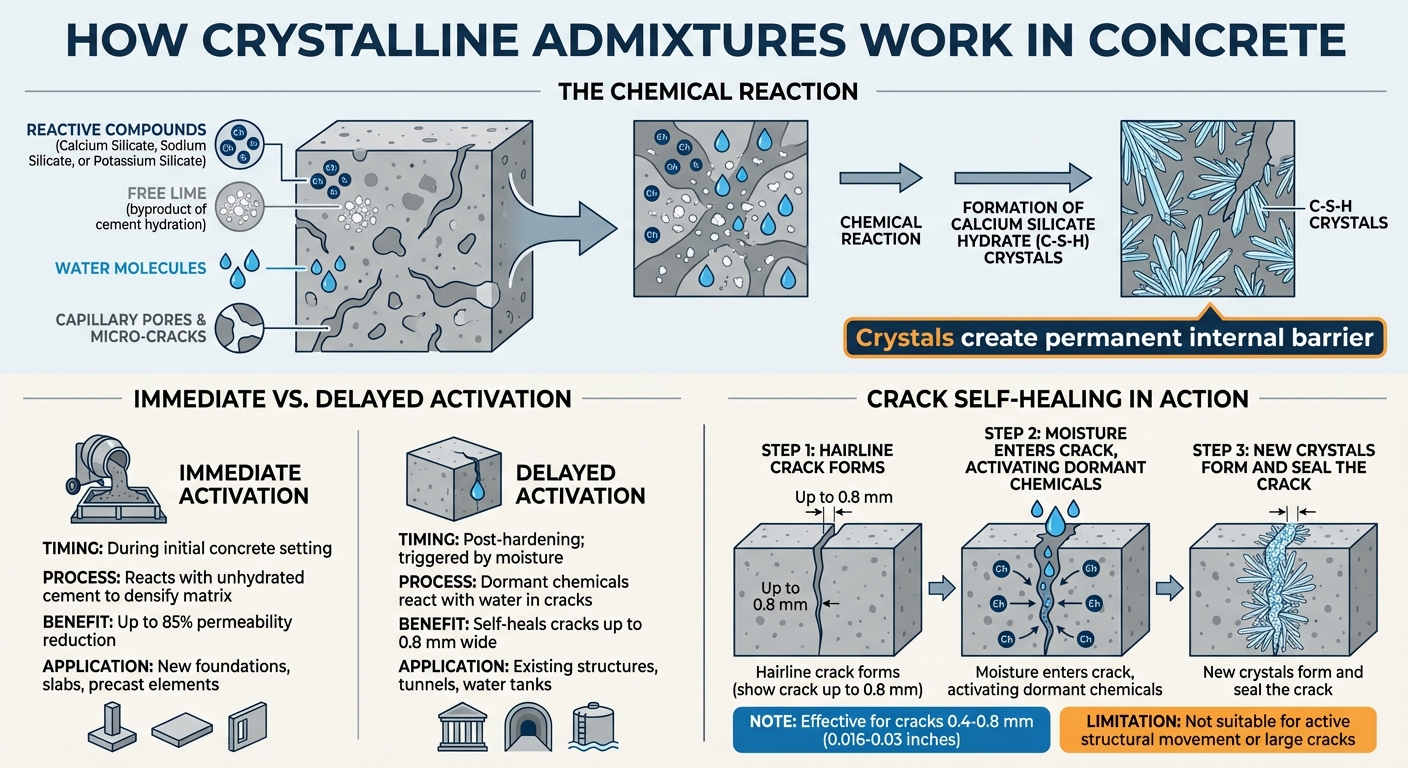
How Crystalline Admixtures Work: Chemical Process and Self-Healing Mechanism
The Chemical Process Behind Crystalline Admixtures
Crystalline admixtures rely on reactive compounds – such as Calcium Silicate, Sodium Silicate, or Potassium Silicate – that trigger a chemical reaction when combined with concrete [1]. These compounds interact with free lime, a byproduct of cement hydration, to form needle-like crystals that effectively seal the pores in the concrete.
"The chemicals will react with the byproducts of the cement’s hydration (free lime) in the presence of water, leading to the natural formation of insoluble crystals." – W. R. Meadows [2]
This reaction produces Calcium Silicate Hydrate (C-S-H) crystals, which grow into the capillary pores, micro-cracks, and voids within the concrete. These crystals create a permanent internal barrier, preventing water from seeping through the concrete matrix. The process continues as long as moisture is present, with the chemicals reacting with any unhydrated cement to produce additional crystals [1][2]. This ongoing reaction supports both immediate and later-stage activation, ensuring effective waterproofing over time.
Immediate vs. Delayed Activation
Crystalline admixtures provide both immediate and delayed activation to protect concrete structures. Immediate activation occurs during the initial hydration and setting of fresh concrete, when the reactive compounds interact with water and cement to form an initial crystal network. This process significantly reduces permeability right from the start, making it suitable for new foundations where uniform waterproofing is essential [5][1].
Delayed activation, on the other hand, comes into play over the structure’s lifespan. When moisture enters through hairline cracks or under hydrostatic pressure, the dormant chemicals react with the water, forming new crystals that seal cracks up to 0.8 mm wide [5][1]. This self-healing capability eliminates the need for excavation or manual repairs, offering long-term durability.
| Feature | Immediate Activation | Delayed Activation |
|---|---|---|
| Timing | During initial concrete setting and hydration | Post-hardening; triggered by moisture ingress |
| Primary Process | Reacts with unhydrated cement to densify the matrix | Reacts with moisture in cracks to "self-heal" |
| Main Benefit | Immediate permeability reduction (up to 85%) [5] | Long-term durability |
| Application | New foundations, slabs, and precast elements | Existing structures, tunnels, and water tanks |
While moisture is the key to triggering crystal growth, extreme temperatures can impact performance. The dual-activation mechanism ensures lasting waterproofing, especially in underground foundations where reliability is essential.
Disclaimer: This content is for informational purposes only. Consult official regulations and qualified professionals before making sourcing or formulation decisions.
Step-by-Step Application Process
Dosage Calculation and Mixing
Crystalline admixtures come in powder form and are added to fresh concrete during the batching process, primarily for new underground foundations. Precise dosage and thorough mixing are essential to ensure the admixture is evenly distributed throughout the concrete. Poor mixing can lead to weak spots where water might seep through, undermining the waterproofing performance [1].
Pouring and Curing Guidelines
When pouring concrete with crystalline admixtures, standard placement procedures apply, but curing requires extra attention to achieve optimal waterproofing. It’s best to pour at moderate temperatures since extreme heat can speed up crystal formation, leading to brittle and fragile structures. Keeping the concrete moist during the curing phase is critical – delays in curing can result in incomplete crystallization. Reliable methods like wet burlap, curing compounds, or continuous water sprays help retain the moisture needed for effective curing [1]. Once properly cured, the self-healing properties of the admixture activate, preserving the waterproof barrier over time.
Crack Self-Healing Mechanism
If moisture enters hairline cracks during the concrete’s service life, dormant chemicals within the crystalline admixture react to form new insoluble crystals, sealing the cracks. Most products are designed to self-heal cracks up to 0.8 mm (about 0.03 inches) in width, making them effective for addressing minor shrinkage and microcracking. However, it’s important to note that crystalline waterproofing cannot replace sound structural design. It is not intended to address active structural movement or large, moving joints [1].
Disclaimer: This content is for informational purposes only. Consult official regulations and qualified professionals before making sourcing or formulation decisions.
Benefits and Limitations for Underground Foundations
Benefits for Below-Grade Structures
Underground foundations, where repairs can be particularly difficult, benefit greatly from crystalline admixtures. These admixtures integrate into the concrete itself, offering permanent waterproofing that resists impact and protects reinforcing steel from chloride ingress and sulfate attack.
They also improve durability by standing up to harsh conditions like freeze-thaw cycles, hydrostatic pressure, and chemical exposure. As MPS Concrete Solutions explains, "Crystalline admixtures have no surface to damage. Once the concrete is cast, the waterproofing cannot be compromised by site activity" [6]. Additionally, their self-healing properties allow them to seal hairline cracks when exposed to moisture over time [6].
Using crystalline admixtures during batching eliminates the need for specialized waterproofing trades, which can significantly cut labor costs. The cost of treated concrete ranges from $25 to $55 per cubic meter (converted from £20–£45) [6], which is far more affordable than external membrane systems that cost $75 to $150 per square meter when labor and protection boards are included [6].
While these advantages are compelling, there are some important limitations to consider.
Limitations and Considerations
One key limitation of crystalline systems is their rigidity, which prevents them from bridging active structural cracks or joints that experience significant movement [1][4]. They are most effective in stable, monolithic concrete structures where shifting is minimal. Their self-healing capabilities work well for hairline cracks between 0.4 mm and 0.8 mm (about 0.016 to 0.03 inches) [1][6], but larger cracks usually require traditional repair techniques.
Proper dosing and mixing are critical for success, as any errors in application can reduce effectiveness [4]. Contamination from substances like oil, grease, dust, or curing compounds can block chemical activation and slow crystal growth [1]. Additionally, extreme pH levels or very high temperatures during application can produce weak or brittle crystals [1]. For high-risk or deep below-grade structures, combining crystalline admixtures with external membranes can provide an extra layer of protection and address the limitations of each system [6].
Comparison: Crystalline Admixtures vs. Waterproofing Membranes
| Feature | Crystalline Admixtures | Waterproofing Membranes |
|---|---|---|
| Depth of Protection | Integral (entire concrete matrix) [6] | Surface-only barrier [6] |
| Self-Healing | Yes, for cracks up to 0.4–0.8 mm [1][6] | No; punctures or cracks cause leaks [6] |
| Ease of Application | High; added at batching, no extra trade [6] | Moderate/Low; requires a cured substrate and extra labor [6] |
| Cost-Effectiveness | High; lower material and labor costs [6] | Lower; higher installation and maintenance costs [6] |
| Resistance to Damage | Immune to site damage/backfilling [6] | Vulnerable to punctures during construction [6] |
| Adaptability for Retrofitting | Limited (requires a topical slurry) [1] | High (applicable internally or externally) [6] |
Disclaimer: This content is for informational purposes only. Consult official regulations and qualified professionals before making sourcing or formulation decisions.
Conclusion
Crystalline admixtures provide permanent waterproofing for underground foundations by becoming part of the concrete itself. These admixtures form insoluble crystal networks within the concrete, effectively blocking water from penetrating the structure [1][3]. Unlike traditional surface membranes that can tear or detach, this internal method avoids many of the pitfalls associated with surface-applied solutions.
"Crystalline waterproofing is a durable and long-lasting solution that can provide protection against water damage and mold growth for the life of the structure." – W. R. MEADOWS [3]
What sets crystalline technology apart is its ability to endure harsh conditions. It performs reliably in extreme temperatures ranging from -25°F to 265°F and resists chemical exposure within a pH range of 3 to 11 [7]. This makes it an excellent choice for below-grade applications, where repairs are often expensive and disruptive. For new construction, these admixtures offer full-depth protection from day one, eliminating the extra steps required by surface-applied methods [1][3].
However, success hinges on proper application. Accurate dosing, thorough mixing, and correct curing are essential to ensure consistent crystal formation. For topical applications, maintaining a surface roughness of 1–3 mm and ensuring the concrete is in a saturated, surface-damp state are crucial for effective chemical transfer [1][4][7].
For construction professionals, crystalline technology delivers a reliable and cost-efficient solution to waterproof underground foundations.
Disclaimer: This content is for informational purposes only. Consult official regulations and qualified professionals before making sourcing or formulation decisions.
FAQs
How do crystalline admixtures stop water in concrete?
Crystalline admixtures work by forming crystals inside the pores, capillaries, and microcracks of concrete. As moisture moves through the material, these crystals grow, creating a self-sealing network that blocks water penetration. This mechanism provides long-lasting waterproofing and enhances the durability of structures such as underground foundations.
Can crystalline admixtures fix existing foundation leaks?
Crystalline admixtures work by forming crystals within new concrete, sealing pores and micro-cracks to block water from entering. However, they are generally not meant for fixing leaks in existing foundations. For those situations, other repair techniques are usually more effective.
When should I use a membrane with a crystalline admixture?
When dealing with concrete that will face hydrostatic pressure, such as in underground foundations, it’s essential to use a membrane containing a crystalline admixture for permanent waterproofing. This type of membrane reacts chemically with water and micro-cracks in the concrete, forming insoluble crystals. These crystals effectively block water pathways, providing durable, long-lasting protection.




Comments are closed