
Creating dairy-free products that meet consumer expectations for creaminess and stability can be challenging. Emulsifiers solve this by stabilizing oil-water mixtures, preventing separation, and improving texture. They are essential for products like plant-based milks, yogurts, and ice creams, where maintaining consistency and shelf life is critical.
Key Points:
- Why Emulsifiers Matter: They prevent phase separation (oil and water splitting) and enhance texture, making dairy-free products smooth and appealing.
- Challenges Without Emulsifiers:
- Oil separation, creaming, and clumping.
- Poor texture and mouthfeel (thin or gritty).
- Limited shelf life due to instability.
- How They Work: Emulsifiers reduce interfacial tension and form protective barriers around oil droplets, ensuring stability even under processing or storage conditions.
- Common Emulsifiers:
- Mono- and Diglycerides: Stabilize fat-water mixtures and withstand heat.
- Glycerol Monostearate (GMS): Prevents droplet merging and improves viscosity.
- Lecithin: Improves mouthfeel and stability in plant-based milks.
- Polysorbates: Enhance fat dispersion and foam quality in creamers. Similarly, Polysorbate 60 is often used in food applications to maintain consistency.
Combining Emulsifiers and Stabilizers
Pairing emulsifiers with hydrocolloids (e.g., xanthan gum, guar gum) improves both stability and texture. For example, adding xanthan gum to emulsifiers strengthens the protective barrier, preventing issues like syneresis (water leakage) or freeze-thaw damage.
Quick Tip:
For better results, emulsifiers should be added during the homogenization process to coat oil droplets effectively. Adjust ingredient concentrations to resolve stability or texture issues.
Emulsifiers are critical for creating dairy-free products that maintain quality from production to the end of their shelf life. By addressing separation, texture, and stability challenges, they ensure consumers enjoy consistent, creamy alternatives to dairy.
NTU scientists develop plant-based emulsifier that could replace eggs and dairy in foods

sbb-itb-aa4586a
Technical Challenges in Dairy-Free Product Formulation
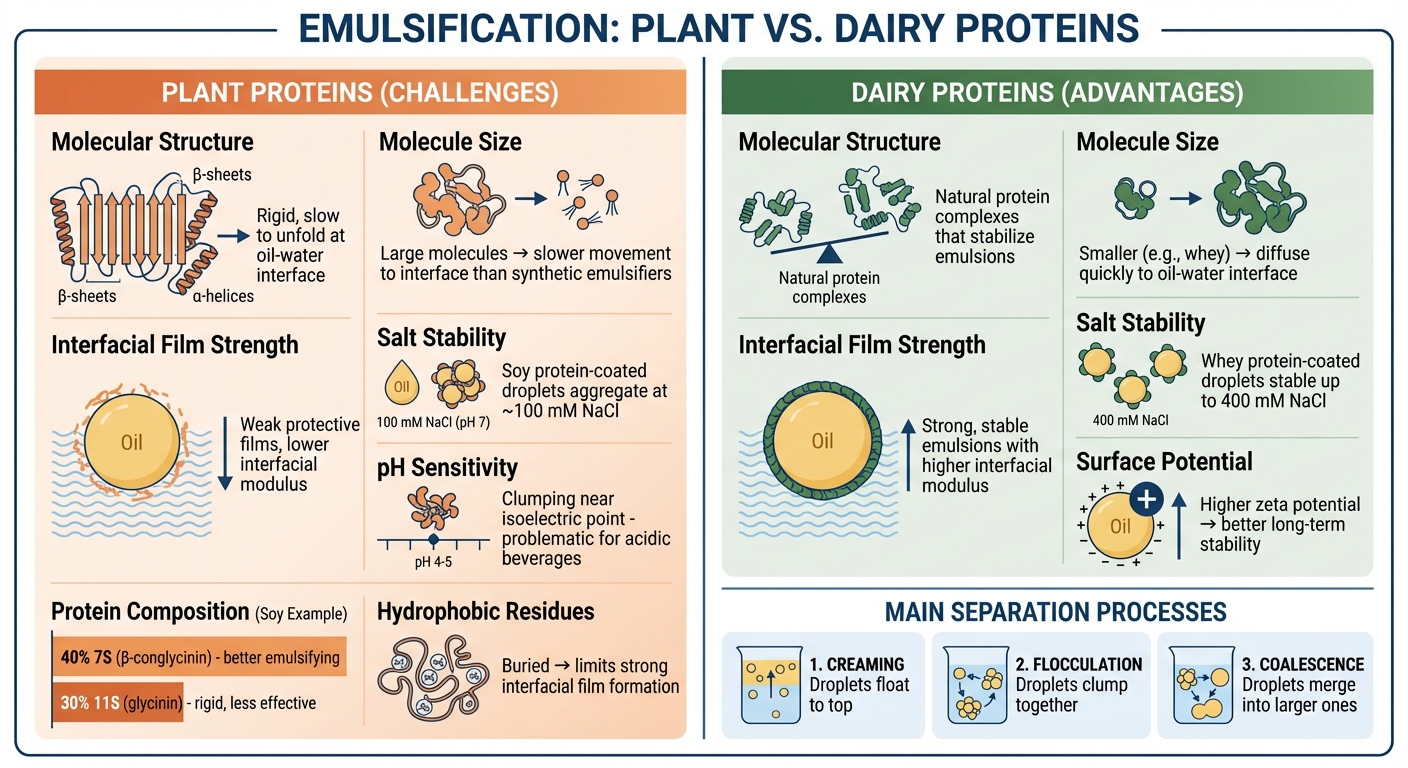
Plant-Based vs Dairy Protein Emulsification Properties Comparison
Crafting stable dairy-free products comes with unique hurdles that aren’t an issue with traditional dairy. Plant-based ingredients behave differently than milk, leading to quality challenges that can impact a product’s success in the market.
Oil-Water Phase Separation Problems
One of the biggest technical difficulties in dairy-free formulations is phase separation – when oil and water naturally separate over time. Unlike dairy milk, which contains natural protein complexes that stabilize emulsions, plant-based ingredients lack these stabilizing properties [2]. This creates a system where oil and water are prone to separating, making the formulation inherently unstable [2].
Plant proteins add to this challenge. They have a higher proportion of β-sheets and fewer α-helices compared to animal proteins, making them too rigid to unfold quickly at the oil-water interface. This results in weak protective films [2]. Additionally, plant proteins are large molecules that move more slowly to the interface than synthetic emulsifiers, which makes forming a stable emulsion even harder [2].
Environmental conditions can make things worse. For instance, soy protein-coated oil droplets start to aggregate in solutions containing about 100 mM NaCl (pH 7), whereas whey protein-coated droplets remain stable in much saltier conditions – up to 400 mM [2]. Plant proteins also tend to clump near their isoelectric point (pH 4–5), which is a problem for acidic dairy-free beverages [2].
Separation in plant-based formulations happens through three main processes: creaming (when droplets float to the top), flocculation (when droplets clump together), and coalescence (when droplets merge into larger ones) [2]. These processes can ruin the product’s appearance, texture, and overall performance, making it less appealing to consumers. Such issues also negatively affect the mouthfeel of the final product.
Texture and Mouthfeel Defects
Texture is another major sticking point for dairy-free products. Plant proteins tend to stay rigid after they adsorb at interfaces, forming weaker interfacial films compared to animal proteins [2]. This leads to a lower interfacial modulus, both under dilation and shear, which impacts the product’s creaminess [2].
The molecular differences between plant and animal proteins are a big factor here. Animal proteins like whey are smaller and diffuse quickly to the oil-water interface, creating a more stable emulsion. In contrast, plant proteins are larger, often aggregated, and less active at the interface [2]. For example, soy protein contains about 40% 7S (β-conglycinin) and 30% 11S (glycinin). The 7S fraction has better emulsifying properties, while the 11S fraction is more rigid and less effective [2].
To mimic the creamy mouthfeel of dairy fat, formulators often rely on hydrocolloids to build viscosity. Without these additives, dairy-free products can feel thin or gritty, which lowers their appeal [3]. Poor texture not only affects consumer satisfaction but also ties into stability issues, which can shorten the product’s shelf life.
Shelf Life Limitations
Shelf life is another area where dairy-free products face challenges. Unstable emulsions – caused by the breakdown of the oil-water interface – can lead to rapid quality deterioration [2]. This is especially problematic for products that experience temperature changes or need to stay fresh for long periods.
Formulators must carefully manage factors like pH, ionic strength, and thermal processing to improve stability [2]. However, plant proteins have buried hydrophobic residues that limit their ability to form strong interfacial films, making long-term stability difficult to achieve. This instability can hurt profitability, as shorter shelf lives lead to more waste and logistical issues. Using advanced synthetic emulsifiers may offer a way to achieve the stability and performance consumers expect in dairy-like products.
How Emulsifiers Improve Dairy-Free Product Performance
Synthetic emulsifiers play a key role in stabilizing dairy-free products by quickly adsorbing at the oil–water interface. This action forms a protective barrier that prevents phase separation, texture issues, and short shelf life, ensuring the product maintains its quality over time [2].
One of their primary functions is enabling the creation of uniformly small oil droplets during processing. These smaller droplets not only contribute to a smoother, creamier texture – similar to traditional dairy – but also increase the overall surface area for stabilization. This reduces the energy required to maintain the emulsion and ensures a consistent texture and stability throughout the product’s shelf life.
Proteins also contribute significantly in emulsified systems. By unfolding at the interface, they expose hydrophobic residues, forming viscoelastic films that provide steric hindrance and electrostatic repulsion. To enhance this effect, formulators often pair proteins with polysaccharides. Proteins act quickly to protect the interface, while polysaccharides create a thicker barrier that further prevents droplets from merging [2].
Another critical aspect is the enhancement of the electrical charge on droplet surfaces, measured as zeta potential. Emulsifiers help establish long-term stability by ensuring droplets carry a strong, like charge, which causes them to repel each other and prevents flocculation or coalescence. For instance, whey protein–coated droplets exhibit a higher surface potential than those coated with soy protein, allowing whey to remain stable even in high salt environments (up to 400 mM NaCl compared to 100 mM for soy) [2]. Jordan Stecz, Principal Technologist at Ingredion Inc., highlights their importance:
"These ingredients extend shelf life by water holding or stabilizing an emulsion to prevent separation over time" [3].
This content is for informational purposes only. Consult official regulations and qualified professionals before making sourcing or formulation decisions.
Common Emulsifiers Used in Dairy-Free Products
Creating dairy-free formulations comes with its fair share of challenges, especially when it comes to stability and texture. Choosing the right emulsifier can make all the difference in overcoming these hurdles. Here’s a closer look at some of the most commonly used emulsifiers and how they help tackle these issues.
Mono- and Diglycerides: Balancing Creaminess and Heat Stability
Mono- and diglycerides are essential for stabilizing the water and fat phases in products like beverages and creamers. They help keep these phases cohesive, which not only extends shelf life but also ensures consistent product quality over time. Their ability to remain stable during pasteurization makes them particularly useful in thermal processing, where they maintain the emulsion even at high temperatures [3].
Glycerol Monostearate (GMS): Protecting Droplet Integrity
Glycerol monostearate (GMS) plays a critical role in preventing droplets from merging, which can otherwise lead to separation issues. By enhancing emulsion viscosity, GMS helps create a texture similar to dairy products. When combined with hydrocolloids, it further boosts stability, ensuring the product maintains its desired consistency throughout its shelf life [3].
Lecithin and Polysorbates: Enhancing Foam and Texture
Lecithin, often sourced from soy or sunflower, reduces the tension between oil and water, improving the mouthfeel of products. It is especially effective in soy- and oat-based milk alternatives, where it contributes to a smoother texture and better stability during storage [2]. Polysorbates, such as Polysorbate 80, are another key player. They enhance fat dispersion, prevent clumping, and improve meltdown properties in frozen items like dairy-free ice creams [2]. In barista-style creamers, combining lecithin with polysorbates significantly improves foam quality and texture, making them behave more like traditional dairy creamers when steamed or frothed [3].
This content is for informational purposes only. Always consult official regulations and qualified professionals before making decisions about sourcing or formulations.
Combining Emulsifiers with Stabilizers
Creating dairy-free products that mimic the creamy textures of traditional dairy requires more than just emulsifiers – it calls for the added support of stabilizers. Together, these ingredients form a powerful combination. Emulsifiers stabilize oil–water mixtures by coating droplet surfaces, while stabilizers thicken the water phase and keep particles suspended. This teamwork helps tackle common issues like oil separation and syneresis in dairy-free formulations.
Emulsifier and Hydrocolloid Combinations
Hydrocolloids, like guar gum and xanthan gum, pair effectively with emulsifiers to improve stability. For example, xanthan gum, an anionic polysaccharide, binds to protein-coated oil droplets, enhancing both steric and electrostatic repulsion to prevent droplet merging. In walnut milk, combining glycerol monostearate (GMS), distilled monoglycerides (DML), and xanthan gum creates a strong interfacial membrane that resists freeze–thaw damage. Adding konjac glucomannan (KGM) strengthens the mix further by forming a physical network that reduces protein particle clumping [1].
"Individually, gums contribute to the creamy textures that consumers prefer… Emulsifiers bring stability to an emulsion… Stabilizers often offer both of these functions."
– Kevin Reed, Customer Technical Support Manager, BENEO [6]
This synergy between emulsifiers and stabilizers is key to achieving better texture and stability in dairy-free products.
Formulation Strategies for Product Development
To make the most of these ingredient combinations, thoughtful formulation strategies are essential. For example, dry blending hydrocolloids with sugar prevents clumping during mixing. Low-molecular-weight emulsifiers should be added before homogenization to quickly coat droplets and improve emulsion stability [1]. When working with microcrystalline cellulose (MCC), high-shear mixing ensures better dispersion and heat resistance [3]. In starch-based drinks like rice or oat milk, controlling homogenization steps is critical to manage the thickening effects of starches [5]. For yogurt-style products, adding 0.1–0.5% pectin helps prevent phase separation and reduces syneresis. In dairy-free cheese, less than 1% alginate provides the thickness and flexibility needed for slicing [3]. If stability issues arise, adjusting ingredient concentrations within recommended ranges can often resolve the problem [5].
Performance Comparison: Without vs. With Emulsifiers
The benefits of combining emulsifiers and stabilizers are clear when you look at the numbers. In peanut milk, adding carrageenan or mono- and diglycerides improves the suspension stability index (SSI) by 25% and increases viscosity from 3.0 cps to as much as 17.5 cps. For coconut milk, using 1% sodium dodecyl sulfate (SDS) reduces the zeta potential to below –20 mV, while Tween 60 cuts droplet size nearly in half, from 10 μm to 5.5 μm. Meanwhile, sucrose esters maintain consistent particle size even after exposure to 250°F (121°C), unlike Tween 60, which causes particle size to increase by 2.3 times [1]. These improvements lead to longer shelf life and consistent texture throughout the product’s lifecycle.
For manufacturers looking to develop reliable dairy-free products, Allan Chemical Corporation offers a wide range of technical-grade emulsifiers and stabilizers. With over 40 years of expertise, they provide tailored solutions, competitive pricing, and compliance with strict regulatory standards.
This content is for informational purposes only. Always consult official regulations and qualified professionals before making decisions about sourcing or formulations.
Emulsifiers: Key to Stability and Quality in Plant-Based Products
Emulsifiers play a critical role in maintaining the stability and texture of plant-based milk alternatives. By reducing oil–water interfacial tension and increasing droplet zeta potential, they help prevent issues like phase separation, creaming, and sedimentation – all of which can negatively impact shelf life and texture. Without emulsifiers, the inherent variability of raw materials and manufacturing methods in plant-based products could lead to poor stability [4].
When paired with hydrocolloid stabilizers, emulsifiers create a powerful synergy that preserves product structure even under challenging conditions like freeze–thaw cycles and ultra-high temperature processing. This combination ensures the smooth mouthfeel and creaminess that consumers expect from dairy alternatives [4].
Choosing the right emulsifier is essential. Factors like Hydrophilic-Lipophilic Balance (HLB) values, pH variations, and high-pressure homogenization must be carefully evaluated. These decisions directly influence protein–polysaccharide interactions at the fluid interface, which are critical for both stability and sensory characteristics [4].
Reliable sourcing of technical-grade emulsifiers is just as important as formulation. Allan Chemical Corporation provides a wide selection of food-grade emulsifiers, supported by over 40 years of experience. With competitive pricing and just-in-time delivery, they are a trusted partner for developing high-quality dairy-free products.
This content is for informational purposes only. Always consult official regulations and qualified professionals before making sourcing or formulation decisions.
FAQs
How do I choose the right emulsifier for my plant-based formula?
To find the right emulsifier for your plant-based product, start by evaluating key factors like the type of product, its pH level, and the processing conditions it will undergo. For instance, lecithin is a good match for neutral beverages, while sucrose esters are better suited for acidic formulations. It’s also crucial to understand how stabilization mechanisms work – whether it’s through electrostatic repulsion, steric hindrance, or viscoelastic films – as this knowledge can help you make an informed choice. Don’t forget to consult with suppliers to ensure the emulsifier meets regulatory requirements and provides consistent quality.
When should emulsifiers be added during processing for best stability?
When preparing for high-energy emulsification processes – such as microfluidization, ultrasonication, or homogenization – it’s important to add emulsifiers beforehand. This step is crucial for achieving the desired texture and ensuring the stability of the final product.
Why do plant proteins separate more easily than dairy proteins?
Plant proteins are easier to separate than dairy proteins due to differences in their molecular structures and interactions. These structural variations affect how well plant proteins stabilize emulsions and bind, often resulting in lower emulsification stability compared to dairy proteins.




Comments are closed