
Photographic fixer chemicals, such as Sodium Thiosulfate (CAS No. 7772-98-7) and Ammonium Thiosulfate (CAS No. 7783-18-8), are essential for stabilizing photographic images by removing unexposed silver halides. These chemicals are widely used in film development and archival photography. However, their purity and safety are critical for performance, long-term image stability, and regulatory compliance.
Key standards for these chemicals include USP, FCC, and ACS grades, which define purity levels, impurity limits, and testing methods:
- USP Grade: Focused on pharmaceutical safety with stringent impurity controls, including heavy metals.
- FCC Grade: Ensures food-grade purity, often referenced for basic quality in non-pharmaceutical applications.
- ACS Grade: Prioritizes high analytical precision, with purity often exceeding 99%, ideal for sensitive photographic uses.
Each standard serves a unique purpose, from laboratory research to industrial-scale applications. Proper selection depends on the specific requirements of your photographic processes and safety protocols.
1. USP Standards
The United States Pharmacopeia (USP) establishes chemical purity standards through monographs that outline minimum specifications [3]. For photographic fixer components like Sodium Thiosulfate or Acetic Acid – when their names align with a USP or National Formulary (NF) title – compliance with the relevant monograph is mandatory. This ensures consistent quality, whether the chemicals are used in pharmaceuticals, laboratories, or photographic applications. Below, we explore USP’s guidelines for purity, impurity limits, and testing methods, setting the stage to compare these standards with those of the FCC and ACS.
Purity Requirements
USP’s stringent purity requirements are designed to maintain the consistency and safety needed for photographic fixer applications.
While USP standards define the minimum acceptable purity, substances that exceed these benchmarks are permissible. If no USP or NF monograph exists for a specific substance, ACS standards are used. For scenarios where the highest analytical purity isn’t necessary, the Food Chemicals Codex (FCC) can be consulted as a reference for basic quality standards.
Impurity Limits
USP regulations specify that reagents must be stored in tightly sealed containers made of resistant glass or other suitable materials. When required, light-resistant containers must also be used. Reagents labeled with a USP designation must include the term "reagent" or "reagent grade." To ensure suitability, standardized atomic absorption and flame photometry tests are conducted to measure metal-ion content and detect trace impurities that might interfere with processes.
Testing Methods
The term "Water" in USP monographs refers to Purified Water, as defined by USP standards. For high-purity applications, water must meet specific criteria, such as being carbon dioxide–free (boiled for at least five minutes or achieving a resistivity of 18 Mohm-cm or more) or deaerated for specialized uses. These strict water quality requirements are essential for ensuring that impurity detection methods work accurately without contamination from the water itself.
This content is for informational purposes only. Consult official regulations and qualified professionals before making sourcing or formulation decisions.
sbb-itb-aa4586a
2. FCC Standards
The Food Chemicals Codex (FCC) establishes quality benchmarks for food-grade chemicals, extending its utility to high-purity applications like photographic fixer chemicals. The FCC’s 14th Edition includes 1,282 monographs and 19 appendices, providing manufacturers with precise guidelines to confirm chemical identity and purity [5].
Purity Requirements
FCC monographs outline detailed procedures for verifying chemical identification, concentration (assay), and impurity levels [5]. These standards are referenced more than 200 times in the U.S. Code of Federal Regulations and are recognized by regulatory authorities in at least nine countries [5]. In cases where regulatory frameworks lack specific impurity controls, FCC monographs serve as a reliable resource for maintaining the highest standards of impurity management [4].
Impurity Limits
The FCC enforces strict impurity limits to protect supply chain integrity. These include controls on heavy metals, residual solvents, and microbial contaminants. For photographic fixer chemicals, such stringent impurity limits ensure reliable performance. However, these standards differ from environmental regulations, which focus on hazardous waste thresholds for metals like silver, chromium, and selenium [2].
Testing Methods
FCC standards include over 150 tests detailed across 19 appendices to assess chemical identity, concentration, and impurities [5]. The FCC also provides Reference Materials to verify the identity, quality, and purity of food ingredients, supporting the safety and integrity of the ingredient supply chain [5]. Since the release of FCC 13 in March 2022, the FCC has adopted an online-only format, with updates every six months to reflect advancements in scientific knowledge [5]. These protocols align with USP guidelines and offer a basis for comparison with ACS standards.
This content is for informational purposes only. Consult official regulations and qualified professionals before making sourcing or formulation decisions.
3. ACS Standards
The American Chemical Society (ACS) sets specifications for reagent-grade chemicals designed to ensure high analytical precision. ACS grade chemicals typically achieve purity levels of at least 95%, with many exceeding 99% purity [1]. This focus on precision sets ACS standards apart from USP and FCC grades, which prioritize safety in pharmaceutical and food-related applications.
Purity Requirements
ACS standards emphasize stringent purity benchmarks, which are verified through a Certificate of Analysis (COA). The COA ensures compliance with specific criteria for consistency and identity [1]. In photographic fixer applications, this level of purity is crucial to prevent unknown impurities from interfering with sensitive chemical processes. For example, in photographic conservation, ACS reagent-grade chemicals like thiourea and iodine are chosen to protect the integrity of delicate emulsions [7].
Impurity Limits
ACS guidelines mandate full transparency in the reporting of chemical properties, including impurity profiles. This is particularly important for photographic applications, where heavy metal contaminants can pose challenges. Used photographic fixers often contain silver concentrations that exceed disposal thresholds, making accurate impurity documentation essential for regulatory compliance [2]. While ACS standards focus on analytical precision rather than environmental limits, they provide the framework for identifying contaminants that could impact both performance and adherence to regulations. This complements the impurity controls established by USP and FCC, ensuring consistent quality across applications.
Testing Methods
ACS Reagent Chemicals includes detailed monographs for nearly 500 reagent chemicals, outlining precise analytical procedures [8]. Common testing methods include titrations for measuring concentrations, spectroscopy for qualitative and quantitative analysis, and chromatography for separating chemical components [1]. The ACS Committee on Analytical Reagents regularly updates these monographs – typically every two years – to incorporate technological advancements [8]. This ensures reproducibility and reliability in laboratory settings [9].
Applications
ACS grade chemicals are indispensable for research, analytical testing, and instrument calibration, particularly in photographic work. These applications often require filtration to eliminate insoluble materials that could disrupt processes [6]. Photographic developers and fixers are especially sensitive to soluble impurities such as tin, lead, zinc, iron, and mercury [6]. For specialized uses like x-ray film processing or archival photography, ACS grade chemicals deliver the precision needed to maintain consistent results across different batches.
At Allan Chemical Corporation, we supply ACS grade reagents that meet these rigorous standards, ensuring dependable performance for photographic conservation and other demanding applications.
This content is for informational purposes only. Consult official regulations and qualified professionals before making sourcing or formulation decisions.
Comparison of Standards
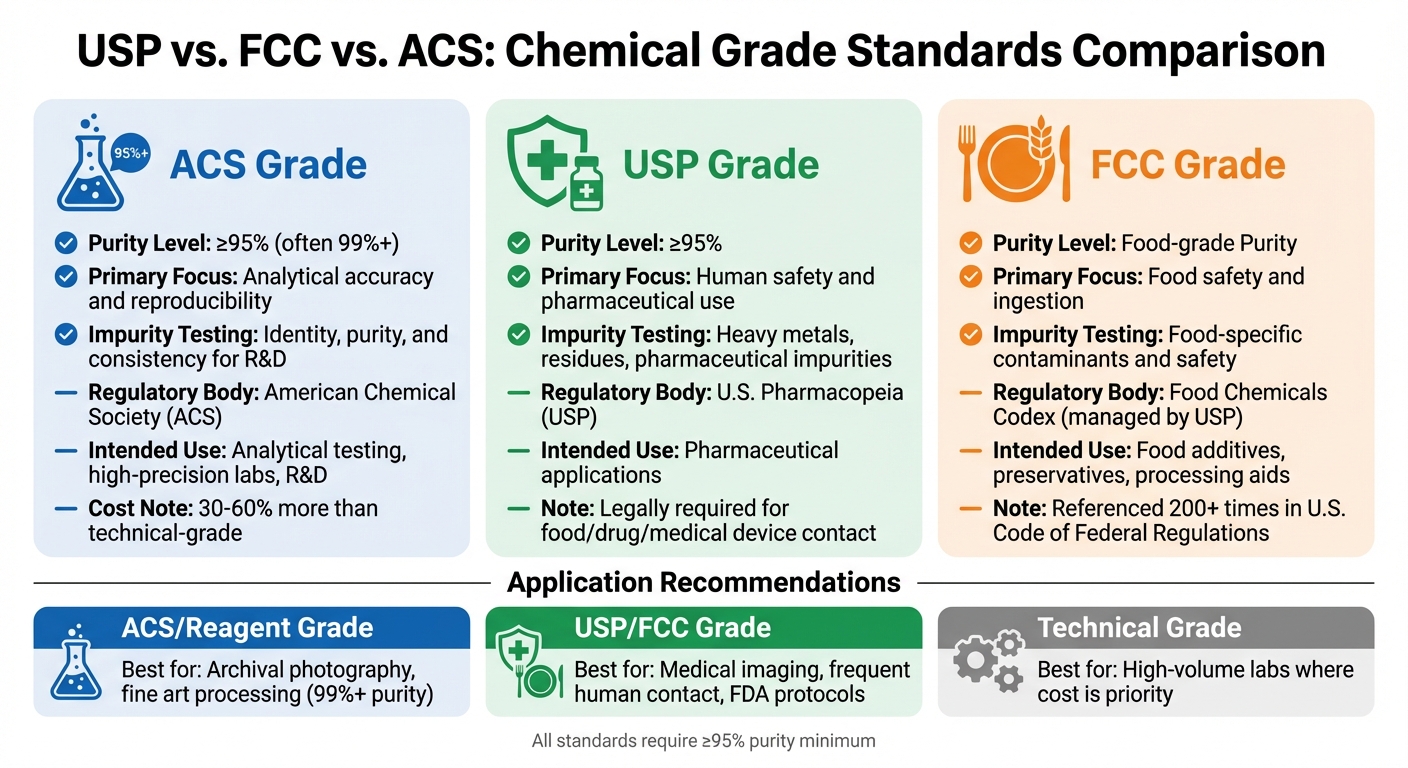
Comparison of USP, FCC, and ACS Chemical Grade Standards for Photographic Fixers
While USP, FCC, and ACS standards all require a purity level of ≥95%, they serve different purposes and adhere to distinct testing criteria. ACS grade chemicals are tailored for high-precision laboratory research, prioritizing analytical accuracy and reproducibility. USP grade chemicals focus on pharmaceutical safety, with strict limits on heavy metals and residues. Meanwhile, FCC grade chemicals are designed for food safety, ensuring that substances intended for ingestion or food-contact applications meet stringent requirements. These differences influence both the cost and complexity of testing, as outlined below.
For example, ACS grade chemicals typically cost 30%–60% more than technical-grade alternatives due to rigorous testing and the inclusion of a Certificate of Analysis [10]. This level of scrutiny is essential for applications requiring precision, such as specialized photographic processes. When deciding on a chemical grade for photographic fixer applications, the choice depends on whether you need laboratory precision, pharmaceutical-grade safety, or compliance with food-contact standards.
Here’s a quick comparison of the key differences among these standards:
| Criterion | ACS Grade | USP Grade | FCC Grade |
|---|---|---|---|
| Purity Level | ≥95% (often 99%+) | ≥95% | Food-grade Purity |
| Primary Focus | Analytical accuracy and reproducibility | Human safety and pharmaceutical use | Food safety and ingestion |
| Impurity Testing | Identity, purity, and consistency for R&D | Heavy metals, residues, pharmaceutical impurities | Food-specific contaminants and safety |
| Regulatory Body | American Chemical Society (ACS) | U.S. Pharmacopeia (USP) | Food Chemicals Codex (managed by USP) |
| Intended Use | Analytical testing, high-precision labs, R&D | Pharmaceutical applications | Food additives, preservatives, processing aids |
Testing protocols also vary significantly. FCC standards include a wide array of tests and assays to verify chemical purity, while USP certification is legally required for substances that come into contact with food, drugs, or medical devices [10]. In contrast, ACS standards emphasize laboratory precision rather than regulatory compliance for human consumption.
Allan Chemical Corporation provides compendial-grade chemicals certified to USP, FCC, and ACS standards, along with full documentation tailored for photographic fixer applications.
This information is intended for general guidance only. Always consult official regulations and qualified professionals when making sourcing or formulation decisions.
Conclusion
Choose the regulatory standard that aligns with your specific application. For tasks like archival photography or fine art processing, where long-term image stability is a priority, ACS/Reagent grade is often the best choice due to its typical purity levels of 99% or higher [1]. On the other hand, technical-grade chemicals are ideal for high-volume laboratories where cost considerations take precedence over minor impurities. For applications involving frequent human contact or strict FDA safety protocols – such as medical imaging – USP/FCC grade chemicals are the recommended option [1].
Equally important is sourcing your fixer chemicals from reliable suppliers. Look for companies that provide full documentation and maintain high-quality standards. For instance, Allan Chemical Corporation offers chemicals that meet USP, FCC, and ACS standards, leveraging over 40 years of experience in regulated industries. Their just-in-time delivery system and strong supplier relationships ensure consistent quality. Always request a Certificate of Analysis (COA) to confirm purity and consult Safety Data Sheets (SDS) for handling and storage guidelines. By selecting the right chemical grade and sourcing from trusted suppliers, you can achieve optimal performance while maintaining compliance with industry regulations.
This content is for informational purposes only. Always consult official regulations and qualified professionals before making sourcing or formulation decisions.
FAQs
Which grade should I use for archival vs high-volume fixing?
For archival fixing, ACS-grade chemicals are preferred to ensure high stability, particularly in processes like platinum palladium printing. For larger-scale fixing tasks, standard photographic fixer chemicals, such as Sodium Thiosulfate, often meet the needs effectively. The choice of chemical grade should match the quality demands and specific application of your project.
Does ACS grade help with silver waste compliance?
ACS grade chemicals play a crucial role in silver waste compliance due to their high purity and extensive documentation. These features ensure precise silver recovery processes and help organizations adhere to regulatory standards efficiently.
What should I check on a COA and SDS for fixer chemicals?
When examining a Certificate of Analysis (COA) and Safety Data Sheet (SDS) for fixer chemicals, it’s essential to check for compliance with relevant standards, such as USP, FCC, or ACS. Focus on the following critical aspects:
- COA: Verify details like chemical purity, concentration levels, and adherence to regulatory requirements.
- SDS: Review hazard classifications, recommended handling practices, and proper disposal guidelines.
Both documents should align with safety and quality expectations for photographic fixer chemicals.



Comments are closed