
A cosmetic ingredient is not “safe” just because it has a low hazard on paper. I look at how much people are exposed to, how often, by which route, and whether the safety margin is high enough for the product’s actual use.
Water (CAS No. 7732-18-5) is a Cosmetic Ingredient that works mainly as a Solvent, and two high-purity uses are USP-grade Facial Cleansers and Sterile Eye-Area Products. I’m using it here as a simple example because toxicological risk assessment is about the material in the formula, the dose, and the records behind the decision.
If I had to boil the article down to the main points, it would be this:
- I start with the exact material, not just the ingredient name. That means identity, purity, impurities, residual solvents, Heavy Metals, CoA, and SDS.
- I separate hazard from risk. Hazard is what the substance can do. Risk depends on exposure.
- I estimate exposure by product type, use pattern, route, concentration, absorption, and body weight.
- I use SED (Systemic Exposure Dose, the amount expected to enter the body each day) for systemic effects, and I keep local dose separate for irritation, sensitization, and eye effects.
- I calculate MoS (Margin of Safety, the gap between the point of departure and the estimated exposure). A simple example in the article gives an SED of about 0.67 mg/kg bw/day for a 1% ingredient in Body Lotion.
- I add exposures across products when the same ingredient shows up more than once per day. In the article’s example, 0.2 + 0.05 + 0.03 = 0.28 mg/kg bw/day.
- I keep a written file that ties the decision to the batch, supplier, specs, study set, assumptions, and version history.
The short version is simple: the safety call stands or falls on dose, data quality, and change control. If the lot changes, the impurity profile shifts, or the supplier process moves, I need to check whether the old conclusion still fits.
A few points matter more than anything else. Leave-on products often mean more exposure than rinse-off products, 100% dermal absorption is often used when data are weak, and children or high-frequency users can drive the limiting case because body weight is lower or use is heavier.
Here’s a quick snapshot of the workflow from the article:
| Step | What I check | Why it matters |
|---|---|---|
| 1 | Identity, purity, impurities, CoA, SDS, properties | The assessment must match the exact commercial material |
| 2 | Product use, route, daily amount, absorption, body weight | Exposure turns use into dose |
| 3 | PoD, SED, MoS, assumptions, gaps | This is where the risk call is made |
| 4 | Records, versioning, supplier changes, batch traceability | The decision needs support if questioned later |
One more point is easy to miss. Local endpoints and systemic endpoints are not judged the same way, so I should not use one calculation to answer both questions.
That is the core of the article: I build the hazard file, estimate exposure under actual use, compare that exposure to a point of departure, and keep the records needed to support the decision.
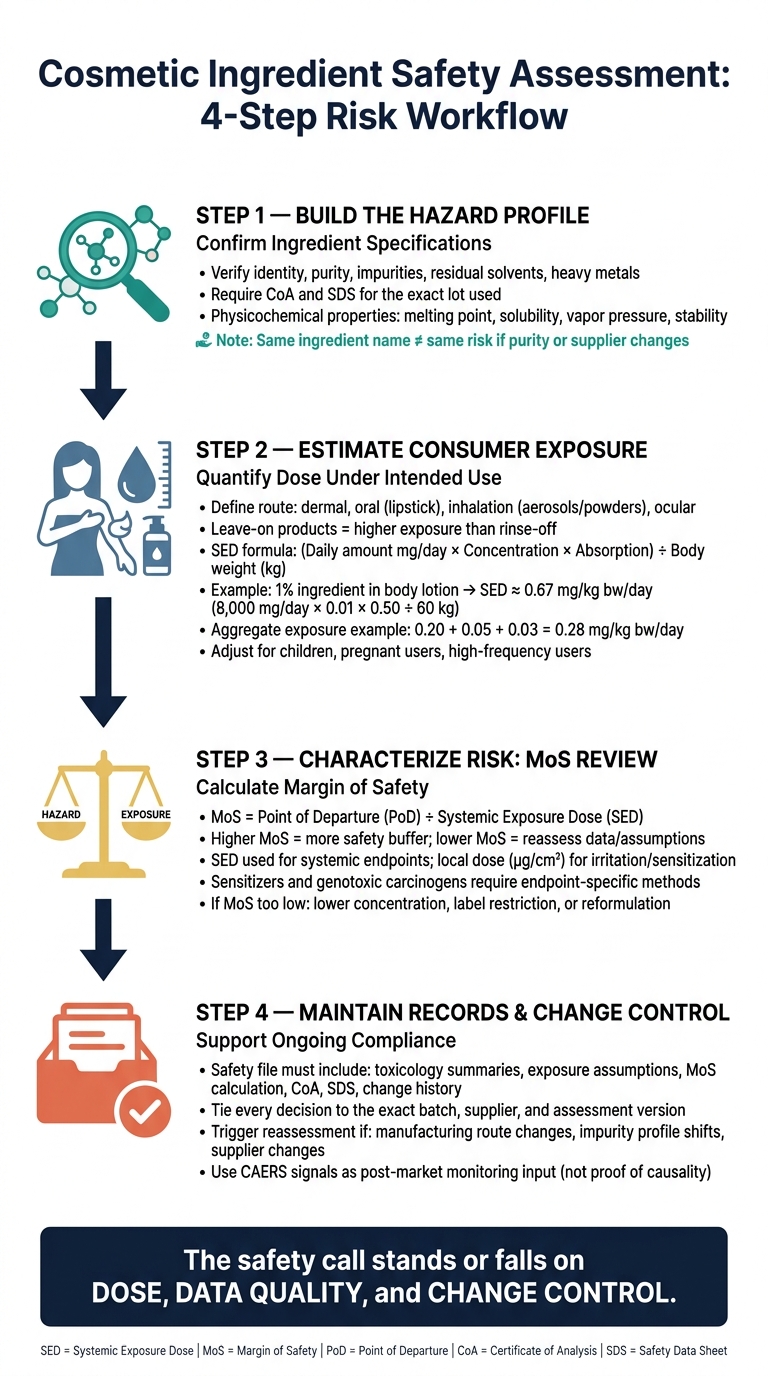
Cosmetic Ingredient Safety Assessment: 4-Step Risk Workflow
Cosmetic Regulatory Compliance: Potentially Toxic Substances in Your Cosmetic Products
sbb-itb-aa4586a
Step 1: Build the Hazard Profile and Confirm Ingredient Specifications
Start with the exact commercial material you plan to use. That means tying the assessment to its identity, purity, impurity profile, and key physicochemical properties. Physicochemical properties are basic material traits such as melting point, boiling point, solubility, and vapor pressure that affect how the substance behaves.
Add flammability, reactivity, and stability to the safety file as well. Those details matter because the same ingredient name can still behave differently when purity shifts, impurities change, or the supplier uses a different process.
Identity, Purity, Impurities, and Supplier Documentation
Check impurity limits, residual solvents, heavy metals, and reaction by-products. Residual solvents are leftover processing liquids, and reaction by-products are chemicals formed during manufacture that may remain in the final material.
Require a Certificate of Analysis (CoA) and Safety Data Sheet (SDS) for the exact lot used in the formulation. The CoA confirms the material meets specification, and the SDS gives hazard and handling details tied to safe use.
If the lot changes, the assessment changes. Use supplier records that are consistent, complete, and linked to the exact lot in the formula, because that record set becomes the baseline for picking toxicology data and setting the point of departure.
Step 2: Estimate Consumer Exposure Under Intended Use Conditions
Once the hazard profile is set, the next job is to quantify exposure under intended use. Exposure estimation turns product use into dose, and that dose shapes each risk call that comes after it.
Define Product Type, Use Pattern, and Route of Exposure
Leave-on products usually lead to higher exposure than rinse-off products because they stay on the skin longer. The route of exposure comes straight from how the product is made to be used.
Dermal contact applies to almost every cosmetic. Some products also add other routes that need their own review. Lipstick and lip gloss can lead to oral exposure through hand-to-mouth transfer. Aerosol hairsprays and loose face powders can add inhalation exposure from airborne particles. Eye products may also need an ocular exposure review, especially for local endpoints such as irritation.
Common product types line up with exposure routes like this:
| Product | Leave-on / Rinse-off | Primary Route | Notes |
|---|---|---|---|
| Body lotion | Leave-on | Dermal | Large surface area; often applied once or twice daily |
| Shampoo | Rinse-off | Dermal | Short contact time; scalp and part of the body |
| Lipstick | Leave-on | Dermal + oral | Reapplied multiple times daily; ingestion fraction needed |
| Loose face powder | Leave-on | Dermal + inhalation | Airborne particle fraction requires a separate estimate |
| Aerosol body spray | Leave-on | Dermal + inhalation | Inhalation exposure depends on aerosolization and breathing rate |
| Facial cleanser | Rinse-off | Dermal | Brief contact; may also require ocular review |
Calculate Systemic Exposure Dose and Local Exposure
Systemic Exposure Dose (SED) is the amount of an ingredient expected to enter the bloodstream per kilogram of body weight per day, expressed in mg/kg bw/day. In plain terms, it estimates how much of the ingredient gets into the body each day after product use. SED is based on the daily product amount, ingredient concentration, dermal absorption, and body weight[3][6][9].
Take a body lotion with 1% of an ingredient, applied at 8,000 mg/day, with dermal absorption set at 50% and an adult body weight of 60 kg – a default used in SCCS guidance[3][6][1]. That gives the following result:
SED = (8,000 mg/day × 0.01 × 0.50) ÷ 60 kg ≈ 0.67 mg/kg bw/day[3][6][9]
When absorption data are thin, assessors often use 100% absorption as a conservative worst-case assumption. If better in vitro dermal absorption studies are available, those data can replace the default and give a more realistic SED[2][5][9].
Use SED for systemic endpoints. Use local dose for irritation, sensitization, and phototoxicity. Local endpoints depend on the dose at the site of contact, not on how much enters the bloodstream. Local exposure is usually expressed as µg/cm² and estimated from the applied amount and the exposed area[8]. Keep the systemic and local calculations separate, and link each one to the endpoints it supports.
Adjust for Multiple Products and Sensitive Populations
Preservatives, UV filters, and emollients often show up in more than one daily-use product. When that happens, aggregate exposure should be calculated by adding the SED from each product in the scenario.
For example, if a preservative adds 0.2 mg/kg bw/day from a body lotion, 0.05 mg/kg bw/day from a shampoo, and 0.03 mg/kg bw/day from a facial cleanser, the aggregate dermal SED is about 0.28 mg/kg bw/day[4][7][10]. Spell out every product included in the aggregate scenario, because that total is the figure Step 3 will compare with the point of departure.
Use separate scenarios for children, pregnant users, and high-frequency users such as frequent hand-cream or lipstick users. Lower body weight and heavier use can push exposure up in a meaningful way, and those cases can end up driving the limiting MoS. Document each scenario and carry it into Step 3’s MoS review.
Those exposure estimates feed straight into the MoS and uncertainty review in Step 3.
Step 3: Characterize Risk Using Margin of Safety and Uncertainty Review
Step 3 takes the hazard profile from Step 1 and the exposure estimate from Step 2 and turns them into a risk decision you can stand behind. The job here is simple in theory: calculate the Margin of Safety (MoS), then decide if the ingredient fits the intended use.
Margin of Safety: Definition and Interpretation
The Margin of Safety (MoS) is the ratio between the point of departure (PoD) and the estimated exposure. Put plainly, it compares the dose linked to harm with the dose people are expected to get.
MoS = Point of Departure ÷ Systemic Exposure Dose (SED)
For systemic toxicity, a higher MoS means more room between exposure and harm. A lower MoS is a warning sign that the assessor should go back and check the data, the assumptions, or the exposure estimate. That comparison only makes sense when the PoD lines up with the same route, endpoint, and use scenario.
MoS is used for systemic effects. Local endpoints need endpoint-specific review.
When Standard MoS Approaches Are Not Sufficient
Standard MoS methods do not fit every case. Some ingredient groups need a more targeted review tied to the endpoint in question.
Sensitizers are a clear example. Ingredients linked to contact sensitization need endpoint-specific evaluation instead of a systemic MoS benchmark.
Use endpoint-specific or route-specific assessment when local, oral, or inhalation exposure is the main concern. Use substance-specific methods for non-threshold hazards, especially genotoxic carcinogens.
Document Data Gaps, Assumptions, and Risk Management Actions
A safety assessment is only as strong as the record behind it. Every assumption used in the MoS calculation, including aggregate exposure scenarios, should be written down with a clear reason.
If the calculation carries uncertainty, note that uncertainty before picking a risk-management action. That paper trail matters, especially when someone later asks, “Why was this call made?”
Use CAERS as a signal source for post-market safety issues, but do not treat it as proof of causality because reports often lack complete product-use and medical context. Record why each signal did or did not change the assessment, and use those signals to check whether the selected limit, label, or reformulation still protects the intended use.
If MoS is too low or the data are not enough, document the action taken. That may mean a lower concentration, a tighter specification, a label restriction, or reformulation.
Step 4: Maintain Records, Control Change, and Support Ongoing Compliance
Once the MoS is set, tie that decision to the exact material, batch, and version. A MoS result is only defensible when the records are complete and the material has not changed.
What to Include in the Safety File
Your safety file should hold the toxicology summaries and study references used to set the point of departure, the exposure assumptions and how they were worked out, and the MoS calculation summary. It should also include ingredient specifications, Certificates of Analysis (CoA), Safety Data Sheets (SDS), and a detailed change history.
Each document needs to trace back to the right batch and the right assessment version. That way, the basis for the safety decision stays clear, and no one has to guess which data supported the call.
Why Supplier Consistency Matters for Assessment Validity
Supplier consistency keeps the assessment linked to the exact material you approved. If the supplier changes, the toxicological reassessment starts too, because even a small shift on paper can turn into a big difference in practice.
If the manufacturing route changes, the impurity profile changes, or the ingredient grade moves to a different specification, the original safety conclusion may no longer fit. That’s why immediate notice of any process change matters: you need time to review the impurity profile before production moves ahead.
Working with a supplier that uses documented quality systems and sends consistent CoAs, SDSs, and technical-grade or compendial-grade documentation makes traceability easier to maintain over time. It helps keep the record trail clean and keeps the safety assessment tied to the material that was actually reviewed.
Conclusion: A Clear Workflow for Defensible Cosmetic Ingredient Safety Decisions
When the assessment is documented and change-controlled, the safety decision stays defensible. Record control is not just paperwork; it is the final link connecting hazard profile, exposure, and MoS.
This content is for informational purposes only. Consult official regulations and qualified professionals before making sourcing or formulation decisions.
FAQs
How do you choose the right point of departure?
Start by identifying the most appropriate toxicology benchmark, or Point of Departure, during the cosmetic hazard review. In plain terms, this is the dose level you’ll use as the anchor for your safety check. Use that value in the Margin of Safety calculation as NOAEL ÷ SED.
Base the review on the ingredient’s identity, including its INCI name and CAS number. That step matters because safety data is only useful when it matches the exact substance under review. For systemic exposure, aim for a Margin of Safety of 100 or greater, and keep your choice traceable in your safety substantiation records.
When should dermal absorption be assumed at 100%?
For a leave-on cosmetic product, assume 100% dermal absorption in the model. That means the ingredient is treated as staying on the skin for the full exposure period, so the full applied amount is counted for skin uptake.
That’s different from rinse-off products. Those products are assumed to stay on the skin for a much shorter time, so their retention is much lower.
What changes require a new risk assessment?
A new risk assessment is needed whenever an ingredient’s safety profile, regulatory status, or formulation specs change in a meaningful way.
That covers cases like new scientific data, a reclassification as Carcinogenic, Mutagenic, or Toxic for Reproduction, updates in supplier documents, shifts in ingredient concentration, and changes to the formula itself. It also applies to pre-MoCRA products that do not meet current standards for adequate scientific evidence.




Comments are closed