
Antioxidant blends are combinations of compounds that slow food spoilage caused by oxidation. This process, known as autoxidation, affects unsaturated fatty acids in fats and oils, leading to off-flavors, odors, and nutrient loss. Common synthetic antioxidants include BHA (butylated hydroxyanisole), BHT (butylated hydroxytoluene), TBHQ (tertiary butylhydroquinone), and propyl gallate, which are often used together to improve effectiveness. These blends work by:
- Scavenging free radicals to stop ongoing oxidation.
- Chelating metals like iron and copper to prevent new oxidation.
Blending antioxidants enhances their performance by targeting multiple stages of oxidation. For example, combining BHT with citric acid protects fats and oils by addressing both radical activity and metal catalysis. These blends are essential in preserving high-fat products, processed meats, and beverages by extending shelf life and maintaining quality.
Regulations limit antioxidant use (e.g., 200 ppm in fats/oils), ensuring safety while optimizing shelf stability. High-quality antioxidants should meet GRAS standards and come with verified purity documentation.
How Synergistic Antioxidant Effects Work
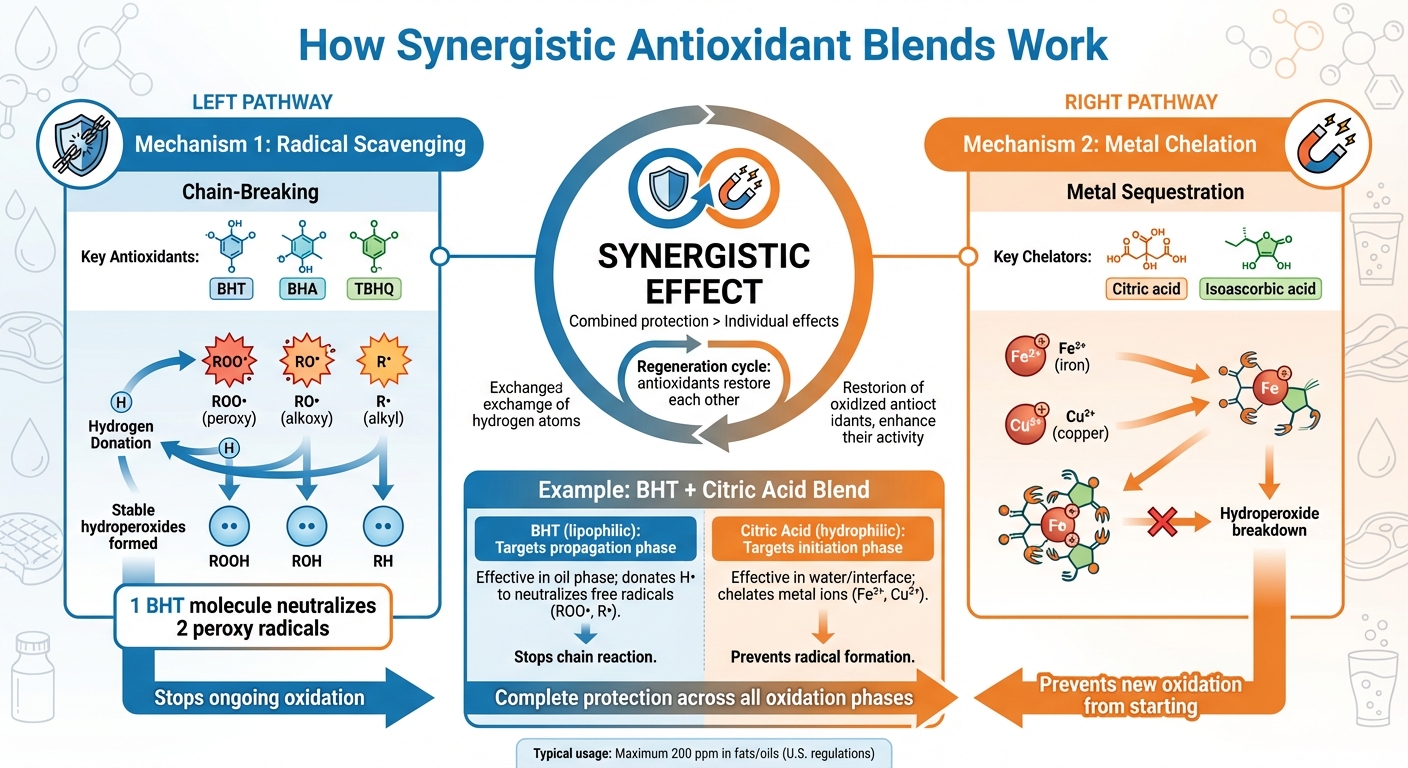
How Synergistic Antioxidant Blends Prevent Food Oxidation
When antioxidants team up, their combined effects go beyond simple addition – they amplify each other. This happens because different antioxidants tackle oxidation from multiple angles, creating a layered defense system that’s more effective than any single antioxidant. Synergy kicks in when one compound addresses ongoing damage while another prevents new oxidation from starting.
The two main mechanisms behind this synergy are radical scavenging (which halts oxidation already underway) and metal chelation (which stops new oxidation from taking root). These processes work hand-in-hand, as explained in the following sections.
Radical Scavenging and Chain-Breaking
Synthetic phenolic antioxidants like BHT (butylated hydroxytoluene) and BHA (butylated hydroxyanisole) neutralize free radicals by donating hydrogen atoms. Free radicals – such as peroxy radicals (ROO•), alkoxy radicals (RO•), and alkyl radicals (R•) – are highly reactive and drive the oxidation process forward.
"Antioxidants are components which prevent auto-oxidation of oils and fats by giving their hydrogen to free radicals formed in the initiation and propagation stages of autoxidation." – Mostafa Taghvaei, Department of Food Materials and Process Design Engineering [3]
For example, when BHT donates hydrogen, it converts peroxy radicals into stable hydroperoxides, effectively stopping the chain reaction [7]. A single BHT molecule can neutralize two peroxy radicals before it becomes inactive. Its phenoxy radical remains stable due to electron delocalization across its aromatic ring and the protective bulk of its tert-butyl groups [7]. This stability ensures that neutralized radicals don’t revert into harmful, pro-oxidant forms.
BHA and TBHQ (tertiary butylhydroquinone) operate similarly, thanks to their structural design. Electron-donating alkyl groups on their aromatic rings lower the energy needed for hydrogen donation, making the process quicker and more efficient [7]. This design advantage allows synthetic antioxidants to perform better than natural ones, especially when considering the thermal stability of synthetic antioxidants in high-heat or long-storage conditions.
Metal Chelation and Pro-oxidant Suppression
While radical scavenging deals with ongoing oxidation, metal chelation prevents it from starting. Chelating agents bind to transition metals like iron (Fe²⁺) and copper (Cu²⁺), which are catalysts for oxidation. These metals break down hydroperoxides into reactive radicals, essentially triggering new oxidation chains.
Metal chelation doesn’t directly neutralize radicals but instead removes the catalysts responsible for generating them [1][3]. For instance, combining BHT (a radical scavenger) with citric acid (a chelator) protects oils by attacking oxidation from two angles at once.
This dual-action strategy explains why blended antioxidants extend shelf life more effectively. The radical scavenger eliminates active oxidation, while the chelator blocks new threats from forming. Some combinations even show a regeneration effect, where one antioxidant restores another to its active state by donating hydrogen. This recycling ability boosts the overall protective power [6]. By targeting both active damage and its root causes, these blends significantly improve food preservation across a range of products.
This content is for informational purposes only. Always consult official regulations and qualified professionals before making sourcing or formulation decisions.
Stay updated on the latest industry trends and chemical innovations by subscribing to our company newsletters.
sbb-itb-aa4586a
Common Synthetic Antioxidant Blends and Their Uses
Food manufacturers often combine antioxidants to address different stages of oxidation. This blending approach allows for lower concentrations of each ingredient while achieving a stronger protective effect. Additionally, it helps companies stay within regulatory limits. For example, U.S. regulations typically cap BHA and BHT at 50 ppm and allow up to 200 ppm in fats and oils [3].
Here are some examples of antioxidant blends tailored for specific food applications.
BHT and Citric Acid Blend
This blend is a go-to option for high-fat foods such as animal fats, cooking oils, and enriched rice. BHT primarily targets the propagation phase of oxidation by scavenging peroxy radicals, while citric acid chelates trace metals like iron and copper that could trigger the initiation phase. This dual action enhances the blend’s overall effectiveness. For instance, BHT is added to enriched rice at levels up to 0.0033% by weight and to poultry at up to 0.01% by fat content. Since BHT is lipophilic and citric acid is hydrophilic, their complementary properties provide protection across all oxidation phases [7]. This combination demonstrates how blending antioxidants can tackle both initiation and propagation phases effectively.
TBHQ and BHA Mixture
This blend excels in high-temperature applications, making it a favorite for vegetable oils and fried foods. TBHQ is known for its excellent stability at elevated temperatures, while BHA offers early-stage antioxidant activity and can convert to TBHQ under certain conditions. Together, they provide robust protection against oxidation during high-temperature processing. Regulatory guidelines typically allow up to 200 mg/kg of these antioxidants, whether used individually or in combination [8]. By blending them, food manufacturers can mitigate the loss of antioxidant efficacy caused by heat.
Multi-Component Blends (BHT, BHA, and Propyl Gallate)
In processed meats, canned foods, and dairy products, propyl gallate is rarely used alone because higher concentrations can lead to discoloration. However, when combined with BHA and BHT, it delivers strong oxygen-scavenging properties while minimizing the risk of color changes. In the U.S., BHT is permitted at levels up to 100 mg/kg when used alone or in combination, and propyl gallate is usually limited to 50 mg/kg in blends to prevent discoloration, even though regulations allow up to 100 mg/kg of total fat content. These blends often include additional chelators like citric acid or isoascorbic acid to suppress metal ions that could promote oxidation, ensuring better antioxidant performance during processing and storage [8].
This content is for informational purposes only. Always consult official regulations and qualified professionals before making sourcing or formulation decisions.
Applications of Antioxidant Blends in Food Products
Antioxidant blends play a key role in extending the shelf life of food products while maintaining their sensory qualities. By combining radical scavenging and metal chelation properties, these blends help manufacturers optimize formulations for different storage and processing needs. Here’s how they work in specific food contexts.
Animal Feed and High-Fat Products
Oxidation in animal feed can negatively impact the quality of meat products. Adding antioxidants to animal diets improves the oxidative stability of pork, poultry, and lamb, resulting in better overall meat quality [9].
In frozen meats, dry sausages, and cured ham, antioxidant blends slow down lipid and protein oxidation, preserving both flavor and texture [9]. Similarly, edible oils and fats, which often face oxidative stress during storage or high-heat cooking, benefit greatly from antioxidant protection. For instance, in a study on sunflower oil stored at 140°F (60°C), samples treated with 200 ppm of BHT showed peroxide values of 36.52 mEq/kg after 12 weeks, compared to 52.34 mEq/kg in untreated samples [1]. This reduction in peroxide levels not only extends shelf life but also helps retain the oil’s flavor and nutritional value.
Beverages and Emulsions
Liquid-based foods, especially emulsions, are highly susceptible to oxidation at the oil–water interface. Antioxidant blends offer protection by stabilizing polyunsaturated fatty acids (PUFAs) and maintaining pigment integrity [1][10].
In fruit juices and other beverages, ascorbic acid acts as an oxygen scavenger, preventing discoloration and protecting oxygen-sensitive nutrients [9]. When combined with other antioxidants, it also prevents off-flavors caused by secondary oxidation. This is achieved by inhibiting the formation of volatile compounds like aldehydes and ketones, which are responsible for unpleasant smells and tastes [1][4]. In wine production, sulfites are commonly used to protect against oxidation and undesirable enzymatic reactions that could alter flavor and color stability.
Blends of radical scavengers, such as BHA or BHT, with metal chelators like citric acid provide comprehensive protection at every stage of oxidation – from initiation to propagation. This synergy explains why blended antioxidants consistently outperform single-component solutions in complex food systems containing both lipid and aqueous phases [9][3].
This content is for informational purposes only. Always consult official regulations and qualified professionals before making sourcing or formulation decisions.
Sourcing High-Quality Synthetic Antioxidants
When selecting synthetic antioxidants, it’s crucial to work with suppliers who adhere to strict regulatory and quality standards. For example, antioxidants should be GRAS-certified (Generally Recognized as Safe) and comply with established Acceptable Daily Intake (ADI) limits. To illustrate, BHA has an ADI of 0–0.5 mg/kg body weight, while BHT is capped at 0–0.3 mg/kg [3]. These limits are designed to ensure consumer safety, with typical usage restricted to a maximum of 0.02% (or 200 ppm) in the U.S. and Canada [3][1].
Benefits of Compendial-Grade Antioxidants
Beyond meeting baseline regulatory requirements, compendial-grade antioxidants offer an added layer of assurance. These products meet stringent purity standards established by the Food Chemicals Codex (FCC) and the United States Pharmacopeia (USP). Such certifications reflect extensive toxicological testing [3]. As highlighted by Mostafa Taghvaei from the Department of Food Materials and Process Design Engineering:
"An antioxidant should have two conditions to be considered as safe: its LD50 must not be less than 1,000 mg/kg body weight, and the antioxidant should not have any significant effect on the growth of the experimental animal in long-term studies" [3].
To ensure compliance, suppliers should provide certificates of analysis and safety data sheets. These documents allow manufacturers to verify product quality and safety before incorporating antioxidants into their formulations. Working with suppliers who prioritize these standards is essential for maintaining both product safety and regulatory compliance.
Allan Chemical Corporation: A Trusted Partner
Reliable sourcing plays a key role in maintaining consistent food preservation. With over 40 years of experience in regulated industries, Allan Chemical Corporation (https://allanchem.com) stands out as a dependable partner for food manufacturers. Their expertise in sourcing compendial-grade solutions – including FCC, USP, ACS, and NF standards – ensures that antioxidants meet strict safety and performance criteria. By collaborating with vetted manufacturers, Allan Chemical offers flexible batch sizes, custom packaging options, competitive pricing, and technical support to help clients navigate regulatory requirements with ease.
This material is for informational purposes only. Always consult official regulations and qualified professionals before making sourcing or formulation decisions.
Conclusion
Synergistic antioxidant blends, as discussed earlier, combine radical scavenging and metal chelation to combat oxidation at every stage of the process [2][5]. This approach not only enhances protection but also allows manufacturers to use smaller amounts of each component while achieving longer shelf life. This is especially important for staying within regulatory Acceptable Daily Intake (ADI) limits and ensuring consumer safety [2][4].
One notable feature of these blends is their regeneration cycle, where one antioxidant replenishes another, boosting the overall effectiveness [5]. This mechanism is particularly crucial in high-fat products, beverages, and animal feed, where maintaining oxidative stability is essential for preserving quality and nutritional value.
Choosing the right antioxidant blend is essential for both product preservation and meeting regulatory standards. High-quality, compendial-grade antioxidants are key to ensuring consistent and reliable performance. Allan Chemical Corporation (https://allanchem.com), with over 40 years of experience, offers manufacturers trusted antioxidant solutions. They provide flexible batch sizes, competitive pricing, and expert technical support to help clients navigate regulatory complexities while maintaining safety and efficacy.
As the global antioxidant market grows at a 6.1% CAGR through 2030 [5], manufacturers focusing on quality sourcing and synergistic formulations will be well-equipped to meet both regulatory demands and consumer expectations for freshness and safety.
This content is for informational purposes only. Always consult official regulations and qualified professionals before making sourcing or formulation decisions.
FAQs
What are synergistic antioxidant blends, and how do they help preserve food?
Synergistic antioxidant blends bring together multiple antioxidants that enhance each other’s ability to slow down oxidation and prevent food spoilage. This teamwork makes these blends more effective than relying on a single antioxidant. They play a key role in extending shelf life while preserving the freshness, flavor, color, and texture of food products.
These blends are particularly helpful in protecting food from oxidative damage caused by oxygen, heat, or light – factors that can gradually degrade quality. You’ll often find them in processed foods, oils, and baked goods, ensuring these products stay safe and enjoyable for longer.
What safety regulations apply to synthetic antioxidants in food?
In the United States, synthetic antioxidants like BHA (butylated hydroxyanisole), BHT (butylated hydroxytoluene), and TBHQ (tert-butylhydroquinone) are closely monitored by the Food and Drug Administration (FDA). These substances undergo rigorous safety evaluations to confirm their safety, approved usage levels, and adherence to strict regulatory standards before they can be included in food products.
The FDA enforces regulations such as 21 CFR Part 172, which specifies allowable usage levels for food additives, ensuring they stay within safe limits. At the same time, some states are examining or imposing restrictions on certain synthetic antioxidants due to growing public health concerns, signaling ongoing scrutiny of their safety.
Food manufacturers are required to comply with these federal and state regulations to ensure consumer safety and maintain legal compliance.
Why is it crucial to use high-quality antioxidants in food preservation?
Using high-quality antioxidants in food preservation is crucial for keeping products fresh and safe. These compounds are effective at preventing lipid oxidation, a process that can cause spoilage, unpleasant flavors, and a drop in nutritional value. By slowing down oxidation, antioxidants help extend shelf life and maintain consistent product quality.
As more consumers lean toward safer, natural ingredients, the importance of sourcing dependable antioxidant blends has grown. High-grade options not only comply with regulatory requirements but also align with the increasing demand for clean-label food products.




Comments are closed