
Pharmaceutical preservatives are essential for preventing microbial contamination in drug formulations, ensuring safety and stability. Selecting the right preservative involves balancing its effectiveness, compatibility, and compliance with regulatory standards, much like how you select excipients for biosimilars to ensure stability and safety. Here are five key factors to consider:
- pH Compatibility: Preservatives work best within specific pH ranges. For example, parabens are effective between pH 4.5–6.0, while benzalkonium chloride works across pH 4.0–9.0. Matching the preservative’s pH range with the formulation is critical.
- Formulation Compatibility: Preservatives must remain stable without reacting with active ingredients, excipients, or packaging. For instance, parabens may degrade when combined with certain vitamins or sugars.
- Safety and Limits: Preservatives must meet regulatory concentration limits to ensure patient safety. For sensitive applications (e.g., injections into the eyes or heart), preservative-free options are recommended.
- Stability: Environmental factors like temperature, light, and pH can degrade preservatives. Stability testing ensures they remain effective throughout the product’s shelf life.
- Quality and Supply: High-purity, pharmaceutical-grade preservatives that meet global pharmacopoeial standards (e.g., USP, Ph. Eur.) ensure consistent quality and reliable supply.
These considerations help formulators create safe, effective, and stable pharmaceutical products. Always consult regulatory guidelines and professionals when selecting preservatives.
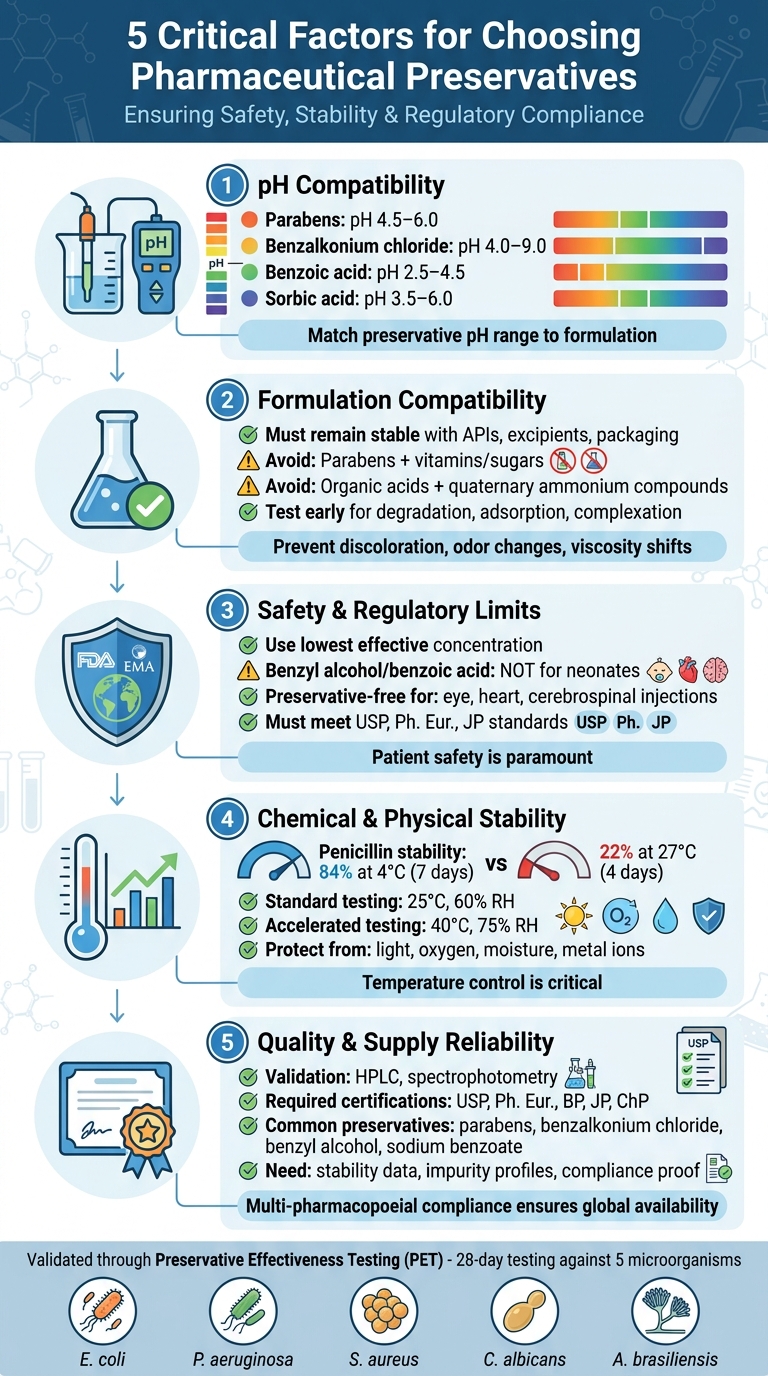
5 Key Factors for Selecting Pharmaceutical Preservatives
Preservatives used in Pharmaceutical industry l Role of preservatives l Interview question answers
sbb-itb-aa4586a
1. pH Compatibility and Antimicrobial Activity Range
pH plays a central role in determining how well a preservative performs. The pH of a drug formulation directly impacts a preservative’s antimicrobial effectiveness, as each preservative operates optimally within a specific pH range. Outside its ideal range, the preservative’s active form may weaken, reducing its ability to combat microbial growth [3]. This concept is clearly reflected in the pH preferences of commonly used preservatives.
"The preservative used should be selected based on whether it has maximal microbial activity at the pH of the formulation." – Sigma-Aldrich [1]
For example, parabens are most effective between pH 4.5 and 6.0, benzalkonium chloride works well across pH 4.0 to 9.0, benzoic acid operates best at pH 2.5 to 4.5, and sorbic acid is effective from pH 3.5 to 6.0 [1].
It’s important to note that no single preservative can target all microorganisms. Certain bacteria, like Pseudomonas aeruginosa, thrive in moist emulsions, leading to issues like rancidity and unpleasant odors. On the other hand, molds such as Aspergillus niger are more problematic in dry powders, where they produce enzymes that can degrade active ingredients [3]. To combat these threats effectively, a preservative must reach its Minimum Inhibitory Concentration within its functional pH range [1].
To ensure broad-spectrum protection, formulators often combine preservatives. For instance, pairing methylparaben with propylparaben creates a synergistic effect, enhancing antimicrobial activity. Additionally, incorporating chelating agents like EDTA can improve performance against resistant microbial strains [1].
This content is for informational purposes only. Always consult official regulations and qualified professionals when making decisions about sourcing or formulation.
2. Compatibility with Formulation Components
When developing a formulation, ensuring chemical compatibility between preservatives and other components is just as important as managing pH. A preservative that works well on its own may become ineffective if it interacts negatively with active pharmaceutical ingredients (APIs), excipients, or packaging materials. Such interactions can lower the drug’s potency or alter its physical characteristics, making thorough compatibility testing a non-negotiable step during formulation development [1].
Preservatives must stay chemically stable within the formulation to avoid issues like adsorption, degradation, or complexation with other ingredients [1]. For example, combining certain organic acids with quaternary ammonium compounds (quats) or Vitamin C, or using parabens alongside vitamins A, C, or niacinamide, can drastically reduce antimicrobial performance [3]. Similarly, phenoxyethanol may interact poorly with specific emulsifiers and quats [3]. These incompatibilities can lead to more than just reduced preservation effectiveness – they can result in visible and sensory changes like discoloration, unpleasant odors, or altered viscosity, all of which signal instability [3]. Early compatibility testing is crucial to catch these issues before they escalate.
Packaging materials also play a role in compatibility challenges. Some preservatives can adsorb into plastic containers, reducing their active concentrations over time [1]. This is especially problematic for multi-dose containers, where maintaining consistent preservative levels is essential to counter repeated contamination risks over the product’s shelf life [1].
To sidestep these challenges, start stability testing early in the development process. Regularly monitor factors such as appearance, odor, pH, and viscosity to catch potential issues before they become major problems [3]. Additionally, screening for known incompatibilities before finalizing the preservative system can save time and resources. While many preservatives are widely used and generally compatible with a variety of formulations, each product requires its own detailed evaluation to ensure stability and efficacy throughout its shelf life.
For pharmaceutical-grade preservatives that have undergone rigorous compatibility testing, Allan Chemical Corporation offers a range of technical-grade and compendial-grade options designed to meet stringent regulatory requirements.
This content is for informational purposes only. Always consult official regulations and qualified professionals when making sourcing or formulation decisions.
3. Safety, Toxicity, and Regulatory Concentration Limits
Preservatives play a critical role in preventing microbial growth, but they must do so without compromising patient safety. Regulatory agencies like the FDA and EMA set maximum allowable concentrations for preservatives based on toxicity data, historical clinical outcomes, and the intended route of administration – whether oral, topical, ophthalmic, or parenteral. This reflects the understanding that preservatives are not inert substances but essential components that contribute to the overall safety of pharmaceutical formulations [4].
The primary goal is to determine the lowest effective concentration that prevents microbial contamination while minimizing toxicity risks. Using excessive amounts can lead to irritation or adverse reactions, particularly in vulnerable populations. For instance, benzyl alcohol and benzoic acid are unsuitable for neonates because their immature livers cannot metabolize these substances effectively, allowing them to cross the blood-brain barrier and potentially cause harm [1]. Additionally, certain administration routes – such as injections into cerebrospinal fluid, the heart, or eyes – are particularly sensitive and should remain preservative-free to avoid direct tissue toxicity.
Regulatory requirements for preservative safety differ from country to country, making it essential for formulation developers to consult local regulatory authorities. Efforts by organizations like the USP, European Pharmacopoeia, and Japanese Pharmacopoeia aim to standardize excipient guidelines globally, but differences still exist. Resources such as the Handbook of Pharmaceutical Excipients provide valuable information, including sections on "Pharmacopeial Specifications", "Safety", and "Regulatory Status", which are crucial for regulatory submissions [4]. Staying updated on pharmacopeial standards is vital, as allowable preservative limits are subject to regular revisions.
These regulatory limits also influence formulation strategies. One effective approach to reduce toxicity involves using synergistic preservative combinations. For example, combining methylparaben with propylparaben can provide broad-spectrum antimicrobial protection at lower individual concentrations. Similarly, adding chelating agents like EDTA enhances preservative activity against resistant microorganisms without increasing the preservative dose [1]. Standardized laboratory tests, such as determining the Minimum Inhibitory Concentration (MIC), help ensure that the preservative concentration is sufficient for microbial control without exceeding what is necessary. This aligns with the pH-dependent activity ranges discussed in Section 1 [3].
Before finalizing a preservative system, it is essential to review the "Regulatory Status" and "Safety" sections of excipient monographs. This ensures compliance with established concentration limits and confirms that the selected preservative is safe for the intended route of administration and patient demographic.
This content is for informational purposes only. Always consult official regulations and qualified professionals when making sourcing or formulation decisions.
4. Chemical and Physical Stability
Stability plays a key role in maintaining the long-term effectiveness of preservatives. If a preservative breaks down during manufacturing, storage, or use, it loses its ability to guard against microbial contamination. Chemical degradation not only weakens antimicrobial performance but can also produce harmful byproducts. On the other hand, physical instability can disrupt the preservative’s even distribution within a formulation, leaving certain areas vulnerable to contamination.
Preservative stability is heavily influenced by environmental conditions. Temperature, in particular, has a significant impact. Higher temperatures speed up chemical reactions like oxidation and hydrolysis, which degrade preservatives and reduce their efficacy. For instance, penicillin retains 84% of its potency after seven days at 4°C (39°F), but its potency drops dramatically to 22% after just four days at 27°C (81°F) [6]. This underscores the need for strict temperature control during storage and distribution. Standard stability testing is performed at 25°C (77°F) with 60% relative humidity (RH), while accelerated tests use 40°C (104°F) and 75% RH to simulate long-term degradation over a shorter time frame [5][6].
Other environmental factors also threaten preservative stability. Exposure to UV or visible light, oxygen, and metal ions like iron or copper can speed up degradation, making light-protective packaging and inert atmospheres essential [5][6]. Extreme pH levels, whether acidic or alkaline, can increase the rate of hydrolysis [6]. Humidity can lead to physical changes such as crystallization or precipitation, while moisture in the formulation affects both water activity and chemical stability [6]. Even mechanical agitation can disrupt physical stability [5].
The container-closure system is another critical factor in preserving stability throughout a product’s shelf life. Poorly sealed containers can allow air, moisture, and contaminants to enter, leading to issues like evaporation, oxidation, or microbial growth. To address this, manufacturers use moisture-barrier bottles, vacuum leak tests with 1 mbar sensitivity, and light-protective packaging for photosensitive preservatives [5]. For formulations prone to oxidation, flushing containers with inert gases like nitrogen before sealing can significantly extend preservative stability [8].
Chemical interactions within the formulation can also undermine preservative stability. For example, parabens (hydroxybenzoate esters) can react with sugars like sorbitol through transesterification, forming sorbitol hydroxybenzoate esters and reducing the active preservative concentration [7]. Stability testing often involves storing liquid products upside down to identify potential interactions or sorption between the preservative and the container [8]. Additionally, testing both sealed and "in-use" conditions ensures the preservative remains effective throughout the product’s usage period [5]. Stability is just as important as pH and compatibility when selecting the right preservative.
This content is for informational purposes only. Consult official regulations and qualified professionals before making sourcing or formulation decisions.
5. Quality, Purity, and Supply Reliability
Pharmaceutical-grade preservatives are held to rigorous standards to ensure both quality and purity [2]. Analytical validation methods like High-Performance Liquid Chromatography (HPLC) and spectrophotometry are used to verify the purity and concentration of these materials [2]. Without consistent quality control, both product safety and compliance with regulatory requirements could be jeopardized [3]. These strict standards are essential not only for ensuring safety but also for maintaining reliable production timelines.
Regulatory authorities must approve preservatives for use in specific dosage forms [2]. Typically, pharmaceutical-grade preservatives align with major international pharmacopoeias, such as the United States Pharmacopeia (USP), European Pharmacopoeia (Ph. Eur.), British Pharmacopoeia (BP), Japanese Pharmacopoeia (JP), and Chinese Pharmacopoeia (ChP). Commonly used preservatives – like parabens, benzalkonium chloride, benzyl alcohol, and sodium benzoate – are required to meet multiple pharmacopoeial standards to ensure their availability for global markets [1]. Compliance with these certifications is critical for maintaining a dependable supply chain, which is essential for uninterrupted pharmaceutical production.
The reliability of the supply chain is vital for both production schedules and regulatory adherence. Preservatives play a key role in multi-use liquid formulations such as injectables, ophthalmic solutions, and oral suspensions by preventing microbial growth and extending shelf life [1]. To ensure consistent batch quality, manufacturers must partner with suppliers that maintain strict quality controls and provide comprehensive documentation, including stability data, impurity profiles, and proof of regulatory compliance [1]. Opting for preservatives that meet multiple pharmacopoeial certifications – such as Ph. Eur., BP, ChP, JP, and USP – helps to ensure global compatibility and reliability [1].
For example, Allan Chemical Corporation offers compendial-grade preservatives that meet USP, FCC, ACS, and NF standards. Their direct relationships with vetted suppliers and robust technical support ensure consistent quality and availability. This level of oversight is critical for reliable supply in pharmaceutical manufacturing.
Choosing the right preservative involves a science-driven evaluation of its chemical properties, antimicrobial mechanism, and overall effectiveness [2]. Commonly approved preservatives include parabens, sorbic acid (and its salts), benzoic acid (and its salts), and benzalkonium chloride [2]. These quality assurances directly impact formulation stability, aligning with the broader considerations for preservative selection discussed throughout this article.
This content is for informational purposes only. Always consult official regulations and qualified professionals before making sourcing or formulation decisions.
Conclusion
Choosing the right pharmaceutical preservative involves carefully considering the five critical factors outlined earlier. The preservative must effectively prevent microbial growth without interfering with the Active Pharmaceutical Ingredients (APIs) [1]. A poor choice can result in product spoilage, such as rancidity or unpleasant odors, contamination with harmful toxins or allergens, and even health risks like skin or eye infections [3]. This delicate balance is confirmed through standardized testing methods.
One essential validation step is Preservative Effectiveness Testing (PET). During this test, a product is intentionally inoculated with five specific microorganisms – Escherichia coli, Pseudomonas aeruginosa, Staphylococcus aureus, Candida albicans, and Aspergillus brasiliensis – at concentrations ranging from 1 x 10⁵ to 1 x 10⁶ colony-forming units (CFU) per milliliter [9]. Over a 28-day period, the preservative’s ability to inhibit or eliminate these organisms is assessed to ensure the product remains safe throughout its shelf life. For Category 1 products, such as parenteral or ophthalmic formulations, the preservative must achieve a 3.0 log (99.9%) reduction in bacterial counts by Day 14. In contrast, Category 3 products, like oral formulations, require only a 1.0 log reduction within the same timeframe [9].
Reputable suppliers play a crucial role by providing high-quality materials that comply with international pharmacopeial standards, including USP, NF, Ph. Eur., BP, ChP, and JP [1]. Allan Chemical Corporation supports formulators with compendial-grade preservatives, along with detailed documentation such as stability data, impurity profiles, and regulatory compliance proof. These assurances align with the formulation strategies discussed earlier, ensuring both product stability and effectiveness. By combining PET validation with thoughtful supplier selection, formulators can safeguard patient safety while meeting regulatory requirements.
This content is for informational purposes only. Always consult official regulations and qualified professionals when making sourcing or formulation decisions.
FAQs
When should a drug product be preservative-free?
A drug product should avoid preservatives if it is intended for single-use, has a limited storage time after opening (usually within 12 hours in an ISO Class 5 environment), or if preservatives might impact its safety or effectiveness. This is particularly critical for delicate formulations like parenteral fluids, where preservatives could interfere with the product’s function or pose risks to patient safety.
How can I confirm a preservative won’t bind to my packaging or ingredients?
To make sure a preservative won’t interact with your packaging or ingredients, it’s important to test its compatibility through stability studies. These studies involve exposing the preservative to your specific formulation and packaging materials to detect any potential binding or unwanted reactions. Reviewing technical data and published research on similar uses can also provide helpful insights. For further guidance, consulting specialists, like those at Allan Chemical Corporation, can shed light on compatibility issues and binding behavior.
What tests prove the preservative stays effective through shelf life and use?
Preservative Efficacy Testing (PET), also known as antimicrobial challenge testing, is used to confirm that a preservative system works effectively. During this process, the product is exposed to controlled microorganisms over approximately 28 days. This helps assess the product’s stability and its ability to maintain antimicrobial protection throughout its shelf life and normal usage.




Comments are closed