
Chemical storage incidents often occur due to improper practices, leading to severe consequences like fires, fines, and operational losses. For example, in 2019, a forklift accident in Texas caused a $2 million fire due to poor chemical segregation. Following strict storage protocols and conducting regular internal audits can prevent such risks.
Key compliance points include:
- Federal Regulations:
- OSHA mandates Safety Data Sheets (SDS), proper labeling, and worker training for hazardous chemicals.
- The EPA’s Emergency Planning and Community Right-to-Know Act (EPCRA) requires facilities to report chemical inventories annually (due March 1).
- The Resource Conservation and Recovery Act (RCRA) enforces hazardous waste management standards based on generator categories.
- Safe Storage Practices:
- Follow chemical compatibility guidelines to separate chemicals by hazard class (e.g., acids, bases, flammables).
- Use proper labeling, secondary containment, and climate-controlled storage.
- Maintain accessible SDS and accurate inventory records.
- Internal Audits:
- Regularly inspect storage areas for compliance with labeling, segregation, and waste management rules.
- Address findings promptly to avoid penalties and operational disruptions.
Training and emergency readiness are equally important. Employees must understand storage protocols, safety equipment, and emergency plans to handle incidents effectively. By prioritizing compliance, facilities can reduce risks and safeguard their operations.
Safeopedia Webinar: Hazardous Materials: Is Your Chemical Storage Solution Compliant?

sbb-itb-aa4586a
Federal Regulations for Chemical Storage
In the U.S., chemical storage facilities must navigate a complex framework of federal regulations covering storage, labeling, and reporting. Key agencies like the Occupational Safety and Health Administration (OSHA) and the Environmental Protection Agency (EPA), alongside laws such as the Emergency Planning and Community Right-to-Know Act (EPCRA) and the Resource Conservation and Recovery Act (RCRA), establish strict compliance requirements. These rules are crucial for conducting internal audits and avoiding penalties. Below, we break down the main regulations governing chemical storage.
OSHA and EPA Requirements
Compliance with OSHA and EPA standards is a critical starting point for audits. OSHA’s Hazard Communication Standard (HCS) requires facilities to maintain Safety Data Sheets (SDS) for all hazardous chemicals. These documents outline the health and physical hazards of each chemical, ensuring that employees are aware of the risks involved. With over 500,000 chemicals requiring SDSs, maintaining accurate and accessible records is essential. Additionally, OSHA mandates proper labeling and worker training to promote safety in handling hazardous substances.
EPA regulations build on OSHA’s mandates by addressing environmental risks linked to chemical storage. Together, these agencies set the groundwork for safe storage infrastructure, emergency preparedness, and documentation practices.
EPCRA and Reporting Obligations
Under the Emergency Planning and Community Right-to-Know Act (EPCRA), facilities storing hazardous chemicals above certain thresholds must meet specific reporting requirements. Sections 311 and 312 of EPCRA require submission of SDSs (or chemical lists) and annual inventory reports to state and local authorities [3][6]. Reporting thresholds vary:
- Extremely Hazardous Substances (EHS): 500 pounds or the Threshold Planning Quantity (TPQ), whichever is lower.
- General Hazardous Chemicals: 10,000 pounds.
- Retail Gasoline (in compliant underground tanks): 75,000 gallons.
- Retail Diesel Fuel (in compliant underground tanks): 100,000 gallons.
Annual inventory reports, due by March 1, typically use the Tier II form, which provides detailed information about chemical storage, including names, quantities, storage methods, and locations. These reports are submitted to the State or Tribal Emergency Response Commission (SERC/TERC), Local or Tribal Emergency Planning Committees (LEPC/TEPC), and local fire departments [3][4].
| Chemical Category | Reporting Threshold |
|---|---|
| Extremely Hazardous Substances (EHS) | 500 lbs or TPQ (whichever is lower) |
| Gasoline (Retail station, underground, compliant) | 75,000 gallons |
| Diesel Fuel (Retail station, underground, compliant) | 100,000 gallons |
| All other Hazardous Chemicals | 10,000 lbs |
EPCRA also enhances public awareness by making submitted information accessible to communities. Additionally, the 2018 America’s Water Infrastructure Act (AWIA) requires community water systems to receive hazardous chemical inventory data to protect water sources [6]. While federal law does not impose filing fees, many states charge fees to fund emergency planning efforts [5].
RCRA Compliance for Hazardous Waste
The Resource Conservation and Recovery Act (RCRA) regulates hazardous waste management, with requirements varying by generator category: Large Quantity Generator (LQG), Small Quantity Generator (SQG), or Very Small Quantity Generator (VSQG). For example, LQGs generating over 1,000 kilograms of hazardous waste per month must store waste for no more than 90 days, while SQGs generating 100–1,000 kilograms monthly have up to 180 days (or 270 days if the nearest disposal facility is over 200 miles away) [7].
Facilities must ensure that containers are in good condition, compatible with their contents, and sealed except during use. Central Accumulation Areas (CAAs) must provide secondary containment, maintain clear access for emergency equipment, and include tools like spill kits and fire suppression systems [7]. Labels on hazardous waste containers must include:
- The words "Hazardous Waste."
- A hazard identifier (e.g., flammable).
- The chemical identity.
- The accumulation start date.
As RCRAReady explains, "The clock starts the moment waste first enters a container in a CAA – not when the container is full, not when it is moved for pickup, and not when the label is written" [7].
Non-compliance can lead to hefty fines, with open container violations reaching up to $93,058 per day [7]. Even facilities that ship waste on time but fail physical requirements, such as proper labeling or containment, can face multiple violations.
Satellite Accumulation Areas (SAAs) allow waste collection at the generation point without a time limit, provided volumes remain below 55 gallons for non-acute hazardous waste or 1 quart for acute (P-listed) hazardous waste [7]. If these limits are exceeded, facilities have three days to transfer the waste to a CAA.
This content is for informational purposes only. Consult official regulations and qualified professionals before making sourcing or formulation decisions.
Safe Chemical Storage Practices
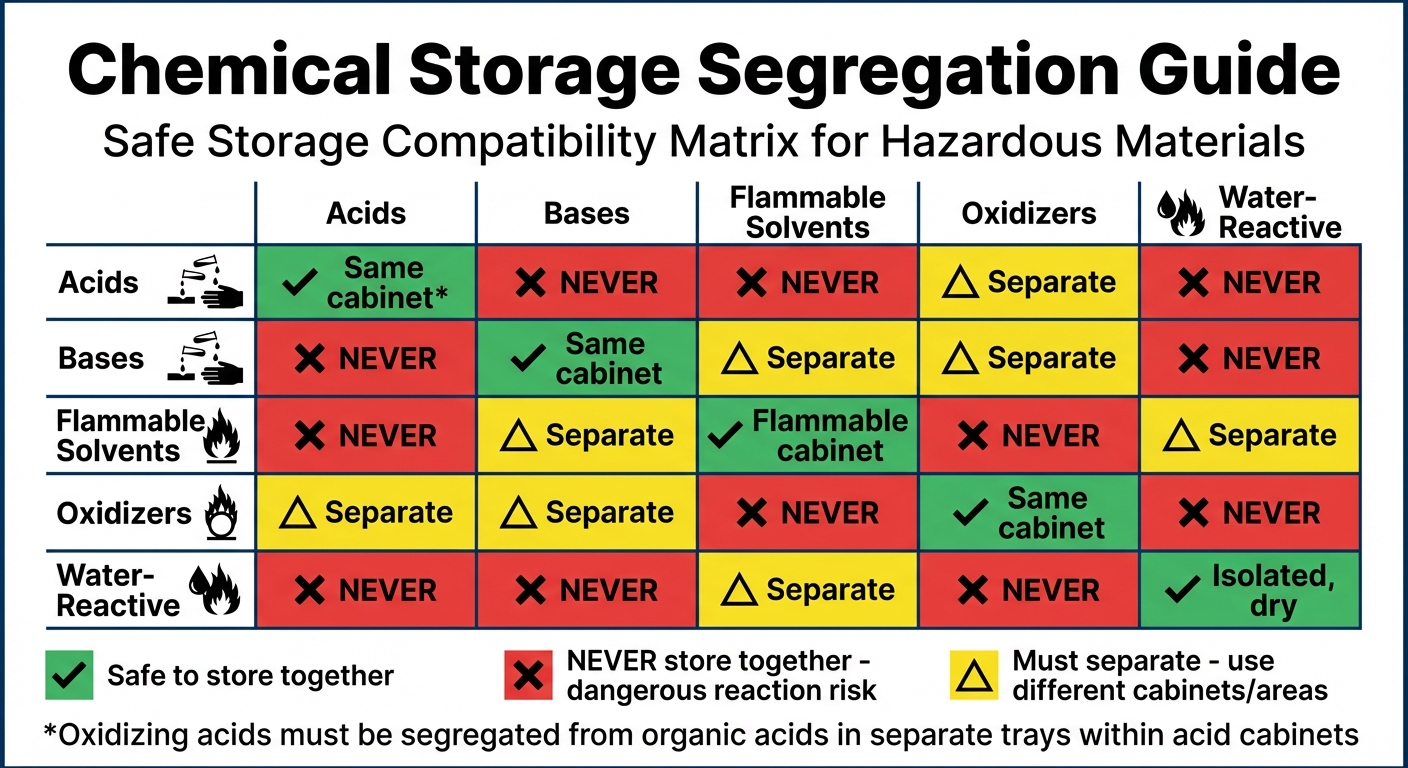
Chemical Storage Segregation Compatibility Chart
Organized and secure storage areas are critical for preventing accidents. Proper segregation, clear labeling, and well-designed infrastructure are non-negotiable elements of safety. These measures not only minimize risks but also simplify compliance during audits.
As Andre Taki, Lead Product Specialist & Sales Manager at Allan Chemical Corporation, explains: "Most chemical incidents don’t happen during use – they happen during storage. A single mistake in segregation or handling can trigger immediate and hazardous reactions" [2].
Chemical Segregation and Compatibility
To avoid dangerous reactions, chemicals must be stored according to their hazard class – not alphabetically. Acids, bases, flammables, oxidizers, and water-reactive substances should each have separate, dedicated safety cabinets. For instance, acids are often stored in blue cabinets, while yellow is used for flammables. Equip these cabinets with secondary containment, such as poly trays, to manage potential leaks.
Even within the same hazard class, additional separation is often needed. For example, mineral acids like sulfuric and hydrochloric acid must be kept apart from organic acids like acetic and citric acid. Oxidizing acids, such as nitric or perchloric acid, should never share space with organic acids or flammable materials.
Acids and bases must always be stored separately. Mixing them can cause violent exothermic reactions, leading to ruptured containers and toxic fumes. Similarly, oxidizers must be isolated from flammable solvents, organic acids, and reducing agents. Posting a chemical compatibility chart in storage areas helps staff verify safe groupings during inventory checks or when receiving shipments.
| Chemical Class | Acids | Bases | Flammable Solvents | Oxidizers | Water-Reactive |
|---|---|---|---|---|---|
| Acids | Same cabinet* | NEVER | NEVER | Separate | NEVER |
| Bases | NEVER | Same cabinet | Separate | Separate | NEVER |
| Flammable Solvents | NEVER | Separate | Flammable cabinet | NEVER | Separate |
| Oxidizers | Separate | Separate | NEVER | Same cabinet | NEVER |
| Water-Reactive | NEVER | NEVER | Separate | NEVER | Isolated, dry |
*Note: Oxidizing acids must still be segregated from organic acids in separate trays within acid cabinets [2].
Labeling and Documentation Standards
Accurate labeling is just as important as proper chemical grouping. Each container must have a GHS-compliant label that includes the product identifier, signal word (like "Danger" or "Warning"), GHS hazard classes and pictograms, and precautionary statements. For chemicals transferred to secondary containers, workplace labels should at least identify the product and highlight key hazards. Inspect labels regularly and replace any that are faded, peeling, or obscured by residue. Monthly audits are recommended to ensure compliance [8].
Safety Data Sheets (SDS) must be easy to access within minutes. Maintain both digital systems and physical binders, organizing them alphabetically by chemical name in storage areas and at shipping desks [2].
A master inventory list is essential for tracking chemicals. Include details like chemical names, CAS numbers, hazard classes, storage locations, and maximum quantities. This documentation simplifies Tier II reporting under EPCRA and ensures you stay within Threshold Planning Quantities (TPQs). Marking containers with "date received" and "date opened" also helps monitor stability. For example, sodium hypochlorite (bleach) loses 0.5–1% of its active chlorine per month at room temperature, with the degradation rate doubling for every 10 °C increase [2][8].
Storage Infrastructure and Ventilation
Storage areas must include secondary containment to prevent spills from reaching drains or soil. Fire-rated construction depends on proximity to other buildings: a four-hour firewall is required for structures less than 10 feet apart, while a two-hour rating suffices for distances of 10–30 feet.
Ventilation is equally critical to prevent vapor accumulation. Negative pressure systems ensure vapors are directed toward exhausts instead of spreading into adjacent spaces. Flammable solvent storage requires a minimum ventilation rate of 1 CFM per square foot of floor area, while acid storage areas need 6–12 air changes per hour to manage corrosive fumes [2].
Exhaust intakes should be positioned based on vapor density. For heavier vapors, such as those from solvents, place intakes at floor level. For lighter gases like ammonia, ceiling-level intakes are more effective. Fuming acids like hydrochloric or nitric acid require corrosion-resistant ductwork made from materials like PVC, PTFE-lined steel, or fiberglass. All components must be explosion-proof (Class I, Division II or I) to avoid ignition risks [9].
Temperature control is another key factor. Mineral acids should be stored between 59–77 °F (15–25 °C), while oxidizers must stay below 68 °F (20 °C) to prevent decomposition and pressure buildup. Reaction rates approximately double for every 18 °F (10 °C) increase, making climate-controlled storage essential [2]. Additionally, OSHA limits the storage of Class I and Class II flammable liquids to 60 gallons per safety cabinet [2].
By adhering to these practices, you can maintain safety and ensure smoother audits.
This content is for informational purposes only. Consult official regulations and qualified professionals before making sourcing or formulation decisions.
How to Conduct Internal Audits for Environmental Compliance
Regular internal audits are essential for maintaining compliance and avoiding fines. By treating them as an ongoing operational task rather than a one-off project, facilities can stay ahead of potential issues.
Audit Preparation and Planning
Start by defining the scope of your audit. List all chemical storage locations – such as laboratories, warehouses, outdoor sheds, mechanical rooms, and contractor carts – and identify the relevant standards (e.g., OSHA, EPA, RCRA, and internal procedures). Assemble a cross-department team that includes representatives from all areas involved in chemical storage. This ensures comprehensive coverage and avoids surprises during the audit process.
Assign leads for specific areas and include health, safety, and environmental experts who are familiar with both local and federal regulations. Review past inventories, previous audit reports, and internal safety procedures to identify recurring issues and build on prior findings. Make sure your master chemical inventory list and Safety Data Sheets (SDS) are current and easily accessible.
Use standardized checklists to address key compliance areas like container integrity, secondary containment, labeling, and segregation. Mobile forms or tablet-based apps can help auditors consistently capture details such as product names, manufacturer information, and container types. Train auditors to handle and tag containers with missing or faded labels rather than ignoring them. Supplement quarterly audits with daily visual checks and weekly inspections to catch potential issues early. These steps lay the groundwork for a thorough physical inspection.
Inspection of Storage Areas
During the inspection, verify that the master chemical list matches the actual inventory on shelves. Ensure incompatible materials – like acids, caustics, oxidizers, and flammables – are physically separated and clearly marked with proper signage. Check containers for signs of rust, leaks, or bulging, and immediately tag and remove any compromised containers from service.
Make sure all containers, including secondary ones, have accurate and legible labels that align with SDS information. Confirm that flammable liquids are stored in approved, ventilated cabinets or rooms, and that corrosives are placed on compatible shelving with intact secondary containment.
Keep aisles, exits, and emergency equipment unobstructed. Verify that spill kits are fully stocked, sealed, and appropriately sized for the largest container in the area. Kits should include neutralizers for acids and caustics. Inspect waste accumulation areas to ensure drums are labeled with their contents, hazard phrases, and the accumulation start date. Confirm that incompatible wastes are stored separately.
In transfer areas, check for proper grounding and bonding for flammable liquids like isopropyl alcohol, acetone, or heptane to prevent static discharge. Look for peroxide formers, such as ethers, that lack an "opened" date, as these can become unstable. Identify any laboratories storing flammable substances in non-explosion-proof refrigeration units. Document all issues promptly to facilitate corrective actions.
Corrective Actions and Continuous Improvement
Assign each non-compliance issue to a specific team, along with a clear timeline for resolution. Use a centralized system to track findings, including when they were identified, who is responsible, and when they are resolved. For recurring problems, implement changes to procedures, engineering controls, or purchasing decisions to address root causes rather than just immediate issues.
Include photos or videos with audit findings and share reports with operations leadership to encourage prompt action and training updates. Conduct follow-up inspections to confirm corrective actions before closing out items.
Group findings by area and type – such as labeling or segregation – to identify trends and guide future improvements. Regularly review open items with operations leadership, perform quarterly trend analyses, and evaluate annually whether updates to the Hazard Communication Plan are needed. Chemical inventory software can automate reminders for tasks like returning borrowed chemicals or replacing expired peroxide formers.
"When audits are seen as something only the safety department does, findings take longer to fix. When supervisors run the checklist, maintenance and warehouse teams close items quickly."
– Andre Taki, Technical Product Specialist, Alliance Chemical
Consistent follow-ups and trend reviews ensure that audit improvements lead to sustained compliance and enhanced safety.
This content is for informational purposes only. Consult official regulations and qualified professionals before making sourcing or formulation decisions.
Training and Emergency Preparedness
In addition to thorough internal audits, consistent training and emergency preparedness play a key role in maintaining safety and compliance. Handling chemicals safely and responding effectively to incidents require well-trained personnel. The Resource Conservation and Recovery Act (RCRA) emphasizes the importance of detailed personnel training and proper waste analysis for facilities managing hazardous waste [10]. Even the best-designed storage systems can pose risks without adequate training and emergency measures.
Employee Training Programs
Training programs must clearly distinguish between storage (handling closed containers) and dispensing (working with open containers), as the latter increases exposure to flammable vapors [9]. Each activity demands specific safety protocols, ventilation requirements, and pressure relief measures. Employees must recognize when they are transitioning between these activities and understand the additional precautions required.
Education should also focus on operating critical safety equipment. Personnel need to know how explosion vent panels work, the locations of gas detection systems, and how fire suppression systems activate [9]. For facilities with explosion vent panels, it’s crucial to maintain a clear discharge area of at least 75 feet to protect nearby people and property [9]. Tailor training to the specific chemicals and operations at your site, consulting local authorities such as the Fire Marshal to address unique hazards. Periodic refresher courses help reinforce safety procedures and keep employees informed about regulatory updates.
Emergency Response Planning
Preparedness goes beyond posting evacuation routes. RCRA requires facilities to develop contingency plans and emergency notification systems to minimize risks from accidental leaks or ruptures [10]. These plans should be regularly updated with accurate contact details to ensure quick responses during emergencies.
Emergency drills are essential for testing more than just evacuation speed. They should evaluate communication efficiency, spill prevention and containment strategies, and coordination with external responders. Documenting each drill allows facilities to refine procedures and address training gaps. Insights from internal audits should guide these updates, ensuring continuous improvement in emergency readiness.
At Allan Chemical Corporation, we emphasize the importance of ongoing training and strong emergency preparedness measures to maintain safe and compliant chemical storage facilities.
This content is for informational purposes only. Consult official regulations and qualified professionals before making sourcing or formulation decisions.
Conclusion
Protecting people, operations, and business assets hinges on environmental compliance. Internal audits play a key role in this effort, helping identify gaps in procedures and inventory before regulators step in. These audits can reveal hidden dangers, such as incompatible chemical pairings or expired, unstable materials, which could lead to fires, explosions, or toxic gas releases [1][2]. This highlights how essential proactive internal audits are to any effective compliance strategy.
The financial risks are significant. Mistakes in chemical storage can cause catastrophic damage – potentially costing millions in fines, lost products, and operational downtime. Regular audits reduce these risks by ensuring incompatible substances are stored separately, inventories remain up to date, and safety equipment operates as intended.
To stay compliant, facilities should implement routine checks, including daily visual inspections, weekly reviews of safety equipment, and thorough quarterly audits. Using chemical inventory software equipped with barcoding or RFID technology can simplify this process by automating reminders. Additionally, displaying chemical compatibility matrices in storage areas can guide safe decision-making [1][2].
By adopting these practices, facilities can confidently meet regulatory requirements while safeguarding their operations. At Allan Chemical Corporation, we recognize the challenges of maintaining compliance in regulated industries. Through regular internal audits, robust training programs, and emergency preparedness measures, facilities can meet safety standards while protecting their employees and communities. Regular audits remain the cornerstone of a compliant and secure chemical storage system.
This content is for informational purposes only. Consult official regulations and qualified professionals before making sourcing or formulation decisions.
FAQs
How do I know which chemicals must be reported under EPCRA?
Chemicals need to be reported under EPCRA when they are classified as hazardous and are stored or used in amounts that meet or exceed specific thresholds. These thresholds include 500 pounds, the Threshold Planning Quantity (TPQ) for Extremely Hazardous Substances, or 75,000 gallons for gasoline at retail gas stations. Always review the applicable thresholds to ensure you meet the reporting requirements.
What’s the quickest way to set up an internal audit program that will pass inspections?
To establish an internal audit program efficiently, use a structured checklist that targets essential compliance areas. Start by reviewing chemical storage, labeling, inventory, and ensuring Safety Data Sheets (SDS) are readily accessible. Conduct thorough site inspections to assess conditions, document every chemical, and confirm that all records are current.
Include regular checks on personal protective equipment (PPE), labeling accuracy, and storage methods. Engage trained team members to identify and address any issues proactively, minimizing risks before external inspections. This approach streamlines the process while maintaining thorough oversight.
What are the most common chemical storage mistakes that trigger fines or fires?
Improper chemical storage can lead to serious safety hazards and regulatory issues. Common mistakes include mixing incompatible chemicals, neglecting secondary containment, and poor container labeling or maintenance.
For example, storing acids with bases or oxidizers alongside organic materials can trigger dangerous reactions. Without proper secondary containment, spills can spread quickly, and proximity to heat sources heightens the risk of fires. These oversights not only endanger safety but can also result in significant fines.
To minimize risks, regular storage audits and strict compliance with EPA, OSHA, and local regulations are essential. These practices ensure safer environments and help maintain regulatory compliance.


Comments are closed