
Recovering precious metals like Gold (Au), Platinum (Pt), Palladium (Pd), and Silver (Ag) from thin film deposition processes is critical for cost savings and material reuse. These metals are widely used in semiconductors, electronics, and catalysts due to their conductivity and stability, but their limited supply has made recovery essential.
Key points:
- Thin film deposition wastes up to 90% of precious metals, often found as overspray or residue on equipment.
- E-waste contains up to 1,740 grams of precious metals per metric ton, far more than natural ores.
- Advanced recovery methods, such as photocatalysis and laser ablation, now achieve over 99% recovery at reduced costs.
- Industries like solar energy, flat-panel displays, and automotive manufacturing benefit from reclaimed materials.
Recovery technologies include chemical methods like hydrometallurgical leaching and ion exchange, as well as physical approaches like electrochemical deposition. These methods improve efficiency, reduce waste, and stabilize supply chains. With rising metal prices and growing demand, recovery efforts are becoming a key part of manufacturing strategies.
Market Drivers and Applications
Economic Reasons for Metal Recovery
Recovering precious metals during thin film deposition can lead to substantial cost savings. In Physical Vapor Deposition (PVD) processes, less than 10% of the precious metal material actually reaches the target substrate. The remaining 90% collects on chamber walls, shields, and other equipment surfaces [9]. For manufacturers working with expensive metals like gold, platinum, and palladium, even a 1% improvement in yield can result in savings of over $700 per kilogram of evaporated gold. At an industrial scale, companies like Materion recover more than 65,000 troy ounces of gold annually through shield and parts cleaning [9]. By utilizing recovered metals in pool accounts, manufacturers can offset future purchase costs and protect themselves from price fluctuations.
On-site recovery systems also transform wastewater treatment from a cost-heavy process into a resource-generating opportunity. Instead of viewing dissolved metals as a compliance expense, these systems turn contaminated water into a valuable resource. This shift reduces liquid waste volumes, minimizes hauling frequency, and lowers the costs tied to drying and disposing of metal-laden sludge [7]. As ElectraMet aptly puts it:
What was once treated strictly as a compliance problem is increasingly viewed as a resource opportunity, one that affects operations, sustainability metrics, and long-term cost structure [7].
Recovery programs also play a key role in stabilizing supply chains. With platinum group metals primarily sourced from countries like South Africa and Russia, recycling and secondary recovery provide a crucial safeguard against supply disruptions [4][8].
Industrial Uses of Recovered Metals
The financial benefits of metal recovery translate into practical applications across several industries. For example, semiconductor manufacturing relies heavily on precious metals like gold, platinum, and palladium for PVD chamber components and wafer substrates. Since most deposition material ends up on shields rather than wafers, chemical cleaning programs allow manufacturers to reclaim these valuable metals while freeing up cleanroom space for core fabrication activities [9].
The solar energy industry also gains from metal recovery. Copper Indium Gallium Selenide (CIGS) thin-film solar cells, which have reached efficiencies of up to 23.6%, depend on recovered silver and indium. Reclaimed silver can be repurposed into electrode paste or high-value nanoparticles for specialized uses. This is particularly important as waste from spent CIGS photovoltaic cells is projected to hit 45,000 tons by 2035 [5].
In flat-panel display production, recovered indium plays a vital role. This industry consumes between 60% and 80% of the global indium supply to create Indium Tin Oxide (ITO) thin films used in LCDs, OLEDs, and touch screens. ITO films are typically composed of 90% In₂O₃ and 10% SnO₂. With indium prices forecasted at around $867 per kilogram by January 2026, maintaining stable indium supplies is critical for controlling costs. The global ITO market, valued at $1.8 billion in 2025 and expected to grow to $2.3 billion by 2030, underscores the economic importance of recovering indium [10].
Other sectors, including automotive and medical devices, also benefit from metal recovery. Automotive manufacturers reclaim platinum, palladium, and rhodium from catalytic converters and sensors, while medical device companies recover silver and gold from precision plating and etching processes.
Advanced chemical solutions continue to improve recovery efficiency. Allan Chemical Corporation, with over 40 years of experience, provides technical-grade solutions designed to maximize recovery yields and support operational sustainability.
This content is for informational purposes only. Consult official regulations and qualified professionals before making sourcing or formulation decisions.
sbb-itb-aa4586a
Recovery Technologies and Methods
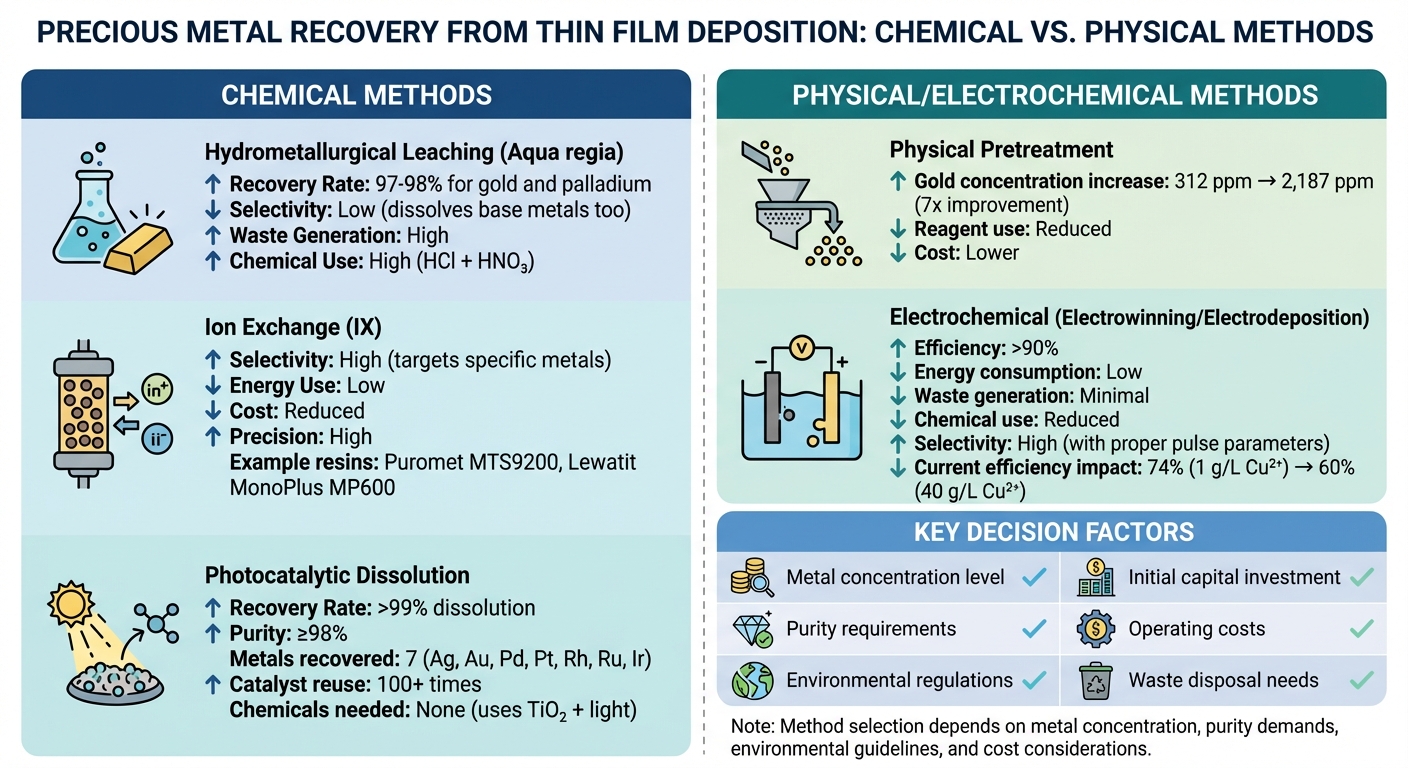
Precious Metal Recovery Methods: Chemical vs Physical Approaches Comparison
Chemical Dissolution and Refining
Hydrometallurgical leaching dissolves precious metals using acidic or alkaline solutions. Aqua regia, a blend of hydrochloric acid (HCl) and nitric acid (HNO₃), is highly effective, achieving 97–98% recovery rates for gold and palladium[11]. However, its lack of selectivity means it also dissolves base metals like copper, zinc, and nickel, which complicates purification processes.
Ion exchange (IX) provides a more selective approach. Resins such as Puromet MTS9200 and Lewatit MonoPlus MP600 can capture precious metal chlorocomplexes even at low concentrations. This method is praised for its lower energy needs, reduced costs, and high precision[4]. For rhodium recovery, neutralizing the solution to a pH of about 7 before using strong base resins significantly improves sorption efficiency[4].
Solvent extraction (SX) separates metal ions by transferring them from an aqueous solution to an organic phase using extractants like D2EHPA or Cyanex 923. While effective, SX typically requires more chemicals than ion exchange[10].
A newer approach, photocatalytic dissolution, uses light and a titanium dioxide (TiO₂) catalyst to recover precious metals without relying on strong acids or cyanide. This kilogram-scale process has successfully recovered seven metals – silver, gold, palladium, platinum, rhodium, ruthenium, and iridium – from electronic waste. The TiO₂ catalyst was reused over 100 times, achieving over 99% dissolution and recovery purities of at least 98%[2].
After chemical treatment, physical methods can further enhance recovery efficiency.
Physical Recycling and Target Reclamation
Physical pretreatment helps concentrate precious metals before chemical recovery, cutting down on reagent use and costs. For instance, manually dismantling hard disk drives can increase gold content from 312 ppm to 2,187 ppm – a sevenfold improvement compared to bulk shredding[13]. Additional techniques like mechanical comminution and thermal delamination separate catalytic layers from substrates, preparing materials for either chemical dissolution or direct reuse.
Electrochemical methods such as electrowinning and electrodeposition recover metals by depositing them onto cathodes using electric currents. These processes reduce chemical use and minimize waste generation[12]. Specific pulse parameters can even enable selective recovery in solutions containing multiple metals and interfering ions[3]. Stefanos Mourdikoudis from the Flemish Institute for Technological Research (VITO) highlighted:
"Electrochemical recycling alternatives have proven beneficial in sustainability, efficiency, performance and cost versus traditional methods."[12]
While electrochemical approaches are energy-efficient and cost-effective, they must be carefully weighed against chemical methods for specific applications.
Comparing Recovery Methods
Both chemical and physical recovery methods have distinct strengths. Choosing the right approach depends on metal concentration, purity demands, environmental guidelines, and cost considerations. Chemical techniques like aqua regia leaching achieve high recovery rates of 97–98%, but they generate significant waste and require extensive chemical handling. On the other hand, physical and electrochemical methods consume less energy, produce minimal waste, and can achieve over 90% efficiency[12]. However, they often require higher initial investments in specialized equipment.
Selectivity is another key factor. Aqua regia dissolves a wide range of metals, while ion exchange and electrochemical methods target specific precious metals, leaving impurities behind. For example, in electrochemical recovery, the presence of oxidants like Fe³⁺ and Cu²⁺ can reduce current efficiency – from 74% at 1 g/L Cu²⁺ to 60% at 40 g/L Cu²⁺ – due to increased solution corrosiveness[3]. In thin-film applications, where metals are present in low concentrations across large areas, ion exchange and electrochemical methods often prove more economical than traditional chemical approaches.
Allan Chemical Corporation supports both chemical and electrochemical recovery strategies with its technical-grade reagents, promoting efficient and responsible recovery solutions.
This content is for informational purposes only. Consult official regulations and qualified professionals before making sourcing or formulation decisions.
Key Precious Metals Recovered
Gold and Platinum
Gold stands out as the most economically important metal recovered during thin film deposition. Its exceptional conductivity and resistance to corrosion make it indispensable in semiconductor manufacturing. Due to inefficiencies in Physical Vapor Deposition (PVD), there’s significant potential for recovery. For instance, improving gold recovery by just 1% can save over $700 per kilogram of evaporated gold[9]. This not only reduces costs but also supports sustainable practices in the deposition process.
The value of gold goes far beyond its market price, which ranges between $70–$80 per gram for bulk material[6]. Its electrical properties and durability make it a key material in applications like transistor thin films, bond wires, and electrical contacts. Interestingly, printed circuit boards (PCBs) contain 300–400 grams of gold per metric ton, a stark contrast to mined ore, which typically holds just 5–10 grams per ton[13]. Although gold makes up less than 1% of a mobile phone’s weight, it accounts for 75% of the device’s total recovery value[13].
Platinum is another crucial metal, particularly for electronics that demand high conductivity and resistance to oxidation[6]. Ultra-high-purity platinum (99.999%) is essential for advanced PVD processes to prevent "spitting", a phenomenon where droplets are ejected during deposition, potentially damaging microelectronic circuits[16]. Both platinum and gold can be refined to such purity levels, allowing recovered materials to perform as effectively as newly mined ones. Alongside these, metals like palladium and silver also play a critical role in electronics manufacturing.
Palladium and Silver
In addition to gold and platinum, palladium and silver are vital to modern electronics. Palladium is used extensively in specialized components and plating for PCBs. These boards typically contain around 110 grams of palladium per ton[13], and recovery processes can achieve purities as high as 99.9%[14]. The concentration of palladium in electronic waste is significantly higher than in natural ore deposits, making recovery a more cost-effective alternative to traditional mining.
Silver, another key material, is widely used in photovoltaic panels and PCBs due to its excellent conductivity. PCBs often contain up to 250 grams of silver per ton[13]. In September 2024, researchers at the University of L’Aquila demonstrated the "Gold-REC1" process for recovering silver from end-of-life solar panels. This method uses a leaching system with sulfuric acid, ferric sulfate, and thiourea to achieve a 99% silver recovery rate in just 120 minutes at 104°F (40°C). The leftover solids can be refined into high-purity silicon for industrial use, showcasing a model for sustainable solar waste management[15]. This process highlights how recovery efforts align with both economic and environmental priorities.
Allan Chemical Corporation provides technical-grade reagents tailored for chemical dissolution and electrochemical recovery processes, enabling manufacturers to optimize recovery rates while maintaining a commitment to environmental stewardship.
This content is for informational purposes only. Consult official regulations and qualified professionals before making sourcing or formulation decisions.
Sustainability and Circular Economy
Reducing Waste and Environmental Effects
Efforts in sustainability are reshaping how we approach waste management and resource conservation, especially in the context of metal recovery. Recovering precious metals plays a key role in tackling electronic waste while preserving limited natural resources. For example, in 2022, the world generated 62 million tons of waste electrical and electronic equipment (WEEE), containing metals valued at about $91 billion [18]. By 2050, managing an estimated 78 million tons of end-of-life photovoltaic modules will become a pressing issue [19]. These recovery efforts turn waste into valuable secondary materials, reducing the need for environmentally harmful primary mining activities.
Recycling copper from printed circuit boards can save up to 85% of the energy required for producing copper from raw materials [17]. Hydrometallurgical recovery methods for copper emit between 13.0 and 40.3 kg CO₂-equivalent per kilogram of copper. Additionally, advanced recovery techniques now achieve impressive efficiencies, such as 99.9% silver leaching from photovoltaic cells and recovery rates of 94.8% for silver, 99.1% for gold, and 99% for palladium from copper anode slimes [17][18][19]. These advancements have encouraged collaboration within the industry to integrate recovery technologies into manufacturing processes more effectively.
Industry Partnerships for Recovery
Industry partnerships have been instrumental in driving forward innovative recovery methods. By working together, material suppliers, equipment manufacturers, and refiners are creating closed-loop systems that enhance resource efficiency. One example is TANAKA Kikinzoku Kogyo K.K., which launched the "TANAKA Green Shield" cleaning method in January 2024. This system uses nickel-plated plates to chemically detach platinum group metal films without damaging the substrate, with a goal of improving platinum group metal recovery rates by 600% by 2025 [21].
Vacuum Engineering & Materials (VEM) has also developed a closed-loop reclamation service for semiconductor and physical vapor deposition (PVD) system components at its Dallas facility. Their robotic Twin Wire Arc Spray (TWAS) system applies aluminum layers to shield kits, enabling chemical removal of precious metals. This process offers a quick turnaround of 7–10 business days for cleaning, inspection, and recovery [20].
Allan Chemical Corporation plays a supporting role by providing technical-grade reagents that facilitate these recovery processes. This approach aligns with the principles of a circular economy, converting manufacturing waste into high-purity secondary materials. By doing so, industries can reduce resource consumption in electronics and renewable energy production while maintaining operational efficiency.
This content is for informational purposes only. Consult official regulations and qualified professionals before making sourcing or formulation decisions.
Recent Developments and Future Outlook
New Recovery Technologies
New methods are reshaping how industries recover precious metals from thin film processes. In February 2025, researchers at the State Key Laboratory of Advanced Processing and Recycling of Non-Ferrous Metals at Lanzhou University of Technology introduced a WO₃ nanoparticle photochemical method. This approach enriches noble metals in just 20 minutes, achieving over 93% recovery rates for gold and platinum. The process produces particles with 99.9% purity, measuring approximately 60 nm for gold and 5 nm for platinum [1].
In February 2026, another breakthrough emerged with photo-regenerative nanocarbon aerogels, developed through a collaboration between Jiangnan University and Nanyang Technological University. Using a phenol-quinone redox cycle, this method achieves an ultrahigh adsorption capacity of about 15,925.5 mg/g for gold while maintaining an operational lifespan of more than 250 hours [22]. This innovation significantly cuts electricity usage by 88.4% and reduces reagent consumption by 97.7% compared to earlier materials. As Xuemin Chen and colleagues explained:
the system "achieves over threefold higher capacity and a tenfold longer operational lifetime" than existing solutions [22].
Another advancement, Electrochemically Assisted Aqueous Reduction (EAR), enables selective gold recovery from complex multimetal solutions containing copper, iron, nickel, zinc, and aluminum, all without the need for additional chemical reagents [3]. Companies are also leveraging AI-driven waste characterization and advanced electromagnetic sensor sorting. For example, Nucor Corporation has upgraded its U.S. facilities with these technologies to boost feedstock yield for automotive and electric vehicle components. Similarly, Aurubis AG has expanded its e-waste division with new hydrometallurgical processes [23]. These innovations are not only transforming the market but also guiding strategic investments.
Market Growth and Challenges
With these technological advancements, the market is poised for considerable growth. The global metal recycling market, valued at $54.5 billion in 2022, is projected to reach $92.2 billion by 2031, growing at a compound annual rate of 6.8% [23]. The Indium Tin Oxide (ITO) market, critical for next-generation 5G/6G telecommunications and AI-related semiconductor applications, was valued at $1.8 billion in 2025 and is expected to grow to $2.3 billion by 2030 [10].
However, material scarcity poses a major challenge. Indium prices, for instance, rose sharply from about $315/kg in 2020–2021 to $867/kg by January 2026 [10]. Since indium is a by-product of zinc, lead, and copper mining, its availability is closely tied to the production of these base metals [10]. Regulatory shifts are also influencing the market. While indium remains classified as a critical metal in the United States and Canada, the European Union removed it from its critical list in 2023 due to increased regional sourcing exceeding consumption levels [10].
Allan Chemical Corporation is supporting these evolving recovery processes by supplying technical-grade reagents that help manufacturers navigate changing market demands and regulatory landscapes.
This content is for informational purposes only. Consult official regulations and qualified professionals before making sourcing or formulation decisions.
Conclusion
Recovering precious metals from thin film deposition is becoming increasingly important, both economically and environmentally. For instance, indium prices have surged from around $315/kg in 2020–2021 to a projected $867/kg by January 2026. Secondary sources now supply 52% of the global indium market as of 2023, making reclamation efforts a critical part of the supply chain [10].
Advances in technology have made recovery processes faster, cleaner, and more efficient. Photochemical techniques, for example, can recover over 93% of gold and platinum in just 20 minutes [1]. Considering that modern smartphones contain up to 0.034 grams of gold each and server boards can hold as much as 2 grams per unit, electrochemical recycling of e-waste has emerged as a valuable resource for urban mining [24]. These advancements are paving the way for greener, more efficient recovery methods.
The move toward green chemistry and electrified metallurgy is reshaping how industries handle metal recovery. As Abhishek Trivedi and colleagues emphasized, methods like laser ablation offer:
a rapid, chemical-free, and highly selective approach, reducing both environmental impact and operational costs [6].
Additionally, the growing demand for ITO (Indium Tin Oxide) underscores the need for continued innovation in this field [10].
In this rapidly changing environment, integrated chemical solutions are vital. Allan Chemical Corporation supports these advanced recovery efforts by providing technical-grade reagents that help manufacturers meet evolving market and regulatory demands. With rising metal prices, cutting-edge recovery technologies, and sustainability priorities, the importance of reclaiming precious metals in thin film deposition industries will only grow in the years to come.
This content is for informational purposes only. Consult official regulations and qualified professionals before making sourcing or formulation decisions.
FAQs
Which recovery method fits my thin-film process?
The most effective recovery method varies based on your deposition technique and the level of purity you need. For Physical Vapor Deposition (PVD) methods, such as sputtering or evaporation, approaches like vacuum evaporation or multistage condensation work well to recover metals like gold, silver, or platinum. On the other hand, Chemical Vapor Deposition (CVD) or chemical processes benefit from techniques like chemical reduction and precipitation, which are excellent for extracting metals from scrap or waste while ensuring high purity and safe handling practices.
How do I estimate ROI from metal recovery?
To figure out ROI, start by comparing the value of the metals recovered – such as gold, silver, or copper – with the costs involved in the recovery process. Begin by calculating the total value of the metals based on current market prices. Then, subtract all associated costs, including expenses for chemicals, energy, labor, and equipment.
Once you have the net profit, divide it by the initial investment to get the ROI. For precise calculations, rely on detailed data about the quantities of metals recovered, market prices, and all related costs. You can also use financial tools like net present value (NPV) or the payback period to strengthen your analysis.
What purity can reclaimed metals reach for redeposition?
Reclaimed precious metals can reach purity levels up to 99.999%. Such exceptional refinement is crucial for high-tech uses, including thin film deposition. In these applications, ultra-pure materials like gold are indispensable for ensuring top-tier performance.




Comments are closed