
Smart emulsifiers make low-fat foods taste just as creamy and satisfying as full-fat versions. By using tiny, edible particles from natural sources like egg yolks and soy protein emulsifiers, these agents transform liquid oils into gel-like textures. This means you can enjoy indulgent foods, like dressings and desserts, with less fat and fewer calories – without sacrificing texture or flavor.
Here’s how they work:
- Thicker Barriers: They create a thicker interface between oil and water, slowing fat breakdown during digestion.
- Custom Textures: Ingredients like xanthan gum and whey protein mimic the smoothness of full-fat products.
- Nutrient Delivery: They also carry vitamins and antioxidants, adding health benefits.
Recent methods, like High Internal Phase Pickering Emulsions (HIPEs), have made it possible to turn healthy oils into stable, low-fat alternatives. These emulsifiers are already used in products like sauces, spreads, and even 3D-printed foods, helping manufacturers meet consumer demand for healthier options.
How Smart Emulsifiers Work
Smart emulsifiers go beyond the basic mixing of oil and water. They form responsive interfaces and intricate networks that allow for fat reduction without sacrificing taste or texture. Here’s how these advanced emulsifiers achieve this balance in food formulations.
Mechanism of Fat Reduction
The secret to fat reduction lies in how smart emulsifiers modify the interface between oil and water. Unlike traditional surfactants, which form thin layers under a nanometer thick, smart emulsifiers create much thicker barriers – often between 5 and 10 nanometers. These thicker layers slow down the activity of lipase, the enzyme responsible for breaking down fats.
In early 2025, the Yili Group‘s Global Innovation Center in Hohhot, working with Jiangnan University, developed a groundbreaking fat-mimetic emulsion. Under the guidance of Caiyun Wang and Professor Fang Zhong, the team created emulsions with water-based cores encased in thin oil layers. This design cut fat content by over half while maintaining stability through sterilization at 194°F for 30 minutes and long-distance transport in 30-ton tanks [2].
Another approach uses anionic polysaccharides, such as xanthan gum, which form bridges with cationic protein-coated droplets. This interaction creates a three-dimensional network that increases viscosity, mimicking the creamy texture of full-fat products. A 2015 study by Wu and McClements demonstrated that adding just 0.02% xanthan gum to a system with 5% protein-coated fat droplets at pH 3 significantly boosted viscosity and elasticity. This technique is ideal for creating reduced-fat dressings and sauces [3].
"Manipulating the aggregation state of fat droplets in emulsions may provide a useful means of controlling their textural and mouthfeel properties and creating reduced fat products."
– Bicheng Wu and David Julian McClements [3]
In digestion, lipids form mixed micelles – tiny structures about 4 nanometers in diameter that include bile salts, fatty acids, and phospholipids. By delaying the release of these lipids, smart emulsifiers can promote early satiety and help manage post-meal fat absorption [5].
Key Properties of Smart Emulsifiers
What sets smart emulsifiers apart is their ability to respond to environmental triggers, making them adaptable to the demands of modern food formulations.
pH Sensitivity: Functional groups like carboxy, amine, or phenolic groups can change their charge depending on the pH. This alters how the emulsifier interacts at the oil-water interface. Protein-polysaccharide complexes, for example, can stabilize emulsions across a wide pH range (pH 2, 4, and 7), making them suitable for foods that undergo acidification or encounter different pH levels during digestion [6].
Temperature Responsiveness: Some emulsifiers use polymers like poly(N-isopropyl acrylamide) (PNIPAM), which change their structure or solubility at specific temperatures. Ionic surfactants become more hydrophilic above their Krafft point, while non-ionic surfactants grow more hydrophobic as their water-attracting groups dehydrate at higher temperatures. This property allows emulsions to remain stable during heat processing but release flavors or nutrients at body temperature [6].
Shear Sensitivity: High mechanical shear from processes like homogenization or sonication breaks bulk phases into smaller droplets. In smart emulsions, this shear also enhances flow and texture. Shear-thinning behavior – where viscosity decreases under stress but thickens again at rest – is especially useful for low-fat sauces, dressings, and even 3D food printing [6].
| Emulsifier Type | Interfacial Thickness | Primary Stabilization Mechanism | Environmental Sensitivity |
|---|---|---|---|
| Small-molecule Surfactants | 0.5–1 nm | Interfacial tension reduction | High (concentration dependent) |
| Globular Proteins | 1–5 nm | Electrostatic & Steric | High (pH near isoelectric point, heat) |
| Hydrocolloids (Polysaccharides) | 5–10 nm | Steric & Viscosity | Moderate (ionic strength) |
| Solid Pickering Particles | 10 nm–mm | Irreversible Steric Barrier | Low (highly stable) |
These properties highlight how smart emulsifiers can be tailored to create healthier, low-fat food products while maintaining desirable textures and stability.
This content is for informational purposes only. Consult official regulations and qualified professionals before making sourcing or formulation decisions.
sbb-itb-aa4586a
Step-by-Step Process for Fat Reduction Using Smart Emulsifiers
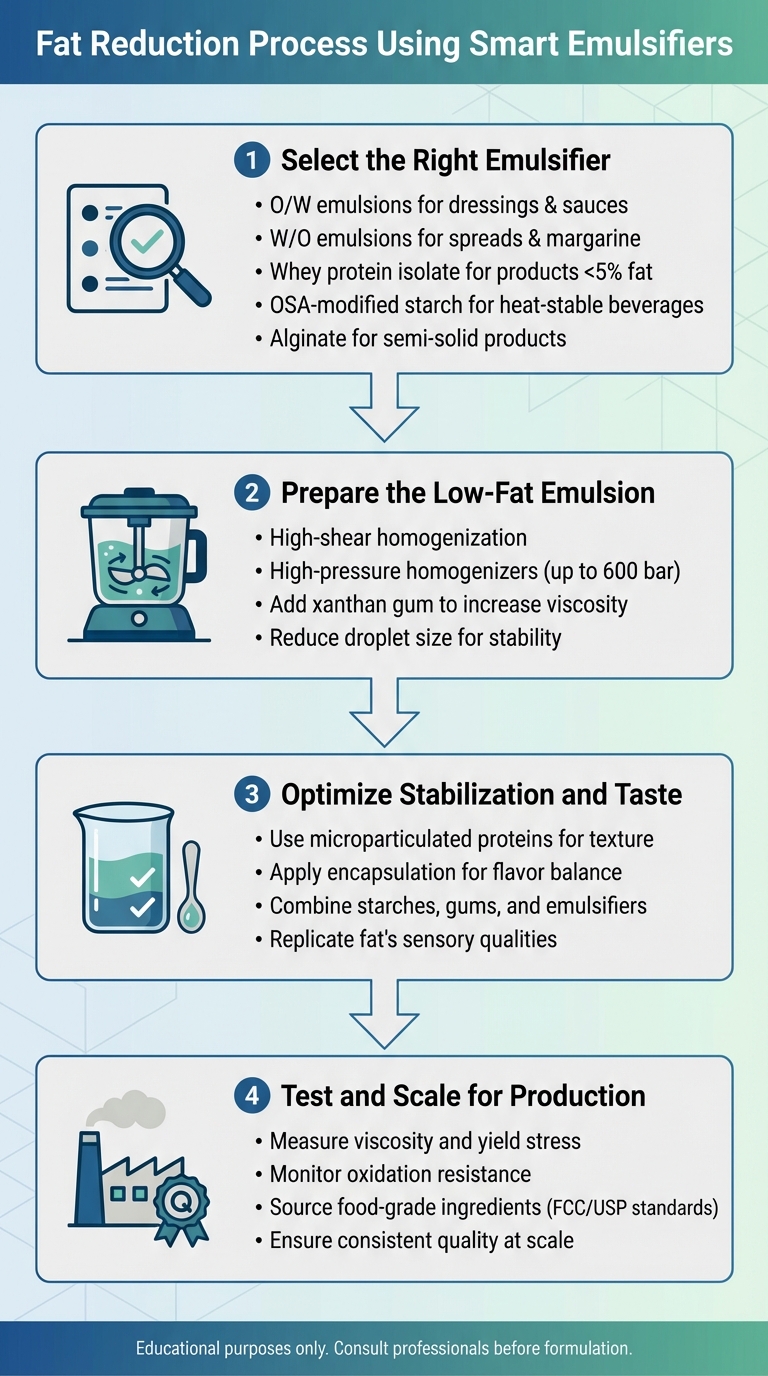
4-Step Process for Reducing Fat in Foods Using Smart Emulsifiers
Reducing fat in food products without compromising texture or flavor requires a careful, methodical approach. By selecting the right emulsifier, fine-tuning the mixing process, and conducting thorough testing, manufacturers can create products that meet consumer expectations while lowering fat content. Let’s break down the process.
Step 1: Selecting the Right Emulsifier
The first step is to evaluate the food’s structure and intended use. For liquid-based products like dressings or sauces, oil-in-water (O/W) emulsions work best. On the other hand, water-in-oil (W/O) emulsions are more suited for spreads or margarine aimed at reducing saturated fats.
When reducing fat content below 5%, appearance can be preserved with light-scattering agents like whey protein isolate. For shelf-stable beverages that require heat stability, OSA-modified starch creates a durable interface that can withstand thermal processing. In semi-solid products like mayonnaise, alginate-stabilized emulsion gels provide a unique thixotropic property – remaining firm at rest but flowing when stirred.
Here’s a quick reference table for different emulsifiers and their applications:
| Emulsifier/System | Primary Property | Best Application | Fat Reduction Capability |
|---|---|---|---|
| Xanthan Gum | Bridging flocculation & viscosity | Acidic sauces, dressings, and dips | High; mimics texture via droplet aggregation |
| Alginate | Thixotropic gel formation | Low-fat mayonnaise alternatives | High; creates stable semi-solid structures |
| OSA-Modified Starch | Thermal stability & encapsulation | Heat-processed functional beverages | Moderate; protects lipophilic vitamins |
| Pickering (Chitosan/GA) | Interfacial stability & bioavailability | Nutrient-fortified low-fat foods | High; stabilizes droplets via solid particles |
| Whey Protein Isolate | Light scattering & interfacial coating | Milky beverages and creamy desserts | Moderate; improves "creamy" appearance |
Recent research (2015–2023) highlights the growing interest in using emulsifiers not only to reduce fat but also as delivery systems for nutrients like omega‑3s, vitamins, and carotenoids, with 157 studies published on the topic [7].
Step 2: Preparing the Low-Fat Emulsion
Once the emulsifier is selected, the next step is mixing to achieve a stable emulsion. This involves high-shear homogenization, which breaks down fat droplets into smaller sizes, creating a texture similar to full-fat products. In some cases, high-pressure homogenizers operating at up to 600 bar are used for even finer droplet dispersion [7].
To prevent creaming and maintain stability, techniques such as reducing droplet size and increasing the viscosity of the aqueous phase are applied. For example, adding a small amount of xanthan gum to protein-coated droplets thickens the mixture while promoting controlled droplet aggregation. This approach replicates the spoonable consistency of mayonnaise without the added fat.
Step 3: Optimizing Stabilization and Taste
After forming a stable emulsion, the focus shifts to recreating the sensory experience of fats. Fat contributes to both texture and flavor, so its removal can leave products feeling and tasting flat. To address this:
- Microparticulated proteins are used to mimic fat’s lubricating properties.
- Encapsulation techniques help balance flavor release, preventing rapid dissipation that can reduce taste complexity.
Replicating fat’s sensory qualities often requires a combination of ingredients. Starches provide bulk, gums add viscosity, and emulsifiers ensure stability. This systems approach helps manufacturers achieve a balanced product [4].
Step 4: Testing and Scaling for Production
Before moving to large-scale production, lab tests are essential to confirm the emulsion’s performance. These tests measure properties like viscosity and yield stress, determining whether the product spreads easily or pours smoothly – both critical for consumer satisfaction. Additionally, when using sensitive ingredients like fish oil or omega‑3 fatty acids, oxidation resistance must be monitored to prevent off-flavors caused by exposure to oxygen.
As production scales up, sourcing high-quality ingredients becomes critical. For example, Allan Chemical Corporation provides food-grade emulsifiers and hydrocolloids that meet Food Chemicals Codex (FCC) and United States Pharmacopeia (USP) standards. Their products ensure consistent quality and come with technical support to help tailor formulations to specific needs.
This information is for educational purposes only. Always consult official regulations and qualified professionals before making sourcing or formulation decisions.
Applications of Smart Emulsifiers in Low-Fat Foods
Smart emulsifiers have become a cornerstone in creating low-fat products across a wide range of food categories. Whether it’s frozen desserts or chocolate bars, these systems ensure the desired texture and flavor are preserved while significantly reducing fat content. Each application comes with its unique challenges, but the versatility of these emulsifiers shines in various uses, particularly in emulsion gels, offering both health benefits and product appeal.
Use in Emulsion Gels
Emulsion gels, often called emulgels, combine the qualities of emulsions and gels to form stable structures that replicate the mouthfeel of high-fat products. Here’s how they work in different food applications:
- Processed meats: Emulgels restore the cohesiveness lost when fat is removed. A study from Hebei Agricultural University (February 2025) replaced 100% of pig backfat in sausages with ultrasound-modified almond protein isolate Pickering emulsions containing 75% soybean oil. This led to a 67% reduction in cooking loss alongside notable improvements in texture, such as increased hardness and chewiness [13].
- Low-fat spreads and dressings: Emulsifiers like MASEMUL® EM 3004 help stabilize these products, maintaining their freshness and consistency [8].
- Chocolate: Emulsifiers reduce the need for cocoa butter by 7% to 10%, enabling manufacturers to achieve the desired viscosity while lowering both fat content and production costs [11].
- Frozen desserts: By controlling fat globules and preventing the formation of large ice crystals, emulsifiers like Polysorbate 80 (used at a 0.5% concentration) enhance smoothness and slow melting. This ingredient is already found in over 2,300 food products, including ice cream [9].
- Baked goods: Emulsifiers play a critical role in maintaining volume and tenderness in reduced-fat recipes. They stabilize air bubbles during baking, ensuring a light and airy texture. As Devane Sharma from Musim Mas explains:
"In low-fat baking, emulsifiers are even more critical… providing extra volume by preserving air bubbles as the cake bakes" [8].
Impact on Consumer Health and Product Appeal
The benefits of smart emulsifiers extend beyond texture and structure – they also contribute to healthier food options. By replacing traditional fats (9 kcal/g) with protein-based emulsifiers (4 kcal/g), these systems significantly lower calorie counts [14]. For example, this calorie reduction is especially appealing in products like dressings and desserts, where indulgence often comes with a caloric trade-off.
In addition to calorie savings, these emulsifiers maintain the visual qualities that consumers associate with premium products. For instance, incorporating fat droplets at just 5% concentration can enhance the lightness (L* values) to over 90, creating the creamy white appearance that buyers expect [14].
Smart emulsifiers also double as carriers for nutrients such as vitamins, carotenoids, and omega-3 fatty acids. Their protein-based structures act as antioxidants, scavenging free radicals and preventing lipid oxidation, which can cause off-flavors and reduce shelf life [12][13]. This dual functionality – reducing fat while protecting sensitive nutrients – aligns with consumer demand for healthier, high-quality options.
However, there’s still room for improvement. Among more than 400 studies on low-fat emulsions, only 6.6% included rigorous sensory evaluations, indicating a need for further research to ensure these products meet consumer expectations beyond lab results [10].
Smart emulsifiers are paving the way for low-fat foods that don’t compromise on taste, texture, or nutrition, offering solutions that cater to both health-conscious consumers and industry demands.
This content is for informational purposes only. Consult official regulations and qualified professionals before making sourcing or formulation decisions.
Conclusion
Smart emulsifiers are reshaping how low-fat foods are made, offering solutions that preserve both texture and flavor. By converting liquid oils into solid gels, they create three-dimensional networks that trap water, mimicking the creamy consistency of full-fat products. This innovation ensures that consumers can enjoy the familiar mouthfeel they expect, even in reduced-fat options.
Beyond texture, these emulsifiers bring functional benefits to a variety of food categories. They enhance oxidative stability in meats, prevent water leakage in dairy alternatives, and efficiently deliver nutrients like omega-3s and vitamins. The market’s growth from $1.8 billion in 2000 to $2.6 billion in 2005 highlights the increasing demand for healthier, high-quality food options [1]. By replacing calorie-dense fats (9 kcal/g) with protein-based alternatives (4 kcal/g), manufacturers can significantly cut calories without compromising on quality.
For producers, the advantages extend beyond health claims. Smart emulsifiers improve production efficiency, extend shelf life, and meet clean-label requirements. Meanwhile, consumers benefit from better gut health, increased dietary fiber, and products that maintain their sensory appeal. As Fang Zhong, a professor at Jiangnan University, explains:
"The future lies in science-based approaches that redefine what consumers can expect from dairy and non-dairy milk stability" [2].
The impact of these systems is clear, with examples like a 67% reduction in cooking loss in sausages [13] and improved product stability across applications. These advancements underscore the practical strategies discussed earlier, cementing smart emulsifiers as a cornerstone of modern food production.
This content is for informational purposes only. Consult official regulations and qualified professionals before making sourcing or formulation decisions.
FAQs
Are smart emulsifiers safe to eat?
Smart emulsifiers used in food products are regarded as safe for consumption. Before they can be approved, their safety undergoes thorough evaluation by research organizations and regulatory authorities. These processes ensure emulsifiers comply with strict standards, prioritizing both quality and consumer safety.
Do smart emulsifiers change how much fat your body absorbs?
Smart emulsifiers play a key role in enhancing food stability and texture by enabling oil and water to mix effectively. However, they don’t have a major impact on how much fat your body absorbs. While these emulsifiers can affect fat characteristics – such as droplet size and digestion – the actual absorption of fat is more influenced by the quantity consumed and an individual’s metabolism. Their primary purpose is to help create lower-fat foods with appealing textures, not to alter fat absorption rates.
Which foods work best with smart emulsifiers?
Smart emulsifiers work well in foods such as beverages, mayonnaise, creams, soups, sauces, cheeses, and high-fat baked goods. They allow for fat reduction while maintaining the texture and flavor that consumers expect.




Comments are closed