
Amino acids are natural compounds essential for skin hydration. They are key components of the Natural Moisturizing Factor (NMF), which helps the skin retain water. These molecules attract moisture through hydrogen bonding, pulling water from the air and deeper skin layers into the outermost layer, the stratum corneum. This process prevents dryness, improves elasticity, and supports the skin barrier.
Here’s what you need to know:
- Hydration Mechanism: Amino acids bind water through their hydrophilic groups (-NH₂ and -COOH), forming strong hydrogen bonds.
- NMF Composition: Free amino acids make up about 40% of NMF. Other components include Sodium, Chloride, PCA, and Urea.
- Top Performers: L-Serine (36%), Glycine (22%), and L-Alanine (13%) are the most abundant amino acids in NMF.
- Skin Benefits: They improve elasticity by reducing keratin fiber tension and allow skin cells to swell, enhancing suppleness.
- Environmental Impact: Factors like low humidity, aging, and cleansing can deplete amino acid levels, causing dryness.
Amino acids are also used in skincare formulations to boost hydration. Combining them with occlusives, like petrolatum, helps lock in moisture, ensuring long-lasting hydration. Proper sourcing of high-purity amino acids ensures stable, skin-friendly products.
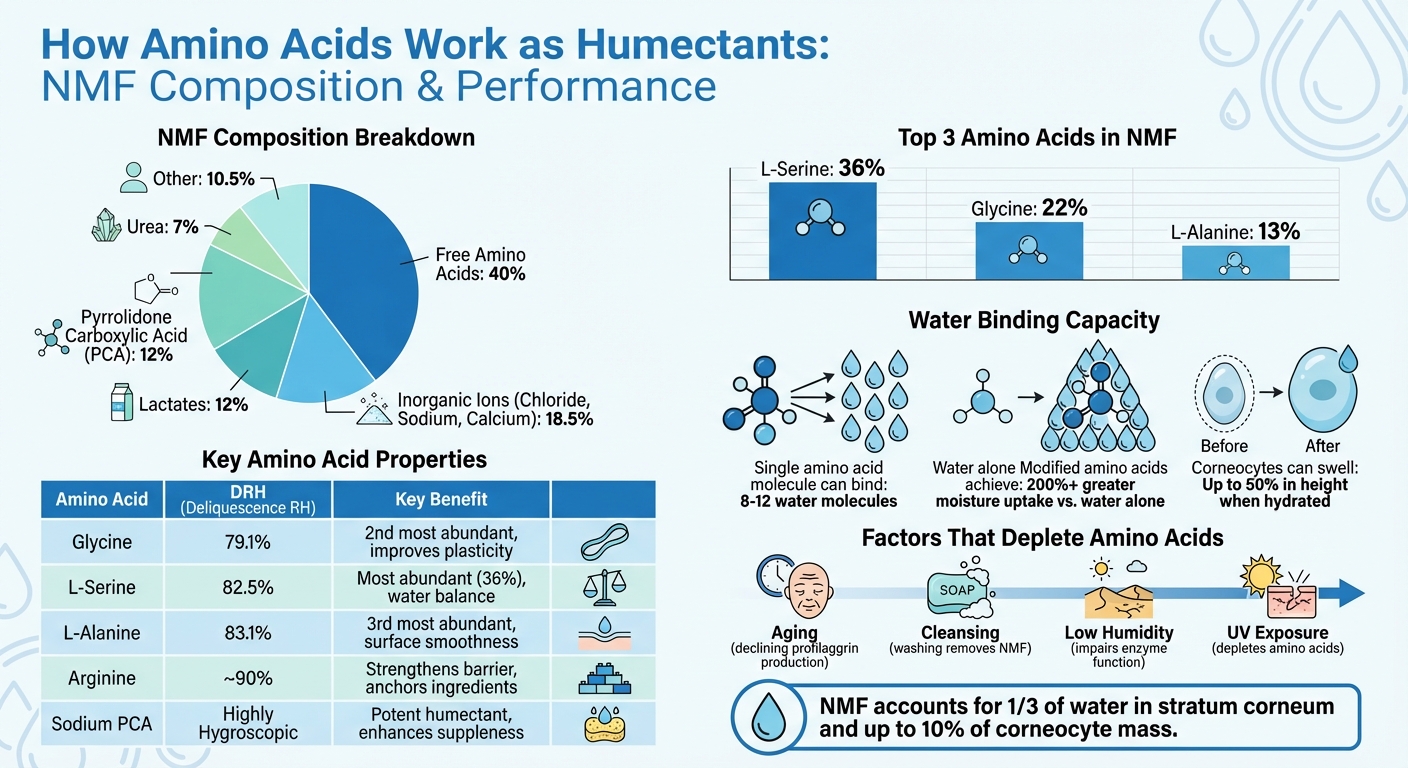
Natural Moisturizing Factor (NMF) Composition and Key Amino Acids for Skin Hydration
Humectants – Everything you need to know | Doctor Anne
sbb-itb-aa4586a
How Humectants Attract and Hold Water
Humectants rely on hydrophilic groups, such as –OH and –NH, to form hydrogen bonds with water. This interaction creates osmotic potential, which draws moisture into corneocytes from both the surrounding air and deeper layers of the skin [4][5]. Interestingly, components of the Natural Moisturizing Factor (NMF) can retain water effectively, even when relative humidity dips as low as 50% [4]. Chiyoung Kang Park, a Medical Marketing Specialist at ISDIN, describes their role:
"NMFs behave like magnets. They attract water and hold onto it, creating a reservoir of hydration that even the best cream can’t fully replicate if NMF levels are off" [6].
Humectants also regulate osmotic pressure in the skin, which is critical for maintaining balance. Excessive water absorption can lead to wrinkling, like what happens during prolonged water exposure, while insufficient water retention can cause cell shrinkage and dryness, manifesting as flaking, scaling, or cracking [4][5]. About one-third of the water in the stratum corneum is held by NMF, contributing significantly to skin elasticity.
When the skin is hydrated, amino acids within the NMF ionically interact with keratin fibers, reducing intermolecular forces. This interaction enhances the skin’s elasticity and suppleness, allowing corneocytes to swell by up to 50% [8]. This water-binding process is a hallmark of the NMF, with amino acids playing a central role in maintaining skin hydration.
Amino Acids in Natural Moisturizing Factor (NMF)
The hydrating power of humectants is amplified by the amino acids in NMF, which naturally help sustain moisture levels. NMF itself is a blend of water-soluble compounds that work together to keep the skin hydrated. Free amino acids make up roughly 40% of NMF’s composition [3][5].
Other key components include inorganic ions like chloride, sodium, and calcium (18.5%), pyrrolidone carboxylic acid (PCA) and lactates (12% each), and urea (7%) [5]. These elements collectively account for up to 10% of a corneocyte’s total mass and 20–30% of the dry weight of healthy outer skin cells [4][5][7].
Within the amino acid group, L-serine is the most prevalent, making up 36%, followed by glycine at 22% and L-alanine at 13% [3]. This specific composition is crucial for retaining moisture and supporting the skin’s barrier function. Interestingly, the conversion of filaggrin into these water-attracting amino acids is humidity-dependent. In high humidity, filaggrin remains stable, but in dry conditions, it breaks down to release these amino acids, helping to protect the skin from dehydration [4].
This content is for informational purposes only. Consult official regulations and qualified professionals before making sourcing or formulation decisions.
How Amino Acids Attract and Retain Moisture
Water Binding and Retention
Amino acids have a remarkable ability to bind and hold water, thanks to their unique structure. Each amino acid contains a basic (-NH₂) group and an acidic (-COOH) group, along with side chains that act as binding sites for water molecules [10][3]. These polar groups form hydrogen bonds with water, creating a strong attraction that draws moisture into the skin.
The capacity of amino acids to hold water varies based on their structure. Research shows that 8–12 water molecules can associate with a single molecule of certain amino acids, like N-hydroxyserine or L-homoserine [9][3]. The oxygen-to-carbon (O/C) ratio plays a critical role – amino acids with higher O/C ratios and more electronegative atoms tend to absorb more moisture [3]. In fact, some modified amino acids can achieve over 200% greater moisture uptake compared to water alone [9][3].
Water in the skin exists in three states: bound (tightly attached to keratin chains), partially bound (loosely held at secondary sites), and mobile (free-moving) [11]. Bound water remains stable regardless of humidity, while partially bound and mobile water levels fluctuate with environmental changes [11]. This layered water retention system helps the skin stay hydrated, even in varying humidity levels. Once water is bound, its interaction with keratin fibers ensures it remains locked in place.
Interaction with Keratin Filaments
After binding water, amino acids take things a step further by securing moisture through interactions with keratin, the skin’s structural protein. Hydrated amino acids form ionic bonds with keratin fibers, reducing the forces between the fibers [4]. This process enhances the elasticity and flexibility of the stratum corneum, allowing skin cells (corneocytes) to swell by approximately 50% in height when fully hydrated [8].
"Hydrated NMF (particularly the neutral and basic amino acids) forms ionic interactions with keratin fibers, reducing the intermolecular forces between the fibers and thus increasing the elasticity of the stratum corneum." – Practical Dermatology [4]
Keratin filaments also act like "polymer brushes", creating long-range repulsion that encourages swelling and moisture retention [8]. When fully hydrated, the distance between α-helical polypeptides in keratin filaments increases from about 9.5 Å in dry conditions to 10.7 Å, highlighting the structural expansion driven by water [8]. This transformation helps the skin shift from a dry, brittle state to one that is supple and resilient, improving both texture and barrier performance.
This content is for informational purposes only. Consult official regulations and qualified professionals before making sourcing or formulation decisions.
Common Amino Acids Used for Hydration
Amino acids play specific roles in maintaining hydration within the stratum corneum, each contributing unique properties.
Alanine and Arginine
Alanine makes up about 13% of the skin’s natural moisturizing factor (NMF) and penetrates deeply into the stratum corneum, enhancing hydration [3] [12] [13].
Arginine helps retain moisture and strengthens the skin’s barrier. As a precursor to urea, it replenishes urea levels in skin affected by aging or conditions like atopic dermatitis [4]. Its positive charge across pH levels from 4 to 9 supports tensile strength and surface hydrophobicity, making it highly effective [2] [4].
Glycine and Glutamine
Glycine, the second most abundant amino acid in NMF at 22%, penetrates deeply and efficiently attracts water, even in environments with 50% relative humidity [3] [4] [12] [2].
Glutamine enhances skin flexibility by contributing to the amino acid balance in the stratum corneum. Its ability to form ionic bonds with keratin fibers when hydrated helps reduce intermolecular forces, improving skin elasticity [4].
Histidine and Asparagine
Histidine is particularly beneficial for aging skin. As amino acid levels naturally decline with age, reduced histidine content is linked to lower hydration. Its positive charge allows it to bind effectively with skin proteins, ensuring hydration across a range of pH levels [2] [4].
Asparagine, with its high moisture-attracting properties (O/C ratio of 0.75 and a deliquescence relative humidity of 91.2%), plays a key role in retaining water within the stratum corneum [3].
These amino acids highlight the intricate ways in which hydration is maintained, setting the foundation for further exploration of factors influencing their performance.
This content is for informational purposes only. Consult official regulations and qualified professionals before making sourcing or formulation decisions.
Factors That Affect Amino Acid Performance
Keeping amino acids effective in maintaining the skin’s Natural Moisturizing Factor (NMF) is crucial for proper hydration. However, their performance can be influenced by aging, cleansing habits, environmental factors, and how they are formulated into skincare products.
Effects of Aging and Cleansing
Aging impacts amino acid levels in the skin. As we age, the production of profilaggrin – a precursor to amino acids – declines, leading to drier, less elastic skin [4]. This reduction contributes to conditions like xerosis (extremely dry skin), itching, and reduced elasticity. For mature skin, replenishing the NMF becomes essential to maintain hydration and skin health.
Cleansing strips amino acids from the skin. Regular washing can wash away water-soluble amino acids from the skin’s surface. For instance, soaking the forearm in warm water (104°F/40°C) for just 10 minutes significantly reduces amino acid levels [3]. While deeper layers of the stratum corneum can recover amino acid levels within a few hours, the outermost layers require the natural shedding of dead skin cells and the migration of new keratinocytes to fully restore NMF [3]. As highlighted in Practical Dermatology:
"Routine soap washing of the skin has been shown to remove the NMF from the superficial layers of the stratum corneum" [4].
Environmental factors like low humidity and UV exposure also deplete amino acids. These conditions impair the enzymes responsible for breaking down filaggrin into free amino acids, leading to dryness and flaking [4][14]. Without sufficient hydration, the enzymes that facilitate natural exfoliation cannot function properly, causing visible scaling and roughness [4][14].
To address these challenges, skincare formulations often include amino acids alongside other ingredients that help retain moisture.
Combining with Occlusives
Occlusives help lock in moisture attracted by amino acids. Ingredients like petrolatum, beeswax, or dimethicone form a barrier on the skin, reducing trans-epidermal water loss (TEWL) and preventing evaporation [15][1]. This protective layer ensures that the hydration provided by amino acids remains in the skin.
Layering different ingredient types enhances hydration. For the best results, start with amino acid-based humectants to draw moisture into the skin, follow with emollients to smooth and soften, and finish with occlusives to seal everything in [15]. This multi-step approach demonstrates how combining complementary ingredients can significantly improve hydration performance.
Using Amino Acids in Cosmetic Products
Formulating effective cosmetic products requires careful selection of amino acids and compatible ingredients. This ensures optimal moisture retention, product stability, and adherence to regulatory standards.
Comparison of Amino Acid Properties
Amino acids play a crucial role in moisture retention, with their performance influenced by molecular structure and ability to attract water. One key metric, Deliquescence Relative Humidity (DRH), measures how effectively an amino acid can absorb moisture from its surroundings. Lower DRH values indicate better water-attracting properties, especially in low-humidity environments [3]. Amino acids with high oxygen-to-carbon (O/C) ratios are particularly effective at retaining water [3].
| Compound | Deliquescence Relative Humidity (DRH) | Role in Skin/Hair | Effect on Elasticity/Structure |
|---|---|---|---|
| Glycine | 79.1% ± 0.2% [3] | Second most abundant NMF amino acid [3] | Helps bind water in the skin, improving plasticity [4] |
| L-Serine | 82.5% ± 3.7% [3] | Most abundant NMF amino acid (36%) [3] | Critical for maintaining water balance in the stratum corneum [3] |
| Arginine | ~90% (calculated) | Anchors other active ingredients [2] | Protects tensile strength during oxidative stress [2] |
| Sodium PCA | Highly Hygroscopic [3] | Potent humectant; 8–10% of NMF [3] | Relieves dry skin symptoms and enhances suppleness [4] |
| L-Alanine | 83.1% ± 11.0% [3] | Third most abundant NMF amino acid [3] | Improves surface smoothness and hydrophobicity [2] |
To maximize the benefits of arginine, formulate within a pH range of 4–9, allowing its cationic charge to bind effectively with proteins [2]. Using arginine salts can also facilitate better uptake of Sodium PCA [2]. For hair conditioners, adding 1.5% w/w L-alanine can enhance surface smoothness and improve texture [2].
Sourcing High-Quality Amino Acids
The effectiveness of cosmetic formulations also depends on sourcing high-purity amino acids. Technical-grade amino acids are preferred for their ability to deliver consistent performance while meeting regulatory requirements. Unlike hydrolyzed proteins, purified amino acids minimize issues like odor, discoloration, and potential allergic reactions [2]. This ensures stable and skin-friendly products.
Allan Chemical Corporation specializes in providing technical-grade and compendial-grade amino acids (USP, FCC, ACS, NF) backed by robust quality systems. With over four decades of experience serving regulated industries, they ensure reliable supply chains and offer just-in-time delivery. Their technical support team is also available to assist with documentation and formulation inquiries, making them a trusted partner for cosmetic formulators.
This content is for informational purposes only. Always consult official regulations and experts for sourcing and formulation decisions.
Conclusion
Amino acids play a critical role in skin hydration by binding water through their unique chemical properties. Their ability to attract and retain moisture is a cornerstone of the Natural Moisturizing Factor (NMF), with their effectiveness linked to factors like oxygen–carbon ratios and bond energies [3][9].
This moisture-binding capability has become a key element in developing advanced skincare formulations. By using purified amino acids, manufacturers can avoid issues like unpleasant odors, discoloration, and potential allergens, while producing stable, high-quality products. As Eiko Oshimura, PhD, from Ajinomoto Co., Inc., highlights:
"Using specifically chosen, purified amino acids instead of hydrolyzed protein apparently has some advantages, such as: the possibility of avoiding odor and color problems; formation of stable products of high quality; minimizing the risk of allergic reactions; and the possibility of designing custom blends" [2].
In addition, combining amino acids with occlusive agents helps lock in moisture, preventing evaporation. For instance, arginine can act as a "foundation" to improve the deposition and retention of other hydrating ingredients like PCA [2], ensuring long-lasting hydration.
To fully leverage these benefits, collaborating with experienced suppliers is crucial. Allan Chemical Corporation offers high-purity amino acids (USP, FCC, ACS, NF) and has over 40 years of expertise in regulated industries. Their technical support team provides assistance with documentation and formulation guidance, helping cosmetic manufacturers achieve reliable, high-quality results.
This content is for informational purposes only. Always consult official regulations and qualified professionals when making sourcing or formulation decisions.
FAQs
What makes amino acids effective humectants in skincare?
Amino acids are excellent humectants because they are naturally part of the skin’s Natural Moisturizing Factor (NMF), which plays a key role in keeping the skin hydrated. By attracting and holding onto water molecules, they help the skin stay moisturized and maintain its softness.
Unlike synthetic options like glycerin or urea, amino acids are naturally compatible with the skin, making them both gentle and effective. Studies indicate that certain modified amino acids can retain water even better than traditional humectants. Additionally, they support the skin’s barrier function, promoting hydration and repair. This combination of benefits makes amino acids a valuable ingredient in skincare products designed to enhance moisture and skin health.
What can affect the ability of amino acids to keep skin hydrated?
Several factors influence how well amino acids help hydrate the skin. External stressors, such as pollution and UV radiation, can harm the skin barrier, making it harder to retain moisture. Aging also plays a role, as it naturally reduces amino acid levels in the outermost skin layer (stratum corneum), leading to diminished hydration over time.
Temperature shifts, like going from a warm indoor space to cold outdoor air, can throw off the skin’s moisture balance. Certain skin conditions, such as atopic dermatitis, further hinder the skin’s ability to retain amino acids and stay hydrated. To get the most out of amino acids, it’s essential to shield the skin from both environmental and internal challenges.
Can amino acids be used with other ingredients to improve skin hydration?
Yes, amino acids can work alongside other ingredients to improve skin hydration. As essential parts of the skin’s natural moisturizing factor (NMF), amino acids like serine, glycine, and alanine help retain moisture and strengthen the skin barrier.
When combined with hydrating agents like hyaluronic acid, glycerin, or urea, amino acids enhance water absorption and maintain proper hydration levels. These pairings take advantage of the moisture-binding abilities of amino acids and their counterparts, making them effective in skincare products aimed at reducing dryness and promoting healthy, well-hydrated skin.




Comments are closed