
Mixing non-Newtonian fluids presents unique challenges due to their variable viscosity and complex flow behaviors. These fluids, unlike Newtonian fluids, change their viscosity under stress, making uniform mixing difficult in industrial applications like pharmaceuticals, food production, and cosmetics. Key issues include stagnant zones, uneven shear distribution, and scaling difficulties in larger production setups.
Key Points:
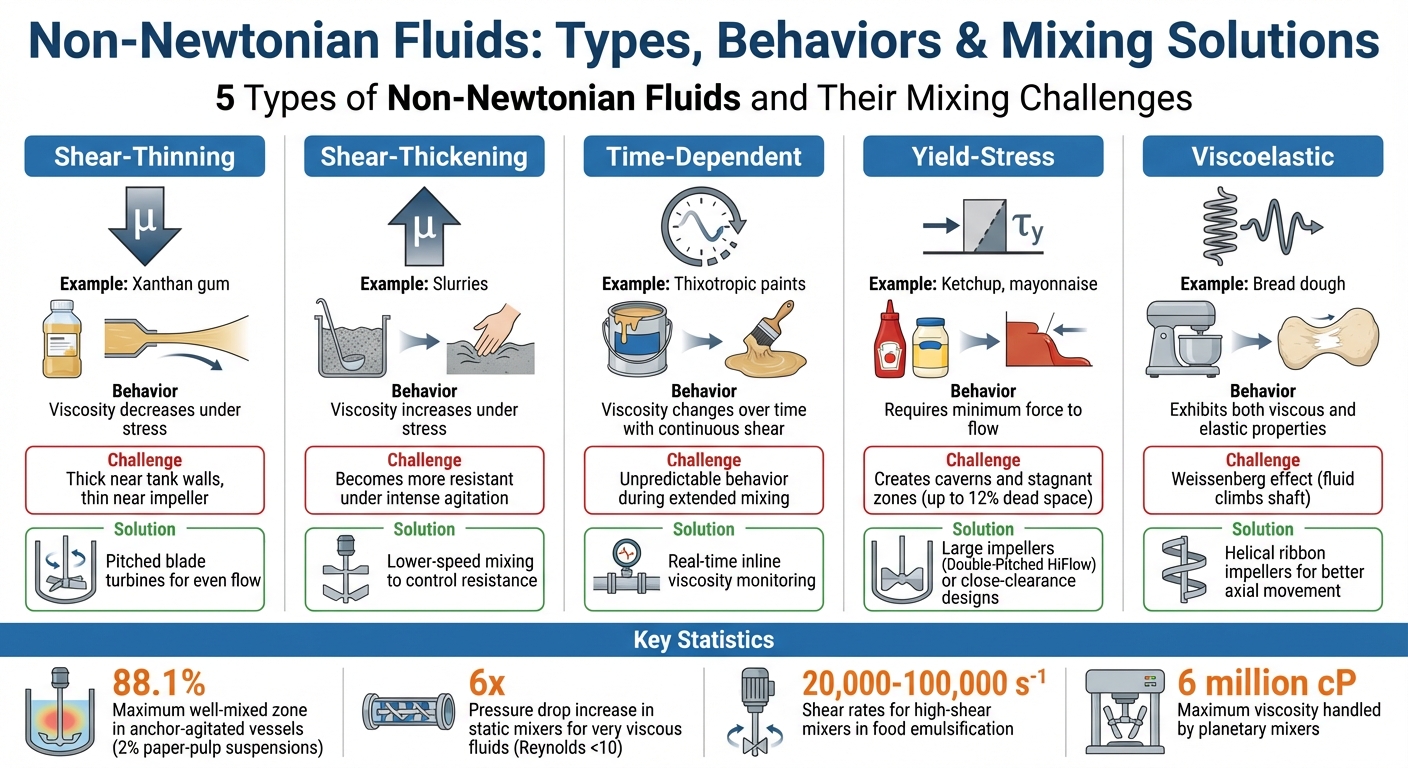
- Types of Non-Newtonian Fluids: Shear-thinning (e.g., xanthan gum), shear-thickening (e.g., slurries), time-dependent (e.g., thixotropic paints), yield-stress (e.g., ketchup), and viscoelastic (e.g., bread dough).
- Mixing Challenges:
- Stagnant zones around impellers, especially in high-viscosity fluids.
- Viscosity changes due to shear and temperature variations.
- Scaling from lab to production often leads to inefficiencies.
- Solutions:
- Use larger or multiple impellers, such as double-pitched or helical designs.
- Opt for equipment suitable for shear-sensitive products, like pitched blade turbines or multi-shaft mixers.
- Implement inline sensors (e.g., viscometers) for real-time monitoring and process control.
- Adjust injection techniques and use Computational Fluid Dynamics (CFD) for optimal mixing efficiency.
By selecting the right equipment, monitoring viscosity in real-time, and addressing specific fluid behaviors, industries can achieve consistent mixing results while reducing energy use and waste. These strategies are critical for ensuring product quality in applications such as creams, sauces, and high-viscosity pharmaceuticals.
5 Types of Non-Newtonian Fluids and Their Mixing Challenges
SPX FLOW Webinar – Mixing of Viscous and Non Newtonian Fluids – EMEA
Common Mixing Challenges in Non-Newtonian Fluids
Mixing non-Newtonian fluids comes with distinct challenges that stem from their unique flow behaviors. These difficulties can significantly impact industrial processes, especially when dealing with large-scale production.
Stagnant Zones and Cavern Formation
Fluids like ketchup, mayonnaise, and hair gel – classified as yield-stress fluids – require a certain level of force to start flowing. This characteristic often results in a "cavern" of movement around the impeller, leaving the rest of the tank largely stagnant. If the impeller is undersized for the vessel, the active mixing zone becomes confined to the center, failing to reach material near the tank walls. In highly viscous fluids, this problem intensifies, leading to incomplete mixing and inconsistent product quality.
For instance, research on anchor-agitated vessels shows that even at higher impeller speeds, the well-mixed zone might only cover about 88.1% of the tank volume when mixing fluids like 2% paper-pulp suspensions. This leaves over 10% of the tank as "dead space", which can reduce heat transfer efficiency, promote gel formation, and increase fouling. Additionally, stagnant zones can drive up energy consumption, compounding operational inefficiencies [1][5].
Viscosity Changes from Shear and Temperature
Non-Newtonian fluids often exhibit viscosity changes based on shear and temperature. Shear-thinning fluids, for example, become less viscous near the impeller but remain thick along the tank walls. On the other hand, shear-thickening fluids grow more resistant to flow under intense agitation. The heat generated during mixing further complicates this, as rising temperatures can alter viscosity and destabilize shear-sensitive products or emulsions.
Time-dependent behaviors add another layer of complexity. Thixotropic materials experience a gradual decrease in viscosity under continuous shear, while rheopectic fluids become thicker over time. Predicting these behaviors is difficult because measuring non-Newtonian fluids in a laboratory rarely replicate the exact shear and temperature conditions of an operating mixing tank [1].
Scale-Up Difficulties in Production Settings
Scaling a mixing process from a small lab setup to full-scale production is notoriously tricky with non-Newtonian fluids. Conventional scale-up methods, which rely on geometric, kinematic, and dynamic similarities, often fail to address the uneven flow patterns and dead zones these fluids create [5]. A process that works seamlessly in a 5-gallon pilot batch can encounter significant issues in a 500-gallon production tank.
One approach to mitigate these challenges is scaling based on constant impeller tip speed, which helps maintain a larger well-mixed zone while reducing energy demands [5]. However, as vessel size increases, viscoelastic properties – such as the Weissenberg effect, where fluid climbs the mixer shaft – can disrupt circulation patterns and further hike power consumption [3]. These unpredictable factors make achieving consistent results during scale-up a persistent challenge.
This content is for informational purposes only. Consult official regulations and qualified professionals before making sourcing or formulation decisions.
Solutions for Non-Newtonian Fluid Mixing Challenges
Tackling the unique challenges of mixing non-Newtonian fluids requires a thoughtful combination of specialized equipment, well-designed processes, and consistent real-time monitoring. These approaches have been successfully applied in industries like pharmaceuticals, food production, and cosmetics.
Using Large or Multiple Impellers
Small impellers often fail to mix evenly, leaving materials near the tank walls untouched. Oversized impellers – such as Double-Pitched HiFlow designs – are a better choice as they cover the entire vessel diameter, ensuring even mixing of viscous materials and eliminating stagnant zones [1]. In taller tanks, multi-tier impellers help by shortening the distance materials need to travel, further reducing dead zones [1].
For high-viscosity fluids, close-clearance impellers like anchors, gates, or helical ribbons are particularly effective. These designs sweep near the tank walls, keeping the material’s viscosity consistent and preventing buildup [1][2]. In cases where fluids have yield stress (e.g., xanthan gum solutions), coaxial systems that pair a wall-scraping anchor with a high-speed central impeller (like a pitched blade or Rushton turbine) provide both bulk flow and localized shear. This combination works well for shear-thinning fluids [5]. Another useful technique is eccentric agitation, where the stirrer shaft is placed off-center. This setup creates asymmetrical flow patterns, improving mixing efficiency and eliminating stagnant zones common in symmetrical designs [4].
Selecting Equipment for Shear-Sensitive Fluids
When working with shear-sensitive products like emulsions, creams, or biological suspensions, selecting the right equipment is crucial to maintaining product quality. Pitched blade turbines are often ideal because they promote axial flow (top-to-bottom circulation) without generating excessive shear that could destabilize delicate structures [1][5]. For extremely viscous fluids, helical ribbon impellers are preferred since they provide better axial movement compared to standard anchors, which primarily create tangential flow with limited vertical motion [5][3].
Baffles also play a role in mixing, but their use depends on the fluid’s viscosity. While low-viscosity fluids benefit from baffles to create turbulence, highly viscous fluids naturally resist flow, making excessive baffles counterproductive [1]. Additionally, when blending liquids of different viscosities, starting with the lower-viscosity fluid and gradually adding the higher-viscosity component can reduce energy requirements and even allow the use of a smaller motor [1].
Optimizing Injection and Flow Techniques
Injection and flow methods directly impact mixing efficiency. Introducing materials into the high-shear zone near the impeller speeds up incorporation, while Computational Fluid Dynamics (CFD) simulations can ensure the impeller design effectively handles the entire batch volume before scaling up [4][5][7].
For continuous processes, static mixers provide an alternative to traditional stirred tanks. These devices use fixed helical elements to divide and recombine flow streams, achieving efficient mixing in a short amount of time (seconds to minutes) [6]. However, for very viscous non-Newtonian fluids (with Reynolds numbers below 10), the pressure drop in pipes with helical static mixers can be about six times higher than in open conduits [6].
Using Inline Sensors and Process Controls
Inline sensors offer a powerful way to maintain control over mixing processes. For instance, inline viscometers like the Rheonics SRV use torsional resonators to continuously measure viscosity and temperature, avoiding issues like mechanical wear that can affect traditional rotational sensors [1]. This is particularly helpful since torque-based measurements often become unreliable in fluctuating process environments [1].
Other tools, such as combined density and viscosity sensors (e.g., Rheonics SRD), allow simultaneous monitoring of multiple parameters, ensuring the correct percent solids and overall mixture uniformity [1]. For opaque or highly concentrated suspensions, Electrical Resistance Tomography (ERT) provides a non-intrusive way to assess mixing by mapping flow velocity profiles and identifying stagnant zones [5]. When paired with automated dosing systems, these sensors enable closed-loop control, adjusting ingredient additions (like thickeners or solvents) based on continuous viscosity readings [1].
This content is for informational purposes only. Consult official regulations and qualified professionals before making sourcing or formulation decisions.
sbb-itb-aa4586a
Industrial Applications and Case Studies
Pharmaceuticals: Mixing High-Viscosity Solutions
In pharmaceutical manufacturing, achieving consistent mixing of high-viscosity products like creams, gels, and ointments is critical. Inline monitoring systems play a key role in ensuring Active Pharmaceutical Ingredients (APIs) are evenly distributed throughout each batch. Tools like inline viscosity sensors and near-infrared (NIR) systems provide continuous tracking of mixing profiles, helping to eliminate stagnant zones that could compromise dosage uniformity – a key quality requirement [1].
High-viscosity blending often generates temperature spikes, which can degrade sensitive compounds. To address this, scrapers on agitator blades improve heat transfer, though they also increase energy demands [8]. Inline sensors offer another advantage by detecting the precise endpoint of mixing when homogeneity is achieved. This allows operators to stop the process at the right moment, saving energy and reducing product waste [1].
These precise methods are equally important in other industries where product consistency and texture are critical.
Food and Beverage: Handling Shear-Sensitive Products
Producing food items like sauces, mayonnaise, and plant-based milk alternatives requires careful attention to maintain their texture and consistency. Many of these products are shear-thinning and time-sensitive, meaning excessive mixing can lead to permanent viscosity loss, rendering the product unusable [1]. Yield-stress fluids, which only flow when sufficient force is applied, further complicate mixing by creating localized zones of activity.
To address these challenges, multi-shaft mixers combine low-speed sweep blades with high-speed dispersers for uniform results [8]. Equipment must also support Clean-in-Place (CIP) cycles to ensure hygiene and prevent bacterial contamination [1]. High-shear mixers, operating at shear rates between 20,000 and 100,000 s⁻¹, are particularly effective for emulsification. However, they require precise control to avoid damaging delicate structures [9].
Cosmetics: Emulsification and Homogenization
Cosmetic products like lotions, creams, and hair gels also rely on precise emulsification to achieve the smooth textures consumers expect. High-shear rotor/stator mixers are the go-to equipment for blending immiscible fluids and ensuring uniformity [10][11]. For formulations with viscosities reaching several hundred thousand centipoise (cP), multi-shaft mixers combine high-speed rotor/stator action with low-speed agitation to maintain even temperature and flow throughout the batch [12].
For extremely thick formulations – up to 6 million cP – planetary mixers are used. These mixers feature blades that move through the product regardless of its flow behavior [12]. Additionally, solids/liquid injection manifolds help incorporate powders directly into high-shear zones, preventing dusting and clumping [12]. Inline viscosity monitoring ensures mixing stops at the right time, preventing over-processing and guaranteeing consistent results across batches [1].
While inline monitoring has streamlined quality control in cosmetics, scaling up high-shear mixing remains a challenge. Limited research on these technologies compared to low-shear methods makes scaling outcomes less predictable without extensive testing [10].
This content is for informational purposes only. Consult official regulations and qualified professionals before making sourcing or formulation decisions.
Conclusion: Improving Non-Newtonian Fluid Mixing for Industrial Success
Mixing non-Newtonian fluids in industries like pharmaceuticals, food, and cosmetics requires careful attention to equipment, process monitoring, and raw material consistency. These steps help tackle common issues such as stagnant zones, sensitivity to shear, and changes in viscosity. A key starting point is selecting an impeller design tailored to the fluid’s behavior, which lays the groundwork for effective mixing.
Using inline viscometers for real-time monitoring eliminates the need for traditional sampling methods. Rheonics highlights the benefits of this approach: "Viscosity management in the mixing process can enable identifying the endpoint reliably and accurately, thus leading to significant reduction in rejects and wastes" [1]. Precision monitoring not only avoids over-mixing but also prevents excessive energy use and damage to shear-sensitive products. Equally important is ensuring raw materials maintain consistent properties, which is essential for predictable and repeatable results.
When chemical inputs have stable rheological properties, operators can fine-tune equipment settings and maintain tight process control. Allan Chemical Corporation, with over 40 years of experience, supplies technical-grade and compendial-grade chemicals (USP, FCC, ACS, NF) to regulated industries. Their reliable just-in-time delivery system and strong supplier relationships provide manufacturers with the consistent materials they need for non-Newtonian applications. This reliability supports precise calibration and process efficiency.
By combining well-matched impeller designs, advanced monitoring systems, and dependable raw material sourcing, manufacturers can achieve the uniformity and process stability their applications demand. These strategies also help reduce waste and energy consumption, making mixing processes more efficient and sustainable.
This content is for informational purposes only. Consult official regulations and qualified professionals before making sourcing or formulation decisions.
FAQs
What are the best practices for scaling up the mixing of non-Newtonian fluids from lab to production?
Scaling up the mixing process for non-Newtonian fluids demands precision to achieve consistent outcomes. A critical factor is maintaining geometric similarity, which means proportionally scaling the vessel dimensions and impeller sizes. This approach ensures that the system retains the same flow dynamics as the scale changes. Adjusting the impeller speed, guided by parameters such as tip speed or shear stress, is another key step to preserve the fluid’s flow characteristics during the transition to larger setups.
Equally important is considering power requirements and the impact of fluid dynamics, including shear stress and flow patterns. These factors are heavily influenced by the choice and design of the impeller. Tools like computational fluid dynamics (CFD) modeling and experimental testing play a vital role in predicting and confirming how the fluid will behave at a larger scale. By following these practices, manufacturers can achieve efficient mixing and maintain consistent product quality in industrial operations.
How do inline sensors enhance the mixing process for non-Newtonian fluids?
Inline sensors, like viscometers and density meters, are essential tools for managing the mixing of non-Newtonian fluids. They provide real-time insights into critical parameters such as viscosity and uniformity, helping operators track changes during the process and make precise adjustments. This prevents problems like over-mixing or under-mixing, which can lead to wasted energy or inconsistent product quality.
By continuously monitoring viscosity, these sensors can signal when the mixture reaches the desired consistency, allowing operators to optimize mixing times and avoid unnecessary energy consumption. Additionally, they can detect irregularities or inconsistencies in the mixture by analyzing data fluctuations, enabling immediate corrections. This real-time feedback not only boosts process efficiency but also reduces waste and ensures reliable product quality in industrial settings.
What is the best equipment for mixing shear-sensitive non-Newtonian fluids?
Inline high-shear rotor/stator mixers are a smart option for handling shear-sensitive non-Newtonian fluids. These mixers apply controlled shear forces to ensure thorough mixing while protecting delicate materials from damage.
Designed to address the specific characteristics of non-Newtonian fluids, these mixers help maintain the fluid’s properties while delivering consistent and reliable results. Choosing the right mixer and using it correctly can enhance both process efficiency and the quality of the final product.




Comments are closed