
Viscosity measures a fluid’s resistance to flow and is influenced by temperature and pressure. As temperature increases, most fluids become less viscous, while lower temperatures can cause thickening or gelation. Pressure changes also impact viscosity, especially in industrial applications like pipelines and machinery. Accurate viscosity testing ensures product performance across industries such as pharmaceuticals, food, cosmetics, and lubricants.
Key testing methods include:
- Kinematic Viscometers (ASTM D445): Measure flow time through calibrated glass capillaries, ideal for Newtonian fluids like lubricants.
- High-Pressure Capillary Viscometers: Simulate extreme conditions to test high-performance fluids like engine oils.
- Rotational Viscometers: Measure torque to assess non-Newtonian fluids, where viscosity changes with shear rate.
- Field Tools (Flow Cups, Falling Sphere): Provide quick, approximate viscosity readings in non-laboratory settings.
Temperature control is critical for reliable results, with precision often required within ±0.02°C. Calibration using certified reference materials ensures compliance with ASTM and ISO standards, maintaining accuracy over a wide range of applications. Proper equipment selection and adherence to testing protocols are essential for consistent and reliable viscosity measurements.
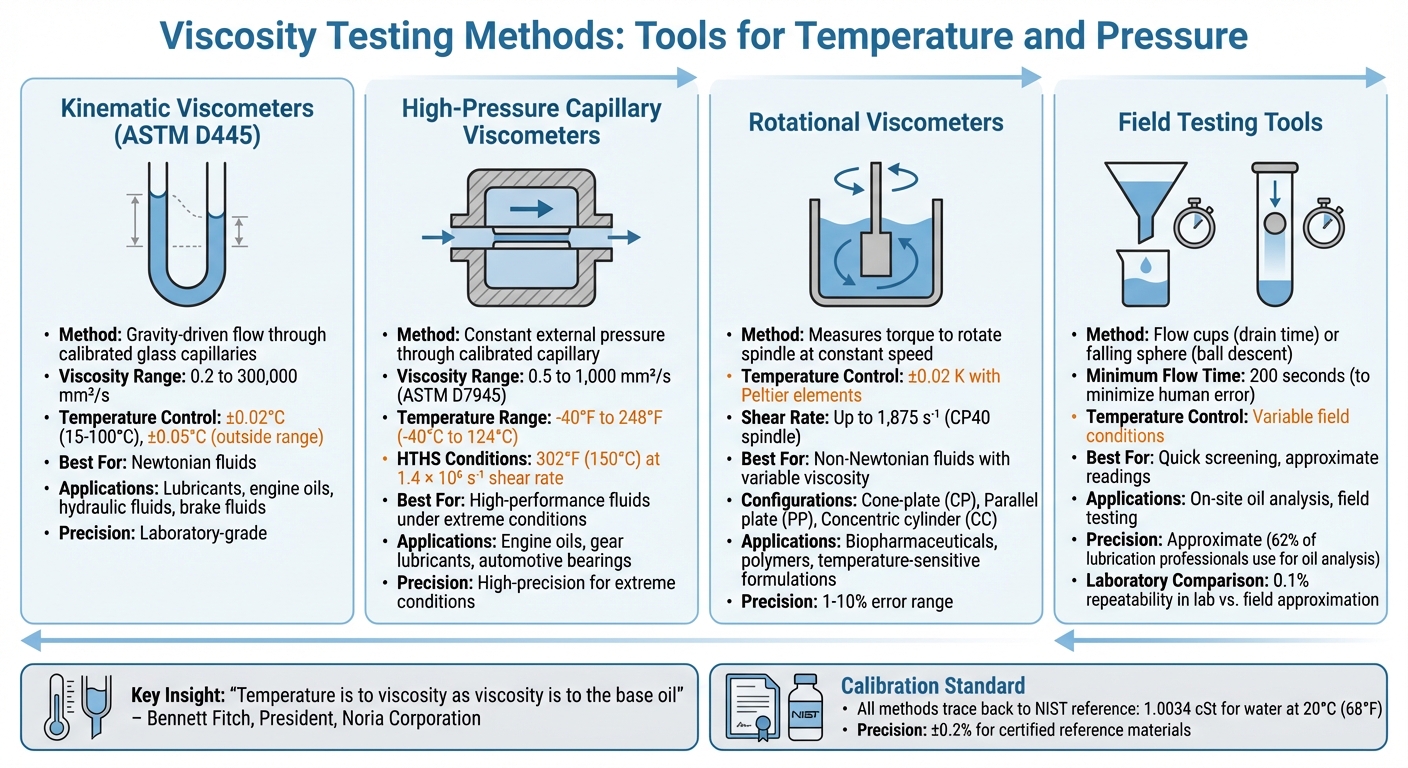
Viscosity Testing Methods Comparison: Tools, Applications, and Temperature Requirements
DVM Demo | Density viscosity HPHT pressure test
sbb-itb-aa4586a
Kinematic Viscometers with Temperature Control (ASTM D445)
Kinematic viscometers determine how long a liquid takes to flow through a calibrated glass capillary. The ASTM D445 method covers viscosities ranging from 0.2 mm²/s to 300,000 mm²/s and is primarily designed for Newtonian liquids – those that maintain a consistent viscosity regardless of shear stress [8]. The process involves multiplying the flow time by a calibrated capillary constant [10]. Common viscometer designs include Modified Ostwald (e.g., Cannon-Fenske), Suspended-level (e.g., Ubbelohde), and Reverse-flow types [9][10]. Accurate temperature control is a key factor for reliable results.
Temperature control plays a critical role in kinematic viscosity testing. For tests conducted between 59°F and 212°F (15°C–100°C), the temperature-controlled bath must maintain stability within ±0.02°C [10]. For temperatures outside this range, the allowable deviation increases slightly to ±0.05°C [10]. Even small fluctuations can impact viscosity readings, making precise temperature management essential.
This method is applicable to liquid petroleum products – transparent and opaque – as well as non-petroleum lubricants. It also covers residual fuel oils, which may display non-Newtonian behavior under certain conditions [8][3]. While ASTM D445 is optimized for Newtonian fluids, measuring non-Newtonian fluids may yield less consistent results due to variations in capillary diameter [8][11].
Setup and Operation Checklist
- Homogenize and degas transparent liquids using an ultrasonic bath.
- Filter samples containing solid particles or fibers larger than 75 µm with a 75 µm pore-size screen to avoid capillary blockages [10].
- For opaque liquids, use reverse-flow capillaries and preheated filtration to keep the meniscus visible during timing [10].
- Allow the charged capillary to equilibrate in the temperature-controlled bath for 30 minutes before measurement [10].
- Use a timing device with ±0.07% accuracy and a recording discrimination of 0.1 seconds [10].
- Perform duplicate measurements, cleaning and drying the capillary thoroughly between tests to prevent residue from affecting results [10].
- Calculate viscosity by multiplying the flow time by the specific capillary constant [10].
Common Applications
ASTM D445 is widely used to test lubricants and other fluids where viscosity is a critical parameter. Typical applications include evaluating automatic transmission fluids, brake fluids, engine oils, electrical insulating fluids, gear lubricants, hydraulic fluids, and turbine lubricants [11]. Accurate viscosity measurements are crucial to ensuring the performance and safety of these products in both industrial and automotive environments.
This information is for general guidance only. Consult official regulations and qualified experts for sourcing or formulation decisions.
High-Pressure Capillary Viscometers
High-pressure capillary viscometers take the concept of gravity-driven methods further by simulating extreme shear conditions. They achieve this by using constant external pressure to push fluids through a calibrated capillary tube. This method allows for the testing of fluids under high mechanical stress and elevated temperatures, extending the scope of ASTM D445. These instruments are particularly useful for evaluating how engine oils and industrial lubricants perform in demanding environments, such as automotive bearings and heavy machinery.
Precision is key in these systems, which rely on advanced sensors for pressure, temperature, and timing. For high-temperature high-shear (HTHS) testing, as outlined in ASTM D5481, the standard operating conditions include a temperature of 302°F (150°C) and a wall shear rate of 1.4 × 10⁶ s⁻¹ [12][13]. This high shear rate accounts for variations across the capillary radius, ensuring results align with other HTHS methods like ASTM D4683 and D4741 [13]. Modern viscometers often use thermoelectric Peltier elements to control temperature quickly, avoiding the need for bulky water baths and speeding up the testing process [6].
Calibration involves using Newtonian reference oils with viscosities ranging from 1.4 to 5.0 mPa·s at 302°F. Multicell configurations enhance throughput, accommodating ASTM D7945 conditions that cover a broad viscosity range (0.5 to 1,000 mm²/s) over temperatures from -40°F to 248°F [1][13]. To calculate kinematic viscosity from dynamic viscosity, fluid density must also be measured at the test temperature [1].
Pressurized Testing Checklist
- Ensure safety protocols and regulatory compliance are in place for handling hazardous materials [1].
- Confirm the sample demonstrates Newtonian behavior, where shear stress and shear rate are proportional, for accurate results [1].
- Use calibrated Newtonian reference oils within the desired viscosity range [13].
- Verify that pressure, temperature, and timing sensors are functioning properly and meet the required precision standards [13].
- For HTHS testing, set the temperature to 302°F (150°C) and confirm the target shear rate of 1.4 × 10⁶ s⁻¹ at the capillary wall [12][13].
- Regularly inspect sealing gaskets and other pressure-sensitive components to maintain system integrity and reduce maintenance costs [6].
- Measure the fluid’s density at the test temperature when converting dynamic viscosity to kinematic viscosity [1].
High-Viscosity Fluid Testing Applications
High-pressure capillary viscometers are indispensable for testing high-performance fluids like engine oils, gear lubricants, and hydraulic fluids, which must endure harsh conditions. The HTHS method is particularly relevant for petroleum-based lubricants, many of which are non-Newtonian – meaning their viscosity changes under mechanical stress and heat [12][13]. Testing at 302°F (150°C) and a shear rate of 1.4 × 10⁶ s⁻¹ mimics the conditions found in automotive bearings. Beyond automotive uses, industries like electronics and ceramics manufacturing rely on these instruments to evaluate adhesives, coatings, and specialty fluids that must maintain stable flow properties under extreme conditions. Reliable viscosity data is essential for optimizing storage, handling, and operational performance in regulated industries [1].
This content is for informational purposes only. Always consult official regulations and qualified professionals before making sourcing or formulation decisions.
Rotational Viscometers with Temperature Baths
Rotational viscometers work by measuring the torque – or shearing stress – needed to rotate a spindle or geometry within a fluid sample at a constant speed [16][17]. Unlike gravity-driven capillary methods, these instruments allow direct control over shear rate, making them particularly suitable for non-Newtonian fluids, whose viscosity changes depending on flow conditions. Temperature control plays a key role since most liquids become less viscous as temperatures rise. Modern rotational viscometers use advanced features like Peltier elements or precision temperature baths to maintain temperatures within 0.02 K, eliminating the need for bulky water baths and enabling rapid temperature scans [6][18].
For example, a study using the Brookfield Ametek DVNext rotational rheometer with a cone-and-plate design demonstrated that rotational testing delivers results comparable to automated capillary methods for Newtonian fluids in the 2–160 cP range at 41°F (5°C) and 68°F (20°C) [16]. This highlights the importance of precise temperature stabilization and geometry selection when working with temperature-sensitive formulations, such as those in biopharmaceutical applications. This is particularly relevant when formulating high-concentration biologics, which often require viscosity-reducing excipients to maintain stability and injectability.
Shear Rate Control Checklist
To achieve accurate viscosity measurements in temperature- and pressure-sensitive applications, follow these key steps:
- Choose the right geometry: Cone-plate (CP) setups provide nearly uniform shear across the gap, while plate-plate (PP) configurations allow adjustable gaps for thermal expansion. Concentric cylinder (CC) setups are ideal for low-viscosity fluids [14]. For CP and PP geometries, ensure the gap is zeroed carefully – trapped air during zeroing can lead to significant errors [14].
- Ensure complete sample loading: Incomplete filling in parallel plate setups can cause viscosity errors of up to 34% [14].
- Use temperature control: A temperature bath or controlled chamber ensures the sample reaches a uniform temperature before measurements begin [14].
- Run an amplitude sweep: Establish the linear viscoelastic (LVE) range where moduli remain unaffected by strain [14].
- Validate with reference liquids: Use certified Newtonian reference liquids from institutes like NIST or PTB to confirm the accuracy of torque and angular deflection sensors [14].
- Apply corrections for non-Newtonian fluids: For PP geometry, adjust for the varying shear rate across the radius to avoid errors in apparent viscosity [14].
Cone-and-Plate vs. Parallel Plate Configurations
Rotational viscometers offer different configurations depending on the application. Cone-and-plate setups measure the torque required to rotate a cone against a flat plate, making them ideal for non-Newtonian fluids by varying rotation speeds [16][17]. For instance, a CP40 spindle can achieve shear rates up to 1,875 s⁻¹, though careful adjustment of the truncation gap is essential [14][16].
Parallel plate setups, on the other hand, measure resistance as fluid moves through the gap between two plates. These systems are highly flexible, allowing gap adjustments to account for thermal expansion. However, for non-Newtonian fluids, corrections must be applied to ensure accurate results [14]. Concentric cylinder configurations are best suited for low-viscosity fluids, though they require "end effect" corrections due to shear rate variations from the cup to the bob wall [14].
Despite their precision, rotational rheometers are not immune to errors, which can range from 1% to 10%, depending on material properties and operator skill. An IUPAC round-robin test on polyolefin melts revealed discrepancies of up to 40% in reported zero-shear rate viscosity, even among experienced laboratories [14].
As Martin Laun and colleagues observed in their IUPAC Technical Report, "This disappointing result shows that generating reliable rheology data still remains a challenge" [14].
This information is intended for educational purposes. Always consult official guidelines and qualified experts before making sourcing or formulation decisions.
Field Testing Tools: Flow Cups and Falling Sphere Viscometers
When laboratory conditions aren’t available, field tools provide practical ways to measure viscosity under varying temperatures and pressures. Flow cups measure how long it takes for a fluid to drain through a calibrated opening, while falling sphere viscometers track the descent of a ball or piston to determine viscosity. As Bennett Fitch, President of Noria Corporation, explains:
In many onsite and in-the-field applications, viscometers are needed to provide quick, approximate viscosity readings usually for the purpose of warranting further analysis [7].
These tools are best used as screening instruments rather than for precise measurements. They help technicians decide if a sample needs more detailed laboratory testing. Below is a checklist to ensure accurate field measurements.
Temperature control is one of the biggest hurdles in field environments. Unlike laboratory baths that maintain temperatures within 0.02°C, field conditions are far less stable. Since temperature has a significant impact on viscosity, it’s essential to record the fluid’s temperature at the time of testing. Falling sphere viscometers rely on Stokes’ law, which means accurate values for terminal velocity, sphere size, and density are critical. To convert between absolute viscosity (measured in centipoise, cP) and kinematic viscosity (measured in centistokes, cSt), the formula is: cSt = cP / SG, where SG stands for specific gravity.
On-Site Measurement Checklist
- Clean thoroughly: Use residue-free solvents to clean the viscometer and inspect it visually to ensure no contamination, especially when working with opaque used oils.
- Choose the right size: Select a viscometer that ensures a minimum flow or fall time of 200 seconds to minimize human error when using a stopwatch [7].
- Monitor temperature: Record the fluid’s temperature immediately before and during the test, as even small fluctuations can affect the results.
- Verify equipment: For falling sphere viscometers, ensure the ball or piston matches the expected viscosity range in size and density.
- Rinse and dry: Clean and dry the apparatus between tests. If solvents aren’t available, use disposable, lint-free materials like clean cotton rags.
- Recalibrate annually: Adjust the viscometer’s constant yearly, particularly at the temperature range where it will be used, to maintain accuracy [7].
- Consider fluid type: These tools are best suited for Newtonian fluids. If the fluid’s viscosity changes with shear rate, results may vary depending on the tool.
Field Testing Tool Limitations
Even with proper preparation, field tools have their limits. Laboratory viscometers can achieve 0.1% repeatability with sample sizes as small as 0.1 milliliter, but field tools are designed for approximate readings to guide further analysis [7]. Manual timing introduces human error, which is why the 200-second rule is important. Additionally, dark or opaque fluids, like used engine oils, make it difficult to observe falling balls or fluid levels [19]. Non-Newtonian fluids add another layer of complexity – gelation or wax structures that form at low temperatures can distort results if the data is extrapolated [2][5].
Modern tools equipped with thermoelectric (Peltier) temperature control offer faster and more stable readings than traditional thermostatic baths, though they still fall short of laboratory precision [6]. Among lubrication professionals, 62% report using viscometers for oil analysis, highlighting the importance of both field and lab-based tools [7].
This content is for informational purposes only. Consult official regulations and qualified professionals before making sourcing or formulation decisions.
Calibration and Compliance Standards
For precise viscosity testing, it’s crucial to follow calibration protocols and meet standards like ASTM D445 and ISO 3104. These guidelines ensure consistent results, even under extreme temperature and pressure conditions. All viscosity standards trace back to the NIST value of 1.0034 cSt for water at 20°C (68°F) [20]. This universal reference makes it possible to compare measurements from different labs and equipment reliably.
Reference standards must adhere to ASTM D2162 and hold ISO/IEC 17025 certification. Calibration should be performed at multiple temperature points to maintain traceability [20][22]. These standards achieve a precision of ±0.2% for viscosity and kinematic viscosity. To preserve their integrity, they must be stored in sealed amber bottles at room temperature, away from direct sunlight, to prevent oxidation or loss of volatile components [20]. The steps below outline how to verify calibration accuracy effectively.
Accuracy Verification Checklist
To maintain accurate calibration, follow these key steps:
- Use certified Newtonian fluids at stable test temperatures: Ensure calibration uses Newtonian fluids that meet ASTM D2162 standards for consistent performance across different shear rates and temperatures.
- Check expiration dates: Certified standards usually expire within 12 to 24 months of purchase [20][22].
- Keep proper documentation: Retain the ISO/IEC 17025 Certification Report and Material Data Safety Sheet (MSDS) for each standard, as these are vital for regulatory audits [20].
- Determine viscometer constants: For manual glass capillary viscometers, calculate kinematic viscosity by multiplying the measured flow time by the specific viscometer constant [23].
- Use the correct capillary diameter: Select a capillary diameter suited to the sample. For non-Newtonian fluids, varying diameters can lead to different results [21].
- Replace mercury thermometers: Mercury thermometers are considered hazardous by the EPA and should be substituted with safer alternatives [21][8].
Common Compliance Challenges
- Non-Newtonian flow behavior: Samples with non-Newtonian properties may produce inconsistent results if capillary diameters vary. For such cases, follow ASTM D445 protocols [1][8][21].
- Low-temperature testing issues: At low temperatures, gelation or wax structures may form, altering viscosity as rotor speed changes. To reduce errors, measure apparent viscosity directly instead of relying on interpolations [2].
- Selecting reference materials: Using the wrong grade of reference material can disrupt traceability. Laboratories should distinguish between Certified Reference Materials (CRMs), Reference Materials (RMs), and Analytical Standards. CRMs are best for instrument qualification and method validation where high accuracy is essential, while Analytical Standards serve as a cost-effective choice for routine checks [24]. Always consult the Certificate of Analysis (CoA) for details like homogeneity, purity, stability, and the producer’s ISO 17034 accreditation [24].
This information is intended for guidance only. Always consult official regulations and qualified experts before making decisions related to sourcing or formulation.
Conclusion
Getting reliable viscosity measurements starts with choosing the right tools for your specific temperature and pressure conditions. For Newtonian fluids at standard temperatures, capillary viscometers are the go-to choice. When dealing with non-Newtonian fluids at lower temperatures, rotational viscometers are better suited. Meanwhile, oscillating piston viscometers provide portability and can operate across a wide temperature range of -40°F to 374°F (-40°C to 190°C) [3][4][5][15].
Temperature control plays a crucial role in ensuring repeatable results, with a precision of 0.02°C often being necessary [7]. As Bennett Fitch, President of Noria Corporation, aptly states:
In terms of importance, temperature is to viscosity as viscosity is to the base oil [7].
Achieving this level of precision requires high-quality equipment, such as borosilicate capillaries, and the use of clean, uncontaminated solvents [7].
After selecting the appropriate viscometer, calibration and compliance with standards are non-negotiable. Adhering to ASTM and ISO standards ensures global comparability and helps meet product specifications in industries like pharmaceuticals, lubricants, and petroleum products [6]. Regular calibration, thorough documentation, and the use of certified reference materials maintain the traceability and reliability of your measurements. Using high-purity chemicals and cleaning solvents, such as those provided by Allan Chemical Corporation (https://allanchem.com), minimizes contamination risks that could compromise your results.
Matching the testing tool to the fluid type and its operating conditions is essential to avoid errors, especially when working with extreme temperatures where gelation or structural breakdown can occur [15]. By combining the right equipment, materials, and adherence to compliance protocols, you can achieve the accurate and reliable data required in regulated industries.
This content is for informational purposes only. Consult official regulations and qualified professionals before making sourcing or formulation decisions.
FAQs
Why is temperature control important for accurate viscosity testing?
Temperature control plays a crucial role in accurate viscosity testing because even minor temperature changes can dramatically affect viscosity readings. Without stable conditions, test results can become inconsistent or unreliable.
Keeping the temperature steady during testing ensures the viscosity measurements accurately represent the material’s behavior under the specified conditions. This is especially critical in industries like pharmaceuticals, food, and cosmetics, where precision and consistency are non-negotiable due to strict regulatory standards.
What is the difference between kinematic and rotational viscometers?
Kinematic and rotational viscometers differ in their measurement methods and the properties they evaluate.
A rotational viscometer determines viscosity by applying a controlled shear force to the fluid with a rotating spindle or cylinder. This approach measures dynamic viscosity, which represents the fluid’s internal resistance to flow. These instruments are highly adaptable, making them suitable for both Newtonian fluids (those with consistent viscosity) and non-Newtonian fluids (those whose viscosity changes with applied stress). They are particularly useful when analyzing how a fluid’s viscosity responds to varying shear rates.
In contrast, a kinematic viscometer measures the time it takes for a liquid to flow through a calibrated capillary tube under the force of gravity. Using this flow time and the fluid’s density, the kinematic viscosity is calculated. These devices are typically designed for Newtonian fluids and offer a straightforward method for assessing flow behavior.
Selecting the right viscometer depends on the type of fluid being tested, the application, and whether you need to measure dynamic or kinematic viscosity.
Why is it important to calibrate viscometers for accurate viscosity measurements?
Calibrating viscometers is essential for obtaining precise and dependable viscosity readings. Over time, without proper calibration, measurements can drift, leading to problems like inconsistent product quality, failure to meet industry standards, and even safety concerns.
The calibration process involves comparing the viscometer’s readings to a known standard, often traceable to organizations like NIST. This comparison helps identify and correct any inaccuracies or deviations. By ensuring accurate measurements, calibration supports adherence to standards such as ASTM and ISO, which are critical for quality control, process efficiency, and regulatory compliance. In industries where viscosity plays a key role in performance and safety, maintaining reliable measurements is non-negotiable.




Comments are closed