
Viscosity Index Improvers (VIIs) are polymers that stabilize oil viscosity across temperature changes. They ensure lubricants flow easily in cold conditions and maintain a protective film in heat, preventing equipment damage. By contracting in cold and expanding in heat, these polymers adapt to temperature shifts, enabling consistent lubricant performance.
- Primary Use: VIIs are used in multigrade oils (e.g., SAE 10W-30) for vehicles, industrial machinery, and hydraulic systems.
- Key Benefit: They reduce the need for seasonal oil changes and enhance equipment protection.
- Market Insight: The VII market reached $4.06 billion by 2024 and is projected to grow to $5.39 billion by 2034, with vehicle lubricants accounting for over half of the demand.
VIIs interact with base oils to control viscosity and are categorized into Olefin Copolymers (OCPs), Polymethacrylates (PMAs), and high molecular weight polymers, each suited for specific applications. Their performance depends on factors like molecular weight, concentration, and shear stability, with trade-offs between thickening efficiency and durability. Proper selection and monitoring are crucial for maintaining lubricant effectiveness.
Lubricant Formulation 101: How to Choose the Right Viscosity Index Improver
sbb-itb-aa4586a
How Viscosity Index Improvers Work in Lubricants
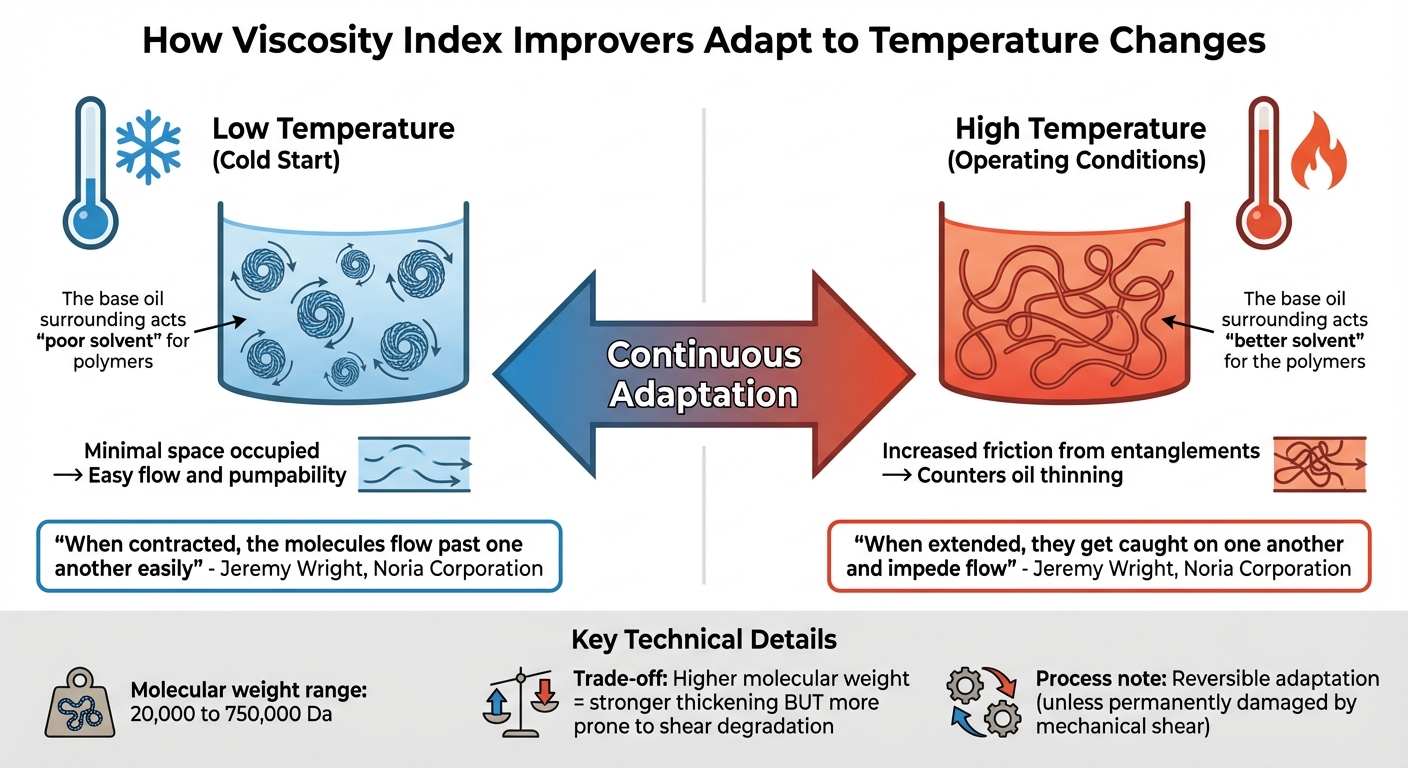
How Viscosity Index Improvers Adapt to Temperature Changes in Lubricants
Viscosity Index Improvers (VIIs) work by leveraging the temperature-sensitive behavior of their polymer chains. These high-molecular-weight polymers exist as coiled structures within the base oil, adapting their configuration to stabilize the oil’s viscosity across varying temperatures.
Polymer Coil Behavior
At lower temperatures, VII polymer chains contract into tight, compact coils. In this state, they take up minimal space, allowing the lubricant to flow easily – an essential characteristic for cold starts and maintaining pumpability.
When temperatures increase, the polymer’s solubility in the base oil improves. This causes the chains to uncoil and expand into longer, more voluminous strands. These expanded coils create entanglements that increase friction, effectively countering the natural thinning of the base oil at higher temperatures.
"When contracted, the molecules flow past one another easily, but when extended, they get caught on one another and impede flow." – Jeremy Wright, Noria Corporation
This process of contraction and expansion is reversible, with the polymer coils continuously adjusting to temperature changes – provided they have not been permanently damaged by mechanical shear. Typically, commercial VIIs have molecular weights ranging from 20,000 to 750,000 Da. While higher molecular weights provide stronger thickening effects, they are also more prone to shear degradation [5].
The effectiveness of this coiling mechanism depends on how the polymer interacts with its surrounding base oil.
Interaction With Base Oils
For VIIs to perform effectively, the base oil must strike the right solvent balance. At lower temperatures, the base oil acts as a "poor solvent", keeping the polymer chains tightly coiled. As the temperature rises, the oil becomes a "better solvent", enabling the chains to stretch out and deliver their thickening effect.
Different types of polymers achieve this balance using distinct chemical approaches. For instance, polymethacrylates (PMAs) include polar ester groups that are only partially soluble in nonpolar mineral oils at low temperatures, ensuring the polymers remain tightly coiled in cold conditions. On the other hand, olefin copolymers (OCPs), especially those with high ethylene content, rely on intermolecular crystallization below 50°F (10°C) to contract the molecule and reduce its impact on cold-temperature viscosity. This ensures the VII remains dissolved and functional until reaching service temperatures.
"Owing to the increased solubility at higher temperature the VI improver displays a greater thickening effect and thus prevents excessive thinning of the lubricant oil at the desired operating conditions." – Jan C.J. Bart, Biolubricants
This content is for informational purposes only. Always consult official regulations and qualified professionals before making sourcing or formulation decisions.
Types of Viscosity Index Improvers
The market for Viscosity Index Improvers (VIIs) is primarily dominated by three polymer families: Olefin Copolymers (OCPs), Polymethacrylates (PMAs), and high molecular weight polymers. Each type brings distinct thermal and shear characteristics that make them suitable for specific lubricant applications.
Olefin Copolymers (OCPs)
OCPs are created from ethylene and propylene through Ziegler catalysis and hold a 30.4% market share as of 2024 [1]. These polymers are known for their excellent thickening efficiency and cost-effectiveness, which makes them a popular choice for high-volume applications like motor oils and hydraulic fluids.
The performance of OCPs is heavily influenced by the ethylene-to-propylene ratio. When ethylene content exceeds 60%, the resulting semicrystalline structures contract at temperatures below 50°F (10°C). This contraction reduces their impact on cold-start viscosity, making "Low-Temperature OCPs" (LTOCPs) particularly effective for improving engine turnover in winter conditions. Despite their focus on low-temperature performance, they maintain effective thickening at normal operating temperatures [5]. Commercial OCPs typically exhibit a Permanent Shear Stability Index ranging from 23 to 55, reflecting moderate to good resistance to mechanical shear [5].
Polymethacrylates (PMAs)
PMAs are ester-based polymers produced via free radical polymerization. They are widely used in applications requiring a high viscosity index and excellent low-temperature performance [5]. These additives are especially well-suited for automatic transmission fluids (ATF), gear oils, and precision hydraulic systems, where maintaining consistent viscosity across extreme temperature variations is essential.
The versatility of PMAs lies in their adjustable side-chain structure. Short hydrocarbon chains influence the viscosity index, intermediate chains (C8–C13) enhance oil solubility, and longer chains (C14+) act as pour point depressants by interacting with wax crystals [5]. This multifunctionality often allows PMAs to perform dual roles in formulations, reducing the need for additional additives. Commercial PMAs come in a wide range of molecular weights, from 20,000 to 750,000 Da, with concentrates containing 30–80 wt% polymer, depending on the intended application [5].
High Molecular Weight Polymers
This category includes polymers like Polyisobutylene (PIB) and hydrogenated styrene-diene copolymers, which deliver maximum thickening power for heavy-duty industrial use. These polymers are particularly effective for high-viscosity gear oils and extreme-pressure lubricants, as they require smaller dosages to achieve the desired viscosity. For example, a 15% PIB blend in paraffinic base oil significantly reduces friction and wear in industrial machinery [6].
However, the efficiency of these high molecular weight polymers comes with a downside. As Jeremy Wright from Noria Corporation explains:
"Higher molecular weight polymers make better thickeners but tend to have less resistance to mechanical shear" [3].
This means that while they provide strong thickening, they are more susceptible to irreversible shear degradation. Hydrogenated styrene-isoprene (SIP) and styrene-butadiene (SBR) copolymers are designed to balance these trade-offs, offering robust thickening capabilities along with acceptable shear stability for engine oil applications [5].
This information is intended for general knowledge. Always consult official guidelines and industry professionals for specific sourcing or formulation decisions.
Factors That Affect VII Performance
The performance of viscosity index improvers (VIIs) is influenced by several factors, including molecular weight, chain structure, concentration, and shear stability. These elements must work together to balance thickening efficiency with long-term durability.
Molecular Weight and Chain Structure
Molecular weight plays a key role in how effectively a polymer thickens oil. Polymers with higher molecular weights occupy more space, which leads to greater viscosity index enhancement while requiring smaller amounts to achieve the desired viscosity [5][4]. For example, PMAs (polymethacrylate polymers) can range from 20,000 to 750,000 Da in molecular weight [5].
However, this efficiency comes with a drawback – higher molecular weight polymers are more prone to mechanical shear. This includes temporary shear thinning, where polymer chains align with the flow, and permanent shear, which occurs when chains break under stress [5][3].
The structure of the polymer chain also matters. Star-shaped polymers, for instance, combine high molecular weight with better shear stability since breakage tends to occur at the core [7]. Comb polymers, on the other hand, improve the temperature-viscosity relationship and cold-weather performance, which can aid fuel efficiency [7]. In olefin copolymers (OCPs), long-chain branching reduces the polymer’s hydrodynamic radius, which can lower thickening efficiency despite the same molecular weight [5].
| Factor | Impact | Performance Trade-off |
|---|---|---|
| Molecular Weight | Boosts thickening efficiency and viscosity index [5] | Reduces shear stability (temporary and permanent) [5] |
| Ethylene Content (OCP) | Improves thickening efficiency [5] | May impair cold-weather performance if content exceeds 50% [7] |
| Branching (OCP) | Lowers hydrodynamic radius [5] | Reduces thickening efficiency for equivalent molecular weight [5] |
| Concentration | Increases viscosity | Risk of reversion, where viscosity improvement diminishes [7] |
The concentration of VIIs in lubricants is another critical factor that affects their overall performance.
Concentration in Lubricants
While molecular weight sets the baseline for efficiency, the concentration of VIIs fine-tunes the viscosity behavior. High molecular weight polymers achieve the desired viscosity at lower concentrations, whereas lower molecular weight polymers require higher amounts but provide better shear stability [4][3]. VII concentrates usually contain 30–80% polymer dissolved in solvent oil [5].
Using excessive concentrations of high molecular weight polymers can lead to a phenomenon called reversion. This happens when polymer coils become overcrowded and cannot fully expand in the thinning solvent, reducing the viscosity index [7]. For example, high molecular weight OCPs (around 100,000 g/mol) typically transition from dilute to semi-dilute behavior at concentrations of 4–5 wt% in oil. Beyond this threshold, the risk of reversion rises sharply [7]. To maintain a stable viscosity-temperature relationship, formulators should avoid overloading lubricants with high molecular weight polymers. For applications exposed to high mechanical stress, opting for lower molecular weight polymers at higher concentrations can help maintain viscosity without permanent degradation [4][3].
Shear Stability and Degradation
Under operating conditions, VIIs face two types of shear stress. Temporary shear occurs when polymer chains align under stress but return to their original state once the stress is removed. Permanent shear, however, results in the physical breakage of polymer chains, leading to an irreversible loss of viscosity and thickening efficiency.
Permanent shear typically involves the breaking of carbon–carbon bonds, often near the middle of the polymer chain. This process creates fragments with approximately half the original molecular weight [5].
Jeremy Wright from Noria Corporation explains:
"As the additive is repeatedly sheared, it loses its ability to act as a more viscous fluid at higher temperatures" [3].
Commercial OCP viscosity modifiers generally have Permanent Shear Stability Index (PSSI) values ranging from 23 to 55, indicating moderate to good resistance to mechanical shear [5].
Different polymer types respond differently to prolonged shear. OCPs tend to stabilize after an initial drop in viscosity, while Hydrogenated Styrene Isoprene (HSI) polymers may continue losing viscosity under extreme conditions [8]. For high-stress applications, using lower molecular weight polymers can improve shear stability. Although this approach requires higher volumes of additive, it prevents permanent degradation and ensures consistent performance [4][3].
This content is for informational purposes only. Always consult official guidelines and qualified professionals for sourcing or formulation decisions.
Benefits and Limitations of VIIs in Lubricants
Viscosity Index Improvers (VIIs) offer significant advantages in lubricant performance but come with trade-offs that must be carefully considered. Understanding these benefits and limitations is essential for making informed decisions when formulating lubricants for specific operating conditions.
Advantages of VIIs
VIIs play a critical role in maintaining a stable lubricating film across a wide range of temperatures. By preventing oil from thinning at high temperatures and thickening at low temperatures, they ensure proper flow and consistent protection. This temperature stability reduces the risk of metal-to-metal contact, helping to minimize mechanical wear under various operating conditions.
Another key advantage is improved energy efficiency. VIIs lower internal fluid friction, which reduces the energy needed to move components. This directly enhances fuel economy in vehicles and boosts system efficiency in industrial machinery. As Jan C.J. Bart, author of Biolubricants, explains:
"The benefits of lubricant additives are not marginal. They are not simply operational extras but essential ingredients which make all the difference in lubricant performance" [2].
Additionally, VIIs enable the creation of multigrade oils, such as SAE 10W-30. These oils combine the benefits of light oils for cold starts with the high-temperature protection of heavier oils, all in a single product. This eliminates the need for seasonal oil changes and extends equipment service intervals, making maintenance more convenient and cost-effective.
Limitations of VIIs
Despite their benefits, VIIs have notable limitations. One major drawback is their vulnerability to mechanical shear. In high-stress environments, such as gearboxes, high-speed bearings, and heavy-duty engines, the polymer chains in VIIs can break. This leads to a permanent loss of viscosity and reduced effectiveness, which can compromise the lubricant’s protective qualities.
Cost is another consideration. High-quality VIIs increase formulation expenses, although these costs are often offset by the benefits of improved fuel economy, reduced energy consumption, and extended equipment life. However, chemical compatibility can also be an issue. VIIs may interact negatively with other additives, such as rust inhibitors or dispersants, potentially causing issues like oil oxidation or interference with demulsification [2].
Thermal and oxidative degradation is another challenge, particularly in high-temperature applications. Over time, this degradation can reduce the effectiveness of VIIs. In heavy-duty engines, factors like fuel dilution, oil oxidation, and soot accumulation can significantly impact the aged viscosity of oils containing VIIs. Research by Chevron Oronite in 2014 highlighted this issue, showing that while Olefin Copolymer (OCP) chemistry stabilized after 90 cycles of testing, Hydrogenated Styrene Isoprene (HSI) chemistry continued to degrade steadily beyond 90 cycles [8].
Comparison Table: Benefits vs. Limitations
The table below provides a clear summary of the advantages and challenges associated with VIIs:
| Benefits | Limitations |
|---|---|
| Maintains stable lubrication at high temperatures | Susceptible to permanent mechanical shear |
| Ensures fluidity and pumpability in cold conditions | Higher formulation costs for high-quality VIIs |
| Enhances fuel economy and system efficiency | Risk of polymer breakage in high-stress environments |
| Supports year-round use of multigrade oils | Can contribute to sludge or deposits if degraded |
| Reduces mechanical wear through consistent film stability | Temporary viscosity loss under extreme shear rates |
For high-shear applications, consider using lower molecular weight VIIs with better shear stability, even if they require higher treat rates. Regular oil analysis is also crucial for monitoring viscosity changes. A permanent decrease in viscosity often signals that the VII polymers have been mechanically sheared, reducing their ability to protect equipment effectively [3].
This content is for informational purposes only. Always consult official guidelines and qualified professionals before making decisions regarding lubricant formulation or sourcing.
Conclusion
Expanding on the mechanisms and performance factors discussed earlier, Viscosity Index Improvers (VIIs) play a pivotal role in stabilizing lubricants across a wide range of temperatures. These polymer additives adapt their structure to temperature changes – staying compact in colder conditions to ensure fluidity and expanding in higher temperatures to maintain a protective oil film. This adaptability ensures consistent lubricant performance, regardless of temperature extremes.
The market highlights the importance of VIIs in industrial applications. As Sanya Mathura, Founder and Managing Director of Strategic Reliability Solutions Ltd, explains:
"The higher the VI, the less effect that temperature has on the oil, which means that the oil can maintain a particular viscosity for a longer time at a more extensive temperature range" [1].
These insights provide valuable guidance for making informed decisions in lubricant formulation.
Key Takeaways
When selecting and formulating VIIs, keep these principles in mind:
- Balance efficiency and durability: High molecular weight polymers offer excellent thickening with lower concentrations but are more prone to breakdown under mechanical stress. On the other hand, lower molecular weight polymers resist shear damage but require higher treat rates. For demanding environments like engines and gearboxes, choose formulations with strong shear stability to prevent permanent viscosity loss.
- Monitor oil health regularly: Routine oil analysis can reveal irreversible VII degradation. A drop in the viscosity index often indicates that polymer chains have broken into smaller, less effective molecules, reducing the oil’s protective qualities. Tailor your VII choice to the operating conditions, base oil type, and shear environment to maximize both performance and longevity.
This material is intended for informational purposes only. Always consult official regulations and qualified professionals before making sourcing or formulation decisions.
FAQs
How do Viscosity Index Improvers reduce the need for seasonal oil changes?
Viscosity Index Improvers (VIIs) are key additives that help lubricants keep their performance steady across varying temperatures. They work by stabilizing the oil’s thickness, ensuring it flows properly in both cold and hot conditions.
Thanks to VIIs, multigrade oils can perform effectively year-round. This eliminates the hassle of switching oils with the seasons, giving you one reliable option whether you’re dealing with freezing winter mornings or sweltering summer heat.
What is the difference between Olefin Copolymers and Polymethacrylates in lubricants?
Olefin Copolymers (OCPs) and Polymethacrylates (PMAs) play a crucial role as viscosity index (VI) improvers in lubricants. Their primary distinction lies in their chemical makeup: OCPs are created from olefin monomers, while PMAs originate from methacrylate monomers.
This difference in structure directly impacts their performance. OCPs excel in shear stability and resist both thermal and oxidative degradation, making them highly reliable under demanding conditions. In contrast, PMAs are valued for their ability to increase viscosity more efficiently – delivering a greater thickening effect per unit of polymer. However, they are more susceptible to breakdown under shear forces. The choice between OCPs and PMAs ultimately depends on the specific performance requirements of the lubricant being formulated.
What is shear stability, and why is it important for viscosity index improvers in lubricants?
Shear stability describes a viscosity index improver’s (VII) ability to retain its molecular structure and thickening properties when subjected to the mechanical stress of an engine or gearbox. In high-speed or tight-clearance systems, the polymer chains in VIIs can break apart, causing a drop in viscosity. This breakdown compromises the lubricant’s protective film, potentially leading to increased wear, decreased oil pressure, and lower fuel efficiency – particularly under high-temperature or heavy-duty conditions.
To address this, formulators prioritize shear-stable chemistries that combine durability with effective thickening. Olefin copolymer (OCP)-based VIIs, for instance, are recognized for their excellent shear stability compared to other polymer types. By incorporating high-quality, shear-stable VIIs – such as those offered by Allan Chemical Corporation – lubricants can maintain consistent viscosity over a broad temperature range, ensuring dependable protection and performance throughout their lifespan.


Comments are closed