
The Strategic Approach to International Chemicals Management (SAICM), launched in 2006, is a global framework designed to improve chemical safety by reducing risks throughout the chemical lifecycle – from production to disposal. For businesses, especially those in regulated industries, aligning with SAICM ensures compliance with international and U.S. regulations, enhances supply chain transparency, and supports market access.
Key updates include the Global Framework on Chemicals, introduced in September 2023, which shifts SAICM from voluntary guidelines to a more structured approach with measurable goals. This framework focuses on accountability, sector-specific directives, and achieving sound chemical management by 2030. Below are essential SAICM tools and resources that help companies meet compliance standards:
- SAICM Knowledge Platform: Offers guidance on chemical safety, emerging policy issues, and supply chain best practices.
- Quick Start Programme (QSP) Toolkit: Provides early-stage capacity-building tools for chemical management.
- Overarching Policy Strategy (OPS) and Dubai Declaration: Foundational documents outlining objectives like risk reduction, governance improvements, and illegal trade prevention.
- U.S. EPA Guidance: Aligns domestic regulations with global chemical management frameworks.
- Industry Support: Specialized suppliers, like Allan Chemical Corporation, simplify compliance with tailored chemical sourcing solutions.
These resources enable businesses to meet regulatory demands while improving chemical safety and supply chain reliability.
Regulatory Realities Navigating the Global Chemical & Product Compliance
Core SAICM Documents and Frameworks
The core documents of SAICM serve as a blueprint for shaping international standards and ensuring compliance within the United States. These foundational texts support the compliance tools and strategies discussed in later sections.
The Overarching Policy Strategy (OPS) lays out key objectives such as reducing chemical risks, improving information exchange, enhancing governance, and building capacity. It emphasizes a life-cycle perspective, addressing environmental and health impacts from raw material extraction to disposal. This aligns closely with both EPA and state-level chemical safety standards.
The Dubai Declaration on International Chemicals Management, adopted during ICCM1 in February 2006, underscores a commitment to reducing the harmful effects of chemicals. While its original target dates have passed, its principles continue to influence policies, trade practices, and regulatory alignment across the globe.
Outcomes from ICCM meetings offer actionable guidance for compliance efforts. They stress the importance of transparency in areas like vendor qualifications and reporting standards. Together with the OPS and Dubai Declaration, these documents form a solid regulatory framework.
For regulated companies, these documents are valuable tools for conducting risk assessments and evaluating suppliers. Their emphasis on precautionary measures and safer alternatives supports both regulatory audits and sustainable practices. This framework also boosts customer confidence by demonstrating a commitment to responsible chemical management. These principles lay the groundwork for exploring practical SAICM tools in the following sections.
Disclaimer: This content is for informational purposes only. Always consult official regulations and qualified professionals before making sourcing or formulation decisions.
Practical Tools and Platforms for SAICM Compliance
While foundational documents establish the regulatory framework, companies need practical tools to put SAICM principles into action. These tools help translate guidelines into real-world applications. Below are some key digital resources and toolkits designed for this purpose.
The SAICM Knowledge Platform serves as a central hub for compliance guidance. It gathers up-to-date information on emerging policy issues and effective chemical management practices. Businesses can find detailed resources on eight critical Emerging Policy Issues (EPIs), including Chemicals in Products, Endocrine-Disrupting Chemicals, Hazardous Chemicals in Electronics, Highly Hazardous Pesticides, Lead in Paint, Nanotechnology, Perfluorinated Chemicals, and Pharmaceutical Pollutants [1][2].
This platform also features Communities of Practice, which connect stakeholders from industries, academic institutions, and other sectors. These communities provide a space to exchange best practices, discuss implementation hurdles, and stay informed on the latest regulatory updates [1][2].
The Quick Start Programme (QSP) Toolkit offers a structured approach to building early-stage capacity. It covers areas like life cycle analysis, inter-agency coordination, and governance improvements [4].
In addition to these tools, the platform provides online training modules, an events calendar, and regular news updates. These features support workforce education, help track progress toward Sustainable Development Goals (SDGs), and keep businesses informed about new challenges in chemical management [1][2][3].
Disclaimer: This content is for informational purposes only. Always consult official regulations and qualified professionals before making sourcing or formulation decisions.
Regulatory Compliance and Industry Support Services
Navigating the regulatory landscape required for SAICM (Strategic Approach to International Chemicals Management) implementation can be challenging. Industry associations and specialized support services play a crucial role in bridging the gap between regulatory requirements and practical application. Here are some examples of how these organizations contribute to SAICM compliance.
The International Council of Chemical Associations (ICCA) has made a notable impact in supporting SAICM compliance efforts. Through their initiatives, ICCA has allocated €860,000 to fund 79 capacity-building projects, promoting Responsible Care® implementation across 70 economies [6].
Regional programs also play a vital role. For instance, the Latin America Regulatory Cooperation Forum (LARCF) and virtual sessions held in the ASEAN region have brought together over 100 industry members and more than 200 government representatives. These collaborations, conducted through webinars and cooperative events, have fostered knowledge sharing and regulatory alignment [6].
Beyond the work of associations like ICCA, companies such as Allan Chemical Corporation showcase how targeted services can simplify compliance. With over 40 years of expertise, Allan Chemical Corporation focuses on chemical sourcing solutions that align with global chemical management standards. Their offerings include technical- and compendial-grade products, accompanied by Certificates of Analysis and Safety Data Sheets. These products are delivered with flexible batch sizes, just-in-time logistics, and a transparent supply chain, making compliance more manageable.
For businesses aiming to meet SAICM requirements efficiently, partnering with experienced chemical suppliers can make a significant difference. These providers offer tailored sourcing solutions, thorough regulatory documentation, and ongoing technical support. This integrated approach ensures compliance while streamlining procurement processes, enabling companies to focus on their core operations.
Disclaimer: This content is for informational purposes only. Always consult official regulations and qualified professionals before making sourcing or formulation decisions.
1. SAICM Overarching Policy Strategy (OPS)
Adopted on February 6, 2006, in Dubai, the Overarching Policy Strategy (OPS) laid out five key objectives that guided chemical management practices. Even though SAICM officially ended in 2020 and was replaced by the Global Framework on Chemicals in September 2023, these objectives remain relevant today [5][7].
The OPS covers all types of chemicals, from agricultural to industrial, and provides guidance on managing them throughout their lifecycle – from production to disposal. It takes into account environmental, economic, social, health, and labor considerations [5].
The Five Core Objectives
For companies looking to strengthen their chemical management practices, the OPS highlights five strategic focus areas:
- Risk Reduction: Limit the harmful effects of chemicals on both human health and the environment by using transparent, science-driven risk assessment and management strategies.
- Improved Knowledge and Information: Make chemical safety data more accessible and understandable by maintaining detailed databases and encouraging open information exchange.
- Improved Governance: Work with regulatory bodies to enhance institutional frameworks, adopt industry standards, and maintain strong internal governance systems.
- Increased Capacity-building and Technical Cooperation: Assist developing nations and transitioning economies by sharing technology, offering training programs, and providing expertise in chemical management.
- Reduction of Illegal International Traffic: Address the illegal trade of hazardous chemicals by implementing rigorous supply chain monitoring and verification processes.
Measuring Progress
The OPS included 20 indicators to track progress and emphasized the importance of collaboration among stakeholders at local, national, regional, and global levels [5]. This framework laid the groundwork for the practical tools and strategies for SAICM compliance, which will be explored in the next section.
Disclaimer: This content is for informational purposes only. Always consult official regulations and qualified professionals before making sourcing or formulation decisions.
2. Dubai Declaration and ICCM Outcomes
The Dubai Declaration, introduced at ICCM1 in 2006, marked the launch of SAICM (Strategic Approach to International Chemicals Management). This framework has shaped how companies address chemical management challenges today. A central element of the declaration was the "2020 goal" – an initiative aimed at reducing chemical risks by 2020. This goal, first outlined at the 2002 World Summit on Sustainable Development, became a cornerstone for global chemical safety efforts and corporate compliance strategies[8]. Below, we explore how these commitments translate into practical actions.
Core Implementation Areas
The Dubai Declaration identified three key focus areas to improve chemical management worldwide:
- Building foundational chemical management capacity: Developing the tools and expertise needed for effective oversight.
- Strengthening national regulations: Enhancing laws and frameworks to ensure safer handling and usage of chemicals.
- Advancing the Globally Harmonized System (GHS): Promoting consistent chemical labeling and handling standards across countries.
SAICM was structured as a voluntary platform, bringing together multiple sectors and stakeholders to drive progress in these areas[8].
Industry Support and Future Direction
Since its inception, industry leaders have championed the goals set forth by the Dubai Declaration. They now call for stronger political and financial commitments to ensure SAICM’s mission remains relevant. This includes better collaboration among international organizations and more transparent reporting on progress toward safer chemical management[8]. These ongoing efforts aim to build a more coordinated and effective global approach to managing chemicals and waste.
Disclaimer: This content is for informational purposes only. Always consult official regulations and qualified professionals before making sourcing or formulation decisions.
3. SAICM Knowledge Platform
The SAICM Knowledge Platform is a digital hub designed to help companies navigate the complexities of global chemical management. By centralizing best practices and regulatory updates, it offers tools to simplify compliance and streamline operations.
Accessing Key Resources for Implementation
The platform provides real-time access to updated SAICM documents, implementation reports, and guidance materials. Companies can download templates, risk assessment frameworks, and compliance checklists tailored to their specific industries. For businesses operating across borders, these standardized resources ensure alignment with international chemical management principles, making compliance less daunting.
Interactive maps are another standout feature, showcasing regional and sector-specific chemical initiatives. These maps help companies pinpoint relevant programs in their areas of operation and connect with local partners for implementation. Advanced search tools allow users to filter resources by chemical category, industry application, or regulatory framework, ensuring quick access to what they need.
Technical Insights and Practical Examples
In addition to compliance tools, the platform houses technical reports developed by industry working groups and advisory panels. These reports cover topics like emerging chemical safety concerns, alternative assessment methods, and sustainable chemistry practices. For specialty chemical companies, these insights can enhance product stewardship and supplier evaluation efforts.
The platform also includes detailed case studies highlighting successful SAICM implementation across various business models. These examples address challenges like improving supply chain transparency, planning for chemical substitutions, and engaging stakeholders effectively.
For businesses aiming to align their practices with international standards, the platform offers guidance on building strong management systems. Its resources complement existing quality management frameworks and support ongoing improvements in chemical safety and performance.
Disclaimer: This content is for informational purposes only. Always consult official regulations and qualified professionals before making sourcing or formulation decisions.
sbb-itb-aa4586a
4. Quick Start Programme (QSP) Toolkit
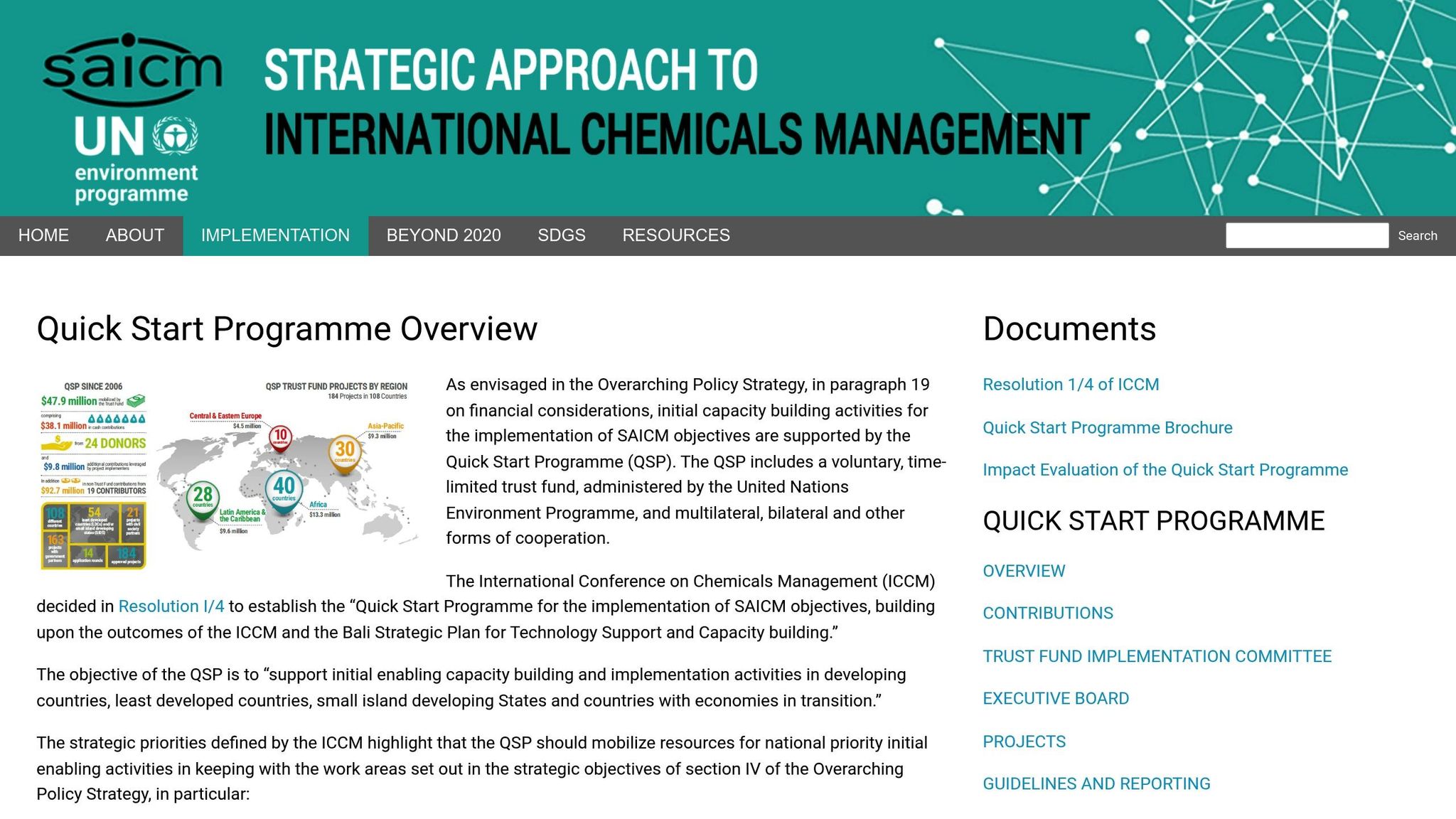
The Quick Start Programme (QSP) was a key initiative under the Strategic Approach to International Chemicals Management (SAICM), running from 2006 to December 2019. This program laid the groundwork for effective chemical management practices that continue to influence global approaches today.
Program Impact and Legacy
Over its 13-year span, the QSP supported 108 developing nations through 184 projects, channeling $47.6 million in funding. The program reached 40 African countries, 30 in Asia-Pacific, 28 in Latin America and the Caribbean, and 10 in Central and Eastern Europe. Among these, 54 least developed countries and small island states were included. An independent evaluation in September 2015 highlighted the program’s success in creating environments conducive to sound chemical management practices [9].
Resources and Learning Materials
The QSP’s resources are preserved on the SAICM Knowledge Platform, offering valuable tools and insights. For instance, the "Interactive Visualization of the Quick Start Programme Implementation", released in April 2020, maps out project locations, focus areas, and outcomes. Similarly, the "Factsheet: 13 Years of Advancing Sound Chemicals Management", published in January 2020, captures key achievements and lessons learned [9].
Practical Insights for Businesses
The QSP’s focus on awareness and capacity building provides a practical framework for companies looking to enhance their chemical management systems. By prioritizing stakeholder collaboration and systematic development, the program offers a roadmap for creating regional chemical safety protocols. Businesses operating across different regions can draw from this experience to adapt chemical safety practices to local contexts, aligning with SAICM’s goal of harmonized global chemical management.
Disclaimer: This content is for informational purposes only. Always consult official regulations and qualified professionals before making sourcing or formulation decisions.
5. Global Framework on Chemicals (2023)
The Global Framework on Chemicals (2023) builds upon the foundation laid by SAICM and earlier initiatives, offering a refreshed approach to managing chemicals on a global scale.
This framework focuses on improving chemical management by reinforcing governance, expanding scientific knowledge, and prioritizing safer practices in chemical operations. It represents a collective effort to address the evolving challenges of chemical safety and sustainability.
To ensure your chemical management systems stay aligned with international expectations, keep an eye on updates from official sources and follow the latest compliance guidelines. Staying informed helps maintain safety and supports responsible practices.
Disclaimer: This content is for informational purposes only. Always consult official regulations and qualified professionals before making sourcing or formulation decisions.
6. U.S. EPA and State Department Guidance
To assist with compliance alongside SAICM tools, U.S. agencies like the Environmental Protection Agency (EPA) and the Department of State provide specialized guidance. These resources are designed to help businesses navigate domestic regulations while aligning with international chemical management frameworks. By working together, these agencies support SAICM goals and ensure companies meet U.S. regulatory standards.
The Department of State has played a pivotal role in shaping SAICM and the Global Framework on Chemicals, which was adopted in September 2023 [10][13].
The EPA enforces regulations that align with global chemical safety practices. For example, the Risk Management Program (RMP) rule requires facilities handling extremely hazardous substances to create detailed plans aimed at preventing chemical accidents [11]. This program also provides training and guidance on emergency preparedness, helping businesses meet both safety obligations and SAICM principles.
In addition, the EPA enforces restrictions under the Toxic Substances Control Act (TSCA), directly influencing how companies handle hazardous chemicals in their operations [12]. Through SAICM partnership projects, the EPA has contributed to the GEF-funded initiative "Global Best Practices on Emerging Chemical Policy Issues of Concern under SAICM." This initiative focuses on key areas such as Lead in Paint and Chemicals in Products, offering guidance for industries like construction, electronics, and toys on managing chemicals of concern [14]. These efforts are complemented by digital tools that simplify compliance.
The SAICM Knowledge platform, supported by the EPA, provides detailed guidance and alternatives for managing hazardous chemicals [12][14]. Together, these resources help businesses align with both international standards and U.S. regulatory requirements.
Staying updated on EPA and State Department announcements is crucial. Regularly reviewing these updates can help you anticipate changes and ensure your chemical management practices comply with U.S. regulations while meeting SAICM standards.
Disclaimer: This content is for informational purposes only. Always consult official regulations and qualified professionals before making sourcing or formulation decisions.
7. Allan Chemical Corporation
For over 40 years, Allan Chemical Corporation has been a trusted partner in helping businesses navigate the complexities of SAICM compliance. Their expertise lies in addressing the unique challenges faced by regulated industries, offering tailored solutions that ensure adherence to strict global standards.
Their approach begins with rigorous supplier evaluations and a strong focus on quality assurance. Every chemical they provide meets the necessary technical and regulatory standards across industries such as pharmaceuticals, food, cosmetics, ceramics, and electronics. This commitment to quality not only guarantees product integrity but also helps companies maintain transparency throughout their supply chains – an essential requirement for meeting SAICM guidelines.
In addition to quality assurance, Allan Chemical Corporation provides robust technical support to simplify compliance efforts. They supply critical documentation, including Certificates of Analysis and Safety Data Sheets, which are indispensable for demonstrating chemical safety across supply chains. This level of support ensures businesses can meet the documentation requirements outlined in SAICM frameworks with confidence.
Their flexible delivery options and custom packaging solutions further enhance operational efficiency. By offering just-in-time delivery, Allan Chemical Corporation helps minimize storage risks while ensuring a steady supply of materials. Custom packaging options also promote safe handling practices that align with SAICM’s safety principles.
For companies working within the Global Framework on Chemicals adopted in 2023, Allan Chemical Corporation delivers both technical-grade and compendial-grade chemicals (USP, FCC, ACS, NF). These solutions meet stringent quality standards and are tailored to fulfill precise regulatory requirements, supporting SAICM objectives. As a family-owned business, they prioritize long-term partnerships, providing stability and reliability throughout the compliance process.
By integrating SAICM principles into their operations, Allan Chemical Corporation empowers businesses to achieve compliance while advancing sustainable chemical management practices.
Disclaimer: This content is for informational purposes only. Always consult official regulations and qualified professionals before making sourcing or formulation decisions.
Resource Comparison Table
This table outlines the role and importance of each SAICM resource in the context of U.S. regulatory compliance, highlighting their strengths, limitations, and relevance for U.S.-based companies.
| Resource | Primary Purpose | Key Strengths | Limitations | U.S. Company Relevance |
|---|---|---|---|---|
| SAICM Overarching Policy Strategy (OPS) | Defines the scope and objectives of SAICM [10][16] | Serves as a foundational policy document; one of the three core SAICM resources | Offers high-level guidance but lacks actionable steps | Helps companies understand global chemical management frameworks |
| Dubai Declaration | Reflects a global commitment to SAICM principles [10][16] | Highlights the 2006 ICCM’s commitment to sound chemical management | Does not provide detailed implementation strategies | Useful for understanding international policy priorities |
| SAICM Knowledge Platform | Provides a knowledge-sharing hub for chemical management [15] | Tracks implementation progress and enables peer learning | No major limitations noted | A key resource for scientific insights and benchmarking practices |
| Global Framework on Chemicals (2023) | Focuses on lifecycle management of chemicals and waste [10] | Encourages a multi-stakeholder, lifecycle approach | Participation is voluntary | Highly relevant for companies aiming to adopt comprehensive management strategies |
| U.S. EPA and State Department Guidance | Offers U.S.-specific guidance on chemical management [10] | Aligns with domestic regulations and aims to reduce health and environmental risks | Primarily focused on U.S. compliance | Directly applicable for meeting U.S. regulatory standards |
| Allan Chemical Corporation | Provides SAICM-aligned chemical sourcing and compliance support | Over 40 years of industry experience; strong supplier partnerships; just-in-time delivery | Pricing customized to specific needs | A reliable partner for compliant chemical sourcing and supply chain support |
The Global Framework on Chemicals stands out for its focus on lifecycle management, making it particularly relevant for U.S. companies looking to integrate SAICM principles across their operations. This framework’s multi-stakeholder approach allows businesses to engage at various organizational levels, ensuring a comprehensive strategy for chemical management [10].
Meanwhile, the U.S. EPA and State Department Guidance provides actionable insights tailored to domestic compliance. The State Department emphasizes SAICM as a voluntary initiative to help countries optimize chemical management within their borders [10]. This alignment with U.S. regulatory frameworks ensures that businesses can seamlessly integrate these guidelines into their existing practices.
The SAICM Knowledge Platform is another valuable tool, offering access to scientific data and peer-to-peer learning opportunities [15]. By leveraging these insights, companies can enhance their compliance strategies and stay informed about best practices.
Together, these resources offer a blend of strategic guidance and practical tools. The foundational principles outlined in the OPS and Dubai Declaration complement more hands-on frameworks like the Global Framework on Chemicals and U.S.-specific guidance. Additionally, specialized support from companies like Allan Chemical Corporation ensures that businesses have access to compliant sourcing solutions, further strengthening their chemical management efforts.
Disclaimer: This content is for informational purposes only. Always consult official regulations and qualified experts before making sourcing or formulation decisions.
Conclusion
The SAICM resources highlighted in this guide offer U.S. companies a clear path to adopting effective chemical management practices. By combining strategic frameworks with practical tools, these resources help businesses navigate both global and domestic expectations.
Key documents like the Overarching Policy Strategy and Dubai Declaration provide the global context for chemical safety, while tools such as the SAICM Knowledge Platform and Quick Start Programme Toolkit offer hands-on support for daily operations. The 2023 Global Framework on Chemicals marks an important shift, focusing on lifecycle management approaches that align with modern supply chain practices.
This blend of global and local strategies ensures U.S. companies can meet international sustainability goals while adhering to domestic regulations. Guidance from the EPA and State Department bridges these priorities, enabling businesses to integrate compliance and sustainability into a single, cohesive approach.
Allan Chemical Corporation plays a critical role in this process. With over 40 years of experience, they help businesses maintain technical compliance and manage supply chains efficiently. Their expertise in sourcing compliant chemicals across industries – pharmaceuticals, food, cosmetics, ceramics, and electronics – allows companies to focus on their core operations while meeting chemical management standards.
By utilizing the frameworks and tools outlined here, businesses can enhance risk management, strengthen regulatory compliance, and build trust with stakeholders. Combining policy guidance, actionable tools, and partnerships with specialized suppliers creates a strong foundation for sustainable chemical management, supporting both business objectives and environmental responsibility.
Disclaimer: This content is for informational purposes only. Always consult official regulations and qualified experts before making sourcing or formulation decisions.
FAQs
How does the 2023 Global Framework on Chemicals impact chemical management for businesses?
The 2023 Global Framework on Chemicals presents a cooperative approach to managing chemicals responsibly. It emphasizes international collaboration to help nations tackle challenges related to chemicals and waste, while also pushing for the gradual elimination of highly hazardous substances.
This framework encourages safer practices by backing global efforts and tools aimed at minimizing risks to health and the environment. By adopting these guidelines, businesses not only enhance safety and compliance within their operations but also play a role in advancing broader sustainability objectives.
What are some practical steps companies can take to apply SAICM principles effectively?
To put SAICM principles into practice, businesses can begin by creating a tailored action plan that incorporates risk assessments and active stakeholder involvement. Leveraging tools like implementation guides and established best practices can help make these plans both effective and practical.
Platforms such as the SAICM Knowledge Base offer a wealth of resources, including tools, insights, and real-world examples to enhance chemical safety management efforts. Additionally, joining capacity-building programs – especially those aimed at supporting early implementation – can provide the foundational knowledge needed to adopt safer chemical practices. These measures not only align with global standards but also contribute to safer and more responsible operations.
What steps can companies take to comply with both SAICM guidelines and U.S. chemical regulations?
To meet SAICM guidelines and U.S. chemical regulations, businesses need a strong chemical management system in place. This system should outline clear steps for documentation, risk communication, and assigning responsibilities. Keeping up with regulatory updates, like changes to U.S. chemical safety laws, is crucial for staying compliant.
Adding traceability systems and integrating safety data into supply chains can show compliance with standards while promoting transparency. Regular training for employees, clear hazard communication, and consistent collaboration with stakeholders further reinforce compliance measures. Focusing on these practices helps companies meet both global and U.S. regulatory expectations responsibly.

Comments are closed