
Chemical Vapor Deposition (CVD) precursors are specialized chemicals used to create thin films for advanced applications like semiconductor transistors and protective coatings. These materials must meet strict purity and stability requirements to ensure reliable film deposition and device performance, especially in cutting-edge processes like 3 nm and 5 nm nodes. Even minor impurities or degradation can lead to defective films, compromising the entire manufacturing process.
To maintain high standards, quality control focuses on three key areas:
- Supplier Selection: Choose suppliers adhering to rigorous standards like cGMP and ensure they provide batch-specific Certificates of Analysis (CoA) confirming purity and impurity levels.
- Analytical Testing: Use advanced methods like ICP-MS, GC-MS, and TGA to verify precursor composition, purity, and thermal stability.
- Storage and Handling: Store precursors in controlled environments, segregate incompatible materials, and implement contamination prevention measures.
Supplier Selection and Quality Verification
Selecting the right supplier is a critical foundation for ensuring quality in advanced CVD (Chemical Vapor Deposition) applications. Supplier performance directly impacts precursor purity, batch consistency, and the overall yield of thin-film processes. Establishing a rigorous evaluation framework helps identify partners who understand the precision demanded by semiconductor manufacturing. This process also paves the way for reviewing supplier certifications and compliance requirements in detail.
Evaluating Suppliers for Compliance and Certifications
To guarantee consistent batch quality and accountability, confirm that suppliers adhere to cGMP standards, such as 21 CFR Part 211 or ICH Q7. The FDA’s Q7 Guidance underscores that "Quality should be the responsibility of all persons involved in manufacturing" [2].
Suppliers should operate FDA-registered and inspected facilities with an independent Quality Unit overseeing both Quality Assurance (QA) and Quality Control (QC). This separation ensures unbiased decision-making for batch release and avoids potential conflicts of interest [2][6].
For CVD applications, it’s crucial to source Semiconductor/Electronic or ACS Reagent grade chemicals. ACS Reagent grade materials typically achieve purity levels between 99.0% and 99.9%+ while maintaining strict trace metal limits, usually between 0.5 and 5 ppm per metal [4]. Additionally, suppliers must comply with ICH impurity guidelines, including Q3A for organic impurities, Q3C for residual solvents, and Q3D for elemental impurities [3].
Request validated evidence of analytical methods to confirm that testing aligns with its intended purpose. According to ICH Guidance Q2(R2), "The objective of validation of an analytical procedure is to demonstrate that the analytical procedure is fit for the intended purpose" [5]. Validation should encompass specificity, accuracy, precision, linearity, and quantitation limits. For detecting ultra-trace metals in CVD precursors, suppliers should employ ICP-MS, an analytical technique capable of measuring impurities at parts per billion (ppb) levels [4].
Reviewing Certificates of Analysis (CoA)
Once supplier compliance is verified, the next step is to carefully examine Certificates of Analysis (CoA) for each batch. A CoA provides batch-specific data, confirming that the precursor meets the stringent requirements of CVD processes. Unlike a general specification sheet, a CoA documents actual analytical test results for a specific production lot, offering traceability between the material received and laboratory data [4].
Match the CoA’s lot number with the container label before using any precursor to ensure the data corresponds to the exact batch. Focus on key parameters like moisture content (often measured via Karl Fischer titration) and trace metal levels (analyzed using ICP-MS or ICP-OES), as these factors directly influence film properties [4].
When reviewing CoAs, evaluate the margin of compliance for each parameter. If test results consistently hover near specification limits, it may signal inadequate process control on the supplier’s end. Request historical CoAs to assess batch-to-batch consistency and retain these records for 5–7 years to aid in troubleshooting potential defects during later production stages [4].
Pay close attention to detection limits noted in the CoA. Results marked with a "<" symbol (e.g., < 0.5 ppm) indicate that impurities are below the detection threshold of the instrument – an ideal outcome for high-purity precursors [4]. Verify the analytical methods listed, such as Gas Chromatography (GC) for volatile organic impurities and ICP-MS for ultra-trace metal analysis.
Lastly, check the manufacturing and retest dates to determine the material’s age and ensure it hasn’t degraded. Degradation can compromise vapor pressure and flow consistency, leading to uneven film deposition. Suppliers should provide stability data to support recommended storage conditions and expiration dates [2][3].
This content is for informational purposes only. Always consult official regulations and qualified professionals before making sourcing or formulation decisions.
Purity Standards and Analytical Testing for CVD Precursors
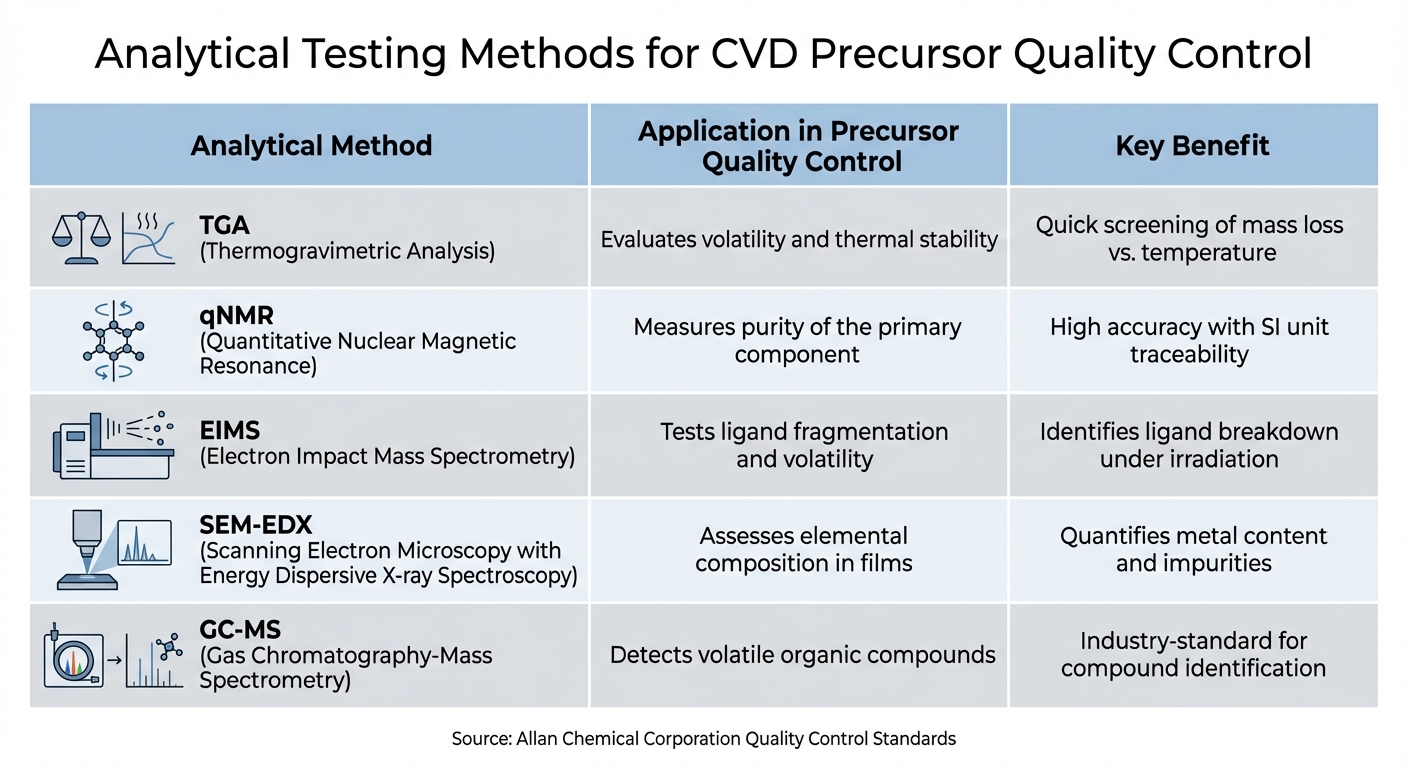
CVD Precursor Analytical Testing Methods Comparison
Key Purity Metrics
Chemical Vapor Deposition (CVD) precursors must meet specific physical and chemical criteria to ensure consistent film quality and minimal contamination. Critical factors include high volatility and sufficient vapor pressure at room temperature, which enable efficient gas-phase transport and rapid deposition [1][8]. For instance, advanced liquid ruthenium precursors, such as TRuST, demonstrate vapor pressures up to 100 times higher than standard liquid ruthenium options under ambient conditions [8].
Thermal stability is another essential property, ensuring that precursors maintain integrity during transport while selectively decomposing on the desired substrate [1]. Precursors with a sublimation onset temperature below 212°F (100°C) are particularly well-suited for use in gas injection systems [7].
The cleanliness of ligands plays a pivotal role in reducing contamination. Ideal ligands, such as carbon monoxide (CO) or carbon dioxide (CO₂), detach cleanly, whereas others, like cyclopentadienyl, can leave behind unwanted carbon residues [7]. For example, copper(II) carboxylate precursors in focused beam-induced deposition have been shown to yield deposits containing just 23 atom % metal due to inefficient ligand dissociation [7]. In contrast, β-diketonates can produce films with purities as high as 99 atom % [7].
Liquid precursors also offer an advantage by maintaining consistent vapor pressure through a stable surface area, ensuring precise dosing and reliable delivery [1].
Meeting these stringent requirements necessitates robust analytical testing to confirm the integrity and performance of CVD precursors.
Analytical Testing Methods
To ensure compliance with rigorous purity standards, several analytical techniques are employed during the quality control process for CVD precursors. Gas Chromatography-Mass Spectrometry (GC-MS) is the gold standard for identifying volatile and semi-volatile organic compounds. This method separates and identifies substances based on their boiling points and mass-to-charge ratios [11][12].
Quantitative Nuclear Magnetic Resonance (qNMR) provides a direct and highly accurate measurement of the primary component’s purity, with results traceable to SI units [9][10]. Thermogravimetric Analysis (TGA) is often used as an initial screening tool, assessing mass loss in response to temperature changes to evaluate volatility and decomposition behavior [1]. Electron Impact Mass Spectrometry (EIMS) examines ligand behavior under irradiation, shedding light on fragmentation and decomposition processes. Meanwhile, Scanning Electron Microscopy with Energy Dispersive X-ray Spectroscopy (SEM-EDX) analyzes the elemental composition of deposited films, quantifying metal content relative to impurities like carbon, oxygen, and fluorine [7].
| Analytical Method | Application in Precursor Quality Control | Key Benefit |
|---|---|---|
| TGA | Evaluates volatility and thermal stability | Quick screening of mass loss vs. temperature [1] |
| qNMR | Measures purity of the primary component | High accuracy with SI unit traceability [9][10] |
| EIMS | Tests ligand fragmentation and volatility | Identifies ligand breakdown under irradiation [7] |
| SEM-EDX | Assesses elemental composition in films | Quantifies metal content and impurities [7] |
| GC-MS | Detects volatile organic compounds | Industry-standard for compound identification [12] |
At Allan Chemical Corporation, these rigorous analytical methods form the backbone of our quality control processes, ensuring that every CVD precursor meets the highest purity standards for optimal performance.
This content is for informational purposes only. Always consult official regulations and qualified professionals before making sourcing or formulation decisions.
Storage and Handling Best Practices
Optimal Storage Conditions
CVD precursors are highly sensitive to factors like temperature, oxidation, light, and moisture, which means they must be stored under carefully controlled conditions [15].
For thermally unstable chemicals, refrigeration (35–46°F/2–8°C) or freezing (<32°F/0°C) is essential [14][15]. Always record the "date received" and "date first opened" on each container to track potential degradation over time [17].
The choice of container is equally important. Materials should be non-reactive, non-additive, and non-absorptive to prevent reactions with the precursor [16]. For many CVD applications, silicon-coated stainless steel containers are preferred because they reduce metal contamination and minimize reactive sites on the container walls. Closed, pressurized systems are ideal for storage, as they protect the precursors from exposure to dust, dirt, moisture, and air [16]. Additionally, all open ends of manifolds, pigtails, and hoses should be covered to prevent contamination [16].
Segregation plays a critical role in maintaining safety and quality. Acids should be stored away from bases, and oxidizers must be kept separate from flammables and reducing agents [14][17]. Pyrophoric and water-reactive materials, such as certain metal hydrides commonly used in CVD, should be stored far from any water sources [17]. Using plastic bins for secondary containment on shelves adds an extra layer of protection against leaks and helps ensure proper segregation by hazard class [17].
Proper storage is just the beginning – effective handling practices are just as important to prevent contamination.
Preventing Contamination
To avoid contamination, always keep chemical containers sealed when not in use [18]. According to MKS Instruments:
"The precursors used for CVD reactions must be of extremely high purity since any impurity will end up incorporated into the deposited film" [19].
Maintaining stable storage conditions is critical because decomposition of precursors can introduce impurities that compromise the process [19].
Regular inspection of handling equipment is essential to prevent particulate shedding [18]. Containers should be clearly labeled, kept sealed, and accessed only by trained personnel [18]. Handling procedures should aim to minimize the formation and spread of aerosols, which can disrupt cleanroom environments [18].
Personnel hygiene is another key factor. Inconsistent glove use, particularly around shared equipment like keyboards, is a common source of contamination [18]. To address this, clearly label computers and sensitive instruments to indicate whether gloves should or should not be worn [18]. Laboratory coats should be stored in designated areas – not in offices or break rooms – to contain potential contaminants [18].
Developing lab-specific Standard Operating Procedures (SOPs) for handling hazardous or sensitive precursors is highly recommended. Additionally, reconciling chemical inventories every six months helps identify and properly dispose of expired or degraded precursors [14]. The FDA underscores this approach with its guiding principle:
"Quality should be built into the product; testing alone cannot ensure product quality" [16].
By following these rigorous practices, the integrity of CVD precursors is preserved, ensuring they deliver optimal performance in thin film deposition processes.
At Allan Chemical Corporation, we adhere to these best practices to maintain the quality and reliability of our CVD precursors.
This content is for informational purposes only. Always consult official regulations and qualified professionals before making sourcing or formulation decisions.
sbb-itb-aa4586a
In-Process Quality Control for CVD Applications
Monitoring Precursor Concentration and Vapor Pressure
Keeping a close eye on precursor concentration and vapor pressure in real time is a key part of maintaining quality in Chemical Vapor Deposition (CVD) processes. Within a Statistical Process Control (SPC) framework, this monitoring allows operators to make immediate adjustments during production [20]. By setting specific control limits for these variables, you can differentiate between normal fluctuations and significant deviations that signal potential problems [20]. When data exceeds these limits, it’s a clear indicator that corrective measures are needed to prevent the production of non-uniform films or defective products. Using real-time SPC software to track vapor pressure and concentration helps uncover hidden process deviations early, enabling adjustments before they impact the quality of the output [20].
Advanced delivery systems also play a critical role in ensuring consistent precursor quality. For instance, ultrasonic atomizers are essential for achieving complete vaporization within the reactor chamber, which is necessary for uniform film deposition [21]. In applications demanding extreme precision, pulsed injection modes can regulate deposition rates down to monolayers per pulse, providing a level of consistency that continuous delivery methods struggle to match [21]. The importance of such precise control is underscored by Six Sigma manufacturing standards, which aim for fewer than 3.4 defects per million products – a benchmark for process efficiency [20].
Equally vital to maintaining process quality is the precise control of gas flow, a topic covered in the next section on Flow Control and Mass Flow Controllers.
Flow Control and Mass Flow Controllers
Once real-time monitoring is in place, accurate flow control becomes essential for delivering consistent amounts of precursor material. High-accuracy mass flow controllers (MFCs), like the Bronkhorst IQ+FLOW series, are designed to provide precise real-time monitoring and control of gas flow, ensuring both qualitative and quantitative accuracy [22]. These controllers integrate seamlessly into CVD systems through digital or analog communication interfaces, offering a compact design without sacrificing performance [22].
For optimal performance, it’s crucial to select MFCs made from non-reactive materials that comply with SEMI F20 HP standards, such as 316L VIM VAR or Hastelloy C-22. These materials help prevent metallic contamination by ensuring an all-metal flow path [24]. In high-flow applications where the flow exceeds 30 liters per minute, maintaining a minimum inlet pressure of 45 psia is necessary to prevent fluctuations that could compromise film uniformity [24]. Automated features like "Auto Zero" and "Auto Shut Off" further enhance accuracy and help prevent process drift over time [24].
Regular system suitability testing is also essential to confirm that all components – equipment, electronics, and analytical systems – are functioning correctly during use [23]. Establishing validated flow rate settings and ranges through rigorous testing ensures consistent results across production cycles [23]. Additionally, conducting trend analyses on MFC performance at scheduled intervals can help identify when recalibration or optimization is needed [23].
This content is for informational purposes only. Always consult official regulations and qualified professionals before making sourcing or formulation decisions.
Advanced Quality Assurance Techniques
Statistical Process Control (SPC)
When it comes to CVD precursors, maintaining quality is critical for successful thin film deposition. Advanced quality assurance techniques ensure precision at every production stage. One such method, Statistical Process Control (SPC), offers a structured way to monitor production consistency and catch issues before they affect product quality. By tracking key parameters in real time, SPC helps identify deviations caused by factors like input variability, equipment wear, or material aging [25]. This proactive approach ensures consistent process performance and reliable product quality [25], enabling manufacturers to address problems swiftly.
In tandem with SPC, Process Analytical Technology (PAT) takes monitoring to the next level. PAT provides real-time data on critical attributes like precursor concentration (using in-line UV cells and online HPLC) and residence time distribution. This allows manufacturers to quickly detect and manage deviations [25]. When irregularities arise, diversion strategies can redirect nonconforming material, preventing it from affecting the final product [25].
While real-time monitoring is essential, it’s just one part of the equation. Comprehensive batch testing ensures the integrity of the entire production process.
Batch Testing and Documentation
To complement in-process controls, batch testing acts as the final checkpoint for quality assurance. Each production run undergoes rigorous testing to confirm it meets established quality and purity standards. This process involves reviewing key production and laboratory records [2]. Any deviations from standard procedures are documented and analyzed, with significant issues triggering formal investigations to uncover root causes and prevent future occurrences [2]. Additionally, annual product quality reviews assess process consistency by examining in-process controls, failed batches, and nonconformance trends [2].
Effective traceability relies heavily on detailed documentation. Master Production Instructions and Batch Production Records (BPR) should provide a thorough history of each batch, including dates, equipment used, measurements, and personnel signatures [2]. In continuous manufacturing systems, batch size may be defined by factors such as output material quantity, input material quantity, or total run time at a specified mass flow rate [25]. Reserve samples from each batch play a crucial role in supporting re-testing during quality investigations or addressing complaints [2]. Furthermore, Certificates of Analysis (CoA) ensure supply chain transparency by detailing the source, lot number, and expiration date of materials [26].
Together, these advanced techniques form a robust quality control framework for CVD precursors. From supplier selection to final documentation, every step is designed to uphold the atomic-level precision required in advanced semiconductor manufacturing.
This content is for informational purposes only. Always consult official regulations and qualified professionals before making sourcing or formulation decisions.
Conclusion
Quality control is the backbone of every step in the CVD process, especially when it comes to managing CVD precursors. The quality of these precursors plays a decisive role in achieving successful thin film deposition. Factors like film uniformity, conformality, and structural integrity – key for integrated circuits and photovoltaic devices – are directly tied to the purity and characterization of the precursors used [13]. When precursors are contaminated or poorly characterized, the resulting films can suffer from defects and performance failures, jeopardizing the entire manufacturing process [3].
Adhering to strict standards for identity, strength, quality, and purity ensures that precursors perform as expected from the start [3]. This aligns with the FDA’s Office of Pharmaceutical Quality’s emphasis on delivering products that consistently meet user expectations – an approach that is just as critical for CVD precursors, where consistency directly impacts process reliability [3].
Proper storage and handling are also essential to maintain the integrity of precursors, preventing issues like degradation or contamination throughout their lifecycle [1][28].
In-process monitoring, backed by validated analytical methods, allows for the early detection of deviations, ensuring decisions are based on reliable data [26]. For precision-dependent applications like Atomic Layer Deposition, where control at the sub-nanometer level is critical, such rigorous oversight is non-negotiable [27].
From the initial selection of suppliers to the final documentation, every quality control measure contributes to achieving the atomic-level precision required in modern semiconductor manufacturing. This meticulous approach minimizes waste, enhances production yields, and ensures consistent performance.
This content is for informational purposes only. Always consult official regulations and qualified professionals before making sourcing or formulation decisions.
FAQs
What should I look for when choosing a trustworthy CVD precursor supplier?
When choosing a supplier for CVD precursors, prioritize regulatory compliance, quality assurance, and dependable service. Confirm that the supplier follows established standards like USP General Chapter <1083> and provides detailed Certificates of Analysis (COAs) for each batch. These COAs should verify critical details such as the product’s identity, purity, and recommended storage conditions.
Additionally, assess their operational strengths. Reliable suppliers should offer efficient traceability systems, flexible just-in-time delivery options, and accessible technical support. Establishing a clear supplier-quality agreement is also crucial. This agreement should outline roles and responsibilities related to testing, documentation, and addressing any quality issues. Partnering with a supplier who meets these criteria ensures consistent quality and smooth operation of your CVD processes.
What are the best analytical methods to ensure the purity of CVD precursors?
To guarantee the purity of CVD precursors, laboratories rely on proven analytical methods such as GC-MS (Gas Chromatography-Mass Spectrometry), HPLC (High-Performance Liquid Chromatography), and NMR (Nuclear Magnetic Resonance). These techniques are essential for precisely detecting impurities, confirming molecular structures, and evaluating key factors like precision, accuracy, and detection thresholds.
By following established guidelines, such as ICH Q2(R2), these testing procedures deliver dependable results, safeguarding the quality of the precursors. This rigorous approach ensures they meet strict quality standards and perform consistently in their intended applications.
What are the ideal storage conditions to ensure the quality of CVD precursors?
To keep CVD precursors in top condition, store them in tightly sealed containers in a cool, dry place with minimal humidity. Shield them from light, air, and temperature extremes, as these can compromise their purity and performance. Proper storage is key to maintaining their stability and ensuring they work reliably in essential applications.




Comments are closed