
Ecological Risk Assessment (ERA) evaluates how pesticides and other chemicals might harm ecosystems. This process, defined by the U.S. EPA, identifies potential risks to non-target species like plants, animals, and insects. It ensures pesticide use complies with laws like FIFRA and the Endangered Species Act, preventing unreasonable harm to wildlife and habitats.
Key points about ERA for pesticides:
- Purpose: Assess exposure and toxicity to non-target species.
- Process: Includes problem formulation, exposure analysis, and risk characterization.
- Tools: EPA uses models (e.g., GENEEC2, PRZM-EXAMS) to predict pesticide behavior.
- Data: Relies on toxicity studies, environmental fate, and usage patterns.
- Thresholds: Risk Quotients (RQ) are compared to Levels of Concern (LOC) to guide regulatory decisions.
Pesticides: which species to test in ecological risk assessments?
The EPA’s Ecological Risk Assessment Process
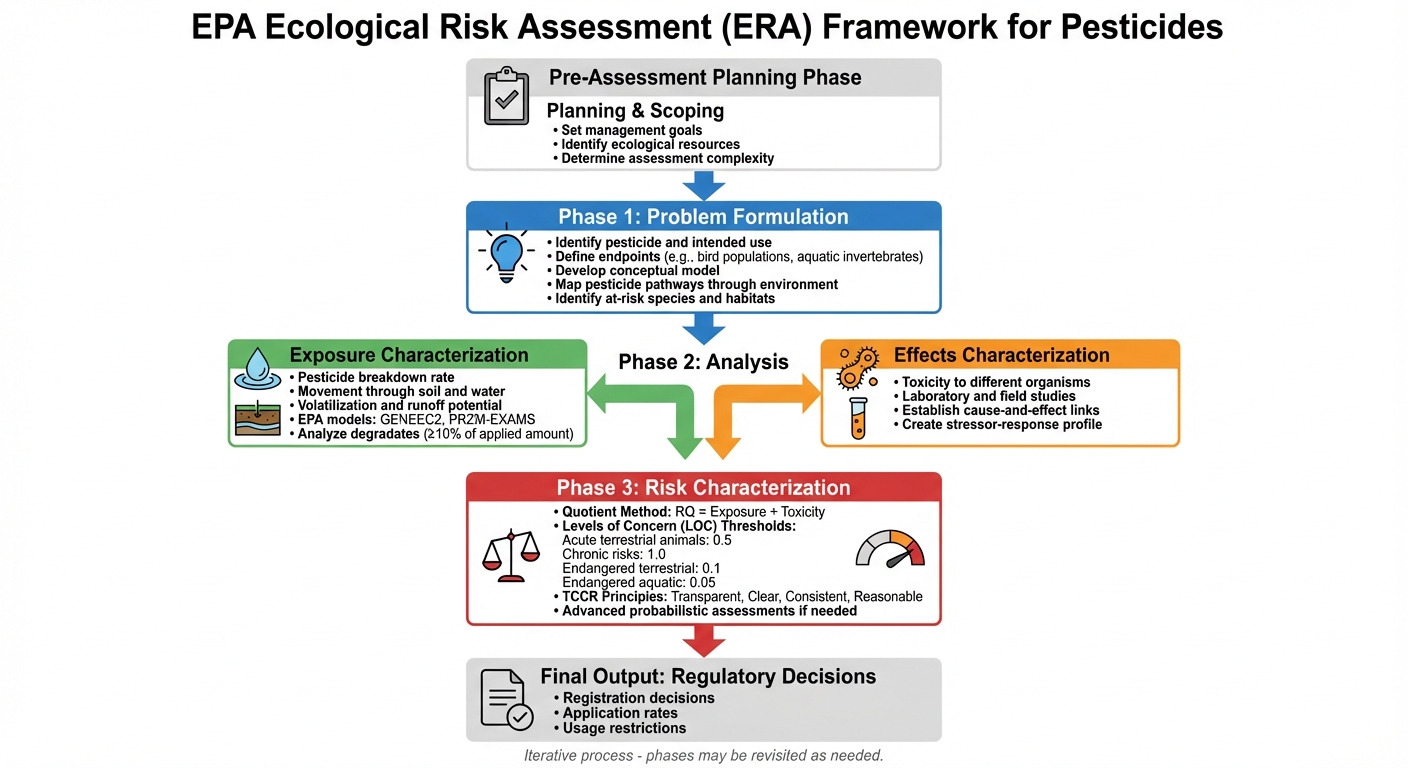
EPA’s 3-Phase Ecological Risk Assessment Process for Pesticides
The Environmental Protection Agency (EPA) uses a structured three-phase framework to evaluate the environmental safety of pesticides. Before diving into the assessment, risk managers take time to plan and define the scope. This involves setting clear management goals, identifying key ecological resources, and determining the complexity of the assessment [4][2]. This preparation ensures the process focuses on the most pressing ecological concerns.
Problem Formulation
This phase serves as the foundation for the entire risk assessment. According to the EPA, "Problem formulation provides the foundation for the ecological risk assessment. It is an iterative process for generating hypotheses concerning why ecological effects occurred from human activities" [1]. During this stage, assessors identify the pesticide in question, its intended use, and the specific endpoints being examined, such as bird populations or aquatic invertebrates. A conceptual model is also developed to map how the pesticide might travel through the environment and which species or habitats are most at risk.
Once the groundwork is laid, the process moves to the analysis phase, which dives deeper into exposure and effects.
Analysis: Exposure and Effects Characterization
The analysis phase has two key components that work together. Exposure characterization looks at how the pesticide behaves in the environment. This includes studying its breakdown rate, movement through soil and water, and potential for volatilization or runoff [7]. The EPA uses tiered modeling systems, ranging from basic screening tools like GENEEC2 to more advanced simulations such as PRZM-EXAMS [7]. If pesticide breakdown products (degradates) form at levels of 10% or more of the applied amount, they must also be analyzed [7].
On the other hand, effects characterization focuses on the pesticide’s toxicity to different organisms. This involves establishing cause-and-effect links through laboratory and field studies [6]. The result is a stressor-response profile that connects exposure levels to potential ecological effects [6].
These insights from exposure and effects analysis lead into the final phase, where risk is quantified and interpreted.
Risk Characterization
In this phase, the EPA combines exposure and effects data to estimate the likelihood of harm. The Quotient Method is a key tool used here. It calculates a Risk Quotient (RQ) by dividing the estimated environmental concentration of the pesticide by its toxicity (RQ = Exposure / Toxicity) [5]. The RQ is then compared to Levels of Concern (LOC) – thresholds that indicate when regulatory actions might be necessary. For example, an LOC of 0.5 is used for acute risks to terrestrial animals, while chronic risks are flagged at an RQ of 1.0 or higher [5]. For endangered species, the thresholds are stricter: 0.1 for terrestrial animals and 0.05 for aquatic species [5].
The EPA ensures that risk characterization adheres to TCCR principles – it must be Transparent, Clear, Consistent, and Reasonable [5]. If initial assessments suggest a high risk, the agency may perform more detailed probabilistic assessments. These refined evaluations estimate the range and probability of adverse effects instead of relying on a single fixed value [5]. The findings from this phase guide decisions about pesticide registration, application rates, and usage restrictions [5].
This information is intended for general guidance. Always consult official regulations and qualified experts before making decisions related to pesticide use or sourcing.
Data Used in Pesticide Ecological Risk Assessments
Ecological risk assessments for pesticides rely on three main categories of data: toxicity, environmental fate, and usage patterns. The Environmental Protection Agency (EPA) evaluates these data collectively to determine whether a pesticide poses acceptable risks to ecosystems. This phased approach helps create a complete environmental risk profile.
Toxicity Data on Non-Target Species
Assessing how pesticides impact organisms they are not intended to target is a key part of ecological risk evaluations. The EPA requires two types of toxicity data: acute toxicity, which measures short-term effects like mortality from a single dose (reported as LD50 or LC50), and chronic toxicity, which examines long-term impacts on survival, growth, and reproduction (measured as NOAEC or LOAEC) [6]. These tests cover a wide range of species, including birds, mammals, fish, aquatic invertebrates, pollinators, and plants – both terrestrial and aquatic [6]. Surrogate species are often used to represent broader taxonomic groups [6]. For example, avian reproduction tests, which typically last 20 weeks, measure outcomes such as the number of eggs laid, viable embryos, and hatchling survival [6].
Field incident data are also considered to validate laboratory findings. The EPA notes that, “The incident data that are available can provide evidence that exposure pathways for a particular pesticide are complete and that exposure levels are sufficient to result in field-observable effects” [9].
Recent studies have expanded the focus beyond mortality to include sublethal effects like behavioral changes, hormonal disruptions, and developmental impairments [10][11]. For instance, some pesticides are more than 11,000 times more toxic to certain non-target insects like plant bugs compared to honeybees [11]. To supplement registrant-submitted data, the EPA also reviews peer-reviewed studies through the ECOTOX database [8], which helps address gaps for species like amphibians and reptiles.
Environmental Fate and Transport Data
Environmental fate and transport data are crucial for predicting how pesticides move and persist in the environment after application. These details help create exposure profiles that describe the intensity, distribution, and duration of pesticide contact with plants, animals, and other environmental components [7]. Using this data, models estimate Estimated Environmental Concentrations (EECs), which are then compared to toxicity thresholds [7][5].
Depending on the pesticide’s intended use, up to 24 studies may be required to evaluate its environmental behavior [7]. These studies often include:
- Degradation studies: Assessing how pesticides break down in water, sunlight, or through microbial activity under aerobic and anaerobic conditions.
- Mobility studies: Examining how pesticides interact with soil, including adsorption and desorption, to predict the likelihood of leaching into groundwater.
- Field dissipation studies: Observing real-world processes like leaching, runoff, volatilization, and plant uptake [7].
The EPA uses a tiered assessment strategy, relying on models like GENEEC2 and PRZM-EXAMS [7]. Any breakdown products, or degradates, that form at levels of 10% or more of the applied pesticide must be identified and assessed. Even degradates present at lower levels are evaluated if they are known to be toxicologically significant [7].
Usage Patterns and Application Rates
How and how much pesticide is applied plays a major role in determining environmental exposure. Usage instructions on pesticide labels guide input parameters for simulation models that estimate exposure levels [3]. According to the EPA, “Use factors on the labeling also determine the input parameters for exposure models and the magnitude of exposure to non-target organisms” [3].
Application methods, such as aerial spraying, ground application, soil injection, or seed treatment, influence exposure pathways like spray drift, runoff, or leaching [7]. For example, when assessing risks to terrestrial plants, spray drift exposure is estimated at 1% of the application rate for ground methods and 5% for aerial, airblast, or chemigation applications [7].
The frequency and timing of applications also affect cumulative exposure and long-term risks [12]. For instance, repeated applications over a growing season or a lifetime can lead to higher residue levels [7]. By analyzing these usage patterns, risk assessors focus on worst-case scenarios to ensure that if a pesticide is safe under these conditions, it is likely safe in less intensive scenarios as well. This usage data is a critical part of the overall risk characterization process.
This content is for informational purposes only. Consult official regulations and qualified professionals before making sourcing or formulation decisions.
sbb-itb-aa4586a
Factors That Influence Pesticide Environmental Risks
The environmental risks associated with pesticide use stem from a combination of the pesticide’s chemical properties, the environmental conditions where it is applied, and the sensitivity of the organisms exposed to it. By understanding these factors, we can better predict how a pesticide behaves after application and assess its potential impact on ecosystems.
Pesticide Properties
The chemical characteristics of a pesticide largely determine its behavior in the environment. One key factor is persistence, which is often measured by its half-life. This metric indicates how quickly the pesticide breaks down due to processes like hydrolysis, photodegradation, or microbial metabolism. Pesticides with longer half-lives stay active for extended periods, increasing the exposure time for non-target species.
Mobility and transport are also critical. These depend on properties such as solubility, volatility, and adsorption/desorption, which describe how a pesticide binds to soil particles. Highly soluble pesticides are more prone to leaching into groundwater or moving into surface water through runoff, while volatile pesticides can vaporize and spread through the air. As the U.S. Environmental Protection Agency (EPA) notes, "stereoisomers may exhibit selective biological effects towards organisms in the environment." Additionally, the physical formulation of a pesticide matters – granular products behave differently than liquid sprays, and droplet size can influence the likelihood of off-target spray drift. Degradates, or breakdown products, may also play a role, as they can sometimes be more persistent or toxic than the original compound. For this reason, the EPA requires identification of degradates that form in amounts exceeding 10% of the applied pesticide [7].
These inherent chemical traits form the foundation for how environmental factors influence risk.
Environmental Conditions
Environmental conditions significantly affect how pesticides behave and the risks they pose. Soil composition and microbial activity, for instance, influence how pesticides bind to soil or break down over time. Factors like sunlight, temperature, rainfall, and wind also play a role in processes such as degradation, runoff, and drift [7]. Pesticides that bind tightly to soil particles are less likely to leach into groundwater, though they may still reach surface water through soil erosion.
Weather conditions during application – such as wind speed and temperature – are particularly important. They can affect spray drift and volatilization. Screening-level assessments often assume that spray drift exposure to terrestrial plants is about 1% of the application rate for ground applications, and 5% for aerial, airblast, or chemigation applications [7]. Field dissipation studies, which account for real-world factors like hydrolysis, photolysis, microbial transformation, and off-site transport, provide additional insights into how pesticides behave under actual use conditions [7].
Non-Target Species Sensitivity
The final piece of the risk puzzle is the sensitivity of non-target organisms. Different species respond to pesticide exposure in varying ways, making sensitivity a critical factor in ecological risk assessments. These assessments focus on the most sensitive species within each taxonomic group to establish protective benchmarks, known as Levels of Concern (LOCs).
Life stage also plays a role in sensitivity. Early developmental stages are often more vulnerable than adults, which is why tests like Fish Early Life-Stage studies are commonly required. Additionally, some species have unique vulnerabilities. For example, fish can be more sensitive to certain herbicides when exposed to ultraviolet light [6]. Special protections are also in place for endangered and threatened species, with LOCs set at a Risk Quotient of 0.1 for terrestrial animals and 0.05 for aquatic species [5].
This content is for informational purposes only. Consult official regulations and qualified professionals before making sourcing or formulation decisions.
Conclusion
Key Takeaways for Pesticide Users and Regulators
Drawing from the detailed risk assessment process discussed earlier, here are the main points to remember. Ecological risk assessment plays a crucial role in ensuring pesticides are used safely. It evaluates a pesticide’s exposure and toxicity to determine whether its application poses risks to the environment. If the Risk Quotient (RQ) exceeds the Level of Concern, it signals the need for mitigation measures or regulatory actions.
For pesticide users, the message is simple: always follow the product label instructions. These labels are legally binding and based on thorough risk assessments that outline proper application rates, timing, and restrictions to safeguard non-target organisms. In sensitive areas, such as those near fisheries or habitats of endangered species, additional precautions like buffer zones or reduced application rates may be required[3][4].
Regulators and stakeholders should understand the tiered nature of risk assessments. Initial screening-level evaluations can quickly highlight potential risks, while more detailed probabilistic models provide deeper analysis when concerns arise[3][5].
Supporting Environmental Compliance Through Expertise
Achieving compliance requires not only high-quality chemicals but also technical know-how. As highlighted in the Journal of Regulatory Science, "The contemporary regulatory paradigm in the U.S. is data rich and analysis intensive by design, and perhaps understandably, biased towards ensuring environmental protection when registering pesticides"[13].
For companies involved in pesticide production or formulation, partnering with experienced chemical suppliers is key to simplifying compliance. Allan Chemical Corporation (https://allanchems.com) offers over 40 years of expertise in providing technical-grade and compendial-grade chemicals (USP, FCC, ACS, NF). Their sourcing capabilities and just-in-time delivery help maintain consistency, while their extensive experience supports businesses in navigating regulatory requirements. Whether you’re developing new formulations or managing existing registrations, working with a knowledgeable supplier can mean the difference between smooth operations and costly setbacks. By tapping into such expertise, manufacturers can uphold both efficiency and environmental responsibility.
This content is for informational purposes only. Always consult official regulations and qualified professionals before making sourcing or formulation decisions.
FAQs
What are Risk Quotients, and how do they help in assessing pesticide risks to the environment?
Risk Quotients (RQs) are numbers that help assess how pesticides might affect non-target organisms in the environment. These values are determined by comparing the estimated levels of pesticide exposure in the environment to toxicity thresholds specific to certain organisms.
The Environmental Protection Agency (EPA) relies on RQs to identify potential acute or chronic risks to wildlife, including birds, fish, and insects. When an RQ surpasses the EPA’s established levels of concern, it can signal the need for regulatory actions or extra steps to safeguard the environment.
How does the EPA evaluate what happens to pesticides in the environment?
The EPA examines how pesticides interact with the environment by studying their breakdown and movement through soil, water, and air. This process involves analyzing both laboratory and field studies that focus on key mechanisms such as hydrolysis, photolysis (in both soil and water), metabolism (in aquatic and soil environments), volatility, and field dissipation.
These investigations provide insight into how long pesticides remain in the environment and whether they could harm ecosystems or wildlife. The results play a vital role in evaluating the environmental impact of pesticides and guiding their safe application.
What factors determine how pesticides affect non-target species?
The effect of pesticides on species that aren’t their target depends on multiple factors. Key considerations include the pesticide’s toxicity, the amount used, and the application method. Environmental aspects, like soil type, weather conditions, and how long the pesticide remains active in the environment, also significantly influence the outcome.
Moreover, the length and intensity of exposure and the specific characteristics of the species – such as its developmental stage and sensitivity – play a crucial role in determining its vulnerability. Recognizing these variables is critical to reducing accidental harm to wildlife and maintaining ecosystem balance.




Comments are closed