
Navigating DOT hazmat compliance involves balancing federal, state, and local regulations. Federal rules under 49 CFR Parts 100-185 provide a uniform framework for transporting hazardous materials, but state and local governments often add their own requirements. This creates challenges for businesses managing transportation, as noncompliance can lead to fines of up to $102,348 per infraction or $500,000 for corporations.
Here’s what you need to know:
- Federal Standards: Apply to all hazmat shipments, including intrastate transportation, and override conflicting state or local rules.
- State Regulations: Often align with federal standards but may add permits, fees, and specific material restrictions like those for LPG or explosives.
- Local Rules: Focus on infrastructure concerns (e.g., tunnel access, bridge usage) and may include permits, routing restrictions, and inspections.
- Preemption Risks: Federal law invalidates state or local rules that conflict with federal hazmat regulations unless they address unique safety concerns without burdening interstate commerce.
- Business Impact: Companies face administrative burdens managing permits, fees, and route audits across jurisdictions.
Key Takeaway: Compliance requires understanding federal rules while accounting for additional state and local requirements. Businesses must stay informed about preemption rulings and tailor strategies to meet multi-jurisdictional standards.
1. Local DOT Hazmat Compliance
When transporting hazardous materials, businesses must navigate not only federal regulations but also additional rules imposed by local jurisdictions. These local requirements often include highway routing restrictions, permit fees, certificates of fitness for drivers, and fire code inspections. While federal law sets the groundwork for classification, packaging, and labeling, local governments focus on specific infrastructure concerns, such as tunnel access, bridge usage, and restrictions on city streets.
Preemption Risk
Federal law generally overrides conflicting local regulations. Under 49 U.S.C. 5125 and 20106, local rules are preempted unless they are "substantively the same" as Federal Hazardous Materials Regulations (HMR). Local laws can exceed federal standards only if they address unique safety or security hazards, align with federal rules, and avoid placing undue burdens on interstate commerce. However, businesses often face challenges when local definitions of "hazardous materials" differ from those of the Department of Transportation (DOT). These inconsistencies can lead to conflicting requirements, some of which may not hold up under federal scrutiny. This legal gray area often results in varied enforcement practices across jurisdictions.
Enforcement Examples
Several municipalities have encountered federal preemption challenges due to their hazmat regulations. For instance:
- In May 2020, PHMSA issued Preemption Determination PD-37(R) regarding New York City’s permit requirements for hazardous materials.
- In June 1999, PD-14(R) addressed Houston’s Fire Code requirements for tank trucks, including inspections and fees.
- In May 2002, Broward County, Florida (PD-18(R)) faced scrutiny for its local rules on hazardous materials definitions, release reporting, and vehicle inspections, which conflicted with federal standards.
These cases highlight the tension between local and federal oversight, often leaving businesses caught in the middle.
Business Impact
For businesses, these regulatory inconsistencies translate into real-world challenges. Carriers must juggle a patchwork of local permits and fees along their transit routes, which increases both administrative costs and compliance risks. To stay compliant, companies need to carefully audit each jurisdiction they pass through, identify specific routing restrictions or permit requirements, and verify whether local fees have been invalidated by PHMSA. Additionally, maintaining thorough documentation for every locality is essential to avoid compliance gaps. The time and resources required to manage these complexities can strain operations, especially when local rules clash with federal standards.
This content is for informational purposes only. Always consult official regulations and qualified professionals before making sourcing or formulation decisions.
2. State DOT Hazmat Compliance
State-level hazardous materials (hazmat) regulations operate within the federal framework outlined in 49 CFR Parts 100-185. However, individual states often add their own layers of rules, such as highway routing restrictions, registration fees, and permits for specific materials like liquefied petroleum gas (LPG) or explosives. States are allowed to implement regulations that align with federal standards, but when they deviate – especially in areas like classification, packaging, labeling, and documentation – they risk being overruled under federal preemption laws (49 U.S.C. § 5125).
Preemption Challenges
State regulations can face preemption if they conflict with federal hazmat laws by creating obstacles or imposing differing requirements. For example, in February 2020, the Pipeline and Hazardous Materials Safety Administration (PHMSA) issued Preemption Determination PD-38(R), ruling that California’s meal and rest break laws for hazmat drivers conflicted with federal safety standards. Similarly, in May 2020, Washington State’s rules on crude oil-by-rail were reviewed under PD-40(R). Federal authorities found that the state’s vapor pressure limits and pre-notification requirements disrupted uniform transportation standards. These cases highlight how state-specific regulations can complicate compliance and lead to inconsistent enforcement practices.
Enforcement Variations
State enforcement often focuses on vehicle inspections and fee-based permitting systems, which differ from the federal approach of unannounced carrier audits. For instance, in November 2004, Tennessee faced scrutiny under Preemption Determination PD-21(R) for its annual remedial action fee and incident reporting requirements that applied even to minor incidents below federal thresholds. Louisiana encountered a similar situation with PD-27(R), where its notification timelines and criteria for hazmat incidents clashed with federal standards requiring immediate telephonic reporting to the National Response Center for major incidents like fatalities or road closures. These examples demonstrate how state-level enforcement adds layers of complexity to compliance efforts.
Business Considerations
For businesses, navigating these regulatory differences can be a logistical challenge. Carriers operating across multiple states must determine whether a Hazardous Materials Safety Permit (HMSP) is needed for high-risk loads, such as radioactive materials or poison-inhalation hazards. Additionally, state-specific permits for LPG, explosives, and hazardous waste require careful route planning and documentation. Companies should regularly review PHMSA’s Preemption Determination index to stay informed about state regulations that have been invalidated, such as unique vehicle bonding or marking requirements. Dual documentation – meeting both federal shipping paper standards and state permit demands – can help businesses avoid compliance issues during roadside inspections. For companies like Allan Chemical Corporation (https://allanchems.com), staying informed about evolving state requirements is key to maintaining smooth operations.
Financial Risks of Non-Compliance
State penalties add another layer of financial risk to federal enforcement. States often impose inspection fees and additional charges on top of federal fines, increasing the cost of non-compliance. This dual penalty structure means businesses must account for both federal and state-level fines when evaluating potential risks.
This content is for informational purposes only. Always consult official regulations and qualified professionals before making sourcing or formulation decisions.
sbb-itb-aa4586a
Pros and Cons
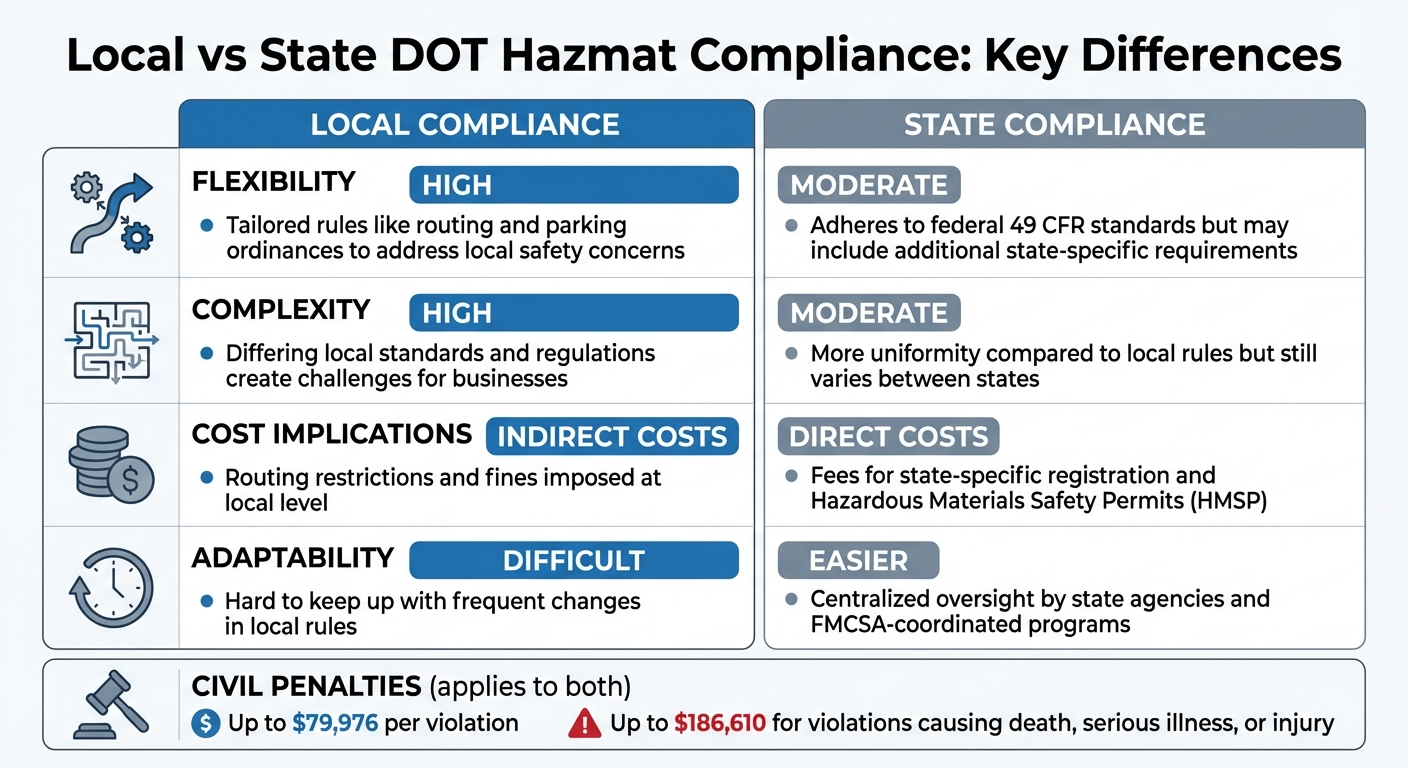
Local vs State DOT Hazmat Compliance: Key Differences Comparison
The table below provides a clear comparison of the advantages and disadvantages of local versus state compliance frameworks.
Choosing between local and state compliance systems involves balancing factors like flexibility, administrative workload, and financial impact. State-level compliance generally aligns with federal 49 CFR standards, offering consistency for businesses operating across multiple areas. On the other hand, local compliance varies significantly by region, with examples like Houston’s tank truck inspections or Broward County’s specific reporting requirements [3].
| Feature | Local Compliance | State Compliance |
|---|---|---|
| Flexibility | High within the jurisdiction; allows for tailored rules like routing and parking ordinances to address local safety concerns [4]. | Moderate; typically adheres to federal 49 CFR standards but may include additional state-specific requirements [1]. |
| Complexity | High for businesses due to differing local standards and regulations [6]. | Moderate; offers more uniformity compared to local rules but still varies between states [1]. |
| Cost Implications | Indirect costs may arise from routing restrictions and fines imposed at the local level [4]. | Direct costs include fees for state-specific registration and Hazardous Materials Safety Permits (HMSP) [1]. |
| Adaptability | Difficult for businesses to keep up with frequent changes in local rules [6]. | Easier to manage, thanks to centralized oversight by state agencies and FMCSA-coordinated programs [5]. |
The decision between these frameworks depends on how businesses prioritize operational efficiency, financial exposure, and adaptability to regulations.
State compliance systems often streamline processes through standardized fees and HMSP requirements, reducing administrative complexity. In contrast, local compliance can add layers of costs through permit fees and inspections. For instance, civil penalties are consistent across both levels – up to $79,976 per violation or $186,610 for violations causing death, serious illness, or injury – but local compliance tends to require more hands-on administrative effort [1]. State systems frequently use centralized electronic portals for Tier II reporting and standardized documentation, simplifying the process. Local compliance, however, involves direct interaction with Local Emergency Planning Committees (LEPCs) and municipal inspectors, creating more touchpoints for businesses to navigate [2].
Despite the added complexity, localized compliance can offer benefits like community-specific emergency planning. This approach allows for tailored strategies that address unique geographic or demographic challenges. Both compliance levels carry distinct requirements that influence operational costs and administrative demands, making it crucial for businesses to craft strategies that align with both federal standards and local specifics.
This content is for informational purposes only. Always consult official regulations and qualified professionals before making sourcing or formulation decisions.
Conclusion
DOT hazmat compliance operates within a framework defined by federal standards, with additional layers introduced by local and state regulations. At the core, the federal rules under 49 CFR set uniform guidelines for packaging, labeling, and documentation. However, businesses must also account for local ordinances, routing restrictions, and state-specific permits, creating a multi-layered regulatory environment that demands a well-coordinated compliance strategy.
To address these complexities, businesses often adopt strategies that mitigate both financial and administrative risks. Civil penalties for violations can reach up to $79,976 per incident, with even steeper fines for serious infractions [1]. Beyond financial concerns, companies must ensure proper driver training and maintain jurisdiction-specific documentation. Achieving compliance requires systems that integrate federal standards with local nuances.
For example, some companies effectively navigate these challenges by implementing robust systems that align federal, state, and local requirements. Their processes, such as just-in-time delivery models, demonstrate how operational discipline can help manage multi-jurisdictional compliance efficiently.
Staying compliant also means treating regulations as a constantly evolving framework. Businesses should regularly review PHMSA Preemption Determinations to understand which local rules remain enforceable [3]. Maintaining up-to-date knowledge of jurisdictional requirements, implementing ongoing training programs, and retaining shipping papers for at least one year are essential steps [1]. By combining regulatory awareness with operational precision, companies can successfully manage hazmat transportation within this complex regulatory landscape.
This content is for informational purposes only. Consult official regulations and qualified professionals before making sourcing or formulation decisions.
FAQs
What’s the difference between local and state DOT hazmat compliance requirements?
State DOT hazardous materials (hazmat) compliance often includes additional layers of regulation that go beyond the federal Hazardous Materials Regulations (HMR). States may require businesses to obtain extra registrations, secure permits, or follow stricter standards for labeling, packaging, and reporting. These rules are enforced by state agencies, which also handle inspections and issue penalties for non-compliance.
At the local level, compliance tends to focus on more specific aspects, such as routing restrictions, municipal permits, and emergency planning. While local governments cannot enforce rules that conflict with federal regulations, they play a role in spot inspections, emergency response coordination, and enforcing supplemental requirements that align with both state and federal laws.
For companies like Allan Chemical Corporation, staying informed about both state and local regulations is essential. This ensures compliance, helps avoid penalties, and keeps operations running smoothly when managing regulated materials.
How can businesses simplify compliance with federal, state, and local hazmat regulations?
To simplify compliance with hazardous materials (hazmat) regulations across different regions, businesses should implement a centralized compliance system. This could involve setting up a dedicated team or using specialized software to monitor and manage federal requirements under 49 CFR Parts 100–185 while aligning them with state-specific rules, such as permits, licensing, and registration processes. For instance, some states may require unique permits, while others mandate registration, making a unified strategy crucial for consistency.
Keeping a master record of essential documents – such as shipping papers, safety data sheets, training logs, and permits – helps ensure compliance with federal Hazardous Materials Regulations (HMR) as well as state-specific requirements. When discrepancies arise between local and federal rules, businesses can often rely on preemption provisions, which allow them to adhere to the stricter regulation.
Collaborating with a reliable supplier like Allan Chemical Corporation can also make compliance more manageable. AllanChem offers pre-qualified chemicals that meet DOT hazmat standards and provides detailed documentation to simplify verification processes. Regular employee training and staying informed about updates to state programs are additional steps that help ensure ongoing compliance while reducing administrative workload.
How does federal preemption address conflicts between state and local hazmat regulations?
Federal preemption ensures that laws governing the transportation of hazardous materials at the federal level take precedence over conflicting state or local regulations. Essentially, if a state or local rule clashes with federal requirements, it is overridden – unless the Department of Transportation (DOT) explicitly grants a waiver.
The DOT applies three main tests to determine whether preemption applies:
- Dual-compliance test: Determines if it’s impossible to comply with both federal and local regulations simultaneously.
- Obstacle test: Assesses whether the local rule hinders the objectives of federal law.
- Substantively-the-same test: Checks if the local rule is not essentially identical to the federal standard.
When a conflict arises, federal rules prevail, establishing a uniform standard across the country. This uniformity is critical for businesses like Allan Chemical Corporation, which depend on clear and consistent regulations to safely and efficiently transport hazardous materials throughout the United States.


Comments are closed