
Chemical dispensing systems automate the delivery of cleaning and etching chemicals in semiconductor manufacturing. These systems are essential for removing contaminants like slurry particles, organic residues, and metal ions from wafer surfaces, ensuring high chip yields. With 20% of semiconductor production steps involving wafer cleaning, precise chemical application is critical. Modern systems use advanced nozzles, flow controllers, and Programmable Logic Controllers (PLCs) to manage flow rates, wafer rotation speeds, and chemical concentrations with exceptional accuracy.
Key features include:
- Chemical storage: Uses corrosion-resistant materials like PTFE, PFA, and HDPE to prevent contamination.
- Dispensing mechanisms: Incorporate precise nozzles and pumps for accurate chemical delivery.
- Flow control: Monitors pressure, flow rates, and concentration to maintain consistency.
- Rinsing and drying: Ensures complete chemical removal and prevents defects.
Three main types of systems:
- Single-wafer systems: Deliver chemicals to individual wafers, reducing cross-contamination but with lower throughput.
- Batch systems: Process multiple wafers simultaneously, offering cost efficiency but higher contamination risks.
- Modular systems: Combine precision and scalability with customizable modules.
These systems handle aggressive chemicals like RCA Clean, Piranha, and HF, ensuring wafer cleanliness while maintaining material compatibility. Proper material selection, such as PFA for tubing and Kalrez® for seals, prevents degradation and contamination. Advanced automation and real-time monitoring enhance precision and safety, making these systems indispensable for semiconductor fabs.
Single Wafer SWC-3000 SWC-4000 SWC-5000, Large Substrate ,Mask ,Reticle Cleaners LSC-4000 LSC-5000
Main Components of Chemical Dispensing Systems
Chemical dispensing systems are built around three key subsystems that work together to deliver exact amounts of aggressive chemicals to wafer surfaces. These components must handle substances that are corrosive, toxic, or flammable, all while ensuring operations remain free from contamination. As Douglas Wagner from Modutek notes, "The amount of chemicals delivered has to be precise and repeatable. Successful wet processing often depends on the right mixture or concentration because etching, stripping, and cleaning can vary with the amount of chemicals in the bath" [6]. The main components – storage reservoirs, dispensing nozzles, and flow control systems – work in harmony to achieve this level of precision.
Chemical Storage Reservoirs and Containers
Storage reservoirs come in different configurations to meet the needs of various fabrication facilities and chemical usage levels. Large-scale operations often use totes with load cell interfaces to monitor volumes continuously, while mid-sized facilities rely on 55-gallon drums. For smaller-scale processes, DOT-approved carboys are commonly used, offering safe handling for laboratory applications [6]. These containers are made from chemically resistant materials like PTFE (polytetrafluoroethylene), PFA (perfluoroalkoxy), or HDPE (high-density polyethylene) to prevent degradation and potential contamination of wafers [4][9]. To enhance safety, secondary containment systems and dual-containment tubing are employed, minimizing spill risks when working with hazardous chemicals [6][4].
Dispensing Nozzles and Delivery Mechanisms
Once chemicals are securely stored, they are delivered with precision using advanced nozzle systems. These nozzles serve as the bridge between chemical storage and the wafer surface. For example, tri-megasonic scrubbing nozzles operating at 1.5 MHz can deliver high-flow streams while using megasonic energy to remove sub-micron particles without damaging delicate structures [1]. A practical example is the NIST NanoFab cleanroom, which employs the SSEC Model 3300ML system with these nozzles to support RCA cleaning processes for substrates ranging from 75 mm to 200 mm [1].
Delivery mechanisms often incorporate two-stage photochemical dispense pumps, which separate filtration and dispensing functions. This design allows for precise control and maintains accuracy even when handling medium-viscosity fluids ranging from 100 to 300 cP [9]. These pumps can operate under pressures up to 60 psi (0.40 MPa) and dispense volumes as small as 0.01 mL [9].
Flow Control and Monitoring Systems
Flow control systems are essential for maintaining consistent chemical application during each cleaning cycle. These systems rely on integrated flow controllers, proportional control valves, and pressure transducers to regulate flow [4]. For instance, the Entegris IntelliGen® MV Dispense System, introduced in June 2022, features dual pressure and temperature (PT) sensors that provide real-time feedback, achieving dispense repeatability of less than 0.02 mL (3 sigma) across hundreds of cycles [9]. Adjustments can be made as precisely as 0.001 mL for volume and 0.001 mL/sec for flow rate [9].
To ensure process consistency, metrology tools monitor factors like chemical concentration, turbidity, and temperature. Bubble sensors detect air pockets as small as 0.3 mL, preventing defects caused by trapped air [9][10]. Additionally, point-of-use filtration with 5-micron or smaller pore sizes removes particulates, protecting dispensing systems and preventing contamination of wafer surfaces [8].
This content is for informational purposes only. Consult official regulations and qualified professionals before making sourcing or formulation decisions.
Types of Chemical Dispensing Systems
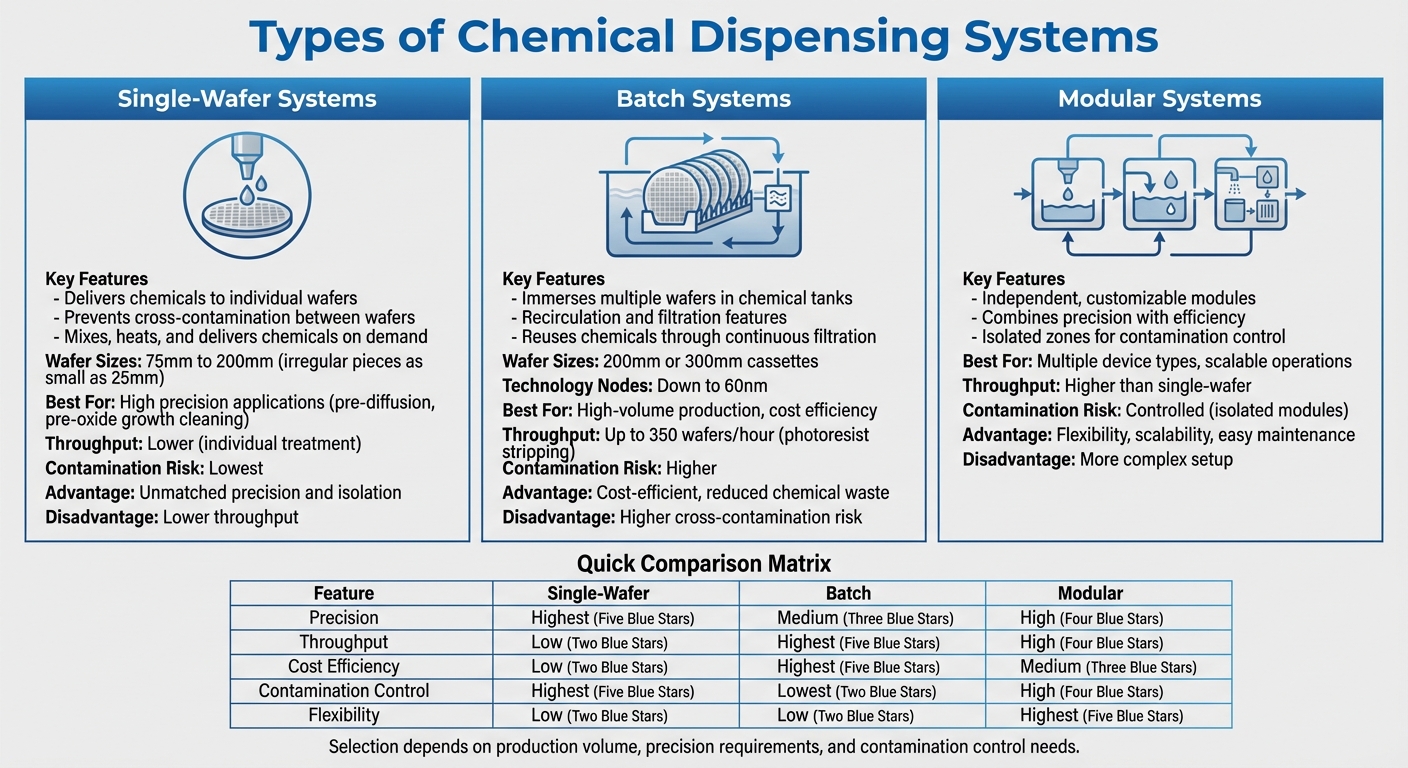
Comparison of Three Chemical Dispensing System Types for Semiconductor Wafer Cleaning
Wafer fabrication facilities rely on three main types of chemical dispensing systems, each designed to balance production volume, precision, and contamination control. These systems address specific semiconductor cleaning needs, ensuring efficiency and reliability in diverse manufacturing scenarios.
Single-Wafer Dispensing Systems
Single-wafer systems deliver chemicals directly to individual wafers as needed, preventing cross-contamination between wafers. As noted, "This system mixes, heats and delivers chemicals on demand and provides better wafer cleaning capability by eliminating cross contamination between wafers" [1]. These systems are particularly suited for applications requiring high precision, such as pre-diffusion and pre-oxide growth cleaning, where even the smallest contamination can impact device performance. They also accommodate a range of wafer sizes, from 75 mm to 200 mm, and can handle irregular pieces as small as 25 mm [1]. While these systems offer unmatched precision and isolation, their throughput is lower compared to batch systems, as each wafer undergoes individual treatment. This approach ensures consistent chemical application for each wafer and integrates seamlessly with processes needing isolated treatment environments.
Batch Dispensing Systems
Batch systems immerse multiple wafers in chemical tanks equipped with recirculation and filtration features, making them ideal for high-volume production. These wet bench setups emphasize cost-efficiency by reusing chemicals through continuous filtration, reducing waste. For instance, ACM Research highlights that "The Ultra C wb is an environmentally friendly system due to reduced process times and less chemical waste compared to single wafer wet clean equipment" [2]. Batch systems are well-suited for technology nodes down to 60 nm and are compatible with standardized 200 mm or 300 mm wafer cassettes [2]. While batch systems carry a higher risk of cross-contamination, independent modules within the system help mitigate this issue, ensuring a balance between efficiency and cleanliness.
Integrated Modular Dispensing Systems
Modular systems combine the precision of single-wafer systems with the efficiency of batch processing. These platforms consist of independent, customizable modules that can be tailored to meet specific production needs [2][6]. Each module operates separately, creating isolated zones that maintain contamination control while achieving higher throughput than standalone single-wafer systems. This flexibility allows manufacturers to scale operations or reconfigure modules as production demands change. Modular systems are especially valuable for facilities producing multiple device types or anticipating shifts in production volumes. Maintenance is also simplified, as individual modules can be serviced without disrupting the entire cleaning line. This adaptability ensures readiness for the precise chemical delivery processes explored in the following section.
This content is for informational purposes only. Consult official regulations and qualified professionals before making sourcing or formulation decisions.
How Chemical Dispensing Systems Work
Chemical dispensing systems operate through a carefully orchestrated process involving chemical delivery, flow rate management, and thorough post-cleaning. These systems ensure precise chemical concentrations, controlled flow rates, and consistent temperatures, which are essential for effective cleaning and maintaining uniform results over thousands of wafer processing cycles.
Chemical Delivery and Mixing
The delivery and mixing stage is critical for ensuring that chemicals reach the wafer surface in the correct concentrations throughout the cleaning cycle. In single-wafer systems, fresh chemicals are mixed, heated, and dispensed immediately using spray nozzles. This approach helps eliminate aging and cross-contamination issues [11][12]. In contrast, batch systems recirculate filtered chemicals within cleaning tanks, reducing chemical waste significantly [2]. As ACM Research explains:
"Unlike single wafer tools that clean by spraying chemicals on the wafer, batch tools reuse the chemicals through re‐circulation/filtration that reduces both chemical and post‐treatment waste disposal costs" [2].
Automated mix-blend systems provide consistent chemical ratios, such as SC1 (NH₄OH + H₂O₂ + H₂O), SC2 (HCl + H₂O₂ + H₂O), or SPM (H₂SO₄ + H₂O₂), ensuring high-purity mixtures before they are delivered to the process chamber [4][13]. Real-time concentration monitors for chemicals like hydrofluoric acid (HF) and phosphoric acid offer continuous feedback, enabling precise adjustments to delivery parameters [11]. Advanced dispensing pumps use two-stage systems, separating filtration and dispensing to maintain purity without sacrificing throughput [9]. Chemicals are transported from bulk storage through leak-proof networks of PFA valves, fittings, and manifolds directly to the point of use [5][6].
Flow Rate and Pressure Control
Accurate flow and pressure control are essential to ensure chemicals are delivered to wafer surfaces at the correct velocity and volume, minimizing defects and ensuring consistent results. Tools like Mass Flow Controllers (MFCs), electronic flowmeters, and proportional control valves regulate chemical volumes with exceptional precision. Dispense rates typically range from 0.1 to 3.0 mL/sec, with adjustments as fine as 0.001 mL/sec [9].
NT pressure transducers continuously monitor system pressure, keeping operations within a defined "Window of Operation" [4]. While photochemical dispense pumps are designed to handle pressures up to 0.40 MPa (60 psi), actual limits for medium-viscosity fluids (100–300 cP) are often lower, around 29 psig [9]. As Entegris notes:
"Maximum pressure is a limit on the Window of Operation. Actual volumes and rates may be restricted to comply with the pressure limits for a given viscosity, tubing diameter, tubing length and tubing height" [9].
These precise controls work in tandem with the delivery system to ensure uniform chemical application while preventing safety threshold violations and maintaining effective cleaning flow rates.
Post-Cleaning Processes
After chemicals are applied, controlled rinsing and drying complete the cleaning cycle. Rinsing is crucial to stop chemical reactions on the wafer surface as soon as it exits the chemical bath [13]. Common rinsing methods include:
- Overflow rinsing: Immersing wafers in a bath with a bottom-up water flow.
- Spray rinsing: Using nozzles to dispense water at variable pressures.
- Quick Dump Rinsing (QDR): Rapidly emptying and refilling cleaning tanks [11][13].
These methods are designed to dilute surface chemical concentrations to less than 1% of the original chemistry [13].
Once rinsing is complete, drying modules remove residual moisture to prevent water spots and maintain wafer stability. Advanced batch systems may use IPA (Isopropyl Alcohol) vapor dryers or gradient dryers to achieve particle-free drying [2][7]. Some facilities employ Multi Clean & Rinse (MCR) baths, which integrate chemical cleaning and deionized water (DIW) overflow rinsing in a single station, saving both space and time [2]. During wafer transfers, around 50–200 mL of medium can be carried over with each 25-wafer batch, making effective rinsing essential to avoid contamination in subsequent steps [13]. High-throughput batch systems, when optimized, can process up to 350 wafers per hour for photoresist stripping processes [2].
This content is for informational purposes only. Consult official regulations and qualified professionals before making sourcing or formulation decisions.
sbb-itb-aa4586a
Material and Chemical Compatibility
When dealing with aggressive cleaning environments, maintaining system integrity hinges on selecting materials that can handle the chemical and physical demands. Semiconductor manufacturing, for instance, relies on chemical dispensing systems that endure exposure to highly corrosive acids, solvents, and oxidizers. Without proper material selection, these substances can corrode components, compromise seals, and contaminate processes. Even minor mismatches in material compatibility can lead to particle shedding, chemical leaching, or complete system failures.
Material Selection for Dispensing Components
The materials used in dispensing components must exhibit strong chemical resistance, thermal stability, and mechanical durability. For wetted surfaces, fluoropolymers are the go-to choice because of their resilience against nearly all cleaning chemistries. Among these, PFA (Perfluoroalkoxy) is the industry standard for tubing, valves, fittings, and manifolds due to its broad resistance to chemicals [4][5].
For sealing applications, Kalrez® perfluoroelastomers stand out, offering excellent chemical and thermal resistance. This ensures that seals remain intact even in harsh conditions. For instance, the Entegris IntelliGen® MV dispense system – designed for medium-viscosity photochemicals (100–300 cP) – utilizes modified PTFE, PTFE, and Kalrez® across all wetted surfaces. This combination guarantees compatibility with aggressive lithography chemicals while delivering exceptional dosing precision, achieving repeatability of less than 0.02 mL over 200 cycles [9].
For bulk chemical storage, HDPE (High-Density Polyethylene) is a cost-effective option. Often used in trilayer configurations, it ensures high purity during chemical transport and storage [4]. Meanwhile, structural components and gas delivery systems rely on specialty alloys like stainless steel, nickel, and Alloy-22 for their mechanical strength. However, their direct contact with corrosive acids is limited compared to fluoropolymers [4].
Electrostatic discharge (ESD) management is another critical factor in fluid handling systems made with PFA. Static charges, especially in low-humidity environments (below 30%), can attract dust and lead to contamination. Solutions like PrimeLock® ESD fittings address these challenges effectively [5][8].
| Material | Chemical Resistance | Thermal Tolerance | Common Applications |
|---|---|---|---|
| PFA (Perfluoroalkoxy) | Excellent; inert to most acids and solvents | Moderate to High | Tubing, valves, fittings, and manifolds [4][5] |
| PTFE / Modified PTFE | Excellent; near-universal compatibility | Moderate to High | Pump wetted surfaces, diaphragms, filters [9] |
| Kalrez® (FFKM) | Excellent; high-performance elastomer | High (up to 600°F) | O-rings and seals in dispense pumps [9] |
| HDPE | Good for aqueous chemicals | Moderate | Bulk storage drums and containers [4] |
| Stainless Steel / Alloy-22 | Moderate; may corrode with some acids | High | Structural components, gas filters [4] |
| Quartz | High; resistant to strong acids | Very High | High-temperature etching baths [6] |
To maintain long-term performance and safety in wafer cleaning operations, it’s essential to verify that all tubing and reservoirs are resistant to the chemicals they will handle. Pre-treating components with a 10% sodium hypochlorite solution before standard cleaning protocols can further enhance durability [8]. Additionally, regular back-flushing with filtered solvents like isopropyl alcohol (IPA) or acetone immediately after use helps prevent clogging and maintains material integrity [8].
This information is for general guidance only. Always consult official regulations and qualified professionals before making any sourcing or formulation decisions.
Advanced Features and Customization Options
Modern chemical dispensing systems go well beyond simple fluid delivery. By integrating intelligent automation and real-time monitoring, these systems transform manual tasks into precise, repeatable processes. On top of these foundational controls, additional advanced features improve both operational consistency and safety.
Automation and Recipe Programming
Programmable recipe management plays a crucial role in streamlining wafer cleaning operations. Today’s systems rely on Man-Machine Interface (MMI) software to simplify programming, giving operators precise control over dispense volumes, rates, and sequences [9]. Why does this matter? Even the smallest variations in chemical delivery can impact yield rates across an entire production run.
One standout innovation is on-demand in-line blending, which uses patented technology to dynamically adjust flow rates while maintaining exact blend accuracy [14]. Instead of storing pre-mixed chemicals – which can degrade over time and occupy valuable cleanroom space – these systems mix only what’s needed for the task at hand. Advanced dispense systems can handle volumes as small as 0.01 mL and as large as 10.0 mL, with adjustments possible in increments as tiny as 0.001 mL. They also deliver remarkable repeatability, with deviations of less than 0.02 mL even over hundreds of cycles [9].
For batch processing, systems like the Ultra C wb demonstrate impressive throughput, handling up to 350 wafers per hour during photoresist strip processes. These systems also employ precise circulation and filtration methods to reuse chemicals, reducing both waste and operational costs [2]. Additionally, two-stage dispense systems equipped with dual pressure/temperature (PT) sensors allow for independent dispensing and filtration. This feature is especially critical when working with medium-viscosity fluids (100 to 300 cP), ensuring purity while automating tasks like venting trapped gas and monitoring each dispense cycle in real time. By eliminating manual interventions, these systems significantly boost production speed and consistency.
Real-Time Monitoring and Safety Features
In addition to automation, real-time monitoring and built-in safety features ensure process reliability and operator protection. On-board analyzers provide essential visibility to detect and prevent process deviations before they escalate. For example, integrated dissolved ozone analyzers enable closed-loop control, keeping chemical concentrations stable even when demand fluctuates across multiple tools [17]. Concentration monitors further enhance efficiency by identifying process excursions and metallic impurities early, helping operators reduce scrap, lower chemical expenses, and increase wafer throughput [18]. For CMP slurry operations, Refractive Index (IoR) technology monitors solids concentration, ensuring precise material removal rates for non-conductive materials [18].
Safety automation has also minimized risks associated with hazardous chemicals. Automated systems eliminate direct user exposure to corrosive acids and solvents [1]. Additional safety measures include liquid-leak switches with built-in amplifiers for immediate failure detection, as well as equipment interlocks and emergency shut-offs to protect personnel from moving robotic arms and wafer handlers [15][16]. When selecting a system, it’s essential to choose one that complies with SEMI S2 (Environmental Health and Safety), S8 (Ergonomics), and S14 (Fire Risk Assessment) guidelines to ensure comprehensive safety across the facility [14].
This content is for informational purposes only. Always consult official regulations and qualified professionals before making sourcing or formulation decisions.
Specialty Chemicals in Wafer Cleaning
High-Quality Chemicals for Consistent Performance
The effectiveness of precise chemical dispensing systems hinges on the use of specialty chemicals with verified purity and performance. Maintaining chemical purity is essential for achieving high wafer yield and profitability, as even the smallest contaminants can render costly wafers unusable [21]. Robert Bruck, Corporate Vice President at Intel, highlights this importance:
"Materials innovation is critical to enabling new capabilities in semiconductor device design and manufacturing" [3].
Semiconductor manufacturing relies on specific purity grades tailored to its unique requirements. Electronic-grade chemicals, designed with stringent impurity limits, are ideal for nodes ranging from 65nm to 200nm. For advanced sub-28nm nodes, where even submicron particles can pose challenges, VLSI/ULSI-grade chemicals with contaminant levels measured in parts-per-trillion are indispensable [21][7].
Specialty chemicals also play a critical role in preparing wafer surfaces for subsequent processing steps. Standard RCA cleaning solutions, typically a mix of water, hydrogen peroxide, and ammonium hydroxide in a 5:1:1 ratio, are commonly used to remove contaminants [20]. Advanced formulations often include chelating agents like EDTA or CDTA, which help prevent redeposition and minimize waste [19]. Some etchants even offer dual functionality, combining contaminant removal with selective etching for added efficiency [3].
These stringent requirements highlight the importance of sourcing chemicals from reliable suppliers to ensure consistent quality.
Allan Chemical Corporation‘s Chemical Solutions

Allan Chemical Corporation is well-equipped to meet the demanding purity standards required in wafer cleaning. They offer technical- and compendial-grade chemicals (USP, FCC, ACS, NF) specifically formulated for electronics applications. With over 40 years of experience in regulated industries, Allan Chemical Corporation ensures a balance between purity and operational efficiency through just-in-time delivery – a critical factor for high-purity chemicals with limited shelf lives [21].
Each chemical batch is accompanied by a Certificate of Analysis, which provides detailed information on metal, organic, and particulate concentrations. Their strong relationships with vetted manufacturers allow for flexible batch sizes and custom packaging options to meet diverse customer needs. To learn more about their semiconductor-grade chemical solutions, visit Allan Chemical Corporation.
This content is for informational purposes only. Always consult official regulations and qualified professionals when making sourcing or formulation decisions.
Conclusion
Chemical dispensing systems provide unmatched precision and efficiency compared to traditional batch methods. By mixing, heating, and delivering fresh chemicals for each wafer, they eliminate cross-contamination risks and maintain precise chemical ratios and temperatures using mass flow controllers and concentration monitors. This precision is essential for preventing over-etching and achieving high yield rates, especially as the industry advances to single-wafer and hybrid architectures for technology nodes below 28nm. Such accuracy is the foundation for subsequent cleaning steps.
Material compatibility plays a crucial role in ensuring both system durability and wafer quality. Using materials that can withstand aggressive reagents prevents equipment damage and contamination, safeguarding both the dispensing systems and the wafers being processed.
The importance of specialty chemicals cannot be overstated. Standard formulations are designed to maintain purity and minimize defect formation, with each requiring strict verification of purity levels. As Robert Bruck from Intel highlights:
"Materials innovation is critical to enabling new capabilities in semiconductor device design and manufacturing" [3].
Advanced chemical systems now achieve sub-6 particle counts at the 26nm node and can reduce sulfuric acid usage by up to 75%, offering significant cost savings for high-volume manufacturers [12].
Modern systems also address environmental and cost concerns. Many incorporate waste management technologies, such as chemical recycling and peroxide abatement, to neutralize hazardous by-products and reduce environmental impact. These features align with the industry’s shift toward dilute chemistries and smaller chemical volumes per process step, which help lower operational costs and environmental footprints [3].
For dependable chemical sourcing, manufacturers can rely on Allan Chemical Corporation. With over 40 years of experience in regulated industries, they offer technical- and compendial-grade solutions backed by Certificates of Analysis and just-in-time delivery. Their expertise ensures the purity standards required for consistent wafer cleaning performance. To learn more about their semiconductor-grade chemical offerings, visit Allan Chemical Corporation.
This content is for informational purposes only. Always consult official regulations and qualified professionals when making sourcing or formulation decisions.
FAQs
What are the benefits of single-wafer cleaning systems compared to batch systems?
Single-wafer cleaning systems bring distinct benefits to advanced semiconductor manufacturing, standing out when compared to batch systems. These systems are designed to handle smaller batches with shorter cycle times, while maintaining precise control over the process. Features like on-demand chemical mixing and accurate temperature adjustments ensure consistent results and contribute to improved yields.
One standout advantage is the prevention of cross-contamination. By using fresh chemicals for each wafer, these systems enhance cleanliness and precision. This makes them particularly well-suited for cleaning high-aspect-ratio or large-diameter wafers, where maintaining exacting standards is absolutely essential.
How do chemical dispensing systems handle aggressive cleaning agents without damaging system components?
Chemical dispensing systems are built to handle tough cleaning agents like sulfuric-peroxide mixtures, strong acids, and high-temperature oxidizers. They achieve this by using materials specifically chosen for their ability to resist corrosion and chemical breakdown. Components such as tubing, pumps, valves, and spray chambers are typically crafted from corrosion-resistant alloys like 304L or 316L stainless steel, or inert fluoropolymers like PTFE and PFA. These materials are well-suited for working with a wide range of harsh chemicals.
Many modern systems incorporate advanced technologies such as point-of-use mixing and closed-loop delivery. These features keep chemicals isolated until they are needed, reducing exposure to sensitive components, preventing cross-contamination, and ensuring accurate chemical delivery. By combining durable materials with these innovative delivery methods, these systems deliver reliable performance while maintaining their structural integrity in demanding semiconductor wafer cleaning applications.
Allan Chemical Corporation offers high-purity cleaning chemicals that align with the strict compatibility standards of these systems, ensuring dependable results and safeguarding critical hardware.
How do specialty chemicals improve wafer cleaning efficiency and production yield?
Specialty chemicals are essential in wafer cleaning, offering targeted chemical reactions that efficiently eliminate particles, organic residues, and metal ions. This meticulous cleaning process is crucial for achieving the cleanliness needed to minimize defect density and optimize cleaning efficiency.
These chemicals ensure consistent, high-precision cleaning, which directly impacts production yield. By meeting the rigorous quality standards of semiconductor manufacturing, they play a pivotal role in delivering reliable and repeatable outcomes in wafer processing.


Comments are closed