
When analyzing excipients in pharmaceuticals, High-Performance Liquid Chromatography (HPLC) and Gas Chromatography (GC) are the two primary methods. Each has distinct strengths and is suited for specific types of compounds. Here’s a quick breakdown:
- HPLC is ideal for non-volatile, polar, and heat-sensitive excipients, such as proteins, polymers, sugars, and ionic compounds. It operates at lower temperatures (68–104°F) and uses liquid solvents, making it suitable for delicate substances.
- GC excels in analyzing volatile and heat-stable excipients, including residual solvents and organic volatile impurities. It operates at higher temperatures (302–572°F) and uses inert carrier gases like helium or nitrogen, providing faster results.
Key Differences:
- HPLC: Handles polar, non-volatile compounds; slower but highly selective; higher operational costs.
- GC: Best for volatile compounds; faster and more cost-effective; limited to thermally stable substances.
Both methods are widely used in pharmaceutical quality control, with the choice depending on the excipient’s properties, regulatory requirements, and lab considerations.
Quick Comparison
| Feature | HPLC | GC |
|---|---|---|
| Mobile Phase | Liquid (solvents) | Gas (inert carrier gas) |
| Volatility | Not required | Mandatory |
| Thermal Stability | Suitable for heat-sensitive | Requires thermally stable |
| Operating Temp. | 68–104°F (20–40°C) | 302–572°F (150–300°C) |
| Speed | Moderate (10–60 min) | Fast (seconds to minutes) |
| Cost | Higher | Lower |
Each method plays a critical role in ensuring excipient purity and compliance with regulatory standards. Selecting the right one depends on the compound’s characteristics and testing needs.
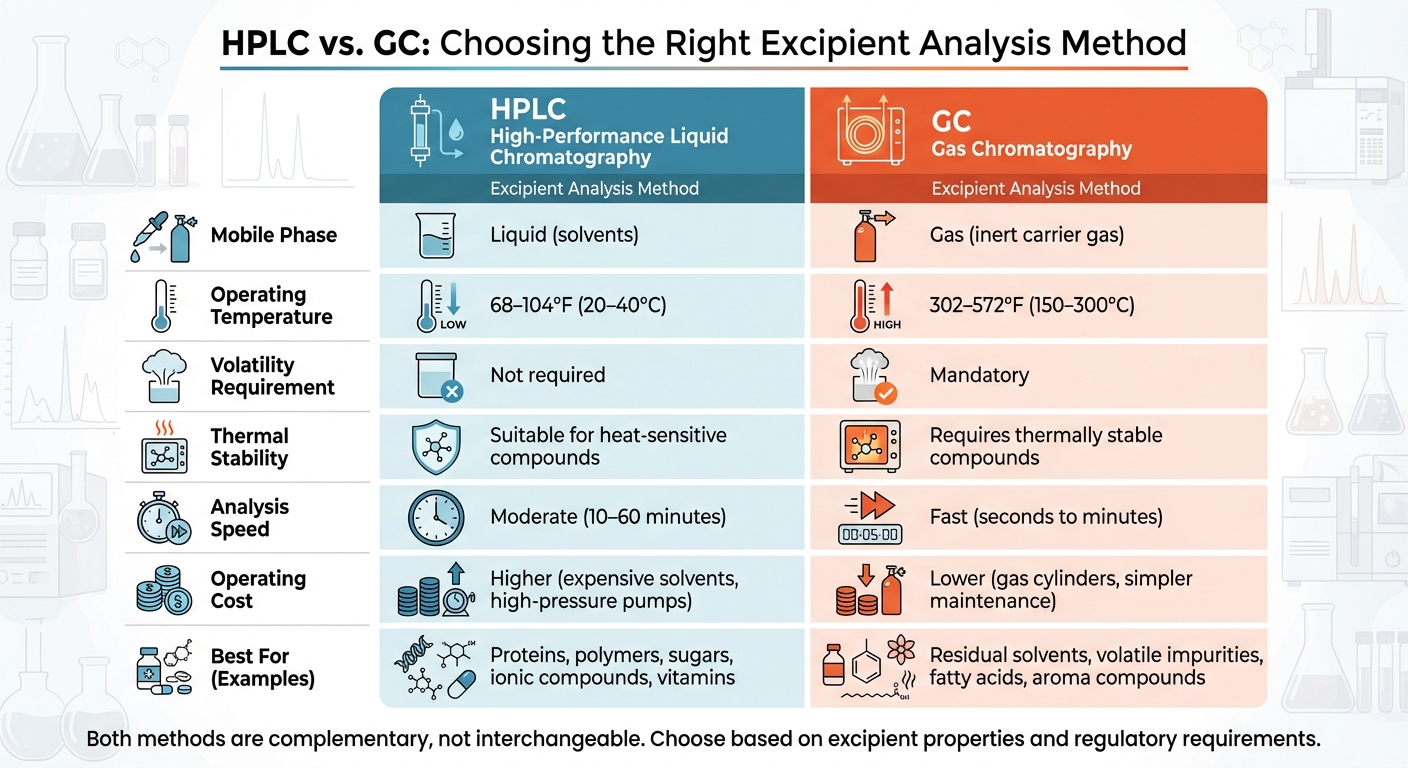
HPLC vs GC Chromatography Methods Comparison Chart
HPLC and GC – what is the difference – animation HD
sbb-itb-aa4586a
HPLC for Excipient Analysis
High-Performance Liquid Chromatography (HPLC) plays a key role in pharmaceutical quality control by separating, identifying, and quantifying excipient components. This process involves pushing liquid samples through a column under high pressure (ranging from 300 to 6,000 psi, with a flow rate of 0.5–5 mL/min) [5]. What sets HPLC apart for excipient analysis is its ability to work with polar, non-volatile, and heat-sensitive compounds – materials that might degrade or fail to vaporize with other methods [5]. This makes it particularly effective for handling delicate substances, as highlighted in the separation mechanisms below.
How HPLC Works
HPLC achieves separation by exploiting differences in how analytes interact with the mobile and stationary phases [8]. Operating at room or slightly elevated temperatures (20–40°C or 68–104°F), it is ideal for thermally unstable excipients [1]. Since the mobile phase is liquid – typically involving polar solvents – there’s no need for analytes to be volatile. This makes HPLC a go-to method for analyzing high-molecular-weight substances like polymers and proteins, which are often unsuitable for other techniques [1][5].
Different HPLC modes cater to various excipient properties. For non-polar compounds, reversed-phase HPLC (RP-HPLC) is widely used. For polar excipients, methods like hydrophilic interaction liquid chromatography (HILIC) or ion-pairing HPLC enhance separation. Meanwhile, size exclusion chromatography (SEC) is effective for isolating large polymers such as polyvinylpyrrolidone (PVP) and cellulose derivatives [7][5].
Common HPLC Applications for Excipients
HPLC’s versatility allows it to analyze a wide range of excipients. For instance, surfactants like Polysorbate 20 and Polysorbate 80 – used to stabilize protein formulations – are typically assessed using reversed-phase methods [3]. Sugars and sugar alcohols such as sucrose, lactose, mannitol, and sorbitol, due to their high polarity, are best analyzed using HILIC or ion exclusion techniques [3][2]. Similarly, preservatives like benzyl alcohol, phenol, and m-cresol, along with buffers and organic acids such as acetate, citrate, and L-histidine, are evaluated via RP-HPLC [3].
One of HPLC’s standout features is its ability to simultaneously analyze up to 17 excipients in complex biopharmaceutical formulations with minimal sample preparation [3]. This is especially valuable in high-concentration protein formulations (exceeding 100 mg/mL), where HPLC is used to monitor "excipient drift" – a phenomenon where protein molecules interact with charged excipients during production [3]. With a peak area precision of 0.1–0.5% relative standard deviation (RSD), HPLC meets the rigorous standards required in pharmaceutical quality control [10]. Given the presence of over 400 protein and peptide-based drugs on the market that rely on precise excipient stabilization, HPLC remains an essential tool in this field [3].
This content is for informational purposes only. Consult official regulations and qualified professionals before making sourcing or formulation decisions.
GC for Excipient Analysis
Gas Chromatography (GC) is a go-to method for analyzing excipients, particularly when dealing with volatile and heat-stable compounds. Unlike High-Performance Liquid Chromatography (HPLC), which uses liquid solvents, GC relies on an inert carrier gas – commonly helium, hydrogen, or nitrogen – to move vaporized samples through a column [1][6]. The separation process happens as compounds vaporize at different rates and interact uniquely with the stationary phase inside the column [1][6]. This makes GC especially useful for identifying and measuring residual solvents and organic volatile impurities, which are critical for quality control in pharmaceutical excipients. Another advantage? GC often delivers results in seconds or minutes, whereas HPLC runs typically take 10–60 minutes [1]. Let’s dive into how GC works in excipient analysis.
How GC Works
GC starts by injecting a sample into a heated port (usually between 150°C or 302°F and 300°C or 572°F), where it instantly vaporizes [1]. The carrier gas then pushes the vaporized sample through a narrow, capillary column. Separation occurs as compounds differ in volatility and their chemical interactions with the stationary phase – less volatile compounds or those with stronger interactions elute later [1][6].
Unlike HPLC, where the liquid mobile phase actively participates in separation, GC’s carrier gas is inert and doesn’t interact chemically with the sample. The separation relies purely on the physical properties of the analytes and their interaction with the column. For excipient analysis, Headspace Gas Chromatography (HS-GC) is a common approach. In HS-GC, the sample is sealed in a vial and heated until its volatile components reach equilibrium in the gas phase. Only the vapor from the vial’s headspace is injected into the GC system, which helps protect the column from non-volatile contaminants and extends its lifespan [11]. This precise separation process underlines GC’s efficiency in detecting and measuring residual solvents and volatile impurities.
Common GC Applications for Excipients
GC is highly effective at identifying and quantifying residual organic solvents, which may linger in excipients after manufacturing. These solvents often include methanol, ethanol, acetone, acetonitrile, chloroform, tetrahydrofuran (THF), cyclohexane, and hexane [11]. Regulatory bodies classify these solvents based on toxicity: Class 1 (carcinogenic), Class 2 (moderate toxicity), and Class 3 (low toxicity, typically under 5,000 ppm or 0.5% w/w) [11].
In September 2022, the National Cancer Institute‘s Nanotechnology Characterization Laboratory highlighted GC’s precision in excipient analysis. Using Headspace-GC with a Flame Ionization Detector, researchers measured ethanol content in Doxil at just 0.004% (37 ppm). The method achieved recovery rates between 90% and 115%, meeting strict pharmaceutical standards [11]. Modern fast GC techniques can even resolve over 30 common pharmaceutical solvents in less than eight minutes [4].
This content is for informational purposes only. Always consult official regulations and qualified professionals when making formulation decisions.
HPLC vs. GC: Side-by-Side Comparison
Choosing between HPLC and GC for excipient analysis comes down to understanding their key differences. These techniques vary in their principles, the types of compounds they handle, and their practical requirements in a laboratory setting.
HPLC operates at lower temperatures (20–40°C or 68–104°F), making it ideal for analyzing non-volatile, polar, and heat-sensitive excipients. On the other hand, GC works at much higher temperatures (150–300°C or 302–572°F) using inert carrier gases, which makes it better suited for volatile and thermally stable compounds [1][12]. This temperature contrast is crucial: HPLC prevents heat-sensitive molecules from degrading, while GC’s elevated temperatures can break down unstable compounds [12][13].
Another distinction lies in speed and cost. GC delivers rapid separations – often in seconds to minutes – and comes with lower equipment costs. HPLC, while slower (10–60 minutes), offers greater selectivity but at a higher expense due to high-purity solvents and high-pressure pumps (operating at 300 to 6,000 psi) [1][12][14].
| Feature | HPLC | GC |
|---|---|---|
| Mobile Phase | Liquid (Solvents) | Gas (Inert carrier gas) |
| Volatility | Not required; handles non-volatile samples | Mandatory; samples must be vaporized |
| Thermal Stability | Suitable for heat-sensitive compounds | Requires thermally stable compounds |
| Operating Temperature | 68–104°F (20–40°C) | 302–572°F (150–300°C) |
| Analysis Speed | Moderate (10–60 minutes) | Fast (Seconds to minutes) |
| Resolution | Sharp, symmetrical peaks | Exceptionally narrow peaks for precise quantification |
| Sample Preparation | Requires solubility | May involve derivatization |
| Equipment Cost | Higher (Solvents, pumps, complex setup) | Lower (Gas cylinders, simpler maintenance) |
| Excipient Suitability | Proteins, polymers, ionic compounds, vitamins, sugars | Residual solvents, aroma compounds, fatty acids |
Capillary GC stands out with its ability to deliver up to 100,000 theoretical plates, resulting in extremely narrow peaks that enhance the quantification of volatile mixtures [16]. Meanwhile, HPLC achieves its selectivity by adjusting the mobile phase composition, though it generally has a lower peak capacity compared to capillary GC [16][12].
This content is for informational purposes only. Always consult official guidelines and qualified professionals before making sourcing or formulation decisions.
Advantages of HPLC for Excipient Analysis
HPLC is highly effective for analyzing non-volatile and heat-sensitive excipients. With operating temperatures ranging from 20–40°C (68–104°F)[1], it safeguards delicate analytes that might degrade under the higher temperatures (150–300°C) required by GC (Gas Chromatography)[1].
One of HPLC’s strengths lies in its ability to separate polar and ionic compounds, as well as high-molecular-weight biomolecules that exceed GC’s approximate 500 Dalton limit. This is achieved by leveraging its liquid mobile phase, which allows for enhanced separation capabilities[1][5]. The FDA highlights this advantage:
"HPLC provides capabilities not possible with GLC, most importantly the ability to separate and quantitate residues of polar, nonvolatile, and heat-labile chemicals." – FDA[5]
In a June 2019 study, researchers showcased an HPLC method capable of analyzing 17 excipients simultaneously in high-concentration monoclonal antibody formulations. Notably, this method required minimal pre-treatment, streamlining the process significantly[3].
Additionally, HPLC facilitates direct analysis, allowing for the simultaneous estimation of multiple excipients. This ensures the stability of their concentrations throughout various study phases, making it a valuable tool for excipient analysis[3].
This content is for informational purposes only. Consult official regulations and qualified professionals before making sourcing or formulation decisions.
Advantages of GC for Excipient Analysis
Gas chromatography (GC) is particularly effective for analyzing volatile and heat-stable excipients, making it an excellent choice for residual solvent testing. Its ability to handle higher operating temperatures without causing decomposition allows GC to deliver fast, precise, and cost-efficient results.
A standout feature of GC is its exceptional separation efficiency. The long, thin capillary columns used in GC generate narrower and sharper peaks compared to those typically seen with HPLC. This enables highly accurate quantification of volatile components, which is crucial when monitoring trace-level impurities. As highlighted in TrAC Trends in Analytical Chemistry:
"GC is a natural choice because organic solvents have relatively low boiling points and are generally thermally stable." [4]
Beyond precision, GC offers rapid and cost-effective separations. While HPLC separations often take minutes, GC completes analyses in seconds. Additionally, GC utilizes relatively inexpensive inert carrier gases like helium, nitrogen, or hydrogen, which not only reduce operational costs but also minimize challenges related to solvent waste disposal.
For residual solvent analysis, GC is widely regarded as the regulatory gold standard. Major pharmacopoeias, including USP and ICH guidelines, recommend GC for detecting Class 1 (toxic/carcinogenic) and Class 2 solvents at trace levels. Supporting this, in September 2022, the Nanotechnology Characterization Laboratory published a protocol using Headspace-GC to measure residual ethanol in the drug product Doxil. Using a Glarus 690 GC system, researchers quantified ethanol content at approximately 37 ppm (0.004%) with recovery rates ranging from 90% to 115% for six analytes, including chloroform and acetonitrile [11].
Another key strength of GC lies in its compatibility with mass spectrometry (GC-MS). This pairing enhances GC’s capabilities by enabling both precise quantification and definitive compound identification. Such capabilities are essential for ensuring excipient purity in regulated pharmaceutical manufacturing. Together with HPLC, GC provides a versatile set of tools tailored to the specific properties of excipients and testing needs.
This content is for informational purposes only. Consult official regulations and qualified professionals before making any sourcing or formulation decisions.
Limitations of HPLC and GC
Both High-Performance Liquid Chromatography (HPLC) and Gas Chromatography (GC) are powerful techniques, but they come with challenges that can affect lab efficiency and budgets. Understanding these drawbacks is crucial when deciding which method to use for excipient testing.
HPLC’s main drawback lies in its high operational costs. This method requires high-purity solvents like acetonitrile and methanol, which not only come with recurring purchase expenses but also require proper hazardous waste disposal. As highlighted in Food Fundamentals and Chemistry, "HPLC requires expensive solvents and a high-pressure pump to push the mobile phase through the column, while GC simply requires gas containers and carrier gas, making it more affordable" [1]. Additionally, HPLC systems depend on high-pressure pumps capable of up to 6,000 psi with precise flow reproducibility (0.2% or better) [9]. These high pressures can shorten column lifespans and increase the frequency of pump maintenance [5]. Furthermore, the method’s analysis times – ranging from 10 to 60 minutes per sample, and even up to 90 minutes for certain biopharmaceutical excipients – can create throughput challenges [1][3].
GC, on the other hand, is restricted by sample compatibility. This technique is suitable only for volatile compounds with molecular weights under 500 Daltons that can endure temperatures between 150°C and 300°C [1]. As a result, heat-sensitive excipients, large polymers, and samples with salts or ionic charges are unsuitable for GC analysis. Another challenge is the rising cost of helium, the most commonly used carrier gas. While some labs are transitioning to hydrogen to mitigate costs, this switch demands additional safety protocols [4].
Both methods also involve complex and costly sample preparation. HPLC requires sub-micron filtration and degassing to prevent issues like column clogging and detector interference [9]. When working with biopharmaceutical formulations, protein precipitation is often necessary, as proteins are incompatible with the organic solvents used in HPLC [3]. In contrast, GC sample preparation may involve headspace extraction or derivatization, which calls for specialized equipment and expertise [1][4]. These preparation steps, combined with the need for consumables and skilled labor, drive up the overall cost per analysis.
This content is for informational purposes only. Consult official regulations and qualified professionals before making any sourcing or formulation decisions.
How to Choose Between HPLC and GC
Choosing the right analytical method isn’t about deciding which technique is "better" – it’s about finding the right tool for your specific excipient and operational needs. The choice depends on three key factors: the physical and chemical properties of your excipient, regulatory requirements, and practical considerations like your lab’s budget and workflow.
Considering Excipient Properties
Start by evaluating whether your excipient can handle high temperatures. Gas Chromatography (GC) operates at elevated temperatures (150°C–300°C), making it suitable only for thermally stable, small volatile molecules (typically <500–1,000 Daltons). In contrast, High-Performance Liquid Chromatography (HPLC) works at ambient temperatures (68°F–104°F), making it ideal for heat-sensitive or larger, ionic compounds.
The polarity of your excipient also plays a role. HPLC’s liquid mobile phase can be tailored to handle polar, ionic, and water-soluble compounds effectively. On the other hand, GC, using inert gases like helium or nitrogen, is better suited for non-polar or low-polarity volatile organics. As the FDA explains:
"HPLC provides capabilities not possible with GLC, most importantly the ability to separate and quantitate residues of polar, nonvolatile, and heat-labile chemicals" [5].
For samples containing salts or those requiring dissolution in water, HPLC is the clear choice. These characteristics often align with regulatory requirements, further guiding method selection.
Addressing Regulatory Standards
Regulatory guidelines frequently dictate the analytical method you’ll need. For example, the International Council for Harmonization (ICH) Q3C guideline and USP <467> specifically require GC for residual solvent testing in pharmaceutical excipients. Headspace Gas Chromatography (HS-GC) is particularly effective for isolating volatile components from a non-volatile matrix with minimal preparation. Method PCC-22, for instance, successfully quantified residual ethanol in Doxil at just 0.004% (37 ppm), meeting stringent ICH Q3C limits for Class 3 solvents [11].
When detecting extremely low levels of impurities, GC’s sensitivity is unmatched. It can identify trace volatile compounds at part-per-trillion levels, making it ideal for analyzing Class 1 solvents, which are suspected carcinogens [14]. Meanwhile, HPLC is widely regarded as the "gold standard" for quantitative analysis of active pharmaceutical ingredients (APIs) and excipients, ensuring compliance with USP guidelines that require 90% to 110% of the labeled amount [15]. If your regulatory submission specifies a compendial method, your choice is effectively predetermined.
Balancing Costs and Operations
Cost and operational efficiency are also important considerations. GC is generally more economical for routine analyses. According to the Food Safety Institute:
"HPLC requires expensive solvents and a high-pressure pump to push the mobile phase through the column, while GC simply requires gas containers and carrier gas, making it more affordable" [1].
GC also offers faster analysis times, with volatile compounds often completing runs in seconds or minutes, compared to HPLC runs that can take 10 to 60 minutes [1]. For labs with high sample volumes, this speed advantage can reduce labor costs and increase throughput.
However, infrastructure and maintenance costs should not be overlooked. GC systems require specialized gas plumbing, high-purity regulators (99.999% to 99.9999% purity), and safety precautions when using flammable hydrogen as a carrier gas [6]. HPLC systems operate under high pressures (up to 6,000 psi), which can lead to shorter column lifespans and frequent maintenance of seals and fittings [5]. If your lab already has the necessary equipment, leveraging it can help manage costs. The FDA notes:
"GLC’s relative simplicity and ruggedness cause it to remain the determinative step of choice for residues to which it is applicable" [6].
While GC may be more cost-efficient, HPLC’s versatility often justifies its higher operational costs when handling complex excipient matrices.
This content is for informational purposes only. Always consult official regulations and qualified professionals before making any sourcing or formulation decisions.
Conclusion
High-Performance Liquid Chromatography (HPLC) and Gas Chromatography (GC) aren’t rivals – they’re complementary tools that together offer a thorough approach to excipient analysis. As Trevor J. Henderson, PhD, puts it:
"HPLC and GC are essential techniques for chemical separation and analysis, but they excel under different conditions… They are complementary, not interchangeable" [13].
This distinction highlights why the choice between these methods hinges on specific testing needs. GC is often favored for its speed – delivering results in seconds to minutes – and lower costs per analysis. It’s particularly suited for residual solvent testing, as outlined in ICH Q3C guidelines [13][4]. On the other hand, HPLC shines when analyzing complex matrices, high-molecular-weight compounds, or heat-sensitive materials. However, it typically involves more expensive solvents and longer run times, ranging from 10 to 60 minutes [13][14].
In modern labs, both methods are frequently used together: GC handles volatile impurities, while HPLC tackles complex matrices. This combination ensures thorough analysis and compliance with regulatory standards. The best method depends on the excipient’s properties, regulatory requirements, and specific operational considerations. As the FDA explains:
"HPLC provides capabilities not possible with GLC, most importantly the ability to separate and quantitate residues of polar, nonvolatile, and heat-labile chemicals" [5].
Choose the method that aligns with your excipient’s characteristics and regulatory needs to achieve accurate results while managing costs effectively.
This content is for informational purposes only. Consult official regulations and qualified professionals before making sourcing or formulation decisions.
FAQs
What should I consider when deciding between HPLC and GC for excipient analysis?
When deciding between high-performance liquid chromatography (HPLC) and gas chromatography (GC) for excipient analysis, it’s essential to assess the characteristics of your analytes. GC works best for volatile and thermally stable compounds, whereas HPLC is more suitable for non-volatile or thermally sensitive excipients.
You’ll also want to consider factors like polarity, the sample matrix, and the level of detection sensitivity required. HPLC tends to be more versatile for handling complex or polar samples, while GC often delivers quicker results for simpler, volatile compounds. Don’t overlook practical considerations such as equipment availability, sample preparation needs, and the desired throughput to ensure the method aligns with your analytical objectives.
For over four decades, Allan Chemical Corporation has been a trusted partner for regulated industries, providing high-quality chemical sourcing and tailored solutions for excipient analysis.
What are the differences in operational costs between HPLC and GC in the lab?
The costs associated with running HPLC (High-Performance Liquid Chromatography) and GC (Gas Chromatography) can differ based on several factors, such as the type of analysis, upkeep of the equipment, and the consumables required. For instance, HPLC often demands pricier solvents and columns, while GC typically uses more economical carrier gases like helium or nitrogen.
HPLC systems also tend to have more complex designs, which can lead to higher maintenance expenses. In contrast, GC systems generally have fewer moving parts, which may help lower long-term upkeep costs. When choosing between these two methods, it’s essential to evaluate the specific needs of your lab and the type of excipient analysis you plan to conduct.
Is gas chromatography (GC) suitable for analyzing non-volatile or heat-sensitive excipients?
No, gas chromatography (GC) is not ideal for analyzing non-volatile or heat-sensitive excipients. This technique depends on analytes being both volatile and thermally stable, as it requires the sample to be vaporized at high temperatures. Substances that don’t vaporize easily or break down under heat would not be suitable for GC, rendering it ineffective for such materials.
In these cases, high-performance liquid chromatography (HPLC) is often the preferred method. Unlike GC, HPLC does not require analytes to be vaporized, making it more suitable for a broader range of chemical properties, including those of non-volatile or heat-sensitive substances.




Comments are closed