
Long-wear cosmetics are designed to maintain their color, texture, and finish throughout the day despite challenges like water, sweat, and skin oils. These formulations are essential for products such as waterproof mascaras, transfer-resistant lipsticks, and long-lasting foundations. Achieving this durability requires precise ingredient selection, including treated pigments for adhesion, film-forming polymers for resistance, and emollients for smooth application. Additionally, stability testing ensures the final product performs well under various conditions.
Key aspects of formulating long-wear cosmetics include:
- Pigment Selection: Treated pigments improve moisture resistance and adhesion.
- Binders & Polymers: Film-forming agents like acrylates and silicone resins lock in color and resist transfer.
- Emollients & Waxes: These ensure smooth application, structural integrity, and comfort.
- Stability Testing: Rigorous tests confirm durability against heat, humidity, and wear.
The process also involves careful blending, temperature control, and compliance with regulatory standards to ensure safety and effectiveness. By understanding the role of each component and employing precise techniques, formulators can create high-performance products that meet consumer expectations.
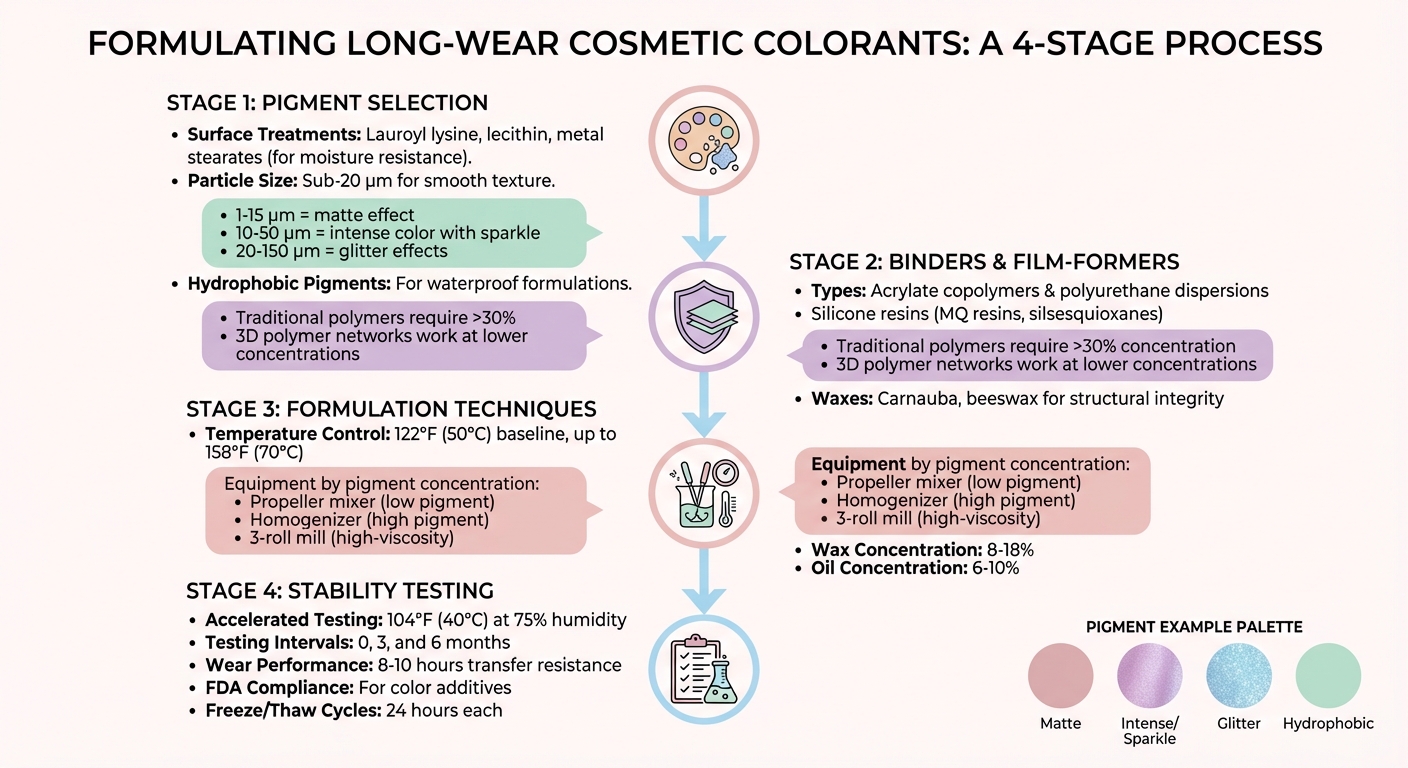
Long-Wear Cosmetics Formulation Process: Key Ingredients and Testing Steps
Making Long-Lasting Lipstick – Journey of a Cosmetic Chemist
Selecting Pigments and Binders for Adhesion
Creating long-wear cosmetics starts with selecting the right pigments and binders. Pigments bring vibrant color and intensity, while binders ensure that color adheres to the skin. When paired effectively, these components help prevent fading, smudging, and transfer. Let’s break down the key traits of pigments and binders that make long-lasting cosmetics possible.
Characteristics of Long-Wear Pigments
A crucial element in choosing pigments for long-wear products is surface treatment. Untreated pigments, which naturally contain polar hydroxyl groups, often struggle with moisture resistance. By applying surface treatments – such as lauroyl lysine, lecithin, or metal stearates – pigments become more resistant to moisture, improving their ability to adhere to the skin and extending wear time[6][3].
"Surface treatments often are used in the cosmetics industry to improve adhesion and wear, enhance physical and chemical stability, diminish the dusting of powders and to aid in pigment dispersion in various media." – Stacey House and Edward Bartholomey, Kobo Products, Inc.[3]
Particle size is another factor that influences both the color payoff and the feel of the product. For a smooth texture, pigments are refined to sub-20 µm sizes. Smaller particles (1–15 µm) create a matte effect, while medium-sized particles (10–50 µm) deliver intense color with a hint of sparkle. Larger particles (20–150 µm) produce glitter effects but may feel gritty[6][5].
To achieve even, streak-free color, dispersibility is key. Organic pigments are known for their bright, bold hues but can be challenging to disperse compared to inorganic pigments like iron oxides[5]. The use of tailored wetting agents can prevent clumping, ensuring an even pigment distribution and maintaining color stability over time.
For products marketed as waterproof or sweatproof, hydrophobic pigments and polymers are indispensable. These formulations are designed to withstand active use or humid conditions, ensuring durability when it matters most[1]. However, pigments alone aren’t enough – effective binders are essential to lock in the color.
Choosing Effective Binders
Once pigments are optimized, choosing the right binders becomes critical. Binders act as a barrier, anchoring pigments to the skin and reducing transfer. Film-forming polymers, such as acrylate copolymers and polyurethane dispersions, create flexible, breathable films that resist water while maintaining comfort on the skin[1].
Silicone resins, including MQ resins and silsesquioxanes, are widely used in transfer-resistant products like lipsticks and foundations. These resins not only improve adhesion but also provide a smooth, silky texture, ensuring the color stays in place for hours[7].
Waxes, such as carnauba, beeswax, and synthetic alternatives, add structural integrity and act as moisture barriers. These are especially useful in stick formulations like lipsticks and eyeliners, where maintaining the product’s shape and color longevity is essential. The challenge lies in balancing adhesion strength with ease of removal – products that cling too tightly to the skin can be difficult to cleanse effectively.
This content is for informational purposes only. Always consult official regulations and qualified professionals before making sourcing or formulation decisions.
Using Film-Forming Polymers and Resins
Film-forming polymers are the backbone of long-wear cosmetics. They shield colorants from water and sebum, ensuring vibrant color that lasts throughout the day.
How Film-Forming Polymers Work
Traditional polymers like dimethicone and acrylates form a single-layer coating on the skin. But to achieve reliable water and wear resistance, these polymers often need to be used in high concentrations – sometimes over 30% of the formula[8].
On the other hand, newer 3D polymer networks offer a more efficient solution. These advanced networks create an interwoven microsphere structure that encapsulates pigments, reducing transfer to other surfaces while maintaining performance at lower polymer concentrations[8].
"Traditional polymers are ineffective at low levels, requiring a large amount (> 30%) in formulations to meet acceptable performance criteria for wear/water resistance."
– Austin Davis and Samuel Shefer, Ph.D., Salvona Technologies LLC[8]
This approach not only enhances performance but also helps cut formulation costs. Alongside these polymers, the choice of resins plays a key role in refining the durability and comfort of the film.
Types of Resins for Long-Wear Formulations
Silicone resins like MQ resins (trimethylsiloxysilicate) and T-propyl siloxane resins are popular choices for long-wear products such as foundations and lipsticks. They create smooth, transfer-resistant films that enhance adhesion and durability[7]. To improve comfort, silsesquioxane waxes (e.g., polymethylsilsesquioxane) are added, preventing the film from feeling brittle or overly tight on the skin[7].
For formulations that need strong sebum resistance, silicone acrylate graft copolymers (e.g., KP-545 or KP-550) combine the durability of acrylics with the silky texture of silicones[7]. Polyurethane dispersions are another option, forming flexible and breathable films that resist water and sweat while remaining comfortable – perfect for athletic or high-performance makeup[1]. Pairing these resins with volatile carriers such as isododecane ensures that the solvent evaporates, leaving behind a durable, dry-feeling film[1].
This content is for informational purposes only. Always consult official regulations and qualified professionals before making sourcing or formulation decisions.
Choosing Emollients, Waxes, and Stabilizers
Once your film-forming base is established, the next step is balancing emollients, waxes, and stabilizers. This balance ensures smooth application, structural integrity, and extended wear, complementing the adhesive properties of the film-formers discussed earlier.
Emollients for Smooth Application
Emollients play a key role in enhancing skin feel and spreadability. Ingredients like isocetyl stearoyl stearate and octyldodecyl stearate offer a glossy finish and a lightweight, comfortable texture [12]. They also help retain moisture, preventing the product from drying out the skin during wear.
For long-wear formulations, it’s important to find the right mix of volatile and non-volatile oils. Volatile oils evaporate quickly, creating a "no-transfer" effect, while non-volatile options like castor oil and hydrogenated polyisobutene add shine and comfort without making the formula feel heavy [4] [12].
Waxes for Structural Support
Waxes provide the structural framework in anhydrous products like lipsticks and balms. They create an organized lattice that traps oils and prevents them from seeping out [9]. Common structuring agents include ozokerite and polyethylene, which raise the melting point and add rigidity to the product [9] [12].
"An ordered, aggregated wax phase is important, as it is usually the primary means of structuring the product and trapping oils from exuding out of the mass."
– Peter Tsolis and Richard Riggs, The Estée Lauder Companies and Next Step Laboratories [9]
For lipsticks, wax concentrations typically range between 8–18%, while oil concentrations fall between 6–10% [12]. When selecting waxes, test them individually with your primary oil or solvent. If the melted mixture appears cloudy, a co-solubilizer may be needed to ensure long-term stability [9]. Additionally, avoid waxes with high free fatty acid content when working with aluminum lake pigments, as they can form aluminum soaps that soften the product [9].
Stabilizers to Maintain Consistency
Stabilizers build on the structural support provided by waxes, ensuring pigments stay evenly distributed and preventing separation. Popular choices like bentonite (a type of clay) and silica absorb excess oils and maintain viscosity, even when waxes lose some of their structural effectiveness at higher temperatures [9] [11].
To ensure stability, measure the crystallization temperature of your wax blend using Differential Scanning Calorimetry (DSC). Mixing the formulation a few degrees above this temperature helps preserve the wax lattice, preventing mechanical disruptions that could permanently soften the product [9]. Stability testing is also essential – products that remain stable at 113°F (45°C) for 12 weeks are generally considered safe for room-temperature storage for up to two years. This is particularly important, as temperatures inside a car can reach 140°F (60°C) in just 90 minutes on a hot day [10].
For sourcing high-quality emollients, waxes, and stabilizers for your long-wear cosmetic formulations, you can explore technical-grade solutions provided by Allan Chemical Corporation (https://allanchems.com).
This content is for informational purposes only. Always consult official regulations and qualified professionals before making sourcing or formulation decisions.
sbb-itb-aa4586a
Formulation Techniques for Stability
Choosing the right ingredients is just the beginning. The way these ingredients are blended and how temperature is managed during production play a huge role in ensuring the final product is both uniform and stable. The order in which components are mixed and the timing of each step are key factors in creating a reliable formula [13]. These processes help products endure everyday use and environmental exposure. Proper mixing also lays the groundwork for controlling temperature and achieving even pigment distribution.
Blending and Homogenization
Creating uniformity in long-wear cosmetics involves three key steps: wetting the powder, dispersion (breaking down particle clumps using wet milling), and stabilization to prevent the particles from re-clumping [5][2]. The type of equipment you use depends on the concentration of pigments in your formula. For low-pigment dispersions, a propeller mixer may be sufficient. However, for high-pigment formulas, high-shear homogenizers or 3-roll mills are necessary to achieve a refined particle distribution [5].
As previously mentioned, achieving a particle size under 20 microns is crucial for vibrant color and a smooth texture. One common issue, "color shifting", occurs when pigments aren’t properly wetted, leading to a final product that doesn’t match the intended shade [5]. To avoid this, surfactants can be added as wetting agents. These reduce the liquid’s surface tension, allowing oil and water to better adhere to the pigment particles [5].
| Equipment Type | Application | Outcome Goal |
|---|---|---|
| Propeller Mixer | Low pigment concentrations | Basic distribution |
| Homogenizer | High pigment concentrations | High-shear particle refinement |
| 3-Roll Mill | High-viscosity/high-pigment pastes | Sub-20 micron particle size |
Organic pigments often pose more challenges in dispersion compared to inorganic pigments, requiring additional wetting agents or surface treatments [5]. During pilot trials, fine-tune heating and milling durations – these are critical variables for achieving proper particle distribution [5]. Once a stable process is developed, test its durability using freeze/thaw cycles (24 hours of freezing followed by 24 hours of thawing) to ensure the emulsion holds up under stress [13]. After achieving uniform dispersion, maintaining precise temperature control becomes vital for consistent results.
Temperature Control in Formulation
The need for heat during production depends on the type of pigment. Organic pigments may not always require heating, but inorganic pigments, like iron oxides and titanium dioxide, typically do [5]. For these inorganic pigments, a baseline temperature of 122°F (50°C) is recommended, with a processing range of up to 158°F (70°C) [5].
Accurate temperature management helps refine particle size, maintain consistent viscosity, and prevent issues like streaking or uneven hues [5].
"Dispersions containing fewer pigment particles will only require simple blending equipment like propeller mixers, while ones with high pigment content will require more powerful machinery like homogenizers or 3-roll mills to refine effectively."
– Applechem [5]
Consider using integrated dispersing emollient systems that combine wetting agents and dispersant aids. These systems can shorten both heating and milling times, reducing energy consumption during production [5]. For sourcing high-quality raw materials for your long-wear cosmetic formulations, you can explore technical-grade solutions offered by Allan Chemical Corporation (https://allanchems.com).
This content is for informational purposes only. Always consult official regulations and qualified professionals before making sourcing or formulation decisions.
Stability Testing and Performance Evaluation
After creating a formulation, it’s essential to test for changes in key attributes like color, odor, pH, viscosity, texture, and separation to confirm its shelf-life quality [14]. These initial evaluations pave the way for accelerated methods that help predict long-term performance.
Stability Testing Procedures
Accelerated stability testing is a widely used method to estimate shelf life without waiting for real-time results. In this process, samples are stored under elevated temperature and humidity – typically 104°F (40°C) at 75% relative humidity – to simulate stress conditions and predict how the product will behave over time [14][15]. Testing is conducted at intervals of 0, 3, and 6 months, along with microbiological assessments to ensure the product resists contamination from bacteria, mold, and yeast [14]. Packaging is also examined to confirm it protects against light and oxygen exposure [14][15].
"One objective of stability testing is to ensure that a product maintains its intended physical, chemical and microbiological qualities – as well as functionality and aesthetics – when stored under appropriate conditions." – Kenneth Edwards, Precision Stability Storage [14]
Wear Performance Evaluation
Testing doesn’t stop at physical and chemical stability – real-world wear performance is equally important. Long-wear products must withstand biological stressors like sebum (skin oil) and sweat, which are common culprits behind pigment separation, lifting, and fading [4][18]. To measure transfer resistance, formulations are applied to skin or models and monitored every two hours under heat and humidity conditions [4][17][15]. Consumers expect long-wear foundations to maintain a consistent, non-transferable appearance for at least 8 to 10 hours daily [4]. For an objective analysis, lab-based pigment evaluation using spectrophotometry ensures color intensity and accuracy across batches, providing more reliable results than visual inspection alone [15].
"Sebum and sweat are typically the worst enemies of long-lasting color cosmetics, especially in emulsion foundations or loose and pressed anhydrous powders." – Nicola Lionetti and Miriam Deola, LabAnalysis, srl [4]
Regulatory Compliance Considerations
Thorough testing not only verifies product performance but also ensures compliance with FDA regulations. In the U.S., all color additives used in cosmetics must be FDA-approved for their specific intended use [16]. For instance, using a color labeled "external use only" in a lipstick would render the product adulterated [16]. Synthetic-organic colors derived from petroleum require batch certification by the FDA, confirming that the specific batch meets purity and composition standards [16]. When purchasing certified colors, always verify the label for details like the legal name (e.g., "FD&C Yellow No. 5"), FDA lot certification number, and any usage restrictions [16]. For long-wear eye products, ensure colorants are approved for "eye-area use", which includes the region within the supra-orbital and infra-orbital ridges [16].
Although stability testing isn’t legally mandated for general cosmetics in the U.S., manufacturers are responsible for ensuring their products are safe under labeled or customary use. This makes stability testing an essential part of safety validation [19][14]. For sourcing compliant, high-quality raw materials for stability testing, Allan Chemical Corporation (https://allanchems.com) provides technical-grade and compendial-grade solutions.
This content is for informational purposes only. Consult official regulations and qualified professionals before making sourcing or formulation decisions.
Conclusion
Creating long-wear cosmetic colorants requires careful decisions at every step, from choosing the right pigments and binders to conducting thorough stability tests. As consumers increasingly seek durable, high-performance makeup, understanding how ingredients and processing techniques interact becomes more important than ever.
The key to success lies in selecting the right combination of ingredients and applying effective processing methods. Using strong film-formers, hydrophobic agents, and sebum-absorbing powders helps prevent oil-related breakdown throughout the day [1]. Achieving a particle size under 20 microns through proper dispersion and milling ensures optimal color intensity and reduces the risk of clumping [5]. Each ingredient serves a specific purpose, working together to deliver the long-lasting performance consumers expect.
"The choice of ingredients is one of the most important aspects of the cosmetic formulation process. The quality and efficacy of the finished product are greatly influenced by the selection of ingredients." – Saili Dixit Gadkari [1]
Thorough testing is essential to confirm the formulation’s durability and to highlight the importance of using high-quality raw materials. For those in need of compendial-grade raw materials, Allan Chemical Corporation (https://allanchems.com) provides technical-grade and USP/FCC-certified solutions, drawing on over 40 years of experience in regulated industries.
This content is for informational purposes only. Always consult official regulations and qualified professionals when making sourcing or formulation decisions.
FAQs
What are the key ingredients in long-wear cosmetics and how do they work?
Long-lasting cosmetics rely on a thoughtful combination of ingredients to deliver bold colors and extended wear. Pigments are the key to providing color and opacity, while fillers such as mica, talc, or silica enhance the product’s texture, coverage, and overall staying power. To prevent smudging and withstand sweat or oil, film-forming polymers like silicone elastomers create a flexible, protective layer. Meanwhile, binders ensure pigments adhere securely to the skin for a lasting effect.
To keep these products stable under different conditions, formulators use pH buffers, antioxidants like tocopherol, and micro-encapsulation systems to shield pigments from heat and environmental stress. For those seeking natural options, plant-based pigments can achieve comparable results when paired with the right supporting ingredients. Together, these elements deliver the smooth, durable finish that users look for in long-wear cosmetics.
How do film-forming polymers improve the longevity of cosmetic products?
Film-forming polymers play a key role in extending the wear of cosmetics by creating a thin, flexible layer that clings to the skin. This layer helps lock in pigments and active ingredients, making the product more resistant to water, sweat, and friction.
These polymers function by forming an even film as the product dries, adhering securely to the skin. They enhance water and smudge resistance by incorporating materials with carefully selected properties, such as an appropriate glass-transition temperature, ensuring the film remains intact under different conditions. By trapping pigments within a stable framework, they minimize fading and significantly improve the product’s longevity.
For cosmetic formulators, Allan Chemical Corporation provides a wide selection of film-forming polymers designed for durability, water resistance, and flexibility, simplifying the creation of dependable long-wear cosmetic products.
What are the best methods to test the stability and performance of long-wear cosmetics?
To ensure that long-wear cosmetics remain stable and perform as expected, several testing methods are commonly employed:
- Accelerated aging: Samples are stored at high temperatures, like 104°F, to mimic months of shelf life in a shorter time. This helps identify any changes in color, texture, or overall quality.
- Freeze-thaw cycling: Products are subjected to repeated cycles of freezing (around 32°F) and warming (approximately 100°F) to check for issues like pigment clumping or separation.
- Light exposure: Samples are exposed to both UV and visible light to assess their ability to resist fading over time.
These rigorous tests ensure that cosmetic colorants stay stable, effective, and durable throughout their intended shelf life and use. Allan Chemical Corporation supports the cosmetics industry by providing a wide selection of high-quality ingredients designed to meet these demanding standards.




Comments are closed